
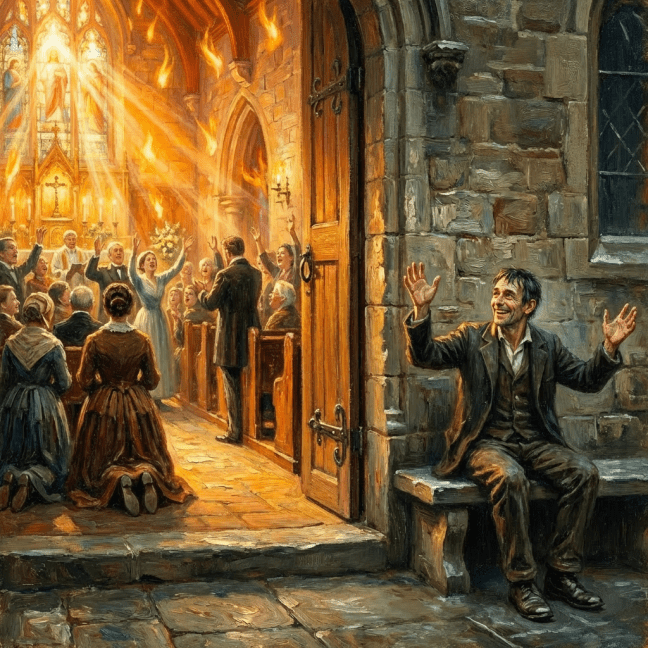
Five Words

“I thank God that I speak in tongues more than any of you. But in a church meeting I would rather speak five understandable words to help others than ten thousand words in an unknown language. Dear brothers and sisters, don’t be childish in your understanding of these things. Be innocent as babies when it comes to evil, but be mature in understanding matters of this kind.”
1 Corinthians 14:18-20 NLT

Paul was apparently a great tongue speaker, but the Corinthians would have known that because he started the church there and pastored them for the first few months. Paul started in the synagogue, found much opposition, and so ended up meeting in a place right next door. But the people in the church had become believers in Jesus, responding to a message which had been the central thrust of Paul’s evangelism. They found that when they believed the Gospel message and were baptised for the forgiveness of their sins, they received the gift of the Holy Spirit in a way that astounded them with its power and its impact on their lives. Apart from when he used the other gifts, Paul was a great tongue-speaker, and that fact wasn’t lost on the Corinthian believers. 

But Paul had to address the overabundant use of the gift of tongues, and he laid out the necessary balance in a church meeting. Great to use the gift of tongues for their personal devotions, he said, but not in a church meeting, please! Instead, he encouraged them to seek God for five helpful words to build up the church. 

Fast forward to today and our church meetings. Whatever and wherever they are, there is always an opportunity to help other believers. Sadly, when we encounter another person, a negative situation often develops. There was a lady I used to know who got to church, which was a miracle in itself, because when she arrived, she unburdened herself of all her family problems. Negative after negative came up in conversation, but in return, a message in tongues would have been no help to her at all. Instead, she needed some words of encouragement to lift her and give her hope again. Sometimes five words would have been sufficient. 

“[God] will never leave you nor forsake you”

As we pilgrims go out and about, there are plenty of opportunities to bring five words of encouragement. It will probably be appropriate to say a few more words than five, but sometimes all another person needs to hear is that God loves them and cares for them. We need to have a word of Scripture ready and waiting. Something like 1 Peter 5:7, “Give all your worries and cares to God, for he cares about you”. Or how about Philippians 4:6-7, “Don’t worry about anything; instead, pray about everything. Tell God what you need, and thank him for all he has done. Then you will experience God’s peace, which exceeds anything we can understand. His peace will guard your hearts and minds as you live in Christ Jesus”? Or there is Deuteronomy 31:6, “Be strong and courageous. Do not be afraid or terrified because of them, for the Lord your God goes with you; he will never leave you nor forsake you”. As we read our Bibles every day, we must squirrel away useful and encouraging verses for future use so that when we meet people, we have a few words to edify them. We live in a sad and bad world, but we have a Heavenly Father who loves us, and He hates to see His children struggling unnecessarily with worldly burdens. 

Dear Heavenly Father. We love You and praise You today. We are so grateful for all You have done for us, for the times when You have lifted us up out of the miry clay and put a song in our hearts. Please help us to be Your mouthpiece to bring encouragement to the discouraged in our churches and neighbourhoods. In Jesus’ name. Amen.

Singing in the Spirit

“Well then, what shall I do? I will pray in the spirit, and I will also pray in words I understand. I will sing in the spirit, and I will also sing in words I understand. For if you praise God only in the spirit, how can those who don’t understand you praise God along with you? How can they join you in giving thanks when they don’t understand what you are saying? You will be giving thanks very well, but it won’t strengthen the people who hear you.”
1 Corinthians 14:15-17 NLT

With all the tongue-speaking going on, interlaced with the use of other gifts such as interpretation of tongues and prophecy, Paul was trying to teach the Corinthians about the proper application of the Holy Spirit’s gifts. The believers there were obviously making good use of the gift of tongues, but previously Paul had pointed out, “ …If you speak to people in words they don’t understand, how will they know what you are saying? You might as well be talking into empty space” (1 Corinthians 14:9). So, Paul introduced the thought that some degree of balance might be appropriate. Don’t neglect the gift of tongues, he said, but also pray in a language people understood. Paul also introduced another use of tongues that might have caused some confusion – singing the tongues rather than speaking them. This was perhaps also adding to the confusion in their public meetings, because it introduced another dimension – the melody used to support the tongues themselves. Imagine if the minister or worship leader starts the next song or hymn only to find that several people are singing their own song with a different melody, different harmonies, and in a different language. Discordant chaos would be the result. Again, Paul introduced the logic that one person’s spiritual song – good though it might have been for them, being full of praise and gratitude – would have been pointless for everyone else who would not have been able to join in because they wouldn’t have known the lyrics. 

There has to be order in the church meetings because otherwise they disintegrate into chaos, losing the impact that love and unity between believers is supposed to convey. So in some denominations, we end up with a pre-written liturgy that is religiously followed each service, with the only differences being the hymns chosen, and the prayers specifically allocated for a particular day or occasion. Even in other churches, not bound to a prayer book, there can be the freedom of new songs and spontaneous prayers, but there is still an absence of the spiritual gifts and singing in the spirit. Where is the balance? Well, that was what Paul was trying to teach the Corinthians. Not an easy process for Paul because of his remoteness from what was happening at the time, but it perhaps explains why he was taking such pains to write about the spiritual gifts and how they should be used. 

Sing a new song of praise to Him

Singing in the spirit is a spontaneous and corporate time of singing in a meeting with a basic melody over which each person’s tongues can be supported. There is also room for singing a new song, with new lyrics and melodies, with words that are understandable and simple enough for the congregation to pick up. The Psalmist in Psalm 33 wrote, “Sing a new song of praise to him; play skillfully on the harp, and sing with joy” (Psalm 33:3). David wrote a Psalm that contains the verse, “He has given me a new song to sing, a hymn of praise to our God. Many will see what he has done and be amazed. They will put their trust in the Lord” (Psalm 40:3). In these verses, tongues, a New Covenant gift, would not have been available then, so the “new song” would have been in the psalmist’s native language.

God has blessed most of His children, if not all, with a gift of music. We pilgrims might be too embarrassed to sing out in public. We might lack the musical ability to construct melodies and harmonies, but we can start with a well-known tune and apply our own words and syllables expressed in our Heavenly language of tongues. That’s all it takes. Perhaps we need to find a private place to practice. Perhaps we need to wait until our worship leader on Sunday provides a musical platform for our new song. But once the effort is made, blessings will follow. Paul said to the Corinthians, “I will sing in the spirit“. For Paul, it wasn’t an optional extra to be enjoyed when he felt like it. It was an act of his will. When problems abound and threaten to overwhelm us, sometimes a simple song in tongues will connect us to the One who cares for us.

Dear Heavenly Father. We know You love us and care for us. Please help us as we take some faltering steps in praying and singing in our Heavenly language, Your gift of tongues. Amen.

Tongues and Interpretation

“So anyone who speaks in tongues should pray also for the ability to interpret what has been said. For if I pray in tongues, my spirit is praying, but I don’t understand what I am saying.”
1 Corinthians 14:13-14 NLT

In the last part of 1 Corinthians 12:10, we find that Paul wrote, “ … Still another person is given the ability to speak in unknown languages, while another is given the ability to interpret what is being said”. The problem with tongues was addressed by Paul in 1 Corinthians 14:2, “For if you have the ability to speak in tongues, you will be talking only to God, since people won’t be able to understand you. You will be speaking by the power of the Spirit, but it will all be mysterious”. It appears that at the Corinthian church’s public meetings, there was much tongue-speaking, and nobody had a clue what anyone else was saying, and Paul spent much of 1 Corinthians 14 saying why that was less than useful for the believers. But the Holy Spirit had all that in hand, and one of the gifts He supplied was the ability to interpret what a message in tongues was really saying. 

In my early years as a Christian, I attended a Pentecostal church where one man gave a message in tongues at every Sunday morning meeting. Fortunately, there was a lady there who had the gift of interpretation, and the church was able to hear what the message really meant. At the time, I was confused about why this was necessary, since I thought a prophetic message everyone could understand would have been more helpful. So why the need for a message in tongues? But we can never put God in a box of our own understanding; instead, we must be open to the Holy Spirit’s gifts.

You will receive power when
the Holy Spirit comes upon you

In Acts 2, on that memorable Day of Pentecost, we read that “all the believers were meeting together in one place”. There were 120 of them present, and I’m sure they weren’t there enjoying a social occasion for Hebrew dancing or joining together for a fellowship meal. Instead, they were there praying, because they remembered what Jesus had said: “But you will receive power when the Holy Spirit comes upon you …” (Acts 1:8a). The miraculous manifestations of tongues of fire, rushing winds, and sounds from Heaven were followed by: “And everyone present was filled with the Holy Spirit and began speaking in other languages, as the Holy Spirit gave them this ability” (Acts 2:4). But these “other languages” didn’t need any interpretation because the messages in tongues were in languages that foreign visitors to Jerusalem could understand, because they were given in their native languages. 

In our churches, a message in tongues using a real, understandable language would not need an interpretation. Although such a tongue is not so common today, such a message is still given on occasion. But in 1 Corinthians 14, Paul was writing about messages in tongues, given in a language no one could understand because they were in the Heavenly language, uniquely given by the Holy Spirit to the person giving the message. Such a message would not be able to be translated because no one, not even the person speaking it, would have been able to discern words and sentences within it. In these days of AI and Google Translate, speaking out the message to the computer in front of them would have been pointless because there was no recognisable language involved. However, now we come to the Holy Spirit’s gift of interpretation, a supernatural manifestation that reveals the meaning of an utterance spoken in other tongues. It is not a translation of words, but an interpretation inspired by the Holy Spirit to communicate God’s message to the hearers. 

So in our church services today, we pray that the Holy Spirit would have the freedom to give the gifts for the benefit of the believers meeting there, and that there would be believers present who will have the courage to use the gifts in any way that God desires. 

Father God. You have given Your children good gifts, for which we are deeply thankful. We take these from You with our open hands, reverently and faithfully, and aware that by using these we can build up the church of which You have made us a part. We thank You for Your grace and love. Amen.

Languages

“It’s the same for you. If you speak to people in words they don’t understand, how will they know what you are saying? You might as well be talking into empty space. There are many different languages in the world, and every language has meaning. But if I don’t understand a language, I will be a foreigner to someone who speaks it, and the one who speaks it will be a foreigner to me. And the same is true for you. Since you are so eager to have the special abilities the Spirit gives, seek those that will strengthen the whole church.”
1 Corinthians 14:9-12 NLT

There are indeed many languages in the world, and they create barriers between people groups who cannot understand each other. In a sense, it is tragic that the main form of communication between human beings is lost in the articulation of syllables. Paul was writing to the Corinthians, who used a form of common Greek in their everyday lives and when they met together for worship, but because it was quite a cosmopolitan city, other forms of Greek as well as Aramaic and even Hebrew would have been heard. And that is just in one city. In my home city of Dunfermline in Scotland, the predominant language is English with a Scottish accent reflecting Dunfermline’s location in the County of Fife, but other languages can be heard here from immigrants and tourists. And around Scotland, there are other variations on English, with accents in some places almost incomprehensible. In the Western Isles and parts of the mainland, another language is spoken: Gaelic. I recently heard that there are 89,000 Gaelic speakers and a further 132,000 with some degree of understanding. But why so many different languages, and how did we get the situation where, globally, there are over 7,000 of them? To find out, we have to turn to Genesis 11. 

At the time of the Flood, all the inhabitants were destroyed except for Noah, his three sons and their wives, and it was from these that the world was repopulated, as we read in Genesis 10:32, “These are the clans that descended from Noah’s sons, arranged by nation according to their lines of descent. All the nations of the earth descended from these clans after the great flood”. There are, of course, many who believe that the Flood was a local occurrence, and most parts of the earth were unaffected. But then the sedimentary geological formations in most parts of the world, together with their fossil records, have to be explained. For anyone interested in researching further, the film “Is Genesis History” is available on YouTube. 

But over the page from Genesis 10 we read, “At one time all the people of the world spoke the same language and used the same words. As the people migrated to the east, they found a plain in the land of Babylonia and settled there” (Genesis 11:1-2). The next few verses explain how the pride and arrogance of the people in the Babylonian region, and their attempts to become like God by building a tower planned to reach Heaven, were frustrated when He confused them with different languages. As a result, the people scattered and eventually populated the earth. Genesis 11:8-9, “In that way, the Lord scattered them all over the world, and they stopped building the city. That is why the city was called Babel, because that is where the Lord confused the people with different languages. In this way he scattered them all over the world”

But back to 1 Corinthians 11, and Paul’s analogy of natural languages being as incomprehensible to different people groups as speaking in tongues would be in a church. Such tongues may have meaning, Paul said, but he wrote, “If you speak to people in words they don’t understand, how will they know what you are saying? You might as well be talking into empty space”. This must have been a stark wake-up call to the Corinthians, bringing with it a generous dose of common sense. The Corinthians apparently overemphasised the gift of speaking in tongues, believing it had a special spiritual significance. But the form of tongues Paul was writing about was the one used for personal devotions. In 1 Corinthians 14:2, Paul wrote, “For if you have the ability to speak in tongues, you will be talking only to God, since people won’t be able to understand you. You will be speaking by the power of the Spirit, but it will all be mysterious”

Can I ask you a question, my reader?
Do you speak in tongues?

Can I ask you a question, my reader? Do you speak in tongues? Whether Christians “should” be able to speak in tongues is a matter of theological debate, but many Christians believe it is a valid spiritual gift given by the Holy Spirit for today. Some denominations emphasise the importance of the gift, believing it is still available today and a way to strengthen spiritual life and pray according to God’s will. Other Christians believe it is not a necessary gift for all believers and that not everyone receives it, as the Bible teaches that there are different spiritual gifts for different people. Personally, I believe that all Christians have access to the gift of tongues, and those without it should seek God through prayer, but it is possible that they will receive one or more of the other Holy Spirit Gifts, either in addition to or instead of it. Jesus said, “So if you sinful people know how to give good gifts to your children, how much more will your heavenly Father give good gifts to those who ask him” (Matthew 7:11). In faith, we come to God, asking for His gifts with thankful hearts. He will answer our prayers.

Dear Heavenly Father. We reverently bow before You today with thankful hearts, believing that You give us good gifts. We ask today for a fresh infilling of Your Holy Spirit and for the ability to speak in the Heavenly language that You have provided for each one of us. In Jesus’ name. Amen.

The Bugle Call

“Dear brothers and sisters, if I should come to you speaking in an unknown language, how would that help you? But if I bring you a revelation or some special knowledge or prophecy or teaching, that will be helpful. Even lifeless instruments like the flute or the harp must play the notes clearly, or no one will recognise the melody. And if the bugler doesn’t sound a clear call, how will the soldiers know they are being called to battle?”
1 Corinthians 14:6-8 NLT

Paul’s message today is rich in analogies, as he compares speaking in tongues with musical instruments. He said that a message in tongues that no one could understand would be useless. Far better to bring a “revelation or some special knowledge or prophecy or teaching”, because that would be much more helpful. But then he went on to describe how flutes, harps and bugles, playing musical notes, must be sounded clearly if people want to recognise the melody. The classic one-line joke from Eric Morecambe comes to mind – “I played all the right notes but not necessarily in the right order”. Traditionally, jazz music, with its improvisation and introduction of different notes and themes, can be confusing to those without the necessary “ear” to hear and understand what is being played, and can even become difficult to listen to for long. Such is the speaking in tongues. There may be a message within it that people need to hear, but without the correct communication process, it is a wasted opportunity. 

But underlying Paul’s words is a sense of urgency. Why did he use the analogy of a bugler, with his trumpet at the ready, if he was not thinking of the prevailing sense and understanding in those days of the imminent return of Christ? In 1 Corinthians 7:29a, Paul wrote, “But let me say this, dear brothers and sisters: The time that remains is very short … “. Amongst those early Christians was an expectation that Jesus would return soon. They even expected this to happen during their generation, perhaps due to Jesus’ words in John 21:23, “So the rumour spread among the community of believers that this disciple wouldn’t die. But that isn’t what Jesus said at all. He only said, “If I want him to remain alive until I return, what is that to you””? And we can see this anticipation building with verses such as 1 Peter 1:20, “God chose him as your ransom long before the world began, but now in these last days he has been revealed for your sake”. 

Paul’s analogy extended to include soldiers ready for battle. Social instability and frequent battles and skirmishes, even between the separate peoples in the Roman Empire, made the sight of soldiers, with all their weaponry, commonplace. They always had to be on high alert, ready for battle at any time. And the signal to attack was sounded using a bugle, which had to play the correct melody to tell the soldiers what to do. But rather than discount this analogy as for then, not for now, we should pause and think, because we pilgrims are engaged in a battle as well. There is not only the constant battle we have with personal sin, as we grow in holiness day by day. Our enemy, the devil, is always prowling around, looking for opportunities to undermine us with discouragement and accusations. Then we have the battle to share the Gospel with those around us who, otherwise, are heading for a lost eternity. A popular hymn in my younger days was “Onward Christian Soldiers”, a hymn much loved by Salvation Army adherents. The theme of the hymn was taking up the Cross as a weapon to attack “satan’s host”. The third verse starts, “Like a mighty army moves the church of God”, but looking at this “army” today, the militancy seems to be lacking. Instead, so many congregations remain huddled in their monolithic buildings, more concerned about the leaking roof than their lacking witness.

A bugle call is still hanging in the air today, as the return of Jesus seems to be getting closer and closer. Will that be in our lifetime? We don’t know, but we heed the final words of Jesus in His parable about the ten virgins. He said, “So you, too, must keep watch! For you do not know the day or hour of my return” (Matthew 25:13). But in the meantime, we have work to do. As pilgrims, our service for the Lord never stops. Age is no barrier either. We must look for an opportunity to reach those in our churches and communities with a Gospel that is both social and eternal, a Gospel that turns the words of Jesus into practical outreach. It may be helping more disadvantaged people or getting involved in charitable work. It may be sharing the love of Jesus with a lonely, lost, hopeless, and unloved person. But whatever we do, we can never say we haven’t heard the bugle call. There it is again – can you hear it?

Dear Lord Jesus. You left this world with a clarion call, commissioning us to make disciples of those around us. Please lead and guide us, so that we can reach the people You want us to reach. In Your precious name. Amen.

New Year Message

“And the Good News about the Kingdom will be preached throughout the whole world, so that all nations will hear it; and then the end will come.”
Matthew 24:14 NLT

A new year always brings a mixture of emotions—hope, excitement, reflection, and sometimes a little uncertainty. When the calendar turns, we feel the invitation to begin again, to reset our priorities, and to realign our hearts. We even make a “new year’s resolution” or two. But this year, as many Christians look around at world events—wars, moral confusion, economic shakiness, and spiritual darkness—some are quietly wondering, “Are we getting close to the end times?” While Scripture reminds us that only the Father knows the day or the hour, we also recognise that many signs Jesus spoke of seem to be intensifying. Yet here’s the beautiful truth: God never intended end-time awareness to create fear in His people. He intended it to produce readiness, hope, and deeper trust. So as we step into this new year, let’s do so with hearts anchored in God’s promises, strengthened by His presence, and confident in His plan for our lives—no matter what unfolds in the world around us.

“Because of the Lord’s great love
we are not consumed…
His mercies never fail.
They are new every morning”

One of the most encouraging truths we can hold onto is this: every new day—and every new year—arrives wrapped in God’s mercy. “Because of the Lord’s great love we are not consumed…His mercies never fail. They are new every morning” (Lamentations 3:22–23). God is not stingy with mercy. He doesn’t ration it out in tiny portions. He gives it freshly, fully, and faithfully. Even if last year held disappointments, failures, or valleys, this year begins with God’s mercy meeting you at the door. Whatever lies ahead, His grace will be enough. We serve a God who steps into the future ahead of us. Calendars, circumstances, or global events do not restrict Him. “You crown the year with Your goodness” (Psalm 65:11). Notice that the psalm doesn’t say some years or only easy years. It says the year. The whole year. Every part of it. Even in a world groaning with end-time signs, God still crowns the year with His goodness. He still guides. He still protects. He still provides. Nothing coming in the next twelve months is unknown or unplanned to Him.

Jesus spoke openly about end-time signs—wars, deception, persecution, natural disasters—but He also said: “See to it that you are not alarmed” (Matthew 24:6). Isn’t that amazing? He didn’t say these things so we would fear the future, but so we would trust Him through it. Prophecy was given not to make God’s people anxious, but to make them anchored. So as we step into this year, we must keep watch, stay prayerful, and remain alert, but we are not shaken. We are held by the One who rules over every era of history. End-time awareness should never lead us into passivity. Instead, it should fill our lives with greater intention and greater urgency. This is not the year to shrink back. Instead, this is the year to shine. Let this be the year we step into our calling more fully than ever before.

Yet I will rejoice in the Lord!
I will be joyful in the
God of my salvation!

One truth echoes through Scripture: the people of God are never without hope. Even in the darkest seasons of history, God’s presence shines brightest through His people. Jesus promised: “I am with you always, even to the end of the age” (Matthew 28:20). Not until things get difficult. Not until signs start appearing. But all the way to the end. We carry a hope that inflation cannot touch, that political chaos cannot shake, and that global uncertainty cannot dim. This year’s strength will not come from our plans but from His presence. Regarding the forthcoming invasion from the Babylonians, Habakkuk wrote, “ … I will wait quietly for the coming day when disaster will strike the people who invade us. Even though the fig trees have no blossoms, and there are no grapes on the vines; even though the olive crop fails, and the fields lie empty and barren; even though the flocks die in the fields, and the cattle barns are empty, yet I will rejoice in the Lord! I will be joyful in the God of my salvation!” (Habakkuk 3:16b-18). Habakkuk’s security was not in temporal things but in the Lord Himself. While the world fears the future, believers look forward with expectation. Christ’s return is not a threat to us—it is our joy, our rescue, our victory. The early church greeted one another with the word Maranatha”, meaning, “Lord, come quickly.” They lived with eyes lifted, hearts ready, and hope unshaken. Let this be our posture in the new year: watchful, hopeful, joyful, expectant.

As this new year unfolds, remember this: We are not stepping into the unknown because we are stepping into God’s known. He has gone before us. He stands beside us. He will carry us. And He will strengthen us for every challenge and every blessing ahead. The world may be trembling—but we are not of this world. We are children of God, chosen for such a time as this. So this year we walk with courage, with purpose, with faith and hope, and in it all we walk with our eyes lifted, knowing that the One who began a good work in us will be faithful to complete it.

Maranatha. And Happy New Year in Christ.

Dear Father God, we pray as John did at the end of Revelation, Come, Lord Jesus. Amen.

Tongues and Prophecy

“But one who prophesies strengthens others, encourages them, and comforts them. A person who speaks in tongues is strengthened personally, but one who speaks a word of prophecy strengthens the entire church. I wish you could all speak in tongues, but even more I wish you could all prophesy. For prophecy is greater than speaking in tongues, unless someone interprets what you are saying so that the whole church will be strengthened.”
1 Corinthians 14:3-5 NLT

There is a supernatural dimension to being a Christian. Through their relationships with their Heavenly God, Christians, believers in Jesus Christ, have access to a Heavenly toolkit of gifts that are just gobbledegook to a secularist, or an atheist who doesn’t believe that there is a supernatural element to human life at all. The average man (or woman) in the street may have a vague sense that there is another spiritual world, but it is largely inaccessible to them, mainly because they don’t really believe it exists. Such a person may look at a horoscope, or even just for a bit of fun, consult a card, palm, or tea leaf reader at a fair or other event. They may think that a person continues to live in a spirit form after they die, and is now in a place where they can look down on the world they left behind. They may even be fascinated by TV programmes made about ghosts, UFOs, aliens, and other supernatural beings or events. Still, in it all, they don’t really believe that there is a spirit world out there, because they can’t discern what it is by their five physical senses – sight, hearing, taste, smell and touch. Sadly, there are even people who call themselves Christian, people usually of a more liberal theological persuasion, who deny that there is anything spiritual and who have relegated the Holy Spirit to a vague feeling inside when they do something wrong or when they feel pleasure in a religious event. 

All of this brings us back to Paul’s emphasis on the Holy Spirit gifts, and, in the verses in 1 Corinthians 14 we are considering today, the gifts of tongues and prophecy. In most established denominations today here in the West, there will be no public declarations in tongues or prophecy. The liturgies don’t allow room for it, as the order of service is set out in a prayer book. Prayers are already in place, Bible readings included, and recommended hymns are sung, all to satisfy the demands of a religious day in the annual calendar, with content determined many years before. So what about a spontaneous prophecy or, horror of horrors, a message in tongues? There’s no place for that. But things were different in the Corinthian church, where the use of the spoken gifts of the Holy Spirit was commonplace to the point of excess. So Paul was trying to introduce some common sense and rationality into the proceedings there. 

Paul distinguished the gift of tongues into that which was for personal edification, and that for public hearing, but only if an interpretation followed it. It is clear from what Paul wrote that the more common tongue-gift was for personal use, because he recognised its value. Paul continued to write that he wished “you could all prophecy”, for the simple reason that a prophetic word was of value for building up the church. 

We need more of the
Holy Spirit and His gifts

In our Charismatic and Pentecostal churches today, there is room for the use of public tongues, interpretation and prophecy. Or there should be, because such churches are founded on the Word of God and know about the Holy Spirit’s gifts. More than that, they believe that the spiritual gifts are just as much for today as in the First century AD. But in these days where persecution is on the increase, we need more of the Holy Spirit and His gifts to encourage His church and build us all up, and the gift of prophecy is an important part of God’s plan for His church.

Dear Father God. Thank You for the good gifts that You have given Your children. As we aspire to receive more of You and more of Your gifts, we pray that Your encouragement, liberally laced with Your grace, love, and mercy, is poured out without limit. In Jesus’ name. Amen.

Love and the Spirit

“Let love be your highest goal! But you should also desire the special abilities the Spirit gives—especially the ability to prophesy. For if you have the ability to speak in tongues, you will be talking only to God, since people won’t be able to understand you. You will be speaking by the power of the Spirit, but it will all be mysterious. But one who prophesies strengthens others, encourages them, and comforts them. A person who speaks in tongues is strengthened personally, but one who speaks a word of prophecy strengthens the entire church.”
1 Corinthians 14:1-4 NLT

Let love be your highest goal”

Paul finally sums up the previous chapter in 1 Corinthians by writing, “Let love be your highest goal”. But then he adds that the believers in Corinth should also desire the gifts of the Spirit. It isn’t an either/or, but love and the gifts work hand in hand, supplementing each other. Someone who loves without the Holy Spirit will lack the focus to determine where their love will be most effective. Someone with Holy Spirit gifts but without love can potentially undermine their effect.

Paul highlights the gift of prophecy as being the one to desire. But he picked out the tongue speakers for a gentle correction. It must have been the case in Corinth that everyone was speaking in tongues in the meetings, yet failing to be understood, resulting in a chaotic situation. So Paul explained that speaking in tongues was only a personal thing, between the person and God. Only He would understand what their tongue-speaking meant. Just as a reminder, there are three types of tongues. The one Paul was referring to was the Heavenly language given by the Holy Spirit for personal devotions. In Romans 8:26-27, we read, “And the Holy Spirit helps us in our weakness. For example, we don’t know what God wants us to pray for. But the Holy Spirit prays for us with groanings that cannot be expressed in words. And the Father who knows all hearts knows what the Spirit is saying, for the Spirit pleads for us believers in harmony with God’s own will”. Perhaps we have reached a blockage in our prayer lives, and fail to understand what we should really be praying for or about. But as we speak in tongues, our spirits are communicating with God, with the Holy Spirit filling in the gap in our knowledge and understanding. 

The second type of tongues is for a public meeting or other setting, where someone present can interpret the message. Some tongue speakers can interpret their own message, with the interpretation revealed to them as they speak. Both the first and second type of tongues sounds strange to a hearer because it is in the form of spoken syllables that make no sense to a hearer and probably not to the speaker either. The gift of tongues is, as Paul wrote, a mystery that will only be revealed when the Perfect comes. This is a faith gift because no rational explanation can be applied from a human perspective. Language is something that we gain from hearing our parents speak when we are just a baby. I have been in the privileged position of hearing a child start to speak at the age of about two. His words started with attempts to mimic those around him and were closely followed by understanding as a patient mum and dad explained and encouraged. As a result, almost daily, new words and phrases began to develop. Speech became clearer, and understanding followed. But our Heavenly language of being able to speak in tongues is indeed a mystery, but it is a Holy Spirit gift that strengthens the personal life of a believer, and in the second context, it is a gift that strengthens the church.

The third type of tongues can be seen in the Acts 2 setting, where the speaking in tongues was in a language unknown to the speaker but was understood by someone of a different nationality. We read from Acts 2:7-8, “They were completely amazed. “How can this be?” they exclaimed. “These people are all from Galilee, and yet we hear them speaking in our own native languages!” This form of tongues is less well known today, but is still sometimes heard, as the Holy Spirit grants the gift.

But back to the first verse of chapter 14. There is a synergy between the quality of agape love and the Holy Spirit’s gift of prophecy. Each without the other lacks the potential that can be achieved by both working together, and Paul completes verse 4 with the assurance that those who prophecy build up the church.

Dear Father God. With Your Spirit empowering the church and its believers, we can grow from strength to strength in love and grace, becoming more like Your Son, Jesus. We worship You today. Amen.

Faith, Hope and Love (2)

“When I was a child, I spoke and thought and reasoned as a child. But when I grew up, I put away childish things. Now we see things imperfectly, like puzzling reflections in a mirror, but then we will see everything with perfect clarity. All that I know now is partial and incomplete, but then I will know everything completely, just as God now knows me completely. Three things will last forever—faith, hope, and love—and the greatest of these is love.”
1 Corinthians 13:11-13 NLT

We continue to look at the three eternal qualities that will surpass the spiritual gifts that Paul has been writing about in 1 Corinthians 12. Yesterday, we briefly considered the first, faith. Today, we move on to consider the quality of hope, something that is misunderstood in today’s secular society. We may start a holiday with the thought, “I hope it won’t rain at the beach”, or we might walk into the exam hall with the thought, “I hope that I pass this exam”. There is a rather depressing verse in Ecclesiastes, “It seems so wrong that everyone under the sun suffers the same fate. Already twisted by evil, people choose their own mad course, for they have no hope. There is nothing ahead but death anyway” (Ecclesiastes 9:3). The author of this Book, traditionally thought to be King Solomon, was referring, I think, to people who had no eternal God-perspective in their lives and, like lemmings, they were rushing on to a sure death and eternal misery. But Solomon quite correctly went on to say that hope is only for the living, and it is through our lives that we are able to live a life of hope. In Hebrews 11:1 we read, “Faith shows the reality of what we hope for; it is the evidence of things we cannot see”.

The Biblical view of hope is defined as being without doubt. Our examples above imply that it might rain or we might fail the exam, building in an element of doubt, but hope lived out God’s way does not doubt because it is underpinned by faith. Worldly hope is just a shadow of what our hope in God really means. In Psalm 16:8-9, we read verses that are permeated with a Biblical hope, “I know the Lord is always with me. I will not be shaken, for he is right beside me. No wonder my heart is glad, and I rejoice. My body rests in safety”. There is an assurance contained within these verses that is unshakeable and an eternal statement of hope. So what is it that we hope for?

I do believe, but help me
overcome my unbelief!”

We pilgrims hope in God for eternal life, including forgiveness of our sins and being with God forever. This hope also includes the future resurrection of the dead, being transformed into the likeness of Christ, and the ultimate redemption of both believers and all of creation. We also hope for strength, guidance, and completion in our spiritual journey through the Holy Spirit’s power to live a life that honours God. There is no room for doubt with such a hope, and we pray the same prayer as the father of the evil-spirit-possessed boy did, “ … I do believe, but help me overcome my unbelief!” (Mark 9:24). Therefore, biblical hope is a confident expectation or assurance based upon a sure foundation for which we wait with joy and full confidence. In other words, “There is no doubt about it!”

The third eternal quality from the last verse of 1 Corinthians 13 concerns love. This is something that we considered a few days ago, and Paul reminds the Corinthians believers that this is the greatest of the three eternal qualities. So in conclusion, we read the last verse in 1 Corinthians 13, with the knowledge that “Three things will last forever—faith, hope, and love—and the greatest of these is love”. Of course, we desire the spiritual gifts because God has provided them for us, to build up, encourage, and serve the community of believers, known as the body of Christ, for the common good and God’s glory. But underpinning them all are the qualities of faith, hope and love, and particularly love. Without them, the spiritual gifts will not be of any use.

Dear Lord, we love You, praise You and worship You today. Please forgive us for the times when we have failed to love others. Amen.

Faith, Hope and Love (1)

“When I was a child, I spoke and thought and reasoned as a child. But when I grew up, I put away childish things. Now we see things imperfectly, like puzzling reflections in a mirror, but then we will see everything with perfect clarity. All that I know now is partial and incomplete, but then I will know everything completely, just as God now knows me completely. Three things will last forever—faith, hope, and love—and the greatest of these is love.”
1 Corinthians 13:11-13 NLT

In the context of the verses we are considering today, we find that love is the essential quality required to enable the spiritual gifts to function. Paul started 1 Corinthians 13 with the thought that no matter how effective a person was in their Holy Spirit gifting, unless they loved others, anything they did, even in God’s name, would be ineffective and pointless. Love of others, true agape love, is the foundation upon which the spiritual gifts are able to function. It is the “glue” that binds believers together and enables God to bring Heaven into our earthly lives. But take away love and the whole Christian faith becomes pointless, indeed no more than a clanging bell peeling from a church tower on a Sunday morning, calling the believers to an empty void in a loveless building. There will come a day, Paul reminded the Corinthians, when the spiritual gifts they enjoyed so much would no longer be required, because once in Heaven there would be no need for them. In Heaven will be found Perfection, and Jesus Himself would eclipse any partial or incomplete experiences of the gifts. Sadly, there are some who believe the Perfect has already come in the form of the Bible, God’s Word, but how can that be possible? There is only One who is Perfect, and He is Jesus Himself. A man-made object, the Bible, even if it contains writings produced under the influence of the Holy Spirit, can never be totally perfect because it, too, only reflects God’s message in a way that is sometimes puzzling and dark. 

Faith, Hope, and Love

There are three eternal qualities that will last forever, even surviving the journey across the Great Divide, death itself. They are faith, hope and love, Paul wrote, and although essential to us pilgrims, they are qualities despised and ridiculed by the secular people around us, who have been prevented from seeing the truth that emanates from Jesus Himself. The devil hates these three qualities, and he will do everything he can to destroy and disrupt, because he knows that once a believer applies them in their lives, he has lost them forever. 

Faith we know everything about, because it is through faith that we have become believers. “A biblical definition of faith reaches beyond mere belief—the simple acknowledgement that God exists—into the realm of trust. Genuine faith involves abandoning all human reliance on self-efforts and placing total dependence upon God’s character, His actions, and His promises, as revealed in His Word” (quote from Gotquestions.org). We all know the verse in Hebrews 11:6, “And it is impossible to please God without faith. Anyone who wants to come to him must believe that God exists and that he rewards those who sincerely seek him”. We pilgrims have that faith, I know, because we are believers in Jesus, who died in our place as a punishment for our sins. How can we ever thank Him for that? But our faith extends further as we apply God’s promises in our lives. This world will throw us many situations that threaten to overwhelm us, but through our faith in God, we are overcomers, applying it and affirming that He is who He said He is. 

Dear Father God. Many will ridicule and even attempt to turn us away from You, but we thank You that through Jesus, we have the strength and determination to be overcomers and stay faithful to You. We declare that we have the faith we need to know that You are who You say You are, and we stand on that foundation today and every day. In Jesus’ name. Amen.