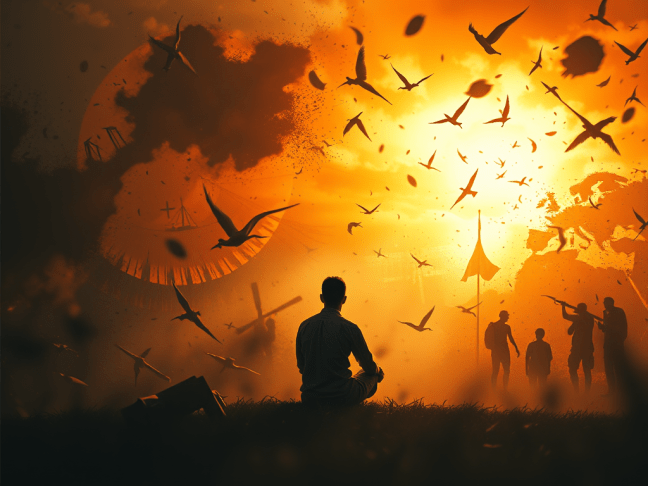
Finding Peace Amidst Global Turmoil

“For when we came into Macedonia, we had no rest, but we were harassed at every turn – conflicts on the outside, fears within. But God, who comforts the downcast, comforted us by the coming of Titus, and not only by his coming but also by the comfort you had given him. He told us about your longing for me, your deep sorrow, your ardent concern for me, so that my joy was greater than ever.”
2 Corinthians 7:5-7 NIVUK

Do Paul’s words sound familiar? He was “harassed at every turn, something we ourselves feel at times. A young mum with demanding children, tired and near the end of her tether. An old person struggling with mobility issues but needing to get to the shops for food. A worker in the office, bombarded with demands from their boss, and unable to see how they were going to complete them all. The list of possible forms of harassment seems limitless. But being harassed seems part of everyday life for humans on Planet Earth. However, something that really strikes a chord within us concerns “conflicts on the outside, fears within”. As I am writing, the war between the US and Israel, and Iran rages on with missile exchanges and bombing continuing. But it doesn’t have to be this particular corner of the globe. Battles and wars keep cropping up all over, and the devil rubs his hands with glee, looking on at all the mayhem that he has caused, directly or indirectly. “Conflicts on the outside”? Definitely. But we shouldn’t be surprised, because Jesus warned us of these times. Jesus said in Matthew 24:6-7, “You will hear of wars and rumours of wars, but see to it that you are not alarmed. Such things must happen, but the end is still to come. Nation will rise against nation, and kingdom against kingdom. There will be famines and earthquakes in various places”. Doom-mongers make claims that this is World War 3, with claims that Armageddon is close, but Jesus was clear in Matthew 24:8, “All these are the beginning of birth-pains”. As we read more in Matthew 24, we can see that there are still events about to happen, and one significant thing that Jesus said is in verse 14, “And this gospel of the kingdom will be preached in the whole world as a testimony to all nations, and then the end will come”. Note that the Gospel has to be preached, and not just the translation of the Bible into all the world’s languages. The End of the Age clock is ticking but it still has a while to go, I believe. We don’t know the hour and the day, but we can be assured that God will not bring about the end of the world until the time is right.

At the time of writing, and regarding the current war in the Middle East, a few church leaders have posted on social media, citing a passage in Jeremiah 49 about Elam, an ancient kingdom located in what is now a corner of Iran, and speculating whether it is the fulfilment of Jeremiah’s prophecy. Of course, Elam no longer exists, having been subsumed into Persia, which became Iran, a long time ago. So, although there are similarities with current events, enough doubt remains to question some of the conclusions being drawn. Another YouTube video has emerged from an American pastor who claims the Doomsday clock has already reached midnight, but as I look out of the window, the sun is still shining. Whenever someone crops up and makes such claims, we pilgrims proceed with caution, waiting for God to confirm if necessary. 

But the point is that the “conflicts outside” bring “fears within”. The headlines in newspapers and other news media platforms scream about the cataclysmic events unfolding. There are even reports that AI-generated videos are circulating, stoking further fears and providing misinformation to mislead people even further. People everywhere are becoming anxious and worried. Even so, many miles away, the effects of the wars will bring inflation and increase the stress of living for those, most people in fact, on limited budgets. It is at times like these that we pilgrims reach for our Bibles to see what advice and encouragement God has for His children. Scriptures provide profound encouragement during times of war by shifting focus from temporary, chaotic circumstances to the eternal sovereignty, protection, and peace of God. They emphasise that while conflict is a reality of a broken world, God remains a refuge and ultimate victor. Psalm 46:1-3 is a great scripture in times such as this. “God is our refuge and strength, an ever-present help in trouble. Therefore, we will not fear, though the earth give way and the mountains fall into the heart of the sea, though its waters roar and foam and the mountains quake with their surging”. These verses reaffirm God’s sovereign rule over His creation and set a baseline from which we can draw comfort and hope. Regarding all the horrors of the “what if’s” Psalm 91:7 provides more assurance about God’s protection, “A thousand may fall at your side, ten thousand at your right hand, but it will not come near you”. This verse was a particular comfort to me many years ago, when the company I worked for began consulting on redundancies, and a few weeks later I learned that my job was secure. God looks after His children.

We remember the time when the Israelites stood on the shores of the Red Sea, unable to go forward, but behind them, the Egyptian army was getting closer and closer. We read in Exodus 14:13-14, “Moses answered the people, ‘Do not be afraid. Stand firm and you will see the deliverance the Lord will bring you today. The Egyptians you see today you will never see again. The Lord will fight for you; you need only to be still’”. God will fight for us when there seems to be no way out. He has our backs, and if we look back over our lives, I’m sure we will remember times when He came through for us when problems seemed insurmountable. 

There are also verses that bolster our mental strength and help us remain calm amid stress caused by fear and societal instability. For example, John 16:33, “I have told you these things, so that in me you may have peace. In this world you will have trouble. But take heart! I have overcome the world”. John 14:27, “Peace I leave with you; my peace I give you. I do not give to you as the world gives. Do not let your hearts be troubled and do not be afraid”. For Christians everywhere, we look at world events with concern, but we remember what Jesus said – “Do not let your hearts be troubled and do not be afraid”.

We are not citizens of the kingdom of the world. Our passport says we are citizens of God’s Kingdom, the Kingdom of Heaven. In Philippians 3:20, Paul wrote, “But our citizenship is in heaven. And we eagerly await a Saviour from there, the Lord Jesus Christ”. So we pray about world events. For the preaching of the Gospel. And for the peace of Jerusalem (Psalm 122:6). And when world events tempt us to look at them and be worried, we instead lift them up in our spiritual hands to the King of kings and the Lord of lords. He knows what’s best and He will lead and guide us, giving us the security of His love and grace.

Dear Heavenly Father. As world events descend into chaos once again, we pray for Your peace and love to smother us. We pray that wars and rumours of wars will cease, and ask that You protect Your people. We thank You for all that You have done for us, and will continue to do in the days, months, and years ahead. Amen.

Embrace Your New Life in Christ

“This means that anyone who belongs to Christ has become a new person. The old life is gone; a new life has begun! And all of this is a gift from God, who brought us back to himself through Christ. And God has given us this task of reconciling people to him.”
2 Corinthians 5:17-18 NLT

One of the most hope-filled promises in the Bible is found in today’s verses. They remind us that, through Christ, we are not merely improved but completely transformed. Paul wrote, “Anyone who belongs to Christ has become a new person”. The transformation described here is not an external behaviour modification, because it is a spiritual rebirth. When we place our faith in Jesus, our identity changes. A verse well known to us is the one that records what Jesus said to Nicodemus, “I tell you the truth, unless you are born again, you cannot see the Kingdom of God” (John 3:3). Being “born again” means just that, starting a new spiritual life. In His conversation with Nicodemus, Jesus compared a natural birth to a spiritual birth, both of which are necessary for a new believer. A baby has to be born into this world, after which they will go through many stages until they leave it, the process of the “womb to the tomb”. Similarly, a person’s spirit must be born into God’s world, His Kingdom, but with a big difference. A reborn spirit never dies. Instead, it inherits eternal life.

We are no longer defined by our past sins, failures, or shame. Instead, we are defined by Christ. We read another verse from Paul yesterday in Galatians 2:20, “My old self has been crucified with Christ. It is no longer I who live, but Christ lives in me”. In Christ, our story does not end with our past. It begins with His grace. Our old lives were represented by our separation from God, because they were ruled by sin and self. Our new lives represent a restored relationship, guided by the Holy Spirit. Paul wrote, “For we died and were buried with Christ by baptism. And just as Christ was raised from the dead by the glorious power of the Father, now we also may live new lives” (Romans 6:4). But what are these “new lives”? Well, we find that we have a new heart. Ezekiel 36:26, “And I will give you a new heart, and I will put a new spirit in you. I will take out your stony, stubborn heart and give you a tender, responsive heart”. We will also find that we have a new mind. Romans 12:2, “Don’t copy the behaviour and customs of this world, but let God transform you into a new person by changing the way you think. Then you will learn to know God’s will for you, which is good and pleasing and perfect”. And pew-warming is not an option for us pilgrims because we have a new purpose. Ephesians 2:10, “For we are God’s masterpiece. He has created us anew in Christ Jesus, so we can do the good things he planned for us long ago”.  Impatient people like me want all these good things right now, but thankfully, God is patient and kind, and He has given us His Spirit to renew and empower us to grow. 

Paul wrote, “all of this is a gift from God”. Becoming a new person is not earned. It is a gift of God’s grace. Paul emphasised this in Ephesians 2:8-9, “God saved you by his grace when you believed. And you can’t take credit for this; it is a gift from God”. We don’t clean up ourselves before we can come to God. Too many people say they are unworthy to come into God’s presence. But through His love and grace, He cleans us up when we come to Him. This truth keeps us humble and grateful. Our salvation is not the result of our efforts. Instead, it is the result of Christ’s finished work on the cross.

We are God’s children

“God … brought us back to himself through Christ”. In other words, we are reconciled to God through Jesus. I always picture in my mind two sides of a deep chasm, too wide to be bridged, or too deep to be scaled. On one side is God and His Kingdom, the place where we want to be. But we find ourselves on the other, too far away to cross the gap through our own efforts. Even the Redcoat soldier in 1689, being pursued by Jacobites, and who was reputed to have jumped across the raging River Garry at Killiecrankie in the Scottish Highlands, would never be able to jump the gap. There is only one Person who can connect us to God across the chasm, and that is Jesus. Colossians 1:19-20, “For God in all his fullness was pleased to live in Christ, and through him God reconciled everything to himself. He made peace with everything in heaven and on earth by means of Christ’s blood on the cross”. Because of what Jesus did for us, we are no longer enemies of God. But it gets better, because God adopted us as His children. 1 John 3:1, “See how very much our Father loves us, for he calls us his children, and that is what we are! But the people who belong to this world don’t recognise that we are God’s children because they don’t know him”.

In 2 Corinthians 5:18, Paul wrote, “And God has given us this task of reconciling people to him”. Paul reminded his Corinthians readers that this is what they were tasked with. I write much about our mission as pilgrims because we contain within us the treasure of knowing Jesus. So what else can we do but tell others? We share the message of reconciliation with those around us at every opportunity. Walking through my local city centre this morning, I was struck by the apparent looks of misery and hopelessness imprinted on people’s faces. They, too, are stuck on the wrong side of the chasm, without hope and any vision for the future, but we have the message of the Good News about Jesus. We pray for opportunities to share it. Our new life is not meant to be private. It is meant to reflect Christ to others. So we live differently, we forgive freely, we love boldly, and we speak the truth gently. Our changed lives become living evidence of God’s grace.

There are some practical things we pilgrims can do in the light of our now being a “new person”. Firstly, we need to stop defining ourselves by our past. We have a natural tendency to say things like, “I’ve always been like that”. Or assume that what we do is the way we always do things. But by doing so, we forget that if we belong to Christ, we are a new creation, set free from the shackles of the past. Secondly, we must remember that salvation is a process we call sanctification. We renew our minds daily by reading the Bible, spending time in prayer, and being obedient to what God asks of us. Our verses from 2 Corinthians today remind us that Christianity is not self-improvement but divine transformation. God takes what was broken and makes it new. He restores what was lost, and He invites us to participate in His redemptive work. The old life is gone, and the new life has begun. And the amazing thing is that it is all a free gift from God.

Dear Father God. Thank You for making us new. We are “ransomed, healed, restored and forgiven”, and it is all because of Jesus. We reach out to You today in praise and worship. Amen.

Remain As You Were

“Yes, each of you should remain as you were when God called you. Are you a slave? Don’t let that worry you—but if you get a chance to be free, take it. And remember, if you were a slave when the Lord called you, you are now free in the Lord. And if you were free when the Lord called you, you are now a slave of Christ. God paid a high price for you, so don’t be enslaved by the world. Each of you, dear brothers and sisters, should remain as you were when God first called you.”
1 Corinthians 7:20-24 NLT

Being born again was a new experience for the Corinthian believers, and they were unsure of how to navigate this new life within them. Here was Paul telling them to calm down a bit and take things more slowly. Society in Corinth was an immoral hotchpotch of different trades and professions, with a liberal presence of slaves, and, although very different to today, there are many similarities. For a start, we don’t have a population of slaves here in the West, and owning a slave is illegal (although this practice goes on under the authorities’ radar). Our society also frowns upon many of the sexual practices that went on in the Greek societies. Still, we must face the reality that our culture today is no more moral than it was in Corinth nearly two thousand years ago. Human nature hasn’t changed when it comes to matters of sin. 

Being born again is a life-changing event that propels unbelievers into a new realm where spiritual rebirth opens a door into the Kingdom of God. It is a wonderful place, full of all kinds of spiritual treasure, that transforms a human being into a spiritual being, albeit shackled to a dying physical body riddled with sin. But then the struggles start, as Paul wrote in Romans 7:15, “I don’t really understand myself, for I want to do what is right, but I don’t do it. Instead, I do what I hate“. He continues, “But if I do what I don’t want to do, I am not really the one doing wrong; it is sin living in me that does it. I have discovered this principle of life—that when I want to do what is right, I inevitably do what is wrong”(Romans 7:20-21). It is only through Jesus that we can find a remedy for the sin that hangs on within us.

However, we can understand why the Corinthians behaved in the way they did because we experience the same struggles. Their approach to their new lives, however, had a tendency to be dramatic, with thoughts of leaving unbelieving spouses or becoming celibates in a very sexually-oriented society. Paul advised them to remain as they were at the time when they were spiritually reborn. If they were married, stay married. If they were circumcised or not, don’t try to change anything. And he advised that if they were in a situation such as a slave, don’t fret about it. 

In the 21st Century, the same advice applies. At the point of salvation experienced by a new believer, they should not make any rapid decisions about their status; whatever profession they were in (as long as it was legal and not immoral) should be continued as before. Paul’s advice, which he wrote about two thousand years ago, remains just as relevant today. He specifically suggested that decisions regarding relationships and marriages should not be rushed, with the new believer waiting until the Holy Spirit provides the necessary guidance. An example from my own experience: when I was reborn by the Spirit of God, I was employed by a UK defence contractor developing an IT-based training facility that would help to teach army gunners to shoot their weapons. I continued for a couple of years until the Holy Spirit suggested to me that this might not be the best profession for me and my conscience. So I moved to another job in a different industry. However, I once knew a couple in a cohabiting relationship who were both saved at the same time and who immediately took steps to remedy the situation by following their pastor’s advice for a pathway towards an early marriage. What they did was right in their situation.

Paul singled out the situation of the slaves, telling them not to worry about their enslaved status, although if they got the chance to become free, they should take it. He put slavery into context by reminding them that they were now slaves of Christ, who “paid a high price for” them, and that is true, because today as well, we know what Jesus did for us at Calvary. However, Paul reminded all believers, then and now, that they must not be enslaved to the world. There is a balance to be struck between living in the Kingdom of God and living in the world. We consist of a physical person and a spiritual person, all wrapped up in the same package, and each part has its own needs. So the physical person needs to be fed and supplied with the necessities of natural life. A spiritual person has spiritual needs, satisfied by communion and fellowship with God. However, the question that needs to be answered is this: how do these two entities live in harmony? Well, the answer is that, more often than we would like, the physical person, complete with their sinful nature, prevails. Thankfully, through the gentle encouragement of the Holy Spirit, our lives become more and more spiritual as we grow in grace and holiness.

Paul’s pastoral love shone out when he referred to the Corinthians believers as “dear brothers and sisters”. From God’s perspective, He looks down from Heaven and refers to us as His dear children. His love and compassion, grace and kindness, know no bounds, and we are fully resourced by Him to face the life that we lead. He knows what’s best for us, and that’s all that matters.

Dear Heavenly Father. We know that we can trust You with our lives and journey towards our Heavenly home. We praise and thank You today. Amen.

One Mind(2)

“Finally, all of you should be of one mind. Sympathise with each other. Love each other as brothers and sisters. Be tender-hearted, and keep a humble attitude.”
1 Peter 3:8 NLT

In a previous blog post we considered the analogy of the human body, and how it is made up of many individual parts and how they all need to be functioning correctly and together to ensure that the body functions as it should. We see the impact of a body part that shouldn’t be there, and working against the rest of the body, in the ravages of cancer. Sadly, many churches fall apart, or split, or even disappear, because of cancerous growths in their midst caused by selfish people with their own agendas, agendas that are at variance with the rest of the body. And today I know of some Christians living near me who no longer attend a church because they are unable to reconcile their beliefs with the church they left behind. Perhaps they have claimed what they consider to be the moral or theological high ground, but have missed the thing that pleases God the most – being kind and caring, in submission to one another. Or perhaps their unrepentant pride and selfish behaviour is the problem. One-mindedness involves self-sacrifice, and we pilgrims should never leave a church lightly, and even then only with God’s blessing.

Being of one mind, particularly with God, pleases Him immensely. A divided church is a sad and pitiable entity, and one that grieves God deeply. Sometimes we spend too long arguing about what divides us, rather than celebrating what we agree on. Jesus taught about the dangers of division. He was once accused of casting out demons by the power of satan. In response he told a parable about a divided kingdom. We read in Matthew 12:25, “Jesus knew their thoughts and replied, “Any kingdom divided by civil war is doomed. A town or family splintered by feuding will fall apart“”. And a few verses further on Jesus ominously said, “Anyone who isn’t with me opposes me, and anyone who isn’t working with me is actually working against me” (Matthew 12:30). We pilgrims don’t want to find ourselves in a place where we are working against Jesus. 

Peter continued with the theme of one-mindedness using words such as “sympathise”, “love”, “tender-hearted” and “humble”. These are all words that describe our attitude to one another. We pilgrims, of course, work hard at being at one with one another. And we look out for ways in which we can humbly implement many of the “one another’s” we find in the Bible. The natural tendency of human beings is to congregate with others of similar race, education and employment. But as believers we have the privilege of making friends with wonderful people from different nations and backgrounds. Being of one mind with fellow believers is God-ordained – we will all one day be worshipping God together, in one mind of course.

Dear Father God. You ordained unity amongst Your children, not strife and division. Please help us to put others first. In Jesus’ name. Amen.