
Understanding the Six Woes of Isaiah 5

Antique brass balance scale on stone pedestal in old stone room with arched doorways and window

“Woe to those who draw sin along with cords of deceit, and wickedness as with cart ropes, to those who say, ‘Let God hurry; let him hasten his work so that we may see it. The plan of the Holy One of Israel – let it approach, let it come into view, so that we may know it.’ Woe to those who call evil good and good evil, who put darkness for light and light for darkness, who put bitter for sweet and sweet for bitter. Woe to those who are wise in their own eyes and clever in their own sight. Woe to those who are heroes at drinking wine and champions at mixing drinks, who acquit the guilty for a bribe, but deny justice to the innocent.”
Isaiah 5:18-23 NIVUK

There are six woes mentioned in Isaiah 5. These are declarations of God’s judgement for the sins of Judah. In verse 8, a woe was declared against those who were oppressing their neighbours and buying up their land and houses, thereby expanding their wealth and bringing them loneliness. Then in verse 11, we read about the judgement coming on those who pursue drunkenness, partying and sexual immorality. In verse 18, we read about those people who openly display their sins, even to the extent of dragging them behind them by the wagonload. In verse 20, we find people who are confused about the difference between good and evil, such is the decline in their morality. We all know people who are “wise in their own eyes”, I’m sure. People with an overconfident opinion of themselves and their capabilities. And, finally, there are those who boast about their prowess with alcoholic beverages. All these “woes” aptly describe the fallen state of society in Judah and, sadly, the state of our societies today. Some things never change and the devil never changes his tactics.

The third “woe” described a people who were not only displaying their sins very visibly, but they were defying God to do what He was threatening to do, obviously with no fear of our Heavenly Father at all. We know people like that today, and I have written before about my neighbour, who was not afraid of the prospect of hell, which he described as being “the big party downstairs”. Perhaps his attitude matched that of the sixth woe, of being ”wise in [his] own eyes”. People can become so accustomed to sinful behaviour that they no longer feel conviction. Instead of asking, “How can I please God?” they ask, “What’s the worst that can happen?” Sadly, that is something that they will find out one day, and it will be far beyond their biggest fears.

The next “woe” expressed moral confusion in a people who had rejected God’s standards and replaced them with their own. They redefined reality by saying that evil [is] good and good [is] evil, who put darkness for light and light for darkness, who put bitter for sweet and sweet for bitter”. This is a serious problem in our society today, because we have so many people who, for example, maintain that men can become women and vice versa. Such people not only ignore God’s truth, but they also seek to blatantly overturn it. This happens whenever society celebrates what God condemns or ridicules what God approves. We pilgrims are called to maintain biblical discernment even when cultural values move in the opposite direction. The Apostle John wrote, “The light shines in the darkness, and the darkness has not overcome it” (John 1:5). We are that light, shining like beacons of hope and countering the lies and deceit the devil has confused the minds of people with.

Isaiah continued with the next “woe”: “Woe to those who are wise in their own eyes and clever in their own sight”. This was the sin of pride and self-sufficiency. The people no longer sought God’s wisdom because they believed they knew better. Their confidence in themselves had replaced dependence on God. But we pilgrims know better, and we follow verses like Proverbs 3:5-6, “Trust in the Lord with all your heart and lean not on your own understanding; in all your ways submit to him, and he will make your paths straight”. We pilgrims know and understand that education, experience, and intelligence are gifts from God, but they become dangerous when they lead us to reject God’s authority. In the workplace, I remember some arrogant and proud managers with questionable morals, but who always seemed to know best; in the light of God’s truth, they fell woefully short. One of them came to a very sad end, sad particularly for his wife and young children as well, because his hobby of skydiving ended in tragedy with an unopened parachute. In those final moments, did God’s grace ever penetrate his personal cleverness and human wisdom? I wonder …

In the final “woe”, Isaiah was not simply condemning drinking; he was condemning a culture that admired drunkenness and excess as if they were achievements. Because of their sinful ways, we see what the outcome was in verse 23, speaking of those “who acquit the guilty for a bribe, but deny justice to the innocent”. Was this the Judaean equivalent of the “old boys” and “laddish” behaviour we sometimes see today? Possibly, but the outcome of the alcohol-focused culture was injustice. We find even today that when personal pleasure becomes the highest value, justice, integrity, and responsibility often suffer. A culture that celebrates moral decline and excess can lose its ability to distinguish right from wrong.

There is much that can be learned from our verses from Isaiah today. 21st-century society seems much the same as it was in 700 BC, with open and defiant sin, moral inversion and confusion over what is right and wrong, self-reliance instead of God-reliance, and self-indulgent corruption and injustice. It is significant that in all the words describing the sinful behaviour of the Judaean people, the word “self” often crops up. In Isaiah’s day, these traits showed a society drifting away from God. We believers are reminded that spiritual decline rarely begins with outward collapse; it begins when people stop taking sin seriously, reject God’s truth, trust their own wisdom, and pursue pleasure above righteousness. For Christians today, the passage is both a warning and a call to live by God’s standards rather than the changing values of the surrounding culture. Paul was very much aware of this, and he wrote, “Don’t copy the behaviour and customs of this world, but let God transform you into a new person by changing the way you think. Then you will learn to know God’s will for you, which is good and pleasing and perfect” (Romans 12:2). I love this verse in the J B Philips translation, “Don’t let the world around you squeeze you into its own mould, but let God re-mould your minds from within, so that you may prove in practice that the plan of God for you is good, meets all his demands and moves towards the goal of true maturity”.

Isaiah’s concern is not merely individual morality but the health of an entire community. When truth is reversed, pride is celebrated, justice is compromised, and society itself begins to unravel. God’s people are therefore called to be a faithful witness to His truth, wisdom, and righteousness. We pilgrims remember once again that we are beacons on a hill, proclaiming the light of Christ.

Dear Heavenly Father. We pray for our societies today that Your light will prevail over all the “dark paths of sin”. We also pray that Your grace will continue to give our friends and families time to find You amidst the noise and chaos of this sinful world. In Jesus’ name. Amen.
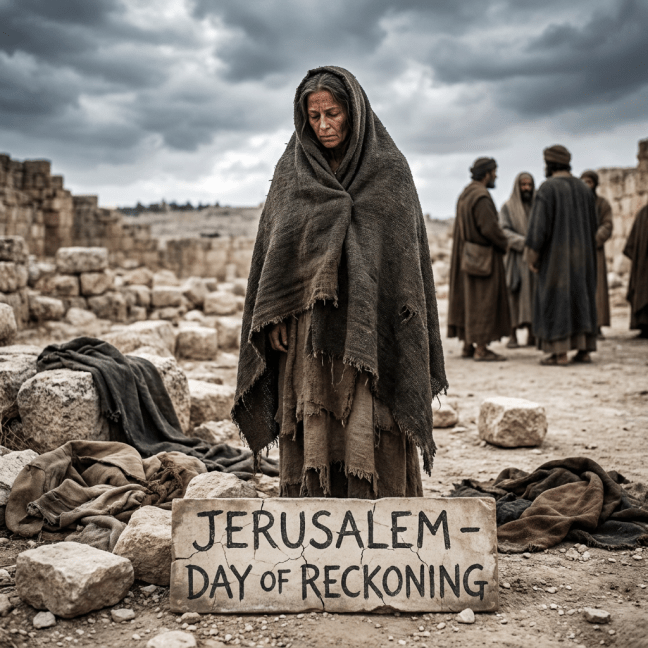
The Folly of External Beauty: Lessons from Isaiah 3

Woman in worn, tattered clothing standing solemnly behind a sign that reads Jerusalem Day of Reckoning

The Lord says, “Beautiful Zion is haughty: craning her elegant neck, flirting with her eyes, walking with dainty steps, tinkling her ankle bracelets. So the Lord will send scabs on her head; the Lord will make beautiful Zion bald.” On that day of judgment, the Lord will strip away everything that makes her beautiful: ornaments, headbands, crescent necklaces, earrings, bracelets, and veils; scarves, ankle bracelets, sashes, perfumes, and charms; rings, jewels, party clothes, gowns, capes, and purses; mirrors, fine linen garments, head ornaments, and shawls.”
Isaiah 3:16-23 NLT

What was going on in Judah? The previous verses in Isaiah 3 paint a picture of corrupt leadership, oppression of the poor, arrogance, social disorder, and, sadly, spiritual rebellion against God. But now Isaiah turned to the “daughters of Zion”, referring to wealthy and influential women in Jerusalem who reflected the culture’s pride and luxury. In his vision, Isaiah described Zion, Jerusalem, as being like one of the affluent women who resided there, a woman who flirted with her eyes, with a mincing walk just sufficient to bring attention to herself with the tinkling of ankle bracelets, and he went on to describe a long list of their possessions. So the woman could be seen to be wealthy, obsessed with outward appearance, and oozing with excessive luxury. 

But Isaiah continued the next section with “On that day of judgement”. All the woman’s finery would disappear when the Lord stripped everything she owned away. And he related all of this to his beloved Jerusalem, the city on the hill that he loved. So much in Jerusalem was just like this woman, full of luxury and finery, but none of it would survive the judgment of the Lord. 

What was going wrong? The people of Jerusalem had become guilty of the sin of pride, outwardly beautiful but spiritually impure. The warning was that external elegance could not save a society that was morally collapsing. The people were cultivating an image of luxury and pride in its appearance while ignoring justice and holiness. They had forgotten verses like 1 Samuel 16:7, “But the Lord said to Samuel, ‘Don’t judge by his appearance or height, for I have rejected him. The Lord doesn’t see things the way you see them. People judge by outward appearance, but the Lord looks at the heart’”. God doesn’t look at how people present themselves externally. He looks directly into what is in their hearts, what they are thinking and how they view God and the people around them. Jesus warned the people about the Pharisees in a lengthy discourse in Matthew 23. Here is a selection of verses that record what He said, “Everything they do is for show. On their arms they wear extra wide prayer boxes with Scripture verses inside, and they wear robes with extra long tassels. … What sorrow awaits you teachers of religious law and you Pharisees. Hypocrites! For you are so careful to clean the outside of the cup and the dish, but inside you are filthy—full of greed and self-indulgence! … Outwardly you look like righteous people, but inwardly your hearts are filled with hypocrisy and lawlessness” (Matthew 23: 5, 25, 28). 

For Christians, God’s people, today, does that mean we must dress sombrely and even poorly, without jewellery or any other embellishments? In days past, religious groups such as the Puritans dressed in sombre colours with styles designed to be modest and unrevealing, and there is nothing wrong with that unless it becomes an obsession. The Bible never forbade finery, with Rebekah being blessed with “… a gold ring for her nose and two large gold bracelets for her wrists” (Genesis 24:22b). The virtuous woman in Proverbs 31 “… dressed in fine linen and purple gowns” (Proverbs 31:22). And of course, we mustn’t forget Lydia in Acts 16. The issue is when appearance becomes an idol, luxury becomes pride, and wealth blinds people to justice and to God.

Peter wrote, “Don’t be concerned about the outward beauty of fancy hairstyles, expensive jewellery, or beautiful clothes. You should clothe yourselves instead with the beauty that comes from within, the unfading beauty of a gentle and quiet spirit, which is so precious to God” (1 Peter 3:3-4). Isaiah 3 speaks powerfully to modern culture, obsessed as it is with image, status symbols, social media presentation, consumerism and valuing appearance above character. If we pilgrims are caught up in any of this, perhaps we should pause and ask, “What are we really trusting in”? Another question perhaps is “How much energy are we expending in our outward appearance or the way we present ourselves, to the neglect of God and His Kingdom”? For the woman in Jerusalem, Isaiah had a stark reminder that beauty fades, and status could disappear at a stroke. The message to both them and us today is that Godly character lasts forever.

Dear Heavenly Father. A sober reminder today about our relationship with You and how so many worldly and temporal things can get in the way. Please forgive us for our pride and arrogance, and lead us in better ways, we pray. In Jesus’ name. Amen.

Confronting Sin in the Corinthian Church

“Perhaps you think we’re saying these things just to defend ourselves. No, we tell you this as Christ’s servants, and with God as our witness. Everything we do, dear friends, is to strengthen you. For I am afraid that when I come I won’t like what I find, and you won’t like my response. I am afraid that I will find quarrelling, jealousy, anger, selfishness, slander, gossip, arrogance, and disorderly behaviour. Yes, I am afraid that when I come again, God will humble me in your presence. And I will be grieved because many of you have not given up your old sins. You have not repented of your impurity, sexual immorality, and eagerness for lustful pleasure.”
2 Corinthians 12:19-21 NLT

The Corinthians must have been a rowdy lot, if Paul’s fears were realised. In fact, it is a surprise that there was a church there at all. Perhaps they were trying to realise the best of both worlds, the Kingdom of God and the kingdom of the world, but as we know, the two are incompatible. Earlier in this letter, Paul wrote, “Don’t team up with those who are unbelievers. How can righteousness be a partner with wickedness? How can light live with darkness? What harmony can there be between Christ and the devil? How can a believer be a partner with an unbeliever?” (2 Corinthians 6:14-15). Perhaps they had heard about the Laodiceans, suffering from the same apostasy, and we read what Jesus said about them, “I know all the things you do, that you are neither hot nor cold. I wish that you were one or the other! But since you are like lukewarm water, neither hot nor cold, I will spit you out of my mouth!” (Revelation 3:15-16). The same incompatibility was in Jesus’ mind, I’m sure, when he said, “No one can serve two masters. For you will hate one and love the other; you will be devoted to one and despise the other. You cannot serve God and be enslaved to money” (Matthew 6:24). If the Corinthians were in fact trying to still live in their old, sinful ways, as well as pursue the things of God, then they were in for a shock, because Paul would have to confront it when he arrived for his third visit. 

Of course, in our churches today, the people would not have the same dichotomy, being “nice” people not guilty of any of the “crimes” Paul wrote about, such as “quarrelling, jealousy, anger, selfishness, slander, gossip, arrogance, and disorderly behaviour”. I’m sure the believers in Corinth knew that such behaviour was wrong and sinful, just the same as we would, but there it was bubbling away in the background, under the surface, but still visible to the Spirit-led gaze of Paul and his colleagues. One of the behavioural problems Paul wrote about was sexual immorality. In those days, without access to pornographic material, either in print form or internet-based, sexual sins would have been very visible, although largely accepted, or even encouraged, by the pagan societies in Greece. Today, the same sin exists, even within men of God, either in leadership or in the pews, who act out their secret lives, hoping that they will never be caught. So on a Sunday, the “nice” people worship together, but terrible things can happen when no one else is around. 

Another sin Paul mentioned was gossip. The sin of talking negatively about another person, criticising them, and even making up things about them that aren’t true. And gossip is not just a thing between people who know each other. It also takes place on social media, with sad people hiding behind a keyboard and the relative anonymity offered by pseudonyms and hidden accounts. 

So, in a nutshell, the problems Paul feared in the Corinthian church were no different from the problems that lie beneath the surface in our modern churches today. I have been in a public meeting when sinful behaviour was called out from the pulpit, but it is a rare occasion today. 

Paul’s complaint was that many of the Corinthians “[had] not given up [their] old sins. [They] [had] not repented of [their] impurity, sexual immorality, and eagerness for lustful pleasure”. As believers in Jesus, there was a time when we came to the foot of the Cross and repented of our sins. So started a journey we call sanctification, as we gradually, and painfully slowly at times, cleaned up our lives with the help of the Holy Spirit, and under God’s Fatherly gaze. It was the same with the Corinthians, but it seemed that their journey was having a problem getting off the starting blocks. I’m sure that this was not a universal problem with the Corinthians, but there was still a worldly element in the church there. 

Today, there are some denominations that have allowed worldliness to enter their churches, as they preach a liberal doctrine that, in some cases, even denies the truth of Scripture. We pilgrims all know what that is and how it is leading to the decline of once-proud and effective beacons of light for the Gospel and our wonderful Jesus, with worldly doctrines that are dividing and destroying fellowship and subverting the purity of the Word and the Good News about Jesus. 

Paul had no choice other than to confront the sinful behaviour of the Corinthians, and through the Holy Spirit gifts that he had access to (as we all do), he would have been able to put his finger on those who were the culprits, not with a view to putting them out of the church (even though that had happened before), but with a view to restoring them back into the fellowship of believers. Paul’s advice to the Corinthians in his first letter was in fact to evict a blatant sinner from their midst: “Then you must throw this man out and hand him over to Satan so that his sinful nature will be destroyed and he himself will be saved on the day the Lord returns. … God will judge those on the outside; but as the Scriptures say, ‘You must remove the evil person from among you’” (1 Corinthians 5:5, 13). But Paul was after restoration and repentance, so that the church could be strengthened and able to continue in the way of the Lord. 

Today we pilgrims must always try to align our lives to that of Jesus, adopting the Biblical truths that set out God’s ways rather than man’s. There is no other way. Liberal doctrines and worldly practices have no place in our churches and fellowships; all that matters is God’s truth.

Dear Father God. We proclaim Your Gospel message of repentance in a world of sin and evil. We want to be pure and holy in Your sight, now and forever. Amen.

A Weak Conscience

“However, not all believers know this. Some are accustomed to thinking of idols as being real, so when they eat food that has been offered to idols, they think of it as the worship of real gods, and their weak consciences are violated. It’s true that we can’t win God’s approval by what we eat. We don’t lose anything if we don’t eat it, and we don’t gain anything if we do.”
1 Corinthians 8:7-8 NLT

Some actions that Christians take can be perceived as offensive to other believers. These are generally things on the margins that would not be included in a list of essential “dos and don’ts” or would count as behaviour to be frowned upon. So in Victorian times, playing cards and attending dance halls were definitely not pastimes fit for a Christian. And the list of “dodgy” behaviour can be quite a long one, even extending to clothes that are worn or not worn, in some cases. In the office space, the use of bad language and expletives can be ubiquitous. Lumped in with smutty jokes or risqué behaviour, they present a problem for believers, who become shunned and excluded from social gatherings because of their attitude to worldliness. In Corinth, the believers had a problem with food offered to idols because “Some are accustomed to thinking of idols as being real, so when they eat food that has been offered to idols, they think of it as the worship of real gods, and their weak consciences are violated“. So what is a conscience?

“The conscience is defined as that part of the human psyche that induces mental anguish and feelings of guilt when we violate it and feelings of pleasure and well-being when our actions, thoughts and words are in conformity to our value systems … The conscience reacts when one’s actions, thoughts, and words conform to, or are contrary to, a standard of right and wrong“. (quote from gotquestions.org). We have concluded before that human beings, made in God’s image, must have a built-in moral understanding which we refer to as a conscience, a moral compass that will guide us through this sad world, riddled as it is by evil and wickedness. No surgeon could ever dissect a human being to find such a thing because it is a part of our thinking, and as such, is something intangible. But there is no doubt that a person’s conscience exists, and how we act or think is governed initially by the remarkable fact that we are made in God’s image. So we are wired to have a Godly standard of right and wrong, well, that is, until the devil gets hold of us, and sin creeps in to corrupt and sear the perfection that God intended. Thankfully, through Jesus, our consciences are going through a repairing process, particularly as more and more we “Put on [our] new nature, created to be like God—truly righteous and holy” (Ephesians 4:24). Two words apply to the spiritual growth of a Christian – salvation and sanctification – both ongoing processes that one day will be completed as we enter God’s presence, and within those processes there are references made to our morals and standards, driven by our redeemed consciences.

So what does all this mean for a Christian? Firstly, we must have a conscience that is aligned with God’s standards. There is no place in God’s Kingdom for a believer with a conscience that is worldly and corrupted. On a number of occasions the Apostle Paul referred to his conscience as being clear, such as in Acts 23:1, “Gazing intently at the high council, Paul began: “Brothers, I have always lived before God with a clear conscience!””. Over the page in our Bibles, he said, “Because of this, I always try to maintain a clear conscience before God and all people” (Acts 24:16). In Romans 2:14-15, Paul addressed the situation of lawless Gentiles. He wrote, “Even Gentiles, who do not have God’s written law, show that they know his law when they instinctively obey it, even without having heard it. They demonstrate that God’s law is written in their hearts, for their own conscience and thoughts either accuse them or tell them they are doing right“. And Paul even referred to his conscience in matters connected to his teaching. Romans 9:1, “With Christ as my witness, I speak with utter truthfulness. My conscience and the Holy Spirit confirm it“. 

But so far, we have connected our consciences to our own behaviour. This is important, of course, but the issue that Paul was addressing in his Corinthian letter concerned the problem with the consciences of others, and how our behaviour might violate their consciences. So, one Christian in Corinth might have no problem with his conscience when he joins in with a feast with food offered to a particular local god. This is because they have reached a position in their thinking that tells them the “god” is just an idolatrous lump of stone without any life or significance to them. But their next-door neighbour, a new believer, might be appalled that they are doing such a thing because they are still very sensitive to their previous life, where they had devoted much time to the worship of this particular idol. In this specific case, the neighbour has a “weak conscience”. 

I’m sure today we can find similar cases. Consider a hypothetical family where the father was an alcoholic and gave his wife and children a terrible time until his early death. Then one of the children becomes a Christian, but has been so sensitised by the problems caused by alcohol that they will not even drink the alcoholic communion wine. In such a case as this, the “wine” should perhaps be of the non-alcoholic variety, to avoid violating a “weak conscience”. 

A last word from “gotquestions.org”, “As Christians, we are to keep our consciences clear by obeying God and keeping our relationship with Him in good standing. We do this by applying His Word, renewing and softening our hearts continually. We consider those whose consciences are weak, treating them with Christian love and compassion”.

Dear Lord God. We know that as we grow in our faith, You will help us fine-tune our consciences so that they are aligned with Your standards. We praise and worship You today. Amen.

Associating with Sinful People

“When I wrote to you before, I told you not to associate with people who indulge in sexual sin. But I wasn’t talking about unbelievers who indulge in sexual sin, or are greedy, or cheat people, or worship idols. You would have to leave this world to avoid people like that. I meant that you are not to associate with anyone who claims to be a believer yet indulges in sexual sin, or is greedy, or worships idols, or is abusive, or is a drunkard, or cheats people. Don’t even eat with such people.”
1 Corinthians 5:9-11 NLT

It’s a difficult balance. Should we, Christian pilgrims, isolate ourselves from worldly people, thereby keeping ourselves pure, holy and sinless, but in the process prevent any chance of contact with people who desperately need to hear the Gospel? It seems that Paul had written a previous letter about this to the Corinthian church, but it has somehow become lost in the mists of time. In that letter, it appears that Paul warned the Corinthians about sexual sins, but it appears that they chose to ignore his exhortations, hence the weight given to his admonishment about the man sleeping with his stepmother. Paul explained that he wasn’t suggesting that the Christians in Corinth should stop meeting with worldly unbelievers, but that they should shun people who claim to be believers but still behave sinfully, and particularly those committing open and blatant sexual sins.

The problem of association, then as now, with worldly people remains a problem, because to fulfil our Christ-given mission, we must have contact with them. Such people may even be our friends or family members. A bit later on in this letter, Paul wrote, “When I am with those who are weak, I share their weakness, for I want to bring the weak to Christ. Yes, I try to find common ground with everyone, doing everything I can to save some” (1 Corinthians 9:22). But he didn’t say that he would participate in worldly behaviour and customs to do the soul winning. In 2 Corinthians 6:14-15, he wrote, “Don’t team up with those who are unbelievers. How can righteousness be a partner with wickedness? How can light live with darkness? What harmony can there be between Christ and the devil? How can a believer be a partner with an unbeliever?” 

So what should we do with believers like the man and his stepmother, if we find them in our churches? We have covered the question of church discipline in a previous blog, but Paul continued to make this important point in his letter. The Apostle Jude wrote, “And you must show mercy to those whose faith is wavering. Rescue others by snatching them from the flames of judgment. Show mercy to still others, but do so with great caution, hating the sins that contaminate their lives” (Jude 1:22-23). We must do our utmost to be merciful to those in our congregations and pray and help them to deal with their sinful behaviour. In his letter, Paul was, I think, referring to persistently unrepentant people in churches who had refused to change their ways of sin, but who still wanted to participate in the church activities, and even claimed to be believers. We find this in churches that tolerate the practices of certain sexual sins, with claims that you can be a Christian but still violate the Biblical foundations of sexual ethics. So a liberal faction is accepting of such people, and traditional and fundamental Bible believing Christians keep them at arm’s length. This leads to the dilemma facing true believers, because such sinful behaviour won’t necessarily lead to the exclusion from public meetings of blatantly sinning and self-claimed believers, but on the other hand, they have to be isolated to avoid their sin from tainting the rest of the believing church. A difficult balance that needs much prayer, grace and wisdom to achieve. 

In these circumstances, we turn to Jesus for guidance. He spent much time in the presence of sinners, tax collectors, prostitutes, and so on. We find his grace at work in the account of the woman caught in the act of adultery (where was the man by the way!). The establishment wanted to stone her to death, but the story ended with Jesus refusing to condemn her, instead commanding her to sin no more. We must take His grace and love into our associations with everyone we meet in the world, and in our churches, we must also do the same. There is no other way for pilgrims to behave. We cannot judge people because that is God’s prerogative, but we can separate ourselves from sinful people, because that is His command. We love the sinners, but hate and avoid the sin.

Dear Heavenly Father, You are building a pure and sinless church of which we are a part. We pray that we hear Your Spirit when we come into contact with sin, and pray also that You grant us the wisdom we need. In Jesus’ name. Amen.

Reigning With Christ

“You think you already have everything you need. You think you are already rich. You have begun to reign in God’s kingdom without us! I wish you really were reigning already, for then we would be reigning with you.”
1 Corinthians 4:8 NLT

Paul suggested with a bit of sarcasm that the Corinthians had begun to “reign in God’s Kingdom” without involving Paul and Apollos and, presumably, other leaders sent to bless this wayward congregation. They had developed this line of thinking because they thought they were already receiving the future blessings of Heaven in their earthly lives, not understanding that they had much to learn and consequently receive. God had graciously provided all the spiritual gifts they needed, as Paul said in 1 Corinthians 1:7, “Therefore you do not lack any spiritual gift as you eagerly wait for our Lord Jesus Christ to be revealed“. So perhaps the Corinthians thought that they didn’t need anything more, but Paul administered a good dose of realism with 1 Corinthians 1:26-27, “Brothers and sisters, think of what you were when you were called. Not many of you were wise by human standards; not many were influential; not many were of noble birth. But God chose the foolish things of the world to shame the wise; God chose the weak things of the world to shame the strong“. But their worldly behaviour in judging the merits of Paul and Apollos exposed a reality gap between what they thought they had become and what they really were. These were just ordinary people saved by God’s grace, but still needing the basics of God’s teaching so that they would grow up to become the people of the Spirit that God desired. 1 Corinthians 3:1-3, “Dear brothers and sisters, when I was with you, I couldn’t talk to you as I would to spiritual people. I had to talk as though you belonged to this world or as though you were infants in Christ. I had to feed you with milk, not with solid food, because you weren’t ready for anything stronger. And you still aren’t ready, for you are still controlled by your sinful nature. You are jealous of one another and quarrel with each other. Doesn’t that prove you are controlled by your sinful nature? Aren’t you living like people of the world?” The Corinthians seemed to have become so arrogant that they believed that they were “reigning with Christ” already, not realising that their worldly behaviour was getting in the way of God’s purposes.

So what does “reigning with Christ” really mean? In Romans 5:17, we receive some insight that provides an answer: “For if, by the trespass of the one man, death reigned through that one man, how much more will those who receive God’s abundant provision of grace and of the gift of righteousness reign in life through the one man, Jesus Christ!” Unbelievers live in a kingdom where death reigns. Romans 5:14, “Nevertheless, death reigned from the time of Adam to the time of Moses, even over those who did not sin by breaking a command, as did Adam, who is a pattern of the one to come”. Because of Adam, sin always brings death. Death became king. It ruled the lives of every person born from Adam, and it still rules our societies today. Until the point when we pilgrims became believers in Jesus, we too were living in the kingdom of this world, living in a place that was without hope and subject to a curse that would result in our ultimate “death” in a place we call hell. Of course, we are referring to spiritual death, and we know that through Jesus, life will reign supreme and eternal. Through His grace, we are reigning in God’s Kingdom, and it is all about Him, Jesus our Saviour. In other words, receiving God’s justification by placing our faith in Christ not only frees us from the kingdom of death, it allows us to rule in the kingdom of life alongside Jesus, as the very children of God.

Do we reign with Christ today? Romans 8:15-17 (MSG), “This resurrection life you received from God is not a timid, grave-tending life. It’s adventurously expectant, greeting God with a childlike “What’s next, Papa?” God’s Spirit touches our spirits and confirms who we really are. We know who he is, and we know who we are: Father and children. And we know we are going to get what’s coming to us—an unbelievable inheritance! We go through exactly what Christ goes through. If we go through the hard times with him, then we’re certainly going to go through the good times with him!” We pilgrims know the future because we have faith in God and His promises. But in the here and now, we receive a foretaste of what is to come, because we are co-heirs with Christ “Now if we are children, then we are heirs – heirs of God and co-heirs with Christ, if indeed we share in his sufferings so that we may also share in his glory” (Romans 8:17 NIV), but we note the added caveat – “sharing in [Christ’s] sufferings”. But what does this suffering look like? Well, for a start, we will be persecuted. It may be in a low-key way here in the West, or it may come to physical harm, as in other parts of the world. We will be ostracised in the office or in any other social gathering, considered as having “weird” beliefs. If we stand firm in our faith, it may reduce job opportunities and even exclusion from certain jobs. And we must also die to our previous sinful lives so that we can live a life of purity and holiness. 

If we wish to “reign with Christ” there is a cost, but ” … the God of all grace, who called you to his eternal glory in Christ, after you have suffered a little while, will himself restore you and make you strong, firm and steadfast” (1 Peter 5:10). Our life on this earth seems to have the potential to go on forever when a person is young, but the reality is that, compared to eternity, it is little more than a puff of wind. So, fellow pilgrims, let us reign together in God’s Kingdom, set free through the blood of Christ.

Dear Father in Heaven. Please help us in our lives today, as we reach out to You for the resources we need to be Your people of faith in a dark, sinful world. In Jesus’ name. Amen.

Sinners and Mockers

“Oh, the joys of those who do not follow the advice of the wicked, or stand around with sinners, or join in with mockers. But they delight in the law of the Lord, meditating on it day and night.”
Psalm 1:1-2 NLT

The Holy Spirit has led me back to the Psalms, the Bible’s prayer and hymn book. A rich source of living with God, communicating with Him, learning from Him and providing a framework for our whole lives, not just the spiritual.

Psalm 1 starts with a contrast between the people who are worldly, and those who follow God and all His ways. Worldly people do not believe in God, in the life-changing redemptive work of Jesus at Calvary. Hedonism, seeking pleasure, is their goal, accomplished by whatever means are possible. Worldliness also includes the thoughts and actions of those who think that they are “good” people, but who fall far short of God’s standard. And that is really the problem – worldly people do not have a compass to guide them in God’s ways because His ways of righteousness do not fit in with their chosen lifestyle. 

The psalmist starts with a selection of the way worldly people behave, starting with those who are wicked. We do not have to go far before we find a wicked person. Open a media report and one will soon be found. But there are those in this category living far closer to home. Wickedness and sinning, the second category, go hand in hand and both have the same root – evil. Simplistically, God is good, and the devil is evil, and this dichotomy is exposed as the psalmist warns God’s people to avoid the wicked and any advice they might offer, to avoid hanging about in sinful company, and to avoid being a mocker or scoffer. Anyone who has spent time in the workplace will know what these things are.

Instead of getting involved with worldly people, the psalmist advised a God-follower to “delight in the law of the Lord”. That is not just the reading of a list of rules and regulations, but acting out what they read in their daily lives. God’s people must not, however, cut themselves off from all contact with the world. We pilgrims have to work in the office, visit the marketplace, be in contact with the people around us, whether they are good or bad. But through our conduct we exemplify a different way of life – God’s way. A way of righteousness and holiness, an alternative lifestyle sourced in God Himself. 

Where better a place to start than with the Psalms, as we delight ourselves in God. He is the Source of our joy. Only He has message, through Jesus, of eternal life with Him. 

Dear Father God. Good advice from the Holy-Spirit-inspired psalmist today. We pray the prayer Jesus taught His disciples, asking for deliverance from the evil round us. Thank You. Amen.

World Identity

“Now I am coming to you. I told them many things while I was with them in this world so they would be filled with my joy. I have given them your word. And the world hates them because they do not belong to the world, just as I do not belong to the world. I’m not asking you to take them out of the world, but to keep them safe from the evil one. They do not belong to this world any more than I do. Make them holy by your truth; teach them your word, which is truth. Just as you sent me into the world, I am sending them into the world. And I give myself as a holy sacrifice for them so they can be made holy by your truth.”
John 17:13-19 NLT

Who do we pilgrims identify with – those unbelieving people in the world around us, or the believers in our Christian communities and fellowships? Unfortunately there is no grey area in the middle. Jesus said that functioning believers, disciples and pilgrims like us, will be hated by the people in the societies around us, people who are soaked in their sins and heading for a lost eternity. And Jesus prayed that His disciples, and pilgrims everywhere by extension, would be kept safe from the enemy, the “evil one”. He made the statement that such people as us “do not belong to this world”

But how do we pilgrims reconcile the Great Commission, to “go into all the world to make disciples”, with the need to keep ourselves separate from the world and, by implication, all of its ways? This was always a challenge to me in an office environment, where the behaviour of those around me was unacceptable for a Kingdom man, with the gossip, the blasphemous language, the flirting, the invitations to attend parties and join the team at the local pub after work, and so on. Sometimes I felt like an outcast, shunned by the people in my team, and assigned work that was less collaborative as a result. But how could a child of the King ever be involved in the ways of the world, a different kingdom, where their “king” was the devil? 

Jesus said in Matthew 5, “You are the salt of the earth” and “You are the light of the world”. And He finished this section  with “In the same way, let your good deeds shine out for all to see, so that everyone will praise your heavenly Father” (Matthew 5:16). In a dark world we are beacons of hope but, as such, vulnerable to attacks from the enemy. Our behaviour is of course influenced by our relationship with God. As an example, in Daniel 1:8 we read, “But Daniel was determined not to defile himself by eating the food and wine given to them by the king. He asked the chief of staff for permission not to eat these unacceptable foods”. The Jewish exiles and Daniel behaved in a way conducive with the Law of Moses. On the other hand, we read in Matthew 9:10-11, “Later, Matthew invited Jesus and his disciples to his home as dinner guests, along with many tax collectors and other disreputable sinners. But when the Pharisees saw this, they asked his disciples, “Why does your teacher eat with such scum?”” It is possible for believers to enter the border territory between the Kingdom of God and the kingdom of the world, but with fear and trembling, and with much care. But after all, how else can we reach the lost with the Good news of eternal life?

Peter wrote, “ … for you are a chosen people. You are royal priests, a holy nation, God’s very own possession. As a result, you can show others the goodness of God, for he called you out of the darkness into his wonderful light” (1 Peter 2:9). ‭‭We are a people sanctified by the blood of Jesus, and because of that the devil can’t touch us – unless we let him!

Dear Heavenly Father. Thank You for Your protection and care. Please lead us to those people in the world who You have chosen, and keep us safe in the process. In Jesus’ name. Amen.

Christ’s Example

“For God called you to do good, even if it means suffering, just as Christ suffered [or died] for you. He is your example, and you must follow in his steps. He never sinned, nor ever deceived anyone.”
1 Peter 2:21-22 NLT

Jesus never sinned, as Peter rightly wrote. After all he should know because he spent three years or so with Jesus as He journeyed around the roads and paths, villages and towns, in Palestine. Those long days spent in His company would have revealed any sins, even those that were hidden, but of course there weren’t any. Paul also wrote that Jesus never sinned, as we read in 2 Corinthians 5:21, “For God made Christ, who never sinned, to be the offering for our sin, so that we could be made right with God through Christ“. And 1 John 3:5, “And you know that Jesus came to take away our sins, and there is no sin in him“.

So how do we pilgrims follow someone who is sinless, when we have all this sin baggage? I suppose we must start by asking ourselves what it is that we do follow, because we all have a passion for something, if we really think about it. I’m writing this near St Andrews, one of the great golfing cities in Scotland. And there will be many today indulging their passion for golf, hitting a small white ball around some beautifully landscaped fairways and greens. Others follow football, or motor racing. The list is seemingly endless. But a passion for following Christ will, I suspect, be well down the list of things that people will follow in this secular society.

There is a cost to following Christ. He said, “If you refuse to take up your cross and follow me, you are not worthy of being mine” (Matthew 10:38). In Jesus’s day, the crowds followed Him, attracted by the miracles that He performed. Enjoying times like the day He fed 5,000 people. For those He healed, appreciating the freedom from long term disability and sickness. In modern parlance, Jesus was cool. A great guy to be around. However, people were more interested in what He did, rather than who He was. Jesus advised that prospective disciples should consider carefully what discipleship could mean. He said, as recorded in Luke 14:28, “But don’t begin until you count the cost. For who would begin construction of a building without first calculating the cost to see if there is enough money to finish it?”

Jesus also said, “You can enter God’s Kingdom only through the narrow gate. The highway to hell is broad, and its gate is wide for the many who choose that way. But the gateway to life is very narrow and the road is difficult, and only a few ever find it” (Matthew 7:13-14). And John 16:33, “I have told you all this so that you may have peace in me. Here on earth you will have many trials and sorrows. But take heart, because I have overcome the world“.

Peter wrote, “[Jesus] is your example, and you must follow in his steps”. Jesus trod a road that was far from easy and it led to His death at Calvary. I’m not suggesting that we pilgrims will come to a violent end, but the road to our Promised Land won’t be an easy one. But Jesus knew the secret for holding on and finishing the course. He is there to help our every step. After all He said, “But take heart, because I have overcome the world“. As we stay close to Him He will do just that. It’s all about trust and faith in Him, our loving Saviour.

Dear Father God. we know that our choice to follow Jesus won’t be easy, but we’re grateful that You will be with us, day by day. In Jesus’ name. Amen.


Temporary Residents

“Dear friends, I warn you as “temporary residents and foreigners” to keep away from worldly desires that wage war against your very souls.”
1 Peter 2:11 NLT

Peter warns his readers “to keep away from worldly desires”. But perhaps we think that this is easier said than done because we live on this world, Planet Earth. It’s a world corrupted by sin and wickedness; we only have to read a newspaper, or, more likely, go on-line and start reading what one of the news outlets provides, to find out how bad things really are. Social media seems to be burgeoning with negative stories, many of them heart-rending in their content. So, for us pilgrims, it is a difficult place to keep apart from, and especially if we ourselves are caught up in one of the negative stories personally. We find too that there are consequences to many of the decisions and actions that we make, driven perhaps by our “worldly desires”.

But Peter started this verse with a strange concept, that his readers were “temporary residents and foreigners”, presumably in this world. How can that be, because it was into this world that each of us was born. To answer that, we have to take a step back and consider two scenarios. Firstly, our natural lives will only span a finite number of years, as we read in Psalm 90:1a, “Seventy years are given to us! Some even live to eighty … ”. So in that respect we are “temporary residents”. Planet Earth was already here when we arrived and will probably still be here when we die. 

What was Peter meaning then when he said we were “foreigners” in this world? This is the second scenario and refers to that day when we pilgrims made a decision for Christ. A decision were we repented of our sins and believed in Jesus. We read in Acts 2:38, “Peter replied, “Each of you must repent of your sins and turn to God, and be baptised in the name of Jesus Christ for the forgiveness of your sins. Then you will receive the gift of the Holy Spirit.” Romans 10:9-10, “If you openly declare that Jesus is Lord and believe in your heart that God raised him from the dead, you will be saved. For it is by believing in your heart that you are made right with God, and it is by openly declaring your faith that you are saved”. That is the decision we call being born again. Jesus told Nicodemus about it in John 3:3, “Jesus replied, “I tell you the truth, unless you are born again, you cannot see the Kingdom of God””. The consequences of this are as Paul wrote in Philippians 3:20, “But we are citizens of heaven, where the Lord Jesus Christ lives. And we are eagerly waiting for him to return as our Saviour”.

There came that point where we pilgrims acquired a new passport, and it says we are citizens of the Kingdom of Heaven. Instead of the cover saying “United Kingdom of Great Britain and Northern Ireland”, or whatever your national passports say, our new passport says “Kingdom of Heaven” or “Kingdom of God”. We don’t however have a physical passport because this is a spiritual kingdom and God doesn’t need to issue one. Instead He has written our names in a Book, called the Lamb’s Book of Life. And the wonderful thing is that instead of only being valid for ten years, like the UK passport, it applies for all of eternity. We read about this book in Revelation 21:27, “Nothing evil will be allowed to enter, nor anyone who practices shameful idolatry and dishonesty—but only those whose names are written in the Lamb’s Book of Life”. 

So, we pilgrims are indeed “temporary residents and foreigners” in this world. One day we will have no need for a UK passport, or, indeed any other passport, and can fully and totally take up our citizenship in Heaven. But back to how we started. While we are “temporary residents and foreigners” we have been warned “to keep away from worldly desires that wage war against [our] very souls.” Sound advice from a man who knew as much as anyone the dangers and temptations in living a worldly life. In 1 John 4:4-6 we can read what the Apostle John wrote about worldly people. “But you belong to God, my dear children. You have already won a victory over those people, because the Spirit who lives in you is greater than the spirit who lives in the world. Those people belong to this world, so they speak from the world’s viewpoint, and the world listens to them. But we belong to God, and those who know God listen to us. If they do not belong to God, they do not listen to us. That is how we know if someone has the Spirit of truth or the spirit of deception.” Paul, the Apostle, wrote in Romans 8:37, and referring to the difficulties of living in the world, “No, despite all these things, overwhelming victory is ours through Christ, who loved us”. 

In God, and through the Holy Spirit who lives within us, we can live a life in the right Kingdom. It isn’t easy, and sometimes we will slip up. But our Heavenly Father is quick to forgive us for our sins, and we are free to move onwards and upwards into our calling in Christ.

Dear Father God. Thank You that You have recorded our names in Your Book of Life, sealing our Heavenly citizenship. What a wonderful gift! Amen.