
Bearing Fruit: Lessons from Jesus’ Vineyard Parable

Person wearing gloves and a hat pruning vines in a foggy vineyard at sunrise

“I will sing for the one I love a song about his vineyard: my loved one had a vineyard on a fertile hillside. He dug it up and cleared it of stones and planted it with the choicest vines. He built a watchtower in it and cut out a winepress as well. Then he looked for a crop of good grapes, but it yielded only bad fruit.”
Isaiah 5:1-2 NIVUK
“I am the true grapevine, and my Father is the gardener. He cuts off every branch of mine that doesn’t produce fruit, and he prunes the branches that do bear fruit so they will produce even more. You have already been pruned and purified by the message I have given you. Remain in me, and I will remain in you. For a branch cannot produce fruit if it is severed from the vine, and you cannot be fruitful unless you remain in me.”   John 15:1-4 NLT 

The first four verses of John 15 were much referred to in the early days of the charismatic renewal. I can still remember a conference sermon based on these verses, delivered in 1979 or thereabouts, in which the speaker lambasted the charismatic audience for producing lots of leaves but no fruit. The “leaves” were all the charisma and excitement of a new move of God, but where was the Holy Spirit fruit being manifested in people’s lives? But Jesus’ illustration was clear. He described Himself as being like a grapevine from which many branches emanated, and there are as many branches as there are believers. The grapevine has always been of great spiritual significance to the Jews. For example, we read in Isaiah 5:1-7 about a vineyard God planted with great care, but instead of producing a harvest of sweet grapes, its fruit was bitter. And Isaiah finished with, “The nation of Israel is the vineyard of the Lord of Heaven’s Armies. The people of Judah are his pleasant garden. He expected a crop of justice, but instead he found oppression. He expected to find righteousness, but instead he heard cries of violence ” (Isaiah 5:7). So, when Jesus described Himself as the Grapevine, the people of His land would know what He meant.  

To a Christian, a true, born-again believer in Jesus, His presence in our lives is indispensable. We cannot survive for long without Jesus’ life-giving spiritual nourishment, which sustains us and provides the resources we need for our daily life and pilgrimage. Sadly, some try to live without Jesus. They will read their Bibles. They will do all the right things, singing all the hymns and saying all the prayers, following their denominational liturgies to a fault, but in reality, they have been cut off from the true Grapevine. Their hope is that if they dig in and don’t do anything they shouldn’t, then they will get into Heaven. But Jesus went on to talk about fruit. Which brings us around to the thought – what fruit are we pilgrims producing? 

Jesus’ analogy was that He was the Grapevine but His Father was the Gardener. The thing about a vine is that it can’t just be left year after year, in the hope that the crop of grapes will never end. It has to be pruned. Dead and unfruitful branches must be cut off. The farmer and his staff therefore, and with great skill, know exactly where to prune to maximise the return on their investment. Some parts of the vine will stop producing the sort of grapes that are required, so those branches have to go. Other parts only produce small grapes – they are no good either. And so by careful husbandry, the vine is cleaned and fruitful. In a spiritual setting, the Master Vinedresser, Father God Himself, carefully does His pruning, and by doing so He allows even more spiritual fruit to be realised. What are we doing that we shouldn’t be doing? Can we feel the secateurs starting to cut? Are we producing fruit that is bitter and sour? Cut, cut. And so the process continues day by day, through God’s careful pruning.  

Thankfully, the Master Gardener is very patient. In Luke 13:6-9 we read, “Then Jesus told this story: “A man planted a fig tree in his garden and came again and again to see if there was any fruit on it, but he was always disappointed. Finally, he said to his gardener, ‘I’ve waited three years, and there hasn’t been a single fig! Cut it down. It’s just taking up space in the garden.’ “The gardener answered, ‘Sir, give it one more chance. Leave it another year, and I’ll give it special attention and plenty of fertiliser. If we get figs next year, fine. If not, then you can cut it down.’”” God is in no hurry to lop off unfruitful branches, but in the end, fruitless branches are finally cut off and burned, and there is no way that they can be re-attached without repentance at the foot of the Cross. Thankfully, our Lord and Master, Jesus Christ, will never reject a repentant sinner.  

Dear Father God, the Wonderful Master Gardener, we praise and thank You today. Amen.
The Parable of the Vineyard: Lessons from Isaiah

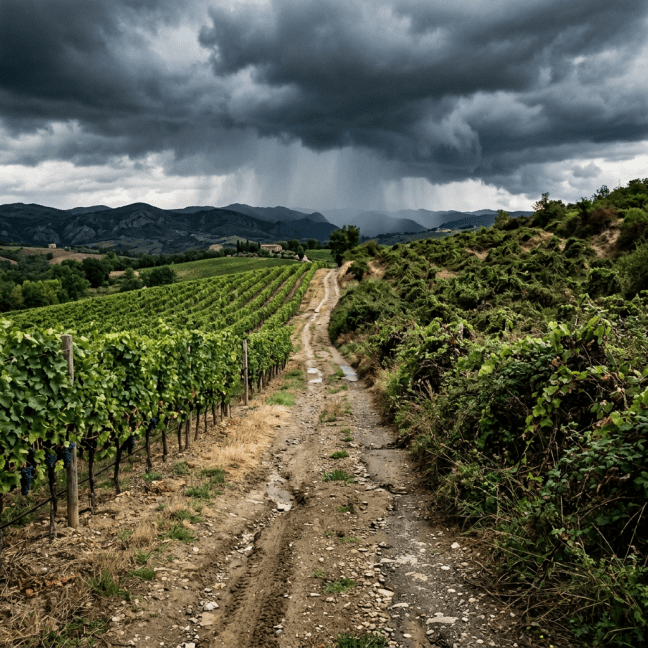
Rain showers over vineyard with grapevines and dirt path under dark stormy clouds

“Now I will sing for the one I love a song about his vineyard: My beloved had a vineyard on a rich and fertile hill. He ploughed the land, cleared its stones, and planted it with the best vines. In the middle, he built a watchtower and carved a winepress in the nearby rocks. Then he waited for a harvest of sweet grapes, but the grapes that grew were bitter.”
Isaiah 5:1-2 NLT

A song about a vineyard. A strange topic for the lyrics? But there have been many stranger ones. People of my vintage might remember the Beatles song, “I Am a Walrus”, which contains the words, “Semolina pilchard climbing up the Eiffel Tower/Elementary penguin singing Hare Krishna”. A good example of piffle, and reminiscent of an age of drug experimentation, hippies, and general nonsense. But Isaiah penned lyrics that describe the establishment of a vineyard. It belonged to the “beloved” who prepared the ground well, removing anything that would get in the way of the growing root systems. The best vines were planted, and all the infrastructure necessary for the functioning of a vineyard, such as the watchtower and the winepress, were put in place. But all to no avail – the fruit was not the intended sweet grapes, but instead, the fruit was bitter and of no use at all. 

What was there about this song that led to its being included in the Bible, in Isaiah’s writings? The first two verses of Isaiah 5 are part of the “Parable of the Vineyard”, a seven-verse story of God’s love for His people and how they spurned and abused His care. It was a lengthy process to create a vineyard from scratch. The correct location had to be found, with soil suitable for the best crops and free of rocks and stones that would prevent vine growth. The locals in Isaiah’s time would have known very well what was required and how long it would take, and the song’s topic was a good example of God’s love for His people. The song describes how, after his beloved had worked hard in preparation and waited for his first harvest, the grapes turned out to be “bitter.” Instead of the sweet grapes used for making wine, the owner discovers that after all the work he has put into his vineyard, the harvest is worthless. 

The next two verses of the parable continue with a question: “Now, you people of Jerusalem and Judah, you judge between me and my vineyard. What more could I have done for my vineyard that I have not already done? When I expected sweet grapes, why did my vineyard give me bitter grapes?” Why, after all of that hard work and preparation, did the fruit turn out to be sour and worthless? What more could have been done? Was it the owner of the vineyard who had done something wrong, or was it the vines, or perhaps the soil? At this point, the listeners were asked for their opinions. But the vineyard owner acted before any response was recorded, taking remedial action by abandoning the vineyard. Walls and hedges were broken down, and the beautifully prepared vineyard would become a wild place of weeds, thorns, and brambles; a dry and dreary place indeed.

But finally, the song’s explanation was given. “The nation of Israel is the vineyard of the Lord of Heaven’s Armies. The people of Judah are his pleasant garden. He expected a crop of justice, but instead he found oppression. He expected to find righteousness, but instead he heard cries of violence” (Isaiah 5:7). The verse is self-explanatory and continues the complaint given in previous chapters. Judah was behaving in a way that was against God’s design, a way in which oppression, injustice, unrighteousness, and sin were prevalent, all characteristics that were the opposite of God’s expectations. The vineyard owner was none other than God Himself, and the beloved was the Lord. The vineyard was Israel and Judah, and the Lord was going to great lengths to ensure the people understood that He established His people as His own. They were His vineyard. His desire for them was that of a grape farmer, that his vines would produce good and useful fruit.

What lesson can we pilgrims draw from this parable, since we were not living in Judah nearly three thousand years ago? Our “vineyard” is well established where God has planted us, and we have a manual of expectations, the Bible, that describes the fruit that He expects. Paul even described the fruit, which can be found in Galatians 5:22-23, “But the Holy Spirit produces this kind of fruit in our lives: love, joy, peace, patience, kindness, goodness, faithfulness, gentleness, and self-control. There is no law against these things!” We would do well to reflect on the “Parable of the Vineyard” and think of our Heavenly Father, who loves us so much, who has done so much for us, and who even sent His Son, Jesus, to ensure that we would one day be in His presence. 

Dear Father God. Thank You for Your care and compassion. Help us to be willing workers in Your vineyard here in our place and generation, that we too would produce the fruit You require. In Jesus’ name. Amen.

Isaiah’s Vision: Hope and Judgment in Jerusalem

“But in that day, the branch of the Lord will be beautiful and glorious; the fruit of the land will be the pride and glory of all who survive in Israel. All who remain in Zion will be a holy people— those who survive the destruction of Jerusalem and are recorded among the living. The Lord will wash the filth from beautiful Zion and cleanse Jerusalem of its bloodstains with the hot breath of fiery judgment. Then the Lord will provide shade for Mount Zion and all who assemble there. He will provide a canopy of cloud during the day and smoke and flaming fire at night, covering the glorious land. It will be a shelter from daytime heat and a hiding place from storms and rain.”
Isaiah 4:2-6 NLT

In his vision, Isaiah could see the day when the Lord would have dealt with the “filth” in Jerusalem by applying “the hot breath of [His] fiery judgement”. He could see a beautiful and glorious city with the survivors, a holy people, washed and cleansed. And the Lord will protect Mount Zion, where Jerusalem was located, with something reminiscent of the flight of the Israelite slaves from Egypt – “a canopy of cloud during the day and smoke and flaming fire at night”.

But what was the “branch of the Lord” that Isaiah could see? Some scholars believe this is a pointer to the coming Messiah, Jesus Himself, the divine descendant of David. There is also mention of the branch in Zechariah 3:8, “Listen to me, O Jeshua the high priest, and all you other priests. You are symbols of things to come. Soon I am going to bring my servant, the Branch.” But is this a prophecy foretelling the First or Second coming of Jesus? Perhaps there is more evidence for the Second, because we have read Revelation and the chapter about the new Jerusalem. However, the picture of a redeemed and holy people, a remnant who have survived the destruction of Jerusalem is an encouragement that God will always bring new shoots of growth as he fulfils His promises to His people. Judgment will ultimately come at the End of the Age, and the “filth [of] beautiful Zion” will be washed away. In the parable of the Wheat and Tares we read, “Let both grow together until the harvest. Then I will tell the harvesters to sort out the weeds, tie them into bundles, and burn them, and to put the wheat in the barn” (Matthew 13:30). Jesus’ parable describes how good and bad people will co-exist until the “harvest”, which is the End of the Age, the day of Judgment. Isaiah also referred to “the fruit of the land”, perhaps an indication of blessing and peace being restored after devastation and judgment. 

Isaiah could see a remnant of God’s people surviving the destruction of Jerusalem. But what about those, the larger group, who will not survive? They are those whom Isaiah spoke out against in the previous chapters. Amongst them were people who “made alliances with pagans”, who practised sorcery, who were involved in idolatry, and who rebelled against God. God views sin very seriously and sooner or later has to deal with it. Judgment is real and will ultimately cleanse His people, but in each generation, a small group of His covenant people remains. Today we are the people, people of the New Covenant, who Peter wrote about in 1 Peter 2:9, “But you are not like that, for you are a chosen people. You are royal priests, a holy nation, God’s very own possession. As a result, you can show others the goodness of God, for he called you out of the darkness into his wonderful light”. 

We notice that Isaiah’s vision did not indicate when the judgment would occur. It was a warning to all those who engaged in sinful behaviour, and many, then as now, refuse to believe that God’s judgment would actually take place. People today live their lives without considering that there will come a time when they will be held to account for their sins. That judgment will occur is without any doubt, because, otherwise, why was it necessary for Jesus to come to this world? He came to provide a remedy for sin so that all who believe in Him will not have to face the terror of judgment. I recently met a man who shared a concern that he needed to move out of London for his retirement, but was at a loss about where to move to. I asked him if he had a faith, and he talked about his Roman Catholic upbringing, but admitted that he rarely gave God any thoughts anymore. I gently reminded him of John 3:16, “For God so loved the world that he gave his one and only Son, that whoever believes in him shall not perish but have eternal life”, after which I talked about sin and the need for salvation in Jesus, as otherwise the only alternative was that he would “perish“. He went away thoughtful, and I pray that the Holy Spirit directs his house move to a place where he will find a Christian community.

Do we pilgrims know someone who needs to hear the same message? After all, there are plenty of opportunities because Jesus said, “ ... The harvest is plentiful, but the workers are few. Ask the Lord of the harvest, therefore, to send out workers into his harvest field” (Luke 10:2). So perhaps we need to brush up on our testimonies and have them ready for the next person we happen to meet.

Dear Father God. Please lead us to the people You want us to share Your wonderful message of hope with. We thank You for Jesus and all He did for us in Jerusalem, two thousand years ago. Amen.

Destitution and Despair

“Instead of fragrance, there will be a stench; instead of a sash, a rope; instead of well-dressed hair, baldness; instead of fine clothing, sackcloth; instead of beauty, branding. Your men will fall by the sword, your warriors in battle. The gates of Zion will lament and mourn; destitute, she will sit on the ground. In that day seven women will take hold of one man and say, ‘We will eat our own food and provide our own clothes; only let us be called by your name. Take away our disgrace!’”
Isaiah 3:24-4:1 NIVUK

Jerusalem and women in despair. The men of Judah killed in battle. Destitution everywhere. Isaiah’s vision was a dire account of what could be the end of Judah, an end that had not yet arrived but was imminent unless the people changed their ways. The people who had so much were going to lose it all. There would be few men left to do the manual work. And the sad situation would arise in which there were so many widows in the land that they had to take drastic steps to assure their future.

The future of a society can never be taken for granted. Yes, all my life I have been fortunate to live in a country without wars or other instability affecting my or my family’s life, and I pray that this will continue for my children and grandchildren and beyond. But it is something neither I nor anyone else can take for granted. With the spectre of another Cold War with Russia emerging on the horizon, perhaps already with us, and the war in Ukraine in its fifth year, with political instability everywhere, the very foundations of our societies in Europe are perhaps under threat. We here in the UK take much for granted, but instead of looking to God, people look to their politicians. And inevitably disappointment will follow.

There was a vast Assyrian army threatening Jerusalem in 701 BC but the king, Hezekiah, declared to the people, “‘Be strong and courageous. Do not be afraid or discouraged because of the king of Assyria and the vast army with him, for there is a greater power with us than with him. With him is only the arm of flesh, but with us is the Lord our God to help us and to fight our battles.’ And the people gained confidence from what Hezekiah the king of Judah said” (2 Chronicles 32:7-8). Soon after, we see what happened to the Assyrians, and things didn’t end well for Sennacherib, the Assyrian king. “And the Lord sent an angel, who annihilated all the fighting men and the commanders and officers in the camp of the Assyrian king. So he withdrew to his own land in disgrace. And when he went into the temple of his god, some of his sons, his own flesh and blood, cut him down with the sword” (2 Chronicles 32:21). Because they turned to God, the Judahites lived, and God resolved the situation. 

The people of Judah and Jerusalem were facing judgement from God because of their sin, rebellion, and idolatry, but they still refused to return to God. Nineveh was faced with the same challenge when Jonah was sent to them with a prophetic message of destruction. Jonah prophesied “ … Forty more days and Nineveh will be overthrown” (Jonah 3:4b). The people responded with a fast, and God relented and did not destroy them. But the people in Judah were stubborn, and those who survived were exiled.

We pilgrims have the benefit of the Bible, showing us, as it does, a limited view of the future. But with the Psalmist David, we declare, “Some trust in chariots and some in horses, but we trust in the name of the Lord our God” (Psalm 20:7). In the First Century AD, there were reportedly many false prophets, and with the spirit of the antichrist present, the Apostle John wrote, “You, dear children, are from God and have overcome them, because the one who is in you is greater than the one who is in the world. They are from the world and therefore speak from the viewpoint of the world, and the world listens to them. We are from God, and whoever knows God listens to us; but whoever is not from God does not listen to us. This is how we recognise the Spirit of truth and the spirit of falsehood” (1 John 4:4-6). Even today, God will help us because His Spirit gives us the strength and direction we need, whatever we are facing.

Dear Heavenly Father. We know that in You are all the resources we need for life in this world. So, please help us to turn from our sins and look to You, as we pray for our nation and our leaders. Soften our hearts, we pray. Amen

The Folly of External Beauty: Lessons from Isaiah 3

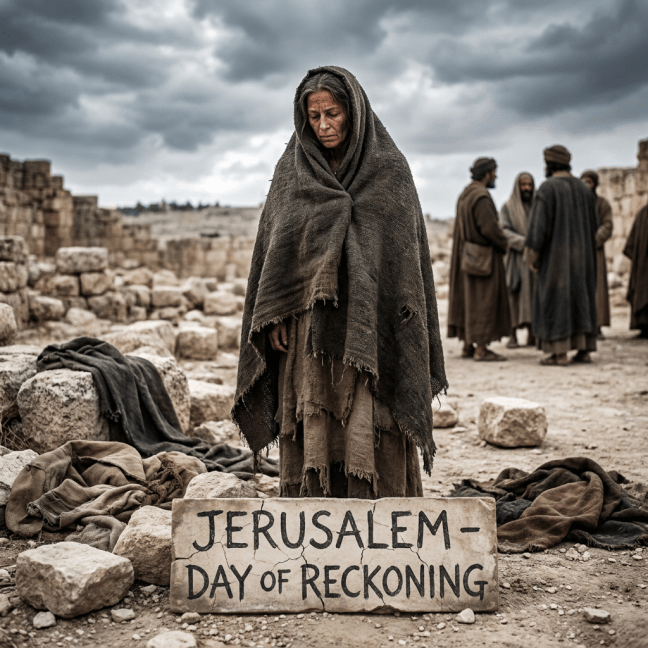
Woman in worn, tattered clothing standing solemnly behind a sign that reads Jerusalem Day of Reckoning

“The Lord says, “Beautiful Zion is haughty: craning her elegant neck, flirting with her eyes, walking with dainty steps, tinkling her ankle bracelets. So the Lord will send scabs on her head; the Lord will make beautiful Zion bald.” On that day of judgment, the Lord will strip away everything that makes her beautiful: ornaments, headbands, crescent necklaces, earrings, bracelets, and veils; scarves, ankle bracelets, sashes, perfumes, and charms; rings, jewels, party clothes, gowns, capes, and purses; mirrors, fine linen garments, head ornaments, and shawls.”
Isaiah 3:16-23 NLT

What was going on in Judah? The previous verses in Isaiah 3 paint a picture of corrupt leadership, oppression of the poor, arrogance, social disorder, and, sadly, spiritual rebellion against God. But now Isaiah turned to the “daughters of Zion”, referring to wealthy and influential women in Jerusalem who reflected the culture’s pride and luxury. In his vision, Isaiah described Zion, Jerusalem, as being like one of the affluent women who resided there, a woman who flirted with her eyes, with a mincing walk just sufficient to bring attention to herself with the tinkling of ankle bracelets, and he went on to describe a long list of their possessions. So the woman could be seen to be wealthy, obsessed with outward appearance, and oozing with excessive luxury. 

But Isaiah continued the next section with “On that day of judgement”. All the woman’s finery would disappear when the Lord stripped everything she owned away. And he related all of this to his beloved Jerusalem, the city on the hill that he loved. So much in Jerusalem was just like this woman, full of luxury and finery, but none of it would survive the judgment of the Lord. 

What was going wrong? The people of Jerusalem had become guilty of the sin of pride, outwardly beautiful but spiritually impure. The warning was that external elegance could not save a society that was morally collapsing. The people were cultivating an image of luxury and pride in its appearance while ignoring justice and holiness. They had forgotten verses like 1 Samuel 16:7, “But the Lord said to Samuel, ‘Don’t judge by his appearance or height, for I have rejected him. The Lord doesn’t see things the way you see them. People judge by outward appearance, but the Lord looks at the heart’”. God doesn’t look at how people present themselves externally. He looks directly into what is in their hearts, what they are thinking and how they view God and the people around them. Jesus warned the people about the Pharisees in a lengthy discourse in Matthew 23. Here is a selection of verses that record what He said, “Everything they do is for show. On their arms they wear extra wide prayer boxes with Scripture verses inside, and they wear robes with extra long tassels. … What sorrow awaits you teachers of religious law and you Pharisees. Hypocrites! For you are so careful to clean the outside of the cup and the dish, but inside you are filthy—full of greed and self-indulgence! … Outwardly you look like righteous people, but inwardly your hearts are filled with hypocrisy and lawlessness” (Matthew 23: 5, 25, 28). 

For Christians, God’s people, today, does that mean we must dress sombrely and even poorly, without jewellery or any other embellishments? In days past, religious groups such as the Puritans dressed in sombre colours with styles designed to be modest and unrevealing, and there is nothing wrong with that unless it becomes an obsession. The Bible never forbade finery, with Rebekah being blessed with “… a gold ring for her nose and two large gold bracelets for her wrists” (Genesis 24:22b). The virtuous woman in Proverbs 31 “… dressed in fine linen and purple gowns” (Proverbs 31:22). And of course, we mustn’t forget Lydia in Acts 16. The issue is when appearance becomes an idol, luxury becomes pride, and wealth blinds people to justice and to God.

Peter wrote, “Don’t be concerned about the outward beauty of fancy hairstyles, expensive jewellery, or beautiful clothes. You should clothe yourselves instead with the beauty that comes from within, the unfading beauty of a gentle and quiet spirit, which is so precious to God” (1 Peter 3:3-4). Isaiah 3 speaks powerfully to modern culture, obsessed as it is with image, status symbols, social media presentation, consumerism and valuing appearance above character. If we pilgrims are caught up in any of this, perhaps we should pause and ask, “What are we really trusting in”? Another question perhaps is “How much energy are we expending in our outward appearance or the way we present ourselves, to the neglect of God and His Kingdom”? For the woman in Jerusalem, Isaiah had a stark reminder that beauty fades, and status could disappear at a stroke. The message to both them and us today is that Godly character lasts forever.

Dear Heavenly Father. A sober reminder today about our relationship with You and how so many worldly and temporal things can get in the way. Please forgive us for our pride and arrogance, and lead us in better ways, we pray. In Jesus’ name. Amen.

The Heavenly Courtroom

“The Lord takes his place in court; he rises to judge the people. The Lord enters into judgment against the elders and leaders of his people: ‘It is you who have ruined my vineyard; the plunder from the poor is in your houses. What do you mean by crushing my people and grinding the faces of the poor?’ declares the Lord, the Lord Almighty.”
Isaiah 3:13-15 NIVUK

A courtroom scene emerges in Isaiah’s vision, and the people are in the dock. Initially, the Lord “enters into judgment against the elders and leaders of His people”. And the indictment includes vineyard ruining, plundering the poor people in the land, “crushing [God’s] people” and “grinding the faces of the poor”. Isaiah’s vision was presented with non-legal, pictorial language, and we have to unpack it to determine what the charges meant for the Judahites.

Firstly, the vineyard referred to God’s people, those who were governed and led by the “elders and leaders”. It has been estimated that there were about 100-120 thousand people in Judah at that time, people mainly involved in various forms of farming, and in Jerusalem, there was a royal administration and religious institution from which the people were governed. But according to Isaiah’s vision, they weren’t doing what they were supposed to do very well at all. In fact, it was worse than that because the vision continued with a reference to plunder. Instead of protecting God’s people from harm, these leaders had become the harm. They were the ones who had devoured the people’s resources. This could mean that they had taken the food from the people as a tax. The shocking statement regarding the “plunder from the poor” meant that the leaders had taken what little the poor people had into their own homes. Instead of protecting the poor, they were using their power to take from those who already had so little to provide for their own households.

The next part of the vision was perhaps inspired by the picture of a mill, grinding grain into flour. The kernels of wheat or some other cereal would have been crushed and ground between large and heavy millstones, and the Lord became indignant, angry even, with His charge that the elders and leaders were doing exactly the same to the people of Judah. We can imagine that Isaiah’s vision would not have been very popular with the higher echelons in Jerusalem!

So what do we pilgrims make of all this? Here in Western societies, there is not the same theocratic or authoritarian form of government that was present in Judah, Israel or most other nations at that time. Even today, there are authoritarian governments subjugating their people, such as in China or North Korea, Iran and elsewhere. Although some limited attempts at democracy emerged early in the 6th Century BC in Greece, modern democracies didn’t appear until the 18th Century. So there is not the same opportunity to suppress people as in the way they were treated in Isaiah’s vision, at least in nations such as the US and UK. But having said that, people in the West are arguably treated unfairly in more subtle ways, through unfair laws and taxation systems. Mostly, these are meant to ensure social cohesion, but they can be applied excessively. 

But the Lord gets angry if a country’s leaders treat their ordinary citizens unfairly. In Romans 13, Paul exhorted the Roman Christians to fully obey the authorities. He wrote, “For the one in authority is God’s servant for your good. But if you do wrong, be afraid, for rulers do not bear the sword for no reason. They are God’s servants, agents of wrath to bring punishment on the wrongdoer” (Romans 13:4). But does that include the same level of obedience to a corrupt leader or government? Are they God’s servants as well? 

As we can see from the courtroom example in our verses today, there will come a day when bad leaders will have to face God’s judgement, and it will be a time of terror that precedes eternal punishment. But that doesn’t let the people off the hook, because they, too, can behave badly and will end up facing God’s judgement. We pilgrims are responsible for the way we treat others, so we put love at the forefront in our interactions with others. Jesus said, “Love the Lord your God with all your heart and with all your soul and with all your mind.” … And the second is like it: ‘Love your neighbour as yourself’” (Matthew 22:37, 39). Who is my neighbour? Well, Jesus answered that question in the parable of the Good Samaritan, as being the person who showed mercy to the man mugged and injured by thieves. Everyone we meet in our daily lives comes into the category of “neighbour”, and we treat everyone with respect and love in a way that shows how God would treat them. Yes, they may look different, dress differently, behave in a different way, and so on, but how does God see them? With love and compassion, and so must we. After all, He sees something that we don’t – what is in people’s hearts.

Dear Heavenly Father. We know that there will be a day of judgement for bad leaders, but we do not concern ourselves with that for now. Please help us to behave in ways in our societies that show Your love and compassion to everyone we meet. In Jesus’ name. Amen.

The Fate of the Godly vs the Wicked: Insights from Isaiah 3

Winding stone path with glowing edges leading through rocky mountains at dusk under stars

Tell the godly that all will be well for them. They will enjoy the rich reward they have earned! But the wicked are doomed, for they will get exactly what they deserve. Childish leaders oppress my people, and women rule over them. O my people, your leaders mislead you; they send you down the wrong road.”
Isaiah 3:10-12 NLT

A gleam of light emerges in Isaiah’s vision, as he sees reassurance for all those who are Godly. There were Godly people living in Judah at that time, but their righteousness was hidden behind the brazen and disgusting sins of the majority of the people. And Isaiah passed on what he received from the Lord, that their Godliness would see them all right in the end. They would one day receive the reward that they deserved. But Isaiah quickly returned to the wicked because they will one day reap what they have deserved as well, and will be doomed to destruction. Notice that everyone in those days, and as is still the case today, will receive “exactly what they deserve”. God is righteous and fair, and no one will ever be able to complain about their treatment on that terrible day when they stand before Him.

Isaiah continued in his vision with two contentious statements. The first condemned the leaders who, God claimed, were childish, and they oppressed God’s people. Childish leaders are often characterised by their reactive, ego-driven and lack of emotional regulation. They may show signs of whining, blaming others, avoiding responsibility, and needing to be the centre of attention. They deflect blame and never take responsibility for their actions. Such were the leaders in Isaiah’s day, but do these characteristics sound familiar when we consider some of our politicians and other leaders today? 

But the next observation from Isaiah’s vision concerned women, and in the context of our verses today, it would seem that women ruling in the Judaean society was not a good thing. This must seem to be a contentious verse in today’s society of equal rights for all, male and female, but in the misogynistic Jewish society, this was a terrible state of affairs. Bible commentators suggest that women had to step up into a leadership role because of the weakness of their male counterparts, and this, of course, might indeed have been the case in Judah nearly three thousand years ago. In a verse from Paul we read, “So a church leader must be a man whose life is above reproach. He must be faithful to his wife. He must exercise self-control, live wisely, and have a good reputation. He must enjoy having guests in his home, and he must be able to teach”. Should leadership in society and in the church just be a male sanctuary today? Perhaps, but this is not an area which is easily decided, regardless of the Scriptures. Today, there are successful women in leadership positions just as there are successful men. But in both cases, there are bad ones as well. 

But returning to the Godly receiving their “rich reward”, do we pilgrims have that assurance, that one day we will indeed hear the Lord say, “Well done …”? Paul wrote, “But on the judgment day, fire will reveal what kind of work each builder has done. The fire will show if a person’s work has any value. If the work survives, that builder will receive a reward” (1 Corinthians 3:13-14). He also wrote, “I press on to reach the end of the race and receive the heavenly prize for which God, through Christ Jesus, is calling us” (Philippians 3:14). Our ultimate reward for a life of belief and trust in Jesus is eternal life, as He promised in John 3:16, “For this is how God loved the world: He gave his one and only Son, so that everyone who believes in him will not perish but have eternal life”. 

In our verses today from Isaiah 3, we read that there is a “But” separating the Godly from the wicked. We pilgrims know which side of the “But” we fall on, and at every opportunity, we try to persuade those around us to make the transition as well.

Father God. Thank You for our salvation and the reward we will one day receive. And we give You all the glory for this wonderful life that You have given us. In Jesus’ name. Amen.

The Consequences of Sin: Lessons from Isaiah and Sodom

“For Jerusalem will stumble, and Judah will fall, because they speak out against the Lord and refuse to obey him. They provoke him to his face. The very look on their faces gives them away. They display their sin like the people of Sodom and don’t even try to hide it. They are doomed! They have brought destruction upon themselves.”
Isaiah 3:8-9 NLT

A very serious accusation appears in Isaiah’s vision. The Judahites are speaking out against the Lord, refusing to obey Him and “[provoking] Him to His face”. And “the very look on their faces gives them away”. Isaiah continues with a reference to the sin of the people of Sodom.

In a conversation with Abraham, we find the Lord confiding in him one of the reasons why He was calling that day. “So the Lord told Abraham, ‘I have heard a great outcry from Sodom and Gomorrah, because their sin is so flagrant. I am going down to see if their actions are as wicked as I have heard. If not, I want to know’” (Genesis 18:20-21). Flagrant sin. Sin so visible as to be abhorrent. No shame. No morality. In Genesis 19:5, we read what the sin of Sodom was: “They shouted to Lot, ‘Where are the men who came to spend the night with you? Bring them out to us so we can have sex with them!’” Was every male in Sodom guilty of that sin? We don’t know for sure, but what we do know is that Abraham had a conversation with the Lord about it, even saying, “Surely you wouldn’t do such a thing, destroying the righteous along with the wicked. Why, you would be treating the righteous and the wicked exactly the same! Surely you wouldn’t do that! Should not the Judge of all the earth do what is right?” (Genesis 18:25). 

Do we pilgrims ever have a conversation with God in that way? It seemed almost irreverential on Abraham’s part to speak to God like that. But we do pray, and we do ask God to change things, and for the better. Some people even pray that God would indeed destroy all the wicked people in the world, a prayer probably rooted in a personal experience of a crime as a victim, or someone looking at the wars started by evil men. But the reality is that there would be no one left in the world if God answered that prayer affirmatively because, as Paul wrote, “For everyone has sinned; we all fall short of God’s glorious standard” (Romans 3:23). God always answers our prayers, but not always in the way we ask him to.

But back in Isaiah’s vision, we find that the Jews are heading, like lemmings, to their destruction. They had forgotten the fate that they were warned about through their ancestors. There were plenty of examples of God’s judgement on those who did wrong. As an example, I’m reminded today of the sin of Achan, who had taken certain items from Jericho, even though he had been expressly forbidden not to do so. We can read the story in Joshua 7. Things didn’t end well for Achan, and he and his family and all their possessions were burnt and ended up under a “great heap of stones”  in a place called the “Valley of Achor”, which means trouble. Sooner or later, God’s judgement will fall on sin.

In the Judahites’ case, and because of their sin, their destruction was coming, because they had “brought destruction upon themselves”. So sad that they had treated God in that way. Do we pilgrims treat the reality of sin positively? Or will we make excuses for ourselves or others, perhaps referring to “white lies” or “boys will be boys”, thereby rationalising the sinful behaviour? Will we think of convoluted reasons for behaving in the ways we do, perhaps deferring remedial action before God until later? The problem with sin is that it creates a barrier between God and us, thereby destroying the relationship we were meant to have with our wonderful Creator. And there is always the ultimate question – will we bring “destruction upon ourselves? Sins are not gradeable, meaning some are less serious than others. That was the trap the Pharisees fell into. Yes, they may not have committed adultery, or committed the sins of Sodom, but did they look lustfully at another man’s wife? (Matthew 5:27f).

But I’m sure we pilgrims know all about this, and we are diligent to maintain short accounts with God, so that our sins never create a barrier to our wonderful God. “He is so rich in kindness and grace that he purchased our freedom with the blood of his Son and forgave our sins. He has showered his kindness on us, along with all wisdom and understanding” (Ephesians 1:7-8). Our forgiveness cost Jesus His life at Calvary. We must never forget that sacrifice He made so that we could spend eternity with Him one day.

Dear Lord Jesus. You died so that we might have life, and life with You forever. Thank You. Amen.

Reviving Moral Leadership in a Troubled Society

“I will make boys their leaders, and toddlers their rulers. People will oppress each other— man against man, neighbour against neighbour. Young people will insult their elders, and vulgar people will sneer at the honourable. In those days a man will say to his brother, “Since you have a coat, you be our leader! Take charge of this heap of ruins!” But he will reply, ‘No! I can’t help. I don’t have any extra food or clothes. Don’t put me in charge!’”
Isaiah 3:4-7 NLT

The verses this morning describe a society that has collapsed into chaos and dysfunction. Boys and toddlers are obviously unsuitable leaders in society but that seems to be the only option left because, as we read in the previous verses, all the competent people had been removed from Judah by the invading armies. When Isaiah wrote this, he could see in a vision what was to come, but history recorded the fact that it actually happened. The Jews ignored his words and ultimately discovered that God spoke truth through His servants. 

There was no social cohesion following the initial exile and no remedy for the crimes of insults and oppression. Faced with no restrictions the true colours of a sinful people started to emerge, with neighbours trying to benefit themselves at the expense of their fellow neighbours. With young people behaving terribly to their elders, and “vulgar people [sneering] at the honourable” amongst them, things were going from bad to worse. The vacuum in leadership was very apparent and people who had even some insignificant and trivial benefit, such as a coat, were promoted as a leader, only to find that they subsequently refused.

But as we read these words today, we see parallels with society today in the UK. Attitudes and beliefs are polarising in a society that contains many different people groups. The cohesion that is present in a God-believing society has all but collapsed in our secular environment, forcing the government to bring in legislation that enables our overstretched police forces to implement moral laws. Hate crimes are now common place and even Christian pastors are being arrested while they preach the Good News about Jesus in public places, all because what they have to say “offends” someone. “Free speech” now seems to be a thing of the past. And our political leaders lack the ability and vision to lead the country through difficult times, putting the “Great” back into “Britain” in the process.

Thankfully, there are still many Christians in the UK who pray for their communities and government faithfully. Churches still hold services. There are Christians amongst our politicians. We pilgrims pray for a Godly society, one in which peace, justice and love prevail. Such a society is committed to God’s values, particularly those that honour the sanctity of life, is fair, and looks after the vulnerable. Justice and reconciliation between different people groups, coupled with just generosity, must be there, but in it all the roots of the society we need is based in God’s Word, the Bible. All we need for society in the way that God planned is there.

So we pilgrims pray. And keep on praying. We refer to our mission, that we are here “for such a time as this” (Esther 4:14). Jesus said early on in His Sermon on the Mount, “You are the salt of the earth. But what good is salt if it has lost its flavor? Can you make it salty again? It will be thrown out and trampled underfoot as worthless. You are the light of the world—like a city on a hilltop that cannot be hidden. No one lights a lamp and then puts it under a basket. Instead, a lamp is placed on a stand, where it gives light to everyone in the house. In the same way, let your good deeds shine out for all to see, so that everyone will praise your Heavenly Father” (Matthew 5:13-16).

But before we go on a rant about how bad our government is, we note what Paul’s wrote in Romans 13. “Everyone must submit to governing authorities. For all authority comes from God, and those in positions of authority have been placed there by God” (Romans 13:1). A little further down the page, Paul wrote something else that is a bit contentious, “Pay your taxes, too, for these same reasons. For government workers need to be paid. They are serving God in what they do” (Romans 13:6). We do not have to take matters into our own hands and rebel in some way, because there will be a time when our leaders and tax authorities will be called into account before God’s throne. God will bless us when, or if, we are badly treated by the authorities, because the treasure that matters is being stored up for us in Heaven.

So we pilgrims pray, and keep praying, for our leaders and anyone else in authorities, because that is must what we do as “salt and light” in our society. We are the “glue” that bonds our dysfunctional society and aligns us with God’s will and purposes for our world.

Dear Heavenly Father. Please help us to be Your witnesses in the places where we live, leading us and guiding us as You desire. Amen.

The Perils of Turning Away from God: Insights from Isaiah

“The Lord, the Lord of Heaven’s Armies, will take away from Jerusalem and Judah everything they depend on: every bit of bread and every drop of water, all their heroes and soldiers, judges and prophets, fortune-tellers and elders, army officers and high officials, advisers, skilled sorcerers, and astrologers.”
Isaiah 3:1-3 NLT

Isaiah starts chapter 3 with a stark outline of what is going to happen when the Judaites would be exiled. The basics of life would go first, bread and water, and then followed by all the people they consider to be important. But notice that this list includes two categories of people that were expressly forbidden to be amongst the Jews – “skilled sorcerers and astrologers”. Deuteronomy 18: 10b-11, 14): “… And do not let your people practice fortune-telling, or use sorcery, or interpret omens, or engage in witchcraft, or cast spells, or function as mediums or psychics, or call forth the spirits of the dead. … The nations you are about to displace consult sorcerers and fortune-tellers, but the Lord your God forbids you to do such things”. Astrology is a form of divination and can be found today in horoscopes and among those who suggest that the alignment of stars and planets has some spiritual meaning. Astrologers were commonplace in Old Testament writings, and frequently mentioned such as in Daniel 2:1-2, “One night during the second year of his reign, Nebuchadnezzar had such disturbing dreams that he couldn’t sleep. He called in his magicians, enchanters, sorcerers, and astrologers, and he demanded that they tell him what he had dreamed …” Of course, they couldn’t help the king, but Daniel could through his relationship with God, as we read the following verses. It was a sad state of affairs that the Judaites had come to depend on the quacks and frauds, rather than turn to the One who was their Source.

What can we pilgrims learn from these verses today? I suppose the first thing is that human structures are not infallible or inviolable. Security and well-being that are sought after outside of God and His ways are temporary and precarious. It’s all about the dangers of coming outside His protection, because as we do things God’s way, His favour will be assured. 

Another thing is that God removed all the structures that supported the Judaean society. The good disappeared along with the bad. Not all the “judges and prophets” were corrupt, and the good people could not survive in a corrupt society on their own when it collapsed. This highlights that when a nation turns from God, its economic, political, and cultural supports crumble simultaneously.

The judgment by exile that was coming was a direct consequence of the people’s rebellion, oppression of the poor, and arrogance. It served as a stark reminder that collective unfaithfulness degrades the very systems that allow a culture to thrive. By actively stripping Judah of its societal pillars, God demonstrated His control over nations and history. The ultimate lesson was a call for humility, urging people to depend on God rather than fallible human systems.

So, it is all the more important that we pilgrims are salt and light in our society. By being so, we hold back God’s judgement in this season of His grace. And we pray. In Paul’s first letter to Timothy, we read, “I urge you, first of all, to pray for all people. Ask God to help them; intercede on their behalf, and give thanks for them. Pray this way for kings and all who are in authority so that we can live peaceful and quiet lives marked by godliness and dignity. This is good and pleases God our Saviour, who wants everyone to be saved and to understand the truth” (1 Timothy 2:1-4). I know that, at times, we despair of our leaders rather than feel inclined to pray for them, but pray we must, because prayer changes things. There is much to pray for, as our leaders embark on Godless legislation, but we must persevere.

Father God. We pray today for our leaders, all who are in our governments and councils. Please help them legislate righteously so that we will continue to live in Your favour. In Jesus’ name. Amen.