Finding Refuge: Overcoming Pride in Times of Trouble

“Send lambs from Sela as tribute to the ruler of the land. Send them through the desert to the mountain of beautiful Zion. The women of Moab are left like homeless birds at the shallow crossings of the Arnon River. “Help us,” they cry. “Defend us against our enemies. Protect us from their relentless attack. Do not betray us now that we have escaped. Let our refugees stay among you. Hide them from our enemies until the terror is past.” When oppression and destruction have ended and enemy raiders have disappeared, then God will establish one of David’s descendants as king. He will rule with mercy and truth. He will always do what is just and be eager to do what is right. We have heard about proud Moab—about its pride, arrogance, and rage. But all that boasting has disappeared.”
Isaiah 16:1-6 NLT

Isaiah chapters 15 and 16 paint a heartbreaking picture. Moab is devastated. Cities have been destroyed, people are weeping, refugees are fleeing, and families are desperately searching for safety. Throughout Isaiah 15 we repeatedly hear the language of grief, with mentions of weeping, crying, faint hearts and more.  It is a picture of people who have discovered that everything they trusted will be taken away. Yet amid this terrible situation, there appears to be an opportunity for refuge. Moab is encouraged to turn towards Zion. But there is a problem. Pride. In our verses today we read, “We have heard about proud Moab—about its pride and arrogance and rage”. Moab desperately needed help, but pride stood in its way.

There is an important spiritual lesson here for us pilgrims. Sometimes the greatest barrier between ourselves and the help that God can supply is not our weakness. It is our pride, and in it we say that we can manage, that we don’t need help from anyone. We say that we will sort this or that particular problem ourselves, and anyway, if all else fails, we will then turn to God. But faith says something very different: it tells the Lord that we need Him. However, we know that God offers us a place of refuge. Psalm 46:1, “God is our refuge and strength, always ready to help in times of trouble”. Matthew 11:28-30 NLT, “Then Jesus said, “Come to me, all of you who are weary and carry heavy burdens, and I will give you rest. Take my yoke upon you. Let me teach you, because I am humble and gentle at heart, and you will find rest for your souls. For my yoke is easy to bear, and the burden I give you is light””. But to come to Christ we must first admit that we need Him. We cannot receive grace while insisting that we are self-sufficient. We cannot find refuge while refusing to admit that we need shelter. We cannot experience the strength of God while pretending that we are strong enough on our own. The tragedy of Moab is that help was available, but pride stood in the way.

Perhaps today God is reminding us that we do not have to carry everything ourselves. We can come to Him, admitting our weaknesses, confessing our needs, and, of course, laying down our pride. And when we do, we discover that God is not waiting to condemn the humble heart. He is waiting to become our refuge. James wrote, “And he gives grace generously. As the Scriptures say, “God opposes the proud but gives grace to the humble.” So humble yourselves before God. Resist the devil, and he will flee from you. … Humble yourselves before the Lord, and he will lift you up in honour” (James 4:6-7, 10). 

Isaiah 16:4-5 reads, “Let our refugees stay among you. Hide them from our enemies until the terror is past. When oppression and destruction have ended and enemy raiders have disappeared, then God will establish one of David’s descendants as king. He will rule with mercy and truth. He will always do what is just and be eager to do what is right”. We pilgrims remember that, in all the mayhem of this turbulent time in history, Someone was coming to establish a Kingdom of mercy and truth, justice and righteousness. His name was, and is, Jesus, our wonderful Saviour. Unlike the Maobites, who had yet to experience the coming King, we know Him from His brief time on this earth. He came as a baby, subsequently living a life of austerity, but His love and compassion were limitless, and through the testimonies of His faithful disciples, we stand before Him, loved, saved and forgiven. We know Him. And we wait for His return, to complete the promise given so many years ago to a people suffering under foreign occupation. 

God is indeed “our refuge and strength”, but is our pride getting in the way? Are we preventing ourselves from entering into the refuge of rest that He promised? In all humility, we bow before Him today, confessing our pride and arrogance, and asking for forgiveness. Are we pilgrims facing into difficulties today, for which God has a solution, if only we would put aside our pride and embrace His provision?

Dear Lord, forgive us for the times when pride prevents us from admitting how much we need You. Help us to stop trusting in our own strengths and abilities. Teach us to come humbly into Your presence and to find our refuge, strength and security in You. Thank You that when we come to You, we know that we will never be turned away. Amen.

Lucifer and Babylon: A Study of Rebellion Against God

Bright meteor streaking across night sky over mountain valley with setting sun

“In that wonderful day when the Lord gives his people rest from sorrow and fear, from slavery and chains, you will taunt the king of Babylon. You will say, “The mighty man has been destroyed. Yes, your insolence is ended. 
“How you are fallen from heaven, O shining star, son of the morning! You have been thrown down to the earth, you who destroyed the nations of the world. For you said to yourself, ‘I will ascend to heaven and set my throne above God’s stars. I will preside on the mountain of the gods far away in the north. I will climb to the highest heavens and be like the Most High.’ Instead, you will be brought down to the place of the dead, down to its lowest depths.”
Isaiah 14:3-4, 12-15 NLT

The verses between 8 and 12 of Isaiah 14 describe the arrival of the king of Babylon in the place of the dead, where he is greeted by “the spirits of world leaders and mighty kings long dead”. There, in the place of the dead, the king will find “maggots are your sheet and worms your blanket”, a graphic illustration describing life for a spirit in hell. Jesus Himself was horrified by the thought of hell, “where the maggots never die, and the fire never goes out” (Mark 9:48), a quotation from Isaiah 66:24. 

But then we read Isaiah 14:12, “How you are fallen from heaven, O shining star, son of the morning!” This has two meanings: the first is that it refers to the king of Babylon, who represented the whole nation of Assyria. Through his pride and arrogance, he even dared to make statements and claims such as “I will ascend to Heaven” and “I will … be like the Most High”. Can we ever believe such arrogance? But the king of Babylon was not unique, making claims no one else did. Throughout Scripture, we notice that Babylon became more than merely an ancient city or empire. “Babylon” increasingly represents organised human pride and rebellion against God. It started, as we know, with the Tower of Babel, in Genesis 11:4, where we read, “Then they said, ‘Come, let us build ourselves a city, with a tower that reaches to the heavens, so that we may make a name for ourselves; otherwise we will be scattered over the face of the whole earth’”. “Make a name for ourselves” in the context of tower building was the first tentative steps in the development of human pride. The association of the names “Babel” and “Babylon” is significant.

So we read the natural progression of pride and arrogance with the king of Babylon, buoyed by his battlefield successes and the expansion of his empire, thought he was unstoppable, even to the extent of claiming “I will … be like the Most High”. However, this was the end of his ascent into high places, because, in Isaiah’s prophecy, the Lord said, “Instead, you will be brought down to the place of the dead, down to its lowest depths”. The end of the king of Babylon, consigned to hell and association with maggots and worms, followed.

The second meaning of Isaiah 14:12 can be found in the NKJV version, “How you are fallen from heaven, O Lucifer, son of the morning! How you are cut down to the ground, You who weakened the nations!” This name, derived from the original Hebrew, means “morning star” or “light bearer” and has been associated with Satan, of whom we read more in Ezekiel 28. The same spirit of self-exaltation and rebellion that was behind the devil was behind the king of Babylon and has been behind many world rulers and others ever since. 

The final fate of “Babylon” and everything associated with it can be found in Revelation 18:1-2, “After all this, I saw another angel come down from heaven with great authority, and the earth grew bright with his splendour. He gave a mighty shout: “Babylon is fallen—that great city is fallen!. Reading on in Revelation 18 provides a fascinating account of the demise of the world system, the very end of capitalism and all the excesses and problems that it has brought. 

From one end of the Bible to the other, we see the sin of man demonstrated. The claim “we will make a name for ourselves” in Genesis 11, the arrogance of “I will … be like the Most High” in Isaiah 14, and the Fall of Babylon in Revelation 18. We pilgrims, in the End Times, may yet see the fruition of these Biblical events and prophecies.

But can we pilgrims glean any principles and helpful thoughts from our verses today. One thing that dominates human sin is two simple words – “I will”. So much of what we do is dominated by these two words, and there was even a popular song, “I’ll do it my way”, written about them. But the challenge for pilgrims everywhere lies in the Lord’s Prayer – “Your will be done”. Which of these two phrases, “I will” or “Your will be done”, sums up our lives? A question to take with us as we go about our daily lives.

Dear Father God. We earnestly pray, “Your will be done” before You say to each one of us, “your will be done”, with all the consequences that it will bring for our lives after we cross the Great Divide. Please help us turn our eyes to You, the One who hates pride and arrogance, when we are tempted to go our own ways. In Jesus’ name. Amen.

Falling Trees

“Look, the Assyrians are now at Aiath. They are passing through Migron and are storing their equipment at Micmash. They are crossing the pass and are camping at Geba. Fear strikes the town of Ramah. All the people of Gibeah, the hometown of Saul, are running for their lives. Scream in terror, you people of Gallim! Shout out a warning to Laishah. Oh, poor Anathoth! There go the people of Madmenah, all fleeing. The citizens of Gebim are trying to hide. The enemy stops at Nob for the rest of that day. He shakes his fist at beautiful Mount Zion, the mountain of Jerusalem. But look! The Lord, the Lord of Heaven’s Armies, will chop down the mighty tree of Assyria with great power! He will cut down the proud. That lofty tree will be brought down. He will cut down the forest trees with an axe. Lebanon will fall to the Mighty One.”
Isaiah 10:28-34 NLT

Just reading these verses provides a glimpse of the horror that was to come in the form of the Assyrian army. Isaiah’s prophecy uses words such as “fear”, “running for their lives”, and “Scream in terror”. Pity for Anathoth emerges. The people of Madmenah are fleeing. People are trying to hide. And the enemy will come close enough to Jerusalem to threaten it. I had a picture in my mind this morning of a map set out on a table, and then a bottle of ink was spilt on one edge. Slowly, but surely, the ink started to creep over the map and finally blotted it out. The cartographic features were hidden under a layer of ink, to be seen no more. In Judah, the people would disappear. Towns pillaged and destroyed. People removed into exile, those who escaped the sword. What a scene of devastation was filling Isaiah’s mind. 

The enemy of the Jewish people, the Assyrians, were seemingly unstoppable, but isn’t that like our enemy, the devil? When he is on the attack, nothing seems to stop him. The cancer spreads despite the treatment. No matter how hard we try, a difficult relationship seems unhealable. Despite active lobbying, the government enacts another unjust and anti-God law. Our prayers go unanswered. Darkness gets darker. Depression gets worse. But just when everything seems unbearable, and we look around for somewhere to hide, we find that the enemy is cut down, just like the “mighty tree of Assyria”. God intervenes at precisely the right moment. Not too early. Not too late. Exactly on time.

I am reminded of another occasion when God intervened to save His people. There, by the side of the Red Sea, the Israelites had set up camp. But, “The Egyptians chased after them with all the forces in Pharaoh’s army—all his horses and chariots, his charioteers, and his troops. The Egyptians caught up with the people of Israel as they were camped beside the shore near Pi-hahiroth, across from Baal-zephon” (Exodus 14:9). The Israelites shouted out in panic and started grumbling and complaining to Moses, “But Moses told the people, “Don’t be afraid. Just stand still and watch the Lord rescue you today. The Egyptians you see today will never be seen again. The Lord himself will fight for you. Just stay calm”” (Exodus 14:13-14). As we read the following verses, we can see the amazing miracle that took place and how the Egyptian army was destroyed. 

But back in Isaiah 10, we see how God changed the narrative. The previously strong and mighty Assyria is chopped down “with great power”. Assyria believed itself unstoppable, but God saw them as trees ready for the axe. The King of Assyria boasted, “By my own powerful arm I have done this. With my own shrewd wisdom, I planned it. I have broken down the defences of nations and carried off their treasures. I have knocked down their kings like a bull” (Isaiah 10:13). Pride always precedes downfall, and the tallest trees often fall the hardest.

In a personal sense, we pilgrims need to watch out for an upsurge of pride in our lives. Perhaps we are overly self-sufficient, or finding success in something we are doing. Perhaps we are involved in a church ministry, and feelings of pride are starting to emerge. Perhaps we have managed to purchase a new car, and pride in its shiny paintwork is bubbling up inside us. But with care and concern, we turn to James 4:6-7, “And he gives grace generously. As the Scriptures say, “God opposes the proud but gives grace to the humble.” So humble yourselves before God. Resist the devil, and he will flee from you”

There is something else that we need to take note of from this passage of Scripture today. That is the reference in verse 33 to “The Lord, the Lord of Heaven’s Armies”. Assyria had an army that was more powerful than any other in the region. They were unstoppable, cruel, and terrifying.  Whatever we pilgrims are facing might seem terrifying in its extent, but the God we worship is far more powerful than any power on earth. What seems overwhelming to us is tiny before Him. His resources are limitless. God is never outnumbered. He never loses control.

There is something in these closing verses in Isaiah 10 that is helpful for us pilgrims. When fear rises and circumstances seem overwhelming, God reminds His people that He knows every movement of the enemy, limits every season of suffering, breaks every yoke, humbles every proud power, and arrives at exactly the right moment to save. So, what “Assyria” are we facing into today? Do we need Christ to lift off of us a burden we are struggling to carry? Where are we putting our trust – in our resources or God’s? And the painful bit – is there any pride within us that God wants to cut away, like the Assyrian tree, so that what remains can grow into something new? The thought of cutting away reminds us of John 15:2, “He cuts off every branch of mine that doesn’t produce fruit, and he prunes the branches that do bear fruit so they will produce even more“. Although painful at the time, the Master Gardener’s pruning can only benefit us in the long term. Isaiah 10 closes with the crash of falling trees, but our Heavenly Father isn’t out to destroy us when we need His help. He wants to strengthen us, not tear us down.

Dear Father God. Thank You for Your loving kindness and help in times of trouble. We praise You today. Amen.

The God of Righteousness and Justice

“What sorrow awaits Assyria, the rod of my anger. I use it as a club to express my anger. I am sending Assyria against a godless nation, against a people with whom I am angry. Assyria will plunder them, trampling them like dirt beneath its feet. But the king of Assyria will not understand that he is my tool; his mind does not work that way. His plan is simply to destroy, to cut down nation after nation. 
After the Lord has used the king of Assyria to accomplish his purposes on Mount Zion and in Jerusalem, he will turn against the king of Assyria and punish him, for he is proud and arrogant.”
Isaiah 10:5-7, 12 NLT

Isaiah’s prophecy moves on from detailing the woes that will strike a proud and arrogant Israel, an Israel that practised idolatry and was governed by corrupt and unjust leaders, and an Israel that seemed ignorant of how the extent of their wickedness was going to lead to a terrible judgement by a nation so much stronger than theirs. There are several places detailed in the Bible where God uses an unbelieving king and nation to either punish or bless His people. In the verses today, we see Assyria, a cruel and strong nation that terrified the nations that it trampled on in its quest for military domination, being used by God to punish His recalcitrant and wicked people. But Isaiah’s message fell on deaf ears because he was saying things that were widely unpopular and, in any case, we remember what God said to the prophet in Isaiah 6:9-10, “And He said, “Yes, go, and say to this people, ‘Listen carefully, but do not understand. Watch closely, but learn nothing.’ Harden the hearts of these people. Plug their ears and shut their eyes. That way, they will not see with their eyes, nor hear with their ears, nor understand with their hearts and turn to me for healing””. As today, an unpopular message that people don’t want to hear will be ignored until they are brought face-to-face with the reality that they have rejected. In Israel’s case, perhaps they rationalised that God would never treat His people in such a way. Today, unbelievers dismiss the warnings that unless they repent of their sin and turn to God, He will reject them and they will end up in hell, because they say that, even if God exists, He would never do that. After all, He is a God of love, they say, forgetting or ignoring the fact that He is also a God of righteousness and judgment. 

Then there was a king called Cyrus, whom Isaiah prophesied about over a hundred years before he was born. Isaiah 44:28, “When I say of Cyrus, ‘He is my shepherd,’ he will certainly do as I say. He will command, ‘Rebuild Jerusalem’; he will say, ‘Restore the Temple’”. In the next verse, God even referred to Cyrus as His anointed one, a rare title for a heathen king. And we can read the fruition of the prophecy in the last verse of 2 Chronicles, “This is what King Cyrus of Persia says: ‘The Lord, the God of heaven, has given me all the kingdoms of the earth. He has appointed me to build him a Temple at Jerusalem, which is in Judah. Any of you who are his people may go there for this task. And may the Lord your God be with you!’

People in Israel forgot that God was all-powerful and had put in place a Covenant that had blessings but also curses. They liked the blessings bit but ignored the curses, although they would soon face the reality of them. God was very much on His throne and was about to use the Assyrians to punish His disobedient and wicked people.

What can we pilgrims learn from these verses today? The same thing that the Israelites had forgotten, or conveniently ignored. God is on His throne. He is not sleeping, as the Psalmist implied in Psalm 44:23, “Wake up, O Lord! Why do you sleep? Get up! Do not reject us forever”. We know from Psalm 145 that God’s anger is slow to be raised: “The Lord is merciful and compassionate, slow to get angry and filled with unfailing love” (Psalm 145:8). In our times, we also know that God is being very patient: “The Lord isn’t really being slow about his promise, as some people think. No, he is being patient for your sake. He does not want anyone to be destroyed, but wants everyone to repent” (2 Peter 3:9). One thing that I’m sure we fail to understand or appreciate is how much God is holding back the forces of evil in our times. Yes, we have concerns about international politics and the wars that can affect us so badly, but they could be much worse. As was the case with the Israelites, there is a tendency to be complacent and maintain that God would never allow the destruction of our nation.

And so, we pilgrims must pray for our government and those ruling our country. We must also pray for organisations such as the Christian Institute and Christian Concern, which are so active in lobbying for righteousness in the corridors of power. We must never forget that our God is never sleeping and that He is always prepared to listen to our prayers. As we give Him our concerns and anxieties, His peace is always available and will flood over us in our times of need.

Dear Heavenly Father. Thank You for Your love and compassion. We thank You for keeping us safe in these troubled times, and we pray for our government and political leaders, that You will lead and guide them as they lead our country. In Jesus’ name. Amen.

The Danger of Pride: Lessons from Isaiah 9

“The Lord has sent a message against Jacob; it will fall on Israel. All the people will know it – Ephraim and the inhabitants of Samaria – who say with pride and arrogance of heart, ‘The bricks have fallen down, but we will rebuild with dressed stone; the fig-trees have been felled, but we will replace them with cedars.’ But the Lord has strengthened Rezin’s foes against them and has spurred their enemies on. Arameans from the east and Philistines from the west have devoured Israel with open mouth. Yet for all this, his anger is not turned away, his hand is still upraised.”
Isaiah 9:8-12 NIVUK

Isaiah sharply switches from the wonder of the coming “great light”, the One who will “reign on David’s throne” forever, to a warning against Israel, the ten Northern tribes. And the message makes grim reading. Isaiah lived in Jerusalem and mostly prophesied to the kings and people of Judah, which comprised the remaining two tribes of the Jewish nation. But occasionally, he had a word for those in the North. Straight away, he put his finger on their problem – “pride and arrogance of heart”. The references to Ephraim and Samaria refer to the people and their centre of political power. 

The city of Samaria was a source of pride for the Israelites, and they had built it up, so they thought, by their own efforts. And so they reasoned that, should it be destroyed, they would rebuild it even better. Their own efforts would be sufficient, so they thought. But how did they reach this mindset, with the Assyrians building up their forces on their borders? What was it in their logical thought processes that made them think that if they were attacked, then they would just recover through their own efforts? That’s arrogance. “We did it before, so next time it won’t take so long” was perhaps their motto. 

The Israelites had obviously forgotten the proverb, “Pride goes before destruction, and haughtiness before a fall” (Proverbs 16:18), or another one, “Before disaster the heart of a man is haughty and filled with self-importance, but humility comes before honour” (Proverbs 18:12). In Daniel 4, we can read what happened to King Nebuchadnezzar. He had a dream that Daniel interpreted for him, and it ended, “You will be driven from human society, and you will live in the fields with the wild animals. You will eat grass like a cow, and you will be drenched with the dew of heaven. Seven periods of time will pass while you live this way, until you learn that the Most High rules over the kingdoms of the world and gives them to anyone he chooses” (Daniel 4:25). It was a year later that his pride and arrogance showed up, and Daniel’s prophecy came true. Daniel 4:30, “As he looked out across the city, he said, ‘Look at this great city of Babylon! By my own mighty power, I have built this beautiful city as my royal residence to display my majestic splendour’”. The next verse delivered God’s judgment, “While these words were still in his mouth, a voice called down from heaven, ‘O King Nebuchadnezzar, this message is for you! You are no longer ruler of this kingdom’”, and off he went to eat grass for seven years and until he “honoured the One who lives forever”.

But this wasn’t just an Old Testament problem. Jesus said, “But those who exalt themselves will be humbled, and those who humble themselves will be exalted” (Matthew 23:12). About Jesus, Paul wrote, “Though he was God, he did not think of equality with God as something to cling to. Instead, he gave up his divine privileges; he took the humble position of a slave and was born as a human being. When he appeared in human form, he humbled himself in obedience to God and died a criminal’s death on a cross” (Philippians 2:6-8). In the preceding verse, Paul wrote, “You must have the same attitude that Christ Jesus had“, and that really sums up all that was wrong with the Israelites. The only had an attitude of pride and arrogance, and this ultimately led to their destruction.

But we pilgrims need to be careful. It is so easy to slip into the same mindset as the Israelites, adopting an attitude of pride and arrogance. Perhaps things are going well for us, and we forget that it will be God showing us His favour, not our efforts producing good results. We must always keep close to God, thanking Him for being with us, for keeping us safe when we could so easily lapse into danger, for helping us when we run out of ideas, and for giving us His Spirit to lead and guide us through the minefields of life.

Dear Heavenly Father. Thank You for Your grace and favour, and for always being with us each and every day. Amen.


‭‭

The Folly of External Beauty: Lessons from Isaiah 3

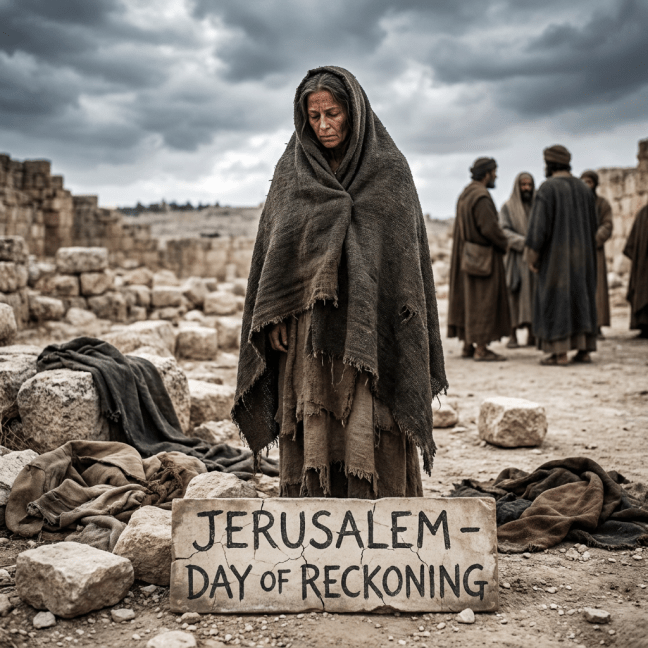
Woman in worn, tattered clothing standing solemnly behind a sign that reads Jerusalem Day of Reckoning

The Lord says, “Beautiful Zion is haughty: craning her elegant neck, flirting with her eyes, walking with dainty steps, tinkling her ankle bracelets. So the Lord will send scabs on her head; the Lord will make beautiful Zion bald.” On that day of judgment, the Lord will strip away everything that makes her beautiful: ornaments, headbands, crescent necklaces, earrings, bracelets, and veils; scarves, ankle bracelets, sashes, perfumes, and charms; rings, jewels, party clothes, gowns, capes, and purses; mirrors, fine linen garments, head ornaments, and shawls.”
Isaiah 3:16-23 NLT

What was going on in Judah? The previous verses in Isaiah 3 paint a picture of corrupt leadership, oppression of the poor, arrogance, social disorder, and, sadly, spiritual rebellion against God. But now Isaiah turned to the “daughters of Zion”, referring to wealthy and influential women in Jerusalem who reflected the culture’s pride and luxury. In his vision, Isaiah described Zion, Jerusalem, as being like one of the affluent women who resided there, a woman who flirted with her eyes, with a mincing walk just sufficient to bring attention to herself with the tinkling of ankle bracelets, and he went on to describe a long list of their possessions. So the woman could be seen to be wealthy, obsessed with outward appearance, and oozing with excessive luxury. 

But Isaiah continued the next section with “On that day of judgement”. All the woman’s finery would disappear when the Lord stripped everything she owned away. And he related all of this to his beloved Jerusalem, the city on the hill that he loved. So much in Jerusalem was just like this woman, full of luxury and finery, but none of it would survive the judgment of the Lord. 

What was going wrong? The people of Jerusalem had become guilty of the sin of pride, outwardly beautiful but spiritually impure. The warning was that external elegance could not save a society that was morally collapsing. The people were cultivating an image of luxury and pride in its appearance while ignoring justice and holiness. They had forgotten verses like 1 Samuel 16:7, “But the Lord said to Samuel, ‘Don’t judge by his appearance or height, for I have rejected him. The Lord doesn’t see things the way you see them. People judge by outward appearance, but the Lord looks at the heart’”. God doesn’t look at how people present themselves externally. He looks directly into what is in their hearts, what they are thinking and how they view God and the people around them. Jesus warned the people about the Pharisees in a lengthy discourse in Matthew 23. Here is a selection of verses that record what He said, “Everything they do is for show. On their arms they wear extra wide prayer boxes with Scripture verses inside, and they wear robes with extra long tassels. … What sorrow awaits you teachers of religious law and you Pharisees. Hypocrites! For you are so careful to clean the outside of the cup and the dish, but inside you are filthy—full of greed and self-indulgence! … Outwardly you look like righteous people, but inwardly your hearts are filled with hypocrisy and lawlessness” (Matthew 23: 5, 25, 28). 

For Christians, God’s people, today, does that mean we must dress sombrely and even poorly, without jewellery or any other embellishments? In days past, religious groups such as the Puritans dressed in sombre colours with styles designed to be modest and unrevealing, and there is nothing wrong with that unless it becomes an obsession. The Bible never forbade finery, with Rebekah being blessed with “… a gold ring for her nose and two large gold bracelets for her wrists” (Genesis 24:22b). The virtuous woman in Proverbs 31 “… dressed in fine linen and purple gowns” (Proverbs 31:22). And of course, we mustn’t forget Lydia in Acts 16. The issue is when appearance becomes an idol, luxury becomes pride, and wealth blinds people to justice and to God.

Peter wrote, “Don’t be concerned about the outward beauty of fancy hairstyles, expensive jewellery, or beautiful clothes. You should clothe yourselves instead with the beauty that comes from within, the unfading beauty of a gentle and quiet spirit, which is so precious to God” (1 Peter 3:3-4). Isaiah 3 speaks powerfully to modern culture, obsessed as it is with image, status symbols, social media presentation, consumerism and valuing appearance above character. If we pilgrims are caught up in any of this, perhaps we should pause and ask, “What are we really trusting in”? Another question perhaps is “How much energy are we expending in our outward appearance or the way we present ourselves, to the neglect of God and His Kingdom”? For the woman in Jerusalem, Isaiah had a stark reminder that beauty fades, and status could disappear at a stroke. The message to both them and us today is that Godly character lasts forever.

Dear Heavenly Father. A sober reminder today about our relationship with You and how so many worldly and temporal things can get in the way. Please forgive us for our pride and arrogance, and lead us in better ways, we pray. In Jesus’ name. Amen.

Understanding Godly Sorrow: Path to Healing and Salvation

“For the kind of sorrow God wants us to experience leads us away from sin and results in salvation. There’s no regret for that kind of sorrow. But worldly sorrow, which lacks repentance, results in spiritual death. Just see what this godly sorrow produced in you! Such earnestness, such concern to clear yourselves, such indignation, such alarm, such longing to see me, such zeal, and such a readiness to punish wrong. You showed that you have done everything necessary to make things right.”
2 Corinthians 7:10-11 NLT

Continuing with Paul’s theme of Godly sorrow, we look at the impact Paul’s first letter had made in the lives of the Corinthian believers. If we remember, it was quite hard-hitting, revealing issues that needed courage to expose. But then, some things are better delivered remotely, as in a letter. Paul must have been sure of a positive reception when he wrote the things that he did, because otherwise it might have done more harm than good. In the end, Paul must have received a positive response because he wrote, “Now I am glad I sent it, not because it hurt you, but because the pain caused you to repent and change your ways. It was the kind of sorrow God wants his people to have, so you were not harmed by us in any way” (2 Corinthians 7:9). A bit further down in this chapter, we see that it was probably Titus who delivered the letter and then he stayed awhile, probably explaining and helping with the issues Paul had raised.

The first letter caused a sorrowful reaction in Corinth, but it was a Godly sorrow that “leads … away from sin and results in salvation”. And the positive result was to make everything right, and Paul listed some of the actions and emotions that emerged as the exhortations contained in the letter were applied in the church. Paul was assured that they had done everything necessary. 

We pilgrims come across situations in our lives where things need to be put right. It is not uncommon for a family falling out, usually over something trivial, to lead to a lifetime of estrangement and no further contact. In my family, many years ago, there were four siblings, a brother and three sisters, who had a row over wedding invitations. Now, nearly forty years later, they have all died, and they made no attempt to put things right. The brother never spoke to his sisters again, and he died a bitter man. But such an event is not unusual in families; friends can be chosen, but siblings and cousins cannot, leading to much grace and determination to resolve issues before they become irresolvable. 

Have we upset anyone? Have we stopped speaking to a family member or friend? Have we fallen out with someone, and are harbouring feelings within us that are corrupting our Christian lives? Is our conscience pricking away, nagging us to sort this out, but we’re at a loss to know how to start? Well, the words of Jesus will help, I’m sure. Matthew 5:23-24, “So if you are presenting a sacrifice at the altar in the Temple and you suddenly remember that someone has something against you, leave your sacrifice there at the altar. Go and be reconciled to that person. Then come and offer your sacrifice to God“. We need to apply this to our lives today, remembering that our bodies are temples of the Holy Spirit. So we need to take action and reconcile the situation. If someone has upset you by what they have done, we remember Colossians 3:13, “Make allowance for each other’s faults, and forgive anyone who offends you. Remember, the Lord forgave you, so you must forgive others“. That’s a big one because our pride will get in the way, but we sometimes see news reports of a parent of a child who has been attacked choosing to publicly forgive the attacker. That’s how we should be, walking in forgiveness to all. There is no point in harbouring bad feelings; someone has said that resentment is like taking poison and waiting for the other person to die. Resentment is a kind of narcissistic bargaining, an insistence that our pain should matter enough to reach across time and consequence and punish the person who caused it. It usually does not. The other person may be oblivious, gone, or thriving, but our bodies keep the score anyway. Paul also wrote, “Instead, be kind to each other, tenderhearted, forgiving one another, just as God through Christ has forgiven you” (Ephesians 4:32). There is no point in unforgiveness and resentment, because Jesus forgave us for far worse. We also need to recognise that we live in a moral universe and that we will all, one day, be held to account for what we have done in this life. God will address the harm that people have done to us. Isaiah 61:8, “For I, the Lord, love justice. I hate robbery and wrongdoing. I will faithfully reward my people for their suffering and make an everlasting covenant with them”.

Paul referred to “Godly sorrow”, which “leads us away from sin and results in salvation“. Ultimately, no relational troubles in this life are worth keeping alive. In the context of eternity, putting things right with another person is a very small requirement.

Dear Heavenly Father. Please forgive us for our stubbornness and pride. We pray David’s prayer, “Search me, O God, and know my heart; test me and know my anxious thoughts. Point out anything in me that offends you, and lead me along the path of everlasting life”. Amen.

Boasting

“Yet I have never used any of these rights. And I am not writing this to suggest that I want to start now. In fact, I would rather die than lose my right to boast about preaching without charge. Yet preaching the Good News is not something I can boast about. I am compelled by God to do it. How terrible for me if I didn’t preach the Good News!”
1 Corinthians 9:15-16 NLT

Paul said he had the “right to boast about preaching without charge”. Isn’t that a strange thing to do? However, I don’t think Paul was a man who would boast, because his humility and zeal ultimately overshadowed any personal accomplishments. He was just making the point that boasting was something that he could do if he wanted to. But what is “boasting”? A dictionary definition is “excessively proud and self-satisfied talk about one’s achievements, possessions, or abilities”. In that context, we are all familiar with many boastful individuals. If we stop and pause for a moment, we can see several world leaders who fall into that category. And if an election looms, we will hear politicians everywhere making boastful, idealistic, and plainly undeliverable claims about their abilities, their political party’s past achievements, and what they will do if elected. There are one or two examples of boasters in the Bible. Nebuchadnezzar was one of them, as we can read in Daniel 4:30, “As he looked out across the city, he said, ‘Look at this great city of Babylon! By my own mighty power, I have built this beautiful city as my royal residence to display my majestic splendour’”. If we read on in Daniel 4, we will find out what God thought of such a boaster!

In his second letter to Timothy, Paul wrote, “For people will love only themselves and their money. They will be boastful and proud, scoffing at God, disobedient to their parents, and ungrateful. They will consider nothing sacred” (2 Timothy 3:2). Was that the church people he was writing about? It might have been, because in verse 5 of this chapter, we read, “They will act religious, but they will reject the power that could make them godly. Stay away from people like that!” We will find people who have a tendency to boast in all parts of society, including our churches and fellowships, and we pilgrims will need to be wary in their company, because boasters want those around them to affirm their identity and listen to their hubris. Mostly, people boast about their quantity and quality of their “stuff” but they often forget that they can’t take anything with them when they die. And even those who have little to boast about sometimes tell everyone who will listen about a “celebrity” whom they happened to meet on some occasion.

Paul wrote earlier in his first letter to the Corinthians that no one should ever boast in God’s presence, because they were not in a position where boasting was an option. 1 Corinthians 1:27-29, “Instead, God chose things the world considers foolish in order to shame those who think they are wise. And he chose things that are powerless to shame those who are powerful. God chose things despised by the world, things counted as nothing at all, and used them to bring to nothing what the world considers important. As a result, no one can ever boast in the presence of God”. And so we pilgrims are never boasters (with one exception), and instead we present the Gospel to those around us from a position of grace and humility, dispensing God’s Word with love.

One of my favourite hymns is “When I survey the wondrous cross” and verse 2 reads, 

Forbid it, Lord, that I should boast,
Save in the death of Christ my God!
All the vain things that charm me most,
I sacrifice them to His blood.

We sing this hymn every Easter season, and it touches even the hardest, boastful heart present, with Isaac Watts’ gracious lyrics. But he was right. If we feel a tendency to boast, there is one thing that we can boast about, and that is what Jesus has done for us. The world may consider it foolish, but my hero is Jesus, and I will boast about knowing Him whenever I can.

Dear Heavenly Father. Your Son is indeed our hero, and we worship and praise Him whenever we can. There is no one greater and no one better than Jesus. We love You, Lord. Amen.

The Enemy’s Traps

“Who are those who fear the Lord? He will show them the path they should choose. They will live in prosperity, and their children will inherit the land. The Lord is a friend to those who fear him. He teaches them his covenant. My eyes are always on the Lord, for he rescues me from the traps of my enemies.
Psalm 25:12-15 NLT

When we think about traps, what springs to mind? A nasty-looking man trap, with a strong spring and bone-crushing teeth? A snare designed to catch an animal? A hole in the ground, disguised for the unwary to fall into? A minefield sown with explosives designed to kill and maim? Or an ambush with an enemy hidden but able to suddenly assault the oncoming soldiers? There are many physical devices that constitute traps and David was probably aware of them all. In those years after David despatched Goliath, Saul attempted on many occasions to trap him and kill him, but God always rescued him. And Saul wasn’t his only enemy. But it is rare to have a physical enemy in the UK today. We live in a time of relative security. There is no occupying force such as European countries outside Germany experienced in the last world war. There are no bands of marauders intent on harming us. There are, of course, those who are more subtle in their attacks, in the office with their snide comments and gossip, and in our schools using social media to denigrate and curse those less able to protect themselves. But traps for the unwary and naïve are commonplace, as ubiquitous as human beings. 

We also have a spiritual enemy, as we are aware. 1 Peter 5:8, “Stay alert! Watch out for your great enemy, the devil. He prowls around like a roaring lion, looking for someone to devour“. Paul also warned us, as we read in Ephesians 6:12, “For we are not fighting against flesh-and-blood enemies, but against evil rulers and authorities of the unseen world, against mighty powers in this dark world, and against evil spirits in the heavenly places“. Just because we cannot physically see these “evil rulers” and “evil spirits” doesn’t mean that they don’t exist. There is much that we experience that we cannot see. For example, take the love of a family member, perhaps our spouses. We cannot weigh that on kitchen scales or box it up and pop it into our briefcases before we travel to work. Jesus said in John 3:8, “The wind blows wherever it wants. Just as you can hear the wind but can’t tell where it comes from or where it is going, so you can’t explain how people are born of the Spirit”. We can’t see the air around us, or the winds that are so prevalent over most of Scotland, where I live. But we know that the air we breathe is there, invisible but ever-present. 

Our enemy the devil has a number of weapons at his disposal. He is a master at finding within us our weak spots and, once there, he will pick away bringing depression and destruction. And even more so in the case of believers, because he wants to destroy our relationship with our wonderful Father God. There are many ways in which he can do this, but three come to mind. 

Think about past hurts. The effects of things that happened in our childhood. Perhaps an abusive parent caused us harm. Or being brought up in a one-parent home, yearning for a father. In our fostering days, my wife and I saw at first hand the impact of alcohol addiction in families, with children in care physically harmed by their parents’s excesses and addiction. Or more recently, perhaps a broken friendship or schism in family relationships left an indelible memory in our minds. On that topic I know of four siblings who fell out over something trivial and because of it one of them never spoke to his three sisters for the rest of his life, a time period extending for over thirty years. He died a bitter man. Past hurts linger in our memories, and impact our behaviour and emotions, if we let them. Thank God that He has redeemed our minds through the blood of Jesus. The memories may remain, but they have been redeemed because we are children of God. Jesus said, “ … Come to me, all of you who are weary and carry heavy burdens, and I will give you rest” (Matthew 11:28). 

Another common attack from the devil is through pride. Have we ever been wronged or have wronged someone else, and, because of our pride, we wait for the other party to make amends? Proverbs 16:18, “Pride goes before destruction, and haughtiness before a fall“. Another Proverb, “All who fear the Lord will hate evil. Therefore, I hate pride and arrogance, corruption and perverse speech” (Proverbs 8:13). The kind of pride that stems from self-righteousness or conceit is sin, and God hates it because it is a hindrance to seeking Him. Those who are proud individuals, so full of themselves, will find themselves tagged as “wicked”, as we read in Psalm 10:4, “The wicked are too proud to seek God. They seem to think that God is dead“. Pride will divert us from God’s ways because it is a sin. Pure and simple.

Here’s another way the devil will attack us. Anger is something that he will use to destroy us. We may be in a discussion with someone, but the conversation isn’t going our way, and we suddenly explode in anger. Or another driver cuts in front of us in a traffic queue and something inside us wells up in anger. Sound familiar? James 1:19-20, “Understand this, my dear brothers and sisters: You must all be quick to listen, slow to speak, and slow to get angry. Human anger does not produce the righteousness God desires”. Of course, there are times when we must get angry, particularly when God’s name is being discredited or an injustice violates His world. Jesus got angry, as we read in Mark 3:5a, “He looked around at them angrily and was deeply saddened by their hard hearts …”. We too must use our feelings of anger to motivate us to correct the injustices of life, by prayer and deed. At the moment the Scottish and UK Parliaments are discussing a law to approve assisted suicide, something that we pilgrims should become angry about, but we must channel our anger in a righteous way by perhaps writing to our lawmakers and in prayer that God will correct the wrongs being perpetrated by godless men and women. But what we must do is never let anger control us, because it will lead us into sin with potential and terrible consequences. 

There are many ways in which the devil will attack us, setting traps for the unwary. But we must regularly examine ourselves and turn to Ephesians 6, where we will find a blueprint for rebuffing the attacks and traps of the enemy. And as David did, we keep our eyes fixed firmly on the Lord. We read in Philippians 4:7, “Then you will experience God’s peace, which exceeds anything we can understand. His peace will guard your hearts and minds as you live in Christ Jesus“. 

Dear God. We pray for Your protection to hedge us around, keeping us safe from the attacks of the evil one. And in our prayers we pray for the protection of our families as well. In Jesus’ name. Amen.

Boasting

“Now I know that the Lord rescues his anointed king. He will answer him from his holy heaven and rescue him by his great power. Some nations boast of their chariots and horses, but we boast in the name of the Lord our God. Those nations will fall down and collapse, but we will rise up and stand firm. Give victory to our king, O Lord! Answer our cry for help.”
Psalm 20:6-9 NLT

To boast about something is not normally a good thing to do. As the old saying goes, “pride comes before a fall”. We are all aware of the children in the playground trying to outdo each other with stories of their families, toys, prowess at sports and so on, boasts abounding. But in a less obvious way, boasts take place in the workplace or the pub. Fishermen boast about the size of their catch. Gardeners boast about the size of their prize marrows. Boasting is a human trait that spans many generations. And here we have David writing about how he “boasts in the name of the Lord” when other nations “boast of their chariots and horses”. 

In the Bible, boasting is considered to be evil, with one exception which we will come to later. James 4:16 is a verse in the context of a man making business plans and arrogantly saying what will happen. James wrote, “As it is, you boast in your arrogant schemes. All such boasting is evil“. Proverbs 27:1-2, “Do not boast about tomorrow, for you do not know what a day may bring. Let someone else praise you, and not your own mouth; an outsider, and not your own lips“. On a national level we are familiar with the boasting of nations with their stories of armaments, their modern equivalents of “chariots and horses”. The Psalmist wrote, “How long, O Lord? How long will the wicked be allowed to gloat? How long will they speak with arrogance? How long will these evil people boast?” (Psalm 94:3-4). On the world stage today, we are familiar with the boastings of leaders in all sorts of disciplines, but we know that they rise and fall, much as we read in Isaiah 40, “ …  And so it is with people. The grass withers and the flowers fade,  … ”.

However, it is acceptable to boast in something that is invincible, indestructible, and all-powerful, as David wrote in our Psalm today. In confidence, and in the face of boasting from others, he could “boast in the name of the Lord our God”. Paul clarified the situation over boasting in 2 Corinthians 10:17, “As the Scriptures say, “If you want to boast, boast only about the Lord.”” Paul also wrote, “As for me, may I never boast about anything except the cross of our Lord Jesus Christ. Because of that cross, my interest in this world has been crucified, and the world’s interest in me has also died” (Galatians 6:14).‭‭ And that is the important distinction. We can boast about Jesus because there is something eternal and complete to boast about. No other person, nation, or religion can match the claim that God came to this earth as a human being and died on a cross for the sins of mankind. That was an event so significant that it can never be exceeded. 

Dear Father God. At every opportunity I will boast about You and Your saving grace. There is nothing like You and never will be. Amen.