
The Parable of the Vineyard: Lessons from Isaiah

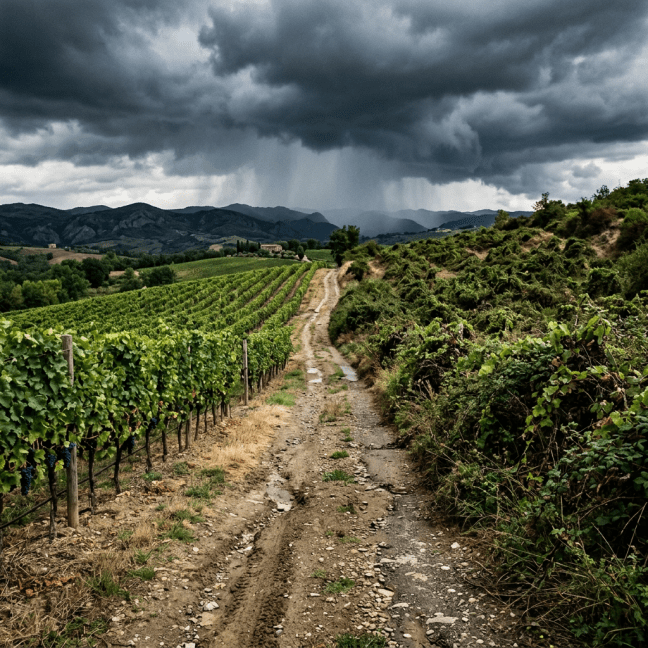
Rain showers over vineyard with grapevines and dirt path under dark stormy clouds

“Now I will sing for the one I love a song about his vineyard: My beloved had a vineyard on a rich and fertile hill. He ploughed the land, cleared its stones, and planted it with the best vines. In the middle, he built a watchtower and carved a winepress in the nearby rocks. Then he waited for a harvest of sweet grapes, but the grapes that grew were bitter.”
Isaiah 5:1-2 NLT

A song about a vineyard. A strange topic for the lyrics? But there have been many stranger ones. People of my vintage might remember the Beatles song, “I Am a Walrus”, which contains the words, “Semolina pilchard climbing up the Eiffel Tower/Elementary penguin singing Hare Krishna”. A good example of piffle, and reminiscent of an age of drug experimentation, hippies, and general nonsense. But Isaiah penned lyrics that describe the establishment of a vineyard. It belonged to the “beloved” who prepared the ground well, removing anything that would get in the way of the growing root systems. The best vines were planted, and all the infrastructure necessary for the functioning of a vineyard, such as the watchtower and the winepress, were put in place. But all to no avail – the fruit was not the intended sweet grapes, but instead, the fruit was bitter and of no use at all. 

What was there about this song that led to its being included in the Bible, in Isaiah’s writings? The first two verses of Isaiah 5 are part of the “Parable of the Vineyard”, a seven-verse story of God’s love for His people and how they spurned and abused His care. It was a lengthy process to create a vineyard from scratch. The correct location had to be found, with soil suitable for the best crops and free of rocks and stones that would prevent vine growth. The locals in Isaiah’s time would have known very well what was required and how long it would take, and the song’s topic was a good example of God’s love for His people. The song describes how, after his beloved had worked hard in preparation and waited for his first harvest, the grapes turned out to be “bitter.” Instead of the sweet grapes used for making wine, the owner discovers that after all the work he has put into his vineyard, the harvest is worthless. 

The next two verses of the parable continue with a question: “Now, you people of Jerusalem and Judah, you judge between me and my vineyard. What more could I have done for my vineyard that I have not already done? When I expected sweet grapes, why did my vineyard give me bitter grapes?” Why, after all of that hard work and preparation, did the fruit turn out to be sour and worthless? What more could have been done? Was it the owner of the vineyard who had done something wrong, or was it the vines, or perhaps the soil? At this point, the listeners were asked for their opinions. But the vineyard owner acted before any response was recorded, taking remedial action by abandoning the vineyard. Walls and hedges were broken down, and the beautifully prepared vineyard would become a wild place of weeds, thorns, and brambles; a dry and dreary place indeed.

But finally, the song’s explanation was given. “The nation of Israel is the vineyard of the Lord of Heaven’s Armies. The people of Judah are his pleasant garden. He expected a crop of justice, but instead he found oppression. He expected to find righteousness, but instead he heard cries of violence” (Isaiah 5:7). The verse is self-explanatory and continues the complaint given in previous chapters. Judah was behaving in a way that was against God’s design, a way in which oppression, injustice, unrighteousness, and sin were prevalent, all characteristics that were the opposite of God’s expectations. The vineyard owner was none other than God Himself, and the beloved was the Lord. The vineyard was Israel and Judah, and the Lord was going to great lengths to ensure the people understood that He established His people as His own. They were His vineyard. His desire for them was that of a grape farmer, that his vines would produce good and useful fruit.

What lesson can we pilgrims draw from this parable, since we were not living in Judah nearly three thousand years ago? Our “vineyard” is well established where God has planted us, and we have a manual of expectations, the Bible, that describes the fruit that He expects. Paul even described the fruit, which can be found in Galatians 5:22-23, “But the Holy Spirit produces this kind of fruit in our lives: love, joy, peace, patience, kindness, goodness, faithfulness, gentleness, and self-control. There is no law against these things!” We would do well to reflect on the “Parable of the Vineyard” and think of our Heavenly Father, who loves us so much, who has done so much for us, and who even sent His Son, Jesus, to ensure that we would one day be in His presence. 

Dear Father God. Thank You for Your care and compassion. Help us to be willing workers in Your vineyard here in our place and generation, that we too would produce the fruit You require. In Jesus’ name. Amen.

Beware of False Apostles: Insights from 2 Corinthians

“But I will continue doing what I have always done. This will undercut those who are looking for an opportunity to boast that their work is just like ours. These people are false apostles. They are deceitful workers who disguise themselves as apostles of Christ. But I am not surprised! Even Satan disguises himself as an angel of light. So it is no wonder that his servants also disguise themselves as servants of righteousness. In the end they will get the punishment their wicked deeds deserve.”
2 Corinthians 11:12-15 NLT

The Corinthian church seemed to have been infiltrated by men who called themselves apostles but weren’t, because they made false claims. They were first-century equivalents of fraudsters who found a way to fleece a gullible congregation with the smooth, eloquent words they used. In their approach, they created what was effectively a different Jesus, because they preached a false gospel with content that perhaps watered down the bits the Corinthians were struggling with or even one that contained errors that were more aligned with the Gnostics or Docetism, or perhaps even encouraging the congregation to adopt the Jewish practices that some of them had abandoned. Paul associated these men with being the devil’s servants, men who followed in the footsteps of the serpent in the Garden, with plausible arguments such as the one that deceived Eve. “Surely God didn’t say” was perhaps replaced by “surely Paul didn’t say”, leading to a subtle but significant change in the Gospel that Paul preached, the one given to him by Jesus Himself. 

These men have modern-day equivalents in the form of those people who wheedle their way into the confidence of gullible people and end up defrauding them of their savings or performing unnecessary work on their houses. There are all sorts of scams out there, and often they sound so convincing that even tech-savvy people are tricked into installing malware on their smartphones or computers. And it begs the question that if the fraudsters can be so successful in their modern-day scams, what is stopping the devil from doing the same in the spiritual world? 

Jesus warned His disciples, and by extension all disciples ever since, about the dangers of false apostles. He said, “Beware of false prophets who come disguised as harmless sheep but are really vicious wolves” (Matthew 7:15). Jesus continued in the next verse with “You can identify them by their fruit, that is, by the way they act. Can you pick grapes from thornbushes, or figs from thistles?” In today’s church, with its established denominations, there are fewer opportunities for false apostles, prophets, and other forms of leadership to enter a church. I belong to the Elim Movement, a Pentecostal organisation, with churches dotted all over the UK and beyond. Anyone able to preach at one of these churches has been carefully vetted and will usually have been through some formal training at an Elim-recognised Bible college. Error or falseness is a rare event. In addition, the Elim congregations usually have a sufficient number of mature Christians who will soon weed out any form of false teaching. However, some years ago, I was briefly in an independent church with a pastor who seemed to preach all the right messages and was well respected by the congregation. There were a few anomalies with his leadership team, but all seemed good. But then a problem emerged – the pastor had a gambling addiction, and the church collapsed soon afterwards when it came to light. So Jesus’ warning about good and bad fruit was spot on. 

In Revelation 2:2, Jesus commended the church in Ephesus for dealing with false apostles. “I know all the things you do. I have seen your hard work and your patient endurance. I know you don’t tolerate evil people. You have examined the claims of those who say they are apostles but are not. You have discovered they are liars”. It might have been helpful to know more about how they weeded out the false apostles, but the devil is subtle in his approaches, and he will erode the margins of doctrine and theology, even Bible verses, introducing error drip by drip. 

There was an episode during Jesus’ ministry when His disciples became concerned that someone outside His group was using Jesus’ name to cast out demons. Mark 9:38, “John said to Jesus, ‘Teacher, we saw someone using your name to cast out demons, but we told him to stop because he wasn’t in our group’”. We read what Jesus said in response in the next two verses, ““Don’t stop him!” Jesus said. “No one who performs a miracle in my name will soon be able to speak evil of me. Anyone who is not against us is for us”. From this example, we discern that there may be men and women in other denominations who are preaching the same Gospel we do without error. They may have a different approach or use different words, but their fruit is all good. 

Paul ended our verses today with the warning that the spiritual fraudsters, the false apostles who had infiltrated the Corinthian church, would receive “the punishment their wicked deeds deserve”. One day, we will all have to stand before God to give an account of our lives, and anyone who has peddled a false gospel will suffer severe consequences. The minister preaching Universalism at a Glasgow funeral I referred to in an earlier blog would possibly fall into this category. Of course, there are men and women in this world who sincerely fall into error and propagate it through their messages and prophecies. They are not fraudsters, as we understand the term, but they are still promoting a false gospel. 

How do we pilgrims avoid falling into error? We do what the people of Berea did. Acts 17:11, “And the people of Berea were more open-minded than those in Thessalonica, and they listened eagerly to Paul’s message. They searched the Scriptures day after day to see if Paul and Silas were teaching the truth”. That is the only way to avoid the subtle and persuasive words of the false apostles. By reading our Bibles.

Dear Father God. Thank You for Your Word, the Bible, and the Holy Spirit within us who is able to lead us into all truth. Help us to keep our eyes fixed upon Jesus, who is the Truth. Amen.