

God’s Promises: A Fruitful Vineyard in Our Lives

Wine bottles and a filled glass overlooking terraced vineyards at sunset

“In that day, sing about the fruitful vineyard. I, the Lord, will watch over it, watering it carefully. Day and night I will watch so no one can harm it. My anger will be gone. If I find briers and thorns growing, I will attack them; I will burn them up—”
Isaiah 27:2-4 NLT

There is that reference again to “In that day”, indicating that this is another End Times prophecy about what is to come at some time yet to happen in the future. It is a frustration to some people that they are neither able to control the present nor the future. Yes, they can put into place some personal steps to minimise their risks, but global events are well beyond them. Regarding their own lives and the reality that one day they will die, they don’t know when or how it will happen, and they choose to suppress any thoughts in that direction. But we pilgrims don’t have that concern, because we know that God has us in His hands and that one day we will be with Him forever. Prophecies such as Isaiah’s “In that day” provide a glimpse of what life will be like when the Lord returns. When the Lord reigns on earth, a restored Israel will be like a pleasant or fruitful vineyard, with some manuscripts describing it as a “vineyard of wine.” In Isaiah 5:2, Isaiah wrote of a vineyard prepared by the Lord. “He ploughed the land, cleared its stones, and planted it with the best vines. In the middle he built a watchtower and carved a winepress in the nearby rocks”. So far, so good. Everything was prepared and ready to produce a crop of the very best grapes. We read on in this verse, “Then he waited for a harvest of sweet grapes, but the grapes that grew were bitter”. The vineyard represented Israel, and the “sweet grapes” that were supposed to grow there were the fruit of righteous lives, lived by God’s own people, the Jews. But sour and bitter grapes resulted from a lack of righteousness in a people who had abandoned God and His ways. They were growing the wrong fruit.

I suppose, as we pause here, we pilgrims can ask ourselves the question, “What fruit am I producing?” Grapes of righteousness, sweet and useful, productive in God’s hands, or something else? In Isaiah 5, as we read on, we find that the Lord removed the protective hedge and wall around the vineyard. This allowed wild animals to come and destroy it. He also sent a drought over the vineyard and allowed thorns and briers to grow and take over. But in the End Times, Israel will have been restored and will be a pleasant “vineyard of wine”. The Lord will be dwelling with His people, and He declared how He would look after them. It will be well-watered with His love and grace, and He will watch over it, day and night. In the wonderful picture of the Revelation 21 prophecy of God living with His people, He will no longer be angry with His wayward children, and in His presence, finally, they will produce the fruit He had always designed for them to produce. 

History records a different set of circumstances for the Israelites. Time and time again, their sinful lives led to consequences when God removed His hedge of protection around them. This took the form of oppression by the surrounding nations, which crescendoed with the conquest by the Assyrian army and exile for many of the remaining people. When they finally returned from Babylon, did their sinning stop? Unfortunately, not, and in Jesus’ day, the Romans had occupied Palestine, and there was a pseudo-religious council keeping a lid on the population. This was never the type of society that God had designed for His people. But throughout the ages, God’s people retained their Jewish identity, and received a glimmer of hope with the return of the Jewish state in 1948. Has their sinning stopped? A question that God Himself will answer one day.

Sin can be defined as rebellion against God and His ways, and this encompasses many behavioural traits that poison a person’s life and future. But there is a remedy, and that came in the person of Jesus Christ. Paul wrote, “But God showed his great love for us by sending Christ to die for us while we were still sinners. And since we have been made right in God’s sight by the blood of Christ, he will certainly save us from God’s condemnation” (Romans 5:8-9). This must be wonderful news for all sinners, past, present, and future, and we will one day enjoy the fruits of God’s vineyard, living with Him forever. Paul continued in Romans 5, “For since our friendship with God was restored by the death of his Son while we were still his enemies, we will certainly be saved through the life of his Son. So now we can rejoice in our wonderful new relationship with God because our Lord Jesus Christ has made us friends of God”. Are we pilgrims feeling a bit jaded and perhaps depressed this morning? After all, world events are not the most uplifting. But as we cast our eyes Heavenward, we will see God’s “vineyard”, the place where we want to be. And today, this very moment, we can feel the warm glow of God’s love and grace flowing over us, bringing peace to our souls. 

Whatever we are facing today, whatever challenge, whatever problem, God has an answer. God has a solution. We pilgrims pray, and keep on praying, bringing our lives and families under His fatherly and gracious spotlight. The Psalmist wrote in Psalm 34:17, “The Lord hears his people when they call to him for help. He rescues them from all their troubles“. 1 John 5:14-15, “And we are confident that he hears us whenever we ask for anything that pleases him. And since we know he hears us when we make our requests, we also know that he will give us what we ask for“. Of course, we must pray prayers that align with God’s will, but He cares for us and always has an answer. In Philippians 4:6-7, we read again, “Don’t worry about anything; instead, pray about everything. Tell God what you need, and thank him for all he has done. Then you will experience God’s peace, which exceeds anything we can understand. His peace will guard your hearts and minds as you live in Christ Jesus“.

Father God. We bring to You our worries and cares, in the knowledge that You are concerned for us and desire to bring us firmly back into Your will. We are truly sorry for the times we have given up praying or failed to pray at all, and we thank You for the times You answered our prayers, spoken or unspoken, anyway. Today, we bring You our praises and petitions, trusting that You will hear our prayers and lead and guide us accordingly. Thank You, Lord. Amen.
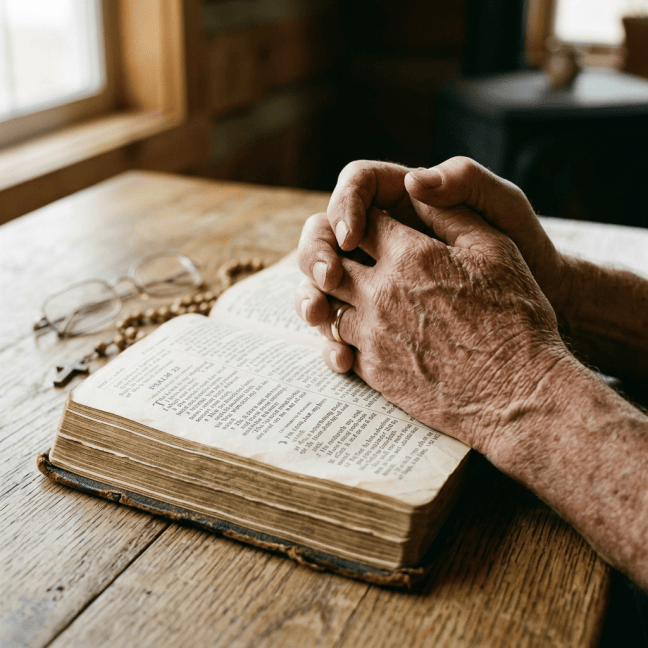
Understanding Delayed Answers to Prayer in Faith

Folded hands resting over an open Bible beside eyeglasses and beads

“Just as a pregnant woman writhes and cries out in pain as she gives birth, so were we in your presence, Lord. We, too, writhe in agony, but nothing comes of our suffering. We have not given salvation to the earth, nor brought life into the world. But those who die in the Lord will live; their bodies will rise again! Those who sleep in the earth will rise up and sing for joy! For your life-giving light will fall like dew on your people in the place of the dead!”
Isaiah 26:17-19 NLT

Do we hear a hint of frustration in Isaiah’s prophetic voice this morning? God’s hand of discipline weighed heavily upon them and, no matter what they did, “nothing [came] of [their] suffering. Like a woman in labour, they cried out in pain, but their efforts seemed to produce nothing. They had hoped to bring deliverance, but instead experienced weakness and disappointment. And, rightly, Isaiah continues with an acknowledgement of his, and the people’s, limitations. Perhaps there was a breakthrough when Isaiah realised that God’s greatness was infinitely more than any human being’s, because, as we move to verse 19 today, we find that he had received a revelation of hope. Hope for the future. Hope for all those who “die in the Lord”. 

Sometimes we pilgrims seem to work away, but nothing seems to come of our labours. A missionary might work in a foreign land and see no converts, despite many years of toil. Pastors might preach many messages from the pulpit, all focused on the congregation’s spiritual growth, but the same issues of sin remain. We pilgrims might pray for a long time for the healing of a loved one, but sickness remains. Perhaps we are praying for revival, for God to visit us again through His Spirit, but nothing changes. We pray over issues, but God never seems to hear our prayers, let alone answer them. Do we waste our time and effort? But then, like Isaiah, we realise God’s ability and our inability, and we shift our focus from the issues to the future. In this life, we pilgrims were never promised that the fruits of our labours would be seen straight away. The problem is that we live in an “instant” generation, expecting immediate answers.

The psalmist Asaph had similar problems. He looked on at the people around him, and found that the proud seemed to survive the catastrophes that he was facing. He had a good rant in Psalm 73, even confessing, “But as for me, I almost lost my footing. My feet were slipping, and I was almost gone” (verse 2). In verse 11, the people even wondered, ““What does God know?” they ask. “Does the Most High even know what’s happening?”” Asaph’s depression deepened and he wrote, “Did I keep my heart pure for nothing? Did I keep myself innocent for no reason? I get nothing but trouble all day long; every morning brings me pain”. And then revelation finally came in verse 17, and he wrote, “Then I went into your sanctuary, O God, and I finally understood the destiny of the wicked”. 

There was a time when Daniel had been praying and, after a time, had a visitation from the Angel Gabriel on the banks of the River Tigris. The figure of the Angel was terrifying, but he said to Daniel, “ … Don’t be afraid, Daniel. Since the first day you began to pray for understanding and to humble yourself before your God, your request has been heard in heaven. I have come in answer to your prayer” (Daniel 10:12). The next verse explained the reason for the delay, “But for twenty-one days the spirit prince of the kingdom of Persia blocked my way. Then Michael, one of the archangels, came to help me, and I left him there with the spirit prince of the kingdom of Persia”. Sometimes we don’t know why God seems to have ears deaf to our prayers. Or why the answers take so long to come. 

Peter wrote, “The eyes of the Lord watch over those who do right, and his ears are open to their prayers…” (1 Peter 3:12). Proverbs 15:29, “The Lord is far from the wicked, but he hears the prayers of the righteous”. We pilgrims are righteous in God’s sight because of Jesus, who died so our sins could be forgiven and we could receive His righteousness. So God hears our prayers, and in faith we believe that this is the case. So why does He seem to delay in answering them? There can be several reasons. Perhaps we have unconfessed sin that is blocking our prayer requests. Or perhaps God’s timing is different to our expectations, because He might have a better answer waiting for just the right time. Perhaps our motives are selfish. But whatever, I firmly believe that God answers “the fervent prayers of a righteous man”. His answers can be “Yes”, “No” or “Wait”. But answer he will. 

What are we pilgrims praying about this morning? Have faith that God has heard your prayer and, like Daniel, the answer will come in due time. In the meantime, however, we need to lift our eyes to Heaven and enter God’s sanctuary. Once in God’s presence, Asaph wrote, “Whom have I in heaven but you? I desire you more than anything on earth. My health may fail, and my spirit may grow weak, but God remains the strength of my heart; he is mine forever” (Psalm 73:25-26). And he finishes the Psalm, “But as for me, how good it is to be near God! I have made the Sovereign Lord my shelter, and I will tell everyone about the wonderful things you do”. 

Dear Father God. Sometimes we pray for years, for a loved one to be saved, or someone we know to be healed from a long illness. But we know that You hear our prayers, and we wait patiently for Your answer. We repent of any barriers we erect in response to our impatience, and instead we, in faith, leave the issues to You and Your perfect ways. We ask this in Jesus’ name. Amen.

Seeking God: Morning and Night Reflections

“In the night I search for you; in the morning I earnestly seek you. For only when you come to judge the earth will people learn what is right. Your kindness to the wicked does not make them do good. Although others do right, the wicked keep doing wrong and take no notice of the Lord’s majesty. O Lord, they pay no attention to your upraised fist. Show them your eagerness to defend your people. Then they will be ashamed. Let your fire consume your enemies. Lord, you will grant us peace; all we have accomplished is really from you.”
Isaiah 26:9-12 NLT

Morning and night. Special times perhaps for God’s people, and pilgrims like us everywhere. Some nights, lying in bed in that “starting to drift off into sleep” mode, I’m conscious of a feeling of relief after a confusing and chaotic day, and I bring before God my thoughts and emotions, asking Him for His perspective and confessing any sins that I might have committed. This leads to praying for the issues that have emerged over the past few hours, and that’s how the day ends. But Isaiah went further; he earnestly searched for the Lord. That builds a picture of a man who is aware of society’s ills and where God cannot be found at all. We pilgrims perhaps feel the same, as we consider our increasingly secular society, where God has been forgotten, ignored and even vilified. Where our fellow citizens follow their selfish desires as they did in the days of the Judges: “In those days Israel had no king; all the people did whatever seemed right in their own eyes” (Judges 21:25). Their moral compass long gone. Their songs, devoid of praises to God, would instead have the lyrics “What’s in it for me” or “I’ll do it my way”. But Isaiah searched for God while lying on his bed, and I’m sure, in the quiet of the night, he found His Lord.

But on awakening, Isaiah sought God again. Faced with such an arrogant and Godless society, he knew that he needed God to be there with him. He didn’t know what he would face in the day ahead, and perhaps he was even a bit scared about the issues he would have to face. The people around him had forgotten God, as we have read in previous chapters, and were following sinful practices, particularly idolatry, even though they went through the motions of the Jewish rites and rituals. But do we pilgrims feel the same? Do we too wake up and immediately start to think God-thoughts, earnestly seeking Him for whatever resources we need for the day ahead? Are we like the Psalmist David, praying as in Psalm 5:3, “Listen to my voice in the morning, Lord. Each morning I bring my requests to you and wait expectantly”? In a time of great stress, David wrote another prayer: “O God, you are my God; I earnestly search for you. My soul thirsts for you; my whole body longs for you in this parched and weary land where there is no water” (Psalm 63:1). This might be an appropriate prayer for those of us pilgrims who are currently living in drought-filled parts of England. But the land in which we live is indeed parched without the living water of God’s Spirit flowing throughout our societies, our churches and communities.

What requests do we have this morning? And, here’s the thing, do we believe that God can bring answers to our prayers? But I know that some people wake up in the morning, just relieved that they have survived another night, having been racked with pain, or unable to sleep. Others wearily haul themselves out of bed, wishing that they didn’t have to face the day ahead at all. But not Isaiah. He had an eager expectation that God would be there with him. He knew what Solomon had written years before: “Great is his faithfulness; his mercies begin afresh each morning” (Lamentations 3:23). 

Jesus always spent time in prayer in the mornings. Mark 1:35, “Before daybreak the next morning, Jesus got up and went out to an isolated place to pray”. Why did He have to do that? Because when He left Heaven, Jesus left behind most of His divine attributes, taking on human form with all the limitations that would follow. So He had to spend time communicating with His Father in Heaven to ensure that He would follow His will in the day ahead. We should do the same because we don’t have a clue about the issues that might appear in the hours ahead. We pray for grace and compassion in our interactions with fellow citizens, God-followers or not. We pray for the words to say when someone needs comforting. We need the leading of the Holy Spirit when God wants us to bring His message of hope into a life devoid of hope at all. And, above all, we need God to fill us afresh with His Spirit, resourcing us for the day ahead. I do not know what I will face today. But I know Someone who does, and I need to hold His hand throughout the day ahead. Thankfully, His hands are big enough to hold each one of us. 

Almost despairingly, Isaiah wrote, “For only when you come to judge the earth will people learn what is right”. A statement of truth, but within it there are pockets of hope for those who follow Him day by day, for those who earnestly seek God for His resources and His righteousness. But by Judgment Day, it will be too late for most to understand the difference between right and wrong. For those who have never understood what God truly desires, Fanny Crosby wrote a hymn in 1869 called “Near the Cross”, and the first verse reads, “Jesus, keep me near the cross,/ There a precious fountain; / Free to all, a healing stream,/ Flows from Calv’ry’s mountain”. And the chorus goes: “In the cross, in the cross / Be my glory ever, / Till my ransomed soul shall find / Rest beyond the river”. That’s where we pilgrims need to be, always aware of what Jesus has done for us. Always close to our Master.

Dear Heavenly Father. It all starts with the Cross at Calvary, and Your Son in agony of body and spirit, taking on to Himself the sins of the world. And before You this morning, I declare my gratitude. In this weary and parched land, I pray that once again, You will awaken us with a new move of Your Spirit. Raise up Godly men and women, we pray, who will pray without ceasing for revival to hit Your churches, shifting the people’s gaze far above their leaking church roofs to Your throne. It’s all about You, Lord, and we echo Your prayer for Your Kingdom to come and Your will to be done, in Your precious name. Amen.

Reviving Moral Leadership in a Troubled Society

“I will make boys their leaders, and toddlers their rulers. People will oppress each other— man against man, neighbour against neighbour. Young people will insult their elders, and vulgar people will sneer at the honourable. In those days a man will say to his brother, “Since you have a coat, you be our leader! Take charge of this heap of ruins!” But he will reply, ‘No! I can’t help. I don’t have any extra food or clothes. Don’t put me in charge!’”
Isaiah 3:4-7 NLT

The verses this morning describe a society that has collapsed into chaos and dysfunction. Boys and toddlers are obviously unsuitable leaders in society but that seems to be the only option left because, as we read in the previous verses, all the competent people had been removed from Judah by the invading armies. When Isaiah wrote this, he could see in a vision what was to come, but history recorded the fact that it actually happened. The Jews ignored his words and ultimately discovered that God spoke truth through His servants. 

There was no social cohesion following the initial exile and no remedy for the crimes of insults and oppression. Faced with no restrictions the true colours of a sinful people started to emerge, with neighbours trying to benefit themselves at the expense of their fellow neighbours. With young people behaving terribly to their elders, and “vulgar people [sneering] at the honourable” amongst them, things were going from bad to worse. The vacuum in leadership was very apparent and people who had even some insignificant and trivial benefit, such as a coat, were promoted as a leader, only to find that they subsequently refused.

But as we read these words today, we see parallels with society today in the UK. Attitudes and beliefs are polarising in a society that contains many different people groups. The cohesion that is present in a God-believing society has all but collapsed in our secular environment, forcing the government to bring in legislation that enables our overstretched police forces to implement moral laws. Hate crimes are now common place and even Christian pastors are being arrested while they preach the Good News about Jesus in public places, all because what they have to say “offends” someone. “Free speech” now seems to be a thing of the past. And our political leaders lack the ability and vision to lead the country through difficult times, putting the “Great” back into “Britain” in the process.

Thankfully, there are still many Christians in the UK who pray for their communities and government faithfully. Churches still hold services. There are Christians amongst our politicians. We pilgrims pray for a Godly society, one in which peace, justice and love prevail. Such a society is committed to God’s values, particularly those that honour the sanctity of life, is fair, and looks after the vulnerable. Justice and reconciliation between different people groups, coupled with just generosity, must be there, but in it all the roots of the society we need is based in God’s Word, the Bible. All we need for society in the way that God planned is there.

So we pilgrims pray. And keep on praying. We refer to our mission, that we are here “for such a time as this” (Esther 4:14). Jesus said early on in His Sermon on the Mount, “You are the salt of the earth. But what good is salt if it has lost its flavor? Can you make it salty again? It will be thrown out and trampled underfoot as worthless. You are the light of the world—like a city on a hilltop that cannot be hidden. No one lights a lamp and then puts it under a basket. Instead, a lamp is placed on a stand, where it gives light to everyone in the house. In the same way, let your good deeds shine out for all to see, so that everyone will praise your Heavenly Father” (Matthew 5:13-16).

But before we go on a rant about how bad our government is, we note what Paul’s wrote in Romans 13. “Everyone must submit to governing authorities. For all authority comes from God, and those in positions of authority have been placed there by God” (Romans 13:1). A little further down the page, Paul wrote something else that is a bit contentious, “Pay your taxes, too, for these same reasons. For government workers need to be paid. They are serving God in what they do” (Romans 13:6). We do not have to take matters into our own hands and rebel in some way, because there will be a time when our leaders and tax authorities will be called into account before God’s throne. God will bless us when, or if, we are badly treated by the authorities, because the treasure that matters is being stored up for us in Heaven.

So we pilgrims pray, and keep praying, for our leaders and anyone else in authorities, because that is must what we do as “salt and light” in our society. We are the “glue” that bonds our dysfunctional society and aligns us with God’s will and purposes for our world.

Dear Heavenly Father. Please help us to be Your witnesses in the places where we live, leading us and guiding us as You desire. Amen.

The Perils of Turning Away from God: Insights from Isaiah

“The Lord, the Lord of Heaven’s Armies, will take away from Jerusalem and Judah everything they depend on: every bit of bread and every drop of water, all their heroes and soldiers, judges and prophets, fortune-tellers and elders, army officers and high officials, advisers, skilled sorcerers, and astrologers.”
Isaiah 3:1-3 NLT

Isaiah starts chapter 3 with a stark outline of what is going to happen when the Judaites would be exiled. The basics of life would go first, bread and water, and then followed by all the people they consider to be important. But notice that this list includes two categories of people that were expressly forbidden to be amongst the Jews – “skilled sorcerers and astrologers”. Deuteronomy 18: 10b-11, 14): “… And do not let your people practice fortune-telling, or use sorcery, or interpret omens, or engage in witchcraft, or cast spells, or function as mediums or psychics, or call forth the spirits of the dead. … The nations you are about to displace consult sorcerers and fortune-tellers, but the Lord your God forbids you to do such things”. Astrology is a form of divination and can be found today in horoscopes and among those who suggest that the alignment of stars and planets has some spiritual meaning. Astrologers were commonplace in Old Testament writings, and frequently mentioned such as in Daniel 2:1-2, “One night during the second year of his reign, Nebuchadnezzar had such disturbing dreams that he couldn’t sleep. He called in his magicians, enchanters, sorcerers, and astrologers, and he demanded that they tell him what he had dreamed …” Of course, they couldn’t help the king, but Daniel could through his relationship with God, as we read the following verses. It was a sad state of affairs that the Judaites had come to depend on the quacks and frauds, rather than turn to the One who was their Source.

What can we pilgrims learn from these verses today? I suppose the first thing is that human structures are not infallible or inviolable. Security and well-being that are sought after outside of God and His ways are temporary and precarious. It’s all about the dangers of coming outside His protection, because as we do things God’s way, His favour will be assured. 

Another thing is that God removed all the structures that supported the Judaean society. The good disappeared along with the bad. Not all the “judges and prophets” were corrupt, and the good people could not survive in a corrupt society on their own when it collapsed. This highlights that when a nation turns from God, its economic, political, and cultural supports crumble simultaneously.

The judgment by exile that was coming was a direct consequence of the people’s rebellion, oppression of the poor, and arrogance. It served as a stark reminder that collective unfaithfulness degrades the very systems that allow a culture to thrive. By actively stripping Judah of its societal pillars, God demonstrated His control over nations and history. The ultimate lesson was a call for humility, urging people to depend on God rather than fallible human systems.

So, it is all the more important that we pilgrims are salt and light in our society. By being so, we hold back God’s judgement in this season of His grace. And we pray. In Paul’s first letter to Timothy, we read, “I urge you, first of all, to pray for all people. Ask God to help them; intercede on their behalf, and give thanks for them. Pray this way for kings and all who are in authority so that we can live peaceful and quiet lives marked by godliness and dignity. This is good and pleases God our Saviour, who wants everyone to be saved and to understand the truth” (1 Timothy 2:1-4). I know that, at times, we despair of our leaders rather than feel inclined to pray for them, but pray we must, because prayer changes things. There is much to pray for, as our leaders embark on Godless legislation, but we must persevere.

Father God. We pray today for our leaders, all who are in our governments and councils. Please help them legislate righteously so that we will continue to live in Your favour. In Jesus’ name. Amen.

Overcoming Anxiety through Faith and Prayer

“On that day of judgement they will abandon the gold and silver idols they made for themselves to worship. They will leave their gods to the rodents and bats, while they crawl away into caverns and hide among the jagged rocks in the cliffs. They will try to escape the terror of the Lord and the glory of his majesty as he rises to shake the earth. Don’t put your trust in mere humans. They are as frail as breath. What good are they?”
Isaiah 2:20-22 NLT

The remainder of Isaiah 2 continues with details of what will happen on “that day of judgement” when “only the Lord will be exalted”. The verses list a sobering and depressing series of catastrophes that will impact the Israelites, and all because of their sin, rebellion, and idolatry. It wasn’t just a minor inconvenience now and then, but a series of disasters as their society was dismantled and destroyed. And through it all, “Human pride will be humbled, and human arrogance will be brought down” (Isaiah 2:17a). Chapter 2 ends with the observation, “Don’t put your trust in mere humans. They are as frail as breath. What good are they?” 

The pathetic nature of human abilities can be seen in many national crises over the centuries, as one ruler after another led their people into wars and other catastrophes, often as they chased ideologies that were just as Godless as those the Israelites sought after. And today the practice continues with out-of-touch politicians and business leaders following the sad observation at the end of the Book of Judges – “In those days Israel had no king; all the people did whatever seemed right in their own eyes” (Judges 21:25). That’s human nature without a compass to lead them in the paths of righteousness. So today in the UK, Godless laws are leaving the stain of sin all over society. Abortion is a crime of the highest proportion and God will not allow such an atrocity to continue for long, I’m sure. The US has largely stepped back from the brink but the UK is even seeking to extend its scope. Then we have the ideologues who are promoting celebrations of all sorts of gender deviations. There are even going to be steps to make “Conversion Therapy” illegal, and I’m sure there will be other attempts to reintroduce Assisted Suicide in the Westminster Parliament. Our politicians surely tick the “What good are they?” box. It is no wonder that mental health, or should it be “mental ill-health”, is an endemic problem. 

We pilgrims must pray and keep praying that there will soon be a time when the wrongs are reversed, and the delusions that have gripped so many in our societies are resolved. But one form of mental illness that is increasing is caused by anxiety. Without a moral compass in our societies, people cast around looking for foundations that are solid and immovable, and, while most are debilitated by their feelings and emotions, some are turning to the Church because it is only there that they find the stability that they are looking for. Bible sales are also increasing, because it is only in God’s Word that something to trust can be found. But anxiety is something that is creeping over our society gradually but seemingly unstoppable. 

Are we pilgrims feeling anxious this morning? As I cast my eyes over the news today, there is much there to cause depression and worry. But God has a remedy, and many scriptures are there to help. The first thing that we do, must do in fact, is pray. Philippians 4:6-7, “Do not be anxious about anything, but in every situation, by prayer and petition, with thanksgiving, present your requests to God. And the peace of God, which transcends all understanding, will guard your hearts and your minds in Christ Jesus”. We should also turn to Romans 12:2, which reads, “Don’t copy the behaviour and customs of this world, but let God transform you into a new person by changing the way you think. Then you will learn to know God’s will for you, which is good and pleasing and perfect”.  

Father God. We realise that as we think and pray Your way, through the help of Your Spirit within us, we are aligning ourselves to Your will and purposes. And we pray for ourselves, that we will grow in grace to be more like Your Son, Jesus. Thank You, Lord. Amen.

Overcoming Apprehension: Lessons from 2 Corinthians

“We have been greatly encouraged by this. In addition to our own encouragement, we were especially delighted to see how happy Titus was about the way all of you welcomed him and set his mind at ease. I had told him how proud I was of you—and you didn’t disappoint me. I have always told you the truth, and now my boasting to Titus has also proved true! Now he cares for you more than ever when he remembers the way all of you obeyed him and welcomed him with such fear and deep respect. I am very happy now because I have complete confidence in you.”
2 Corinthians 7:13-16 NLT

It must have been the case that Titus was a bit apprehensive about going to meet with the Corinthians, because Paul wrote that their welcome for him “set his mind at ease”. I think any of us would have been a bit unsure of the reception we would receive, carrying in our pocket the missive that Paul had penned. To add to his concern was the long journey to reach Corinth from where Paul was at the time. It is thought that Paul wrote his first letter while at Ephesus, meaning a 290-mile sea journey would have been required to reach Corinth. A land journey was possible, although much longer, so it would have taken weeks at the normal walking pace of 15-20 miles per day. But all that time dwelling on the contents of the letter throbbing in his pocket would have weighed on Titus’ mind. I expect Paul was relieved as well, hearing that his letter had been so positively received, having achieved its purpose, which was to bring the Corinthian believers back on the “straight and narrow” path. 

It would have been much easier for Paul to have delivered what he had to say in person, because by doing so there would have been a feedback mechanism in place, allowing for the optimisation of the delivery. He began his first letter by addressing the quarrels that had been occurring. “For some members of Chloe’s household have told me about your quarrels, my dear brothers and sisters” (1 Corinthians 1:11). It would have been easier for Paul to gather together the quarrelling parties and work with them to resolve their differences. In that process, his love and compassion for them would have won them over and brought about a reconciliation. But just to point out the problem and leave it to them to sort out would not have been very efficient, if it even worked. So Titus’ apprehension was understandable.

What about for us pilgrims? We have, I’m sure, encountered times when a problem or difficulty has to be confronted. It could be a parent to a child, or a manager to an employee. Even, perhaps, between friends. And I’m sure that the build-up to the day the encounter was to take place would have been full of apprehension, even with a sleepless night involved. We would have prayed and asked God to help in the meeting, but there would still have been that unease niggling in our minds. “I wish it were all over” was a thought probably in our minds. To the Galatians, Paul wrote, “Dear brothers and sisters, if another believer is overcome by some sin, you who are godly should gently and humbly help that person back onto the right path. And be careful not to fall into the same temptation yourself” (Galatians 6:1). Such advice, valuable as it is, requires a face-to-face encounter to be able to communicate with gentleness and humility.

In today’s internet-enabled world, it is sometimes easy to just fire off an email or message to another person, or make a comment on a social media platform, to avoid personal contact. But in the process, sight is lost of the innuendo and interpretation of the message by the other person. We may write the message from our perspective, but when it’s received by the other person, it means something totally different to them. Such a thought must always have been in Paul’s mind as he wrote his letters. In 3 John 1:13-14, we read, “I have much more to say to you, but I don’t want to write it with pen and ink. For I hope to see you soon, and then we will talk face to face”. Some things have to be said person to person, and not by “pen and ink”. 

The message from our verses in 2 Corinthians today is clear and affects both the giver and the receiver. If we have a message to deliver, particularly if it is of the importance that Paul could see, then we must carefully think through the process to avoid unnecessary or unintended consequences, such as a permanent schism resulting. If we are in receipt of the message, then we must not react in anger, rejecting both the message and the messenger, but must carefully take it away and consider it through prayer, asking for God’s help in discerning what has been said. Some unease on the part of either party is to be expected, but with God’s help, the problem is resolved, and apprehension dissipated.

Dear Father God. Human interaction can be difficult sometimes, but we each pray for ourselves today, praying “May the words of my mouth and the meditation of my heart be acceptable in your sight, O LORD, my Rock and my Redeemer”.  Thank You for Your grace and love. Amen.

Uncertainty

“A wife is bound to her husband as long as he lives. If her husband dies, she is free to marry anyone she wishes, but only if he loves the Lord. But in my opinion it would be better for her to stay single, and I think I am giving you counsel from God’s Spirit when I say this.”
1 Corinthians 7:39-40 NLT

So, Paul wrote that “A wife is bound to her husband as long as he lives”. In today’s society, which is conscious of and sensitive to the rights of women, this is not a politically correct instruction. To single out a woman’s responsibility to her husband but not the other way round is enough to make any feminist’s blood boil. But in the misogynistic and patriarchal societies two thousand years ago, instructions such as these were not uncommon. A woman was considered the lesser of the two people in the marriage partnership. In first-century Greece, formal education for women varied significantly according to where a person lived. Corinthian girls would have received little to no formal instruction, instead learning domestic skills like weaving and household management from their mothers to prepare for marriage and motherhood. Male education varied by place as well, but generally involved foundational literacy and numeracy for the wealthy, with higher learning for affluent boys through Sophists and philosophers, emphasising rhetoric and philosophy. Physical training was also standard, often in a gymnasium, to instil discipline and prepare for military service. Today, in Western societies, education is available to all, regardless of sex, providing equal opportunities. This ensures that marriage is equally supported by both men and women, even to the extent of traditional role reversals, with the husband taking on childcare and managing the household.

Paul, however, suggested that, should the husband die first, then the wife, presumably a believer, was free to remarry, as long as the new husband was another believer. But, and here’s the thing, Paul suggested that it would be better for the widow to stay unmarried and remain single. This would not always be the best option for the poor woman, because these were days before Social Security payments were available. The church would have helped out in a way such as was recorded in Acts 6:1, “But as the believers rapidly multiplied, there were rumblings of discontent. The Greek-speaking believers complained about the Hebrew-speaking believers, saying that their widows were being discriminated against in the daily distribution of food”. But nevertheless, Paul promoted singleness for the widow, writing, “I think I am giving you counsel from God’s Spirit when I say this”. “I think …” indicates a degree of uncertainty on Paul’s part, as he showed an honesty about what he thought he was hearing from the Holy Spirit.

If we pilgrims are honest with ourselves today, “I think …” is more common than we might be prepared to admit. Faced with an important decision, it is difficult most of the time to separate our human thoughts from God’s thoughts. Although the Bible is full of God’s counsel, on many matters it is difficult to get a definitive answer from it. Yes, we will receive general advice in line with God’s principles, but often we come up against situations about which Scripture is silent. This introduces a difficulty when it comes to matters of direction. “Should I accept this job …”, or “should I date this girl …”. Perhaps, “Should I become a missionary”, or “Should I go to Bible College”, might be options laid before us. For older people, thoughts of moving to a smaller house or a new part of the country to be nearer family might present themselves as potential “I think’s“. So what should a pilgrim do?

If we find ourselves presented with a life-changing option, such as the widow in Paul’s verses today, we must first pray about the situation, believing that through our faith, the Holy Spirit will lead and guide us. In parallel, we might bounce our thoughts off a trusted friend or pastor, obtaining more guidance and a different perspective. But if we’re still not sure, then for the “risk-averse” amongst us, perhaps the best solution is to put the matter before God, leaving it “on the back burner” until we get the confirmation or direction that we need. This is not always best, though, because sometimes God wants us to step out in faith, much as Jackie Pullinger did when she boarded a steamer asking God to reveal to her the port where He wanted her to start her missionary calling. We must also be aware that often, the decision before us may be acceptable to God, whichever way we go and whatever we do. In the end, He wants us to grow in His grace and love, flourishing in the place and bearing fruit where He has placed us.

“I think …” may be a God-thought that we need to act upon. Consider ourselves a sailing ship, tied up in port, while we wait for the right wind, one that is right in terms of direction and speed. But it never comes, and we remain in the port, increasingly unhappy and frustrated, never going anywhere. Sometimes God wants us to launch out and leave the port anyway, because once we are on the move, God can work in the situation to bring the right circumstances. These may not be what we were expecting while in the port, but once on the move, God can show us the course He wants us to take. Psalm 119:105, “Your word is a lamp to guide my feet and a light for my path“. Psalm 37:5, “Commit everything you do to the Lord. Trust him, and he will help you”. Proverbs 16:3, “Commit your actions to the Lord, and your plans will succeed“. God doesn’t mind sometimes if we make mistakes. Paul wrote in Romans 8:28, “And we know that God causes everything to work together for the good of those who love God and are called according to his purpose for them”. Once we are on the move, God will redeem the situation we find ourselves in, and as we look to Him in faith, He will guide us. We don’t know what the future holds for us in our natural lives, but we do know who holds the future, both now and forever.

Dear Father God. We know that You love us and want the very best for each one of Your children. Please lead us and guide us, we pray, as we walk along Your paths in this life, in preparation for the next. In Jesus’ name. Amen.

Prayer and Fasting

“Do not deprive each other of sexual relations, unless you both agree to refrain from sexual intimacy for a limited time so you can give yourselves more completely to prayer. Afterward, you should come together again so that Satan won’t be able to tempt you because of your lack of self-control. I say this as a concession, not as a command. But I wish everyone were single, just as I am. Yet each person has a special gift from God, of one kind or another.”
1 Corinthians 7:5-7 NLT

We remember that this chapter started with a question from the Corinthian believers to Paul about sexual ethics, which even floated, as a possible answer, the concept of celibacy. Paul went on to discuss the subject of marriage and how sexual relations should apply in that context, and he expanded on his theme by saying that the married couple, the husband and wife, should “not deprive each other of sexual relations”, but with one caveat, unless they mutually “agree to refrain from sexual intimacy for a limited time so [they] can give [themselves] more completely to prayer”. This shows that even the closest human bond must at times give way to seeking God. But Paul warns: don’t stay apart too long, lest temptation creep in. Satan looks for moments of weakness, although unity in marriage protects against this.

The refraining from sexual relations is a form of fasting, which is the voluntary abstention from food or other pleasures for spiritual purposes, aimed at deepening one’s relationship with God, although Scripture does not command Christians to fast. God does not require or demand it of Christians. At the same time, though, the Bible presents fasting as something good, profitable, and beneficial. We see how this is beneficial with Scriptures such as Acts 13:2, “One day as these men were worshipping the Lord and fasting, the Holy Spirit said, “Appoint Barnabas and Saul for the special work to which I have called them””. Another Scripture about prayer and fasting is in Acts 14:23, “Paul and Barnabas also appointed elders in every church. With prayer and fasting, they turned the elders over to the care of the Lord, in whom they had put their trust”. Fasting and prayer are often linked together (Luke 2:37, “Then she lived as a widow to the age of eighty-four. She never left the Temple but stayed there day and night, worshipping God with fasting and prayer), but too often the focus of fasting is on the lack of food. Instead, the purpose of fasting should be to take our eyes off the things of this world to focus completely on God. Fasting is a way to demonstrate to God, and to ourselves, that we are serious about our relationship with Him. Fasting helps us gain a new perspective and a renewed reliance upon God.

In 1 Corinthians 7:5, Paul didn’t mention fasting particularly, highlighting prayer as the reason for an abstention from sexual relations, but implicit within the verse is the principle of fasting. We pilgrims should perhaps widen our perspective to include all types of fasting, not just food, but in the process, it is God who leads and guides us. In the end, it is all about Him, not us.

Dear Father God. We want to please You and spend more time with You at every opportunity. Please lead and guide us, we pray, so that all we do is to Your glory. In Jesus’ name. Amen. 

Loneliness

“Turn to me and have mercy, for I am alone and in deep distress. My problems go from bad to worse. Oh, save me from them all! Feel my pain and see my trouble. Forgive all my sins.”
Psalm 25:16-18 NLT

Loneliness is a terrible place to be. It is something that afflicts too many people, who may be surrounded by their family, friends and neighbours, but lack any meaningful contact with any of them. I recently came across an elderly woman sitting on a seat in the town centre, her walker cum shopping trolley next to her, but she was staring blankly into the distance. I wished her a cheery “good morning” and this unleashed a tale of distress about her life of being alone. She had mobility issues and had struggled to get there after a short bus journey. She was almost marooned in a first floor flat without a lift and her neighbours had no time for her. There was no family close by and she was facing into an uncertain future, lonely and miserable. Her situation is not unique by a long way and there are many in the UK today just like her. Just this morning I came across a man sitting on a park bench, seemingly impervious to the cold wind. He seemed to be in a lonely other-world and only briefly returned my greeting before lapsing back into his musings. God once said to me that sometimes all He wants me to do is to say “Good Morning” to someone when out on my daily walks. An opportunity to share God’s Gospel of hope will perhaps come later.

David confessed to being alone in spite of all the people around him. At least at this point in his life when he wrote Psalm 25 he seemed to lack the companionship of someone like Jonathan, King Saul’s son. We read about the start of his friendship in 1 Samuel 18:1, 3, “After David had finished talking with Saul, he met Jonathan, the king’s son. There was an immediate bond between them, for Jonathan loved David. …  And Jonathan made a solemn pact with David, because he loved him as he loved himself”. The next few chapters in 1 Samuel provide a story of an increasingly unstable Saul and how Jonathan tried to mitigate the attacks against David. And then in 1 Samuel 31:2 we read, “The Philistines closed in on Saul and his sons, and they killed three of his sons—Jonathan, Abinadab, and Malkishua“. David was devastated, as we can expect. 2 Samuel 1:11-12, “David and his men tore their clothes in sorrow when they heard the news. They mourned and wept and fasted all day for Saul and his son Jonathan, and for the Lord’s army and the nation of Israel, because they had died by the sword that day“.‭‭ After Jonathan, David never really seemed to build a friendship with anyone, and here he is lamenting in Psalm 25 about being lonely. He grumbles to God, “Feel my pain and see my trouble“.

Loneliness was something God wanted mankind to avoid right from the beginning of His creation. Genesis 2:18, “Then the Lord God said, “It is not good for the man to be alone. I will make a helper who is just right for him“”. Adam was never going to be lonely with God and Eve blessing his life. In those idyllic days in the Garden, God used to walk with Adam and Eve in the coolness of the evening (Genesis 3:8) but note that because of sin, that custom ceased, and Adam and Eve had the potential to become lonely. The devil has tormented mankind ever since the Fall, to fuel his intention to destroy and abuse anything to do with God. Loneliness is one of the ways in which he causes distress to mankind.

Jesus experienced loneliness, but for a different reason because He often withdrew to desolate places to pray. In those times He communed with His Father in Heaven. However, Jesus’ final loneliness appeared when He was crucified. It was there, pinned to a Roman cross, taking onto Himself the sins of the whole world, that His Father turned His back on His only Son. We read, “Then at three o’clock Jesus called out with a loud voice, “Eloi, Eloi, lema sabachthani?” which means “My God, my God, why have you abandoned me?”” (Mark 15:34). But that loneliness experience was not for long because Jesus said, “Yes, I came from the Father into the world, and now I will leave the world and return to the Father” (John 16:28), and then, “Men of Galilee,” they said, “why are you standing here staring into heaven? Jesus has been taken from you into heaven, but someday he will return from heaven in the same way you saw him go!” (Act 1:11).

We pilgrims will never be lonely because of Jesus. He is the Friend who sticks closer than a brother (Proverbs 18:24), and He has promised never to leave us. Matthew 28:20b, “ …  And be sure of this: I am with you always, even to the end of the age“. Every time we sit down to pray there is a minimum of four people there – God the Father, God the Son and God the Holy Spirit, and ourselves. Feeling lonely today? Then pick up the phone and call a dear friend, or call Jesus Himself. He is alive and waiting your call.

Dear Lord Jesus. Thank You for always being close to us, an ever present Help in times of trouble and loneliness. Help us to look around for those who are lonely and neglected, so that we can bring the sunshine of Your hope into their lives. In Jesus’ name. Amen.