
Ahaz Refuses the Lord

“Later, the Lord sent this message to King Ahaz: “Ask the Lord your God for a sign of confirmation, Ahaz. Make it as difficult as you want—as high as heaven or as deep as the place of the dead.” But the king refused. “No,” he said, “I will not test the Lord like that.” Then Isaiah said, “Listen well, you royal family of David! Isn’t it enough to exhaust human patience? Must you exhaust the patience of my God as well?”
Isaiah 7:10-13 NLT

Ahaz was a bad king in Judah. In 2 Chronicles 28 we read, “… he followed the example of the kings of Israel. He cast metal images for the worship of Baal. He offered sacrifices in the valley of Ben-Hinnom, even sacrificing his own sons in the fire. In this way, he followed the detestable practices of the pagan nations the Lord had driven from the land ahead of the Israelites. He offered sacrifices and burned incense at the pagan shrines and on the hills and under every green tree”. The same chapter records that the Lord “… allowed the king of Aram to defeat Ahaz and to exile large numbers of his people to Damascus. The armies of the king of Israel also defeated Ahaz and inflicted many casualties on his army”. In Isaiah 7, we now find that the armies of Syria and Israel are now advancing on Jerusalem itself, causing alarm and terror. The goal was to remove Ahaz from the throne and install their own king, “the son of Tabeel”

Isaiah brought the Lord’s message to Ahaz, telling him to “stop worrying” and not to fear, and later he followed it up with an extraordinarily gracious offer from the Lord. “Ask the Lord your God for a sign of confirmation, Ahaz. Make it as difficult as you want—as high as heaven or as deep as the place of the dead.” Why should God have been so kind and gracious to a king and his people, yet who were so deeply involved in sin and idolatry, and who had rejected God Himself? Why not let the pagan hordes (yes, Israel was a “pagan” nation at this time as well) overrun the whole of Judah, and assign the people to death or exile? After all, they had broken their side of the Covenant that God had made with His people through Moses. But God offered Ahaz a deal to bolster his faith and show him how stupid he was being with his idolatry and evil ways. Ahaz was told to ask for a miraculous sign to prove to him that God was who He said He was, and would protect him and his (remaining) people. 

But Ahaz refused. He said that he “[would] not test the Lord like that”. What was he afraid of? Probably because if he had asked for an impossible sign, he would have faced the reality that God is real and that he would have to change his ways. How could he continue in idolatry, knowing that the lumps of metal that he worshipped had no power like the Lord? Surely he could remember the story of the time when the Ark of God was captured by the Philistines, and they placed it in the temple of their own god, a statue called Dagon. We can read the story in 1 Samuel 5, “But when the citizens of Ashdod went to see it the next morning, Dagon had fallen with his face to the ground in front of the Ark of the Lord! So they took Dagon and put him in his place again. But the next morning the same thing happened—Dagon had fallen face down before the Ark of the Lord again. This time his head and hands had broken off and were lying in the doorway. Only the trunk of his body was left intact”. What a farce! What followed was enough to terrify the inhabitants of Ashdod, and they couldn’t wait to send the ark back to its rightful people. That is the power of the Lord, and even today, denial of the Lord in pursuit of other “gods” will have consequences, either in this life or the life to come. 

Perhaps Ahaz was frightened about testing God, because the test might be accompanied by something unpleasant. There was the account of Elisha, on his deathbed, in conversation with King Jehoash of Israel. We read in 2 Kings 13:18-19, “Then [Elisha] said, “Now pick up the other arrows and strike them against the ground.” So the king picked them up and struck the ground three times. But the man of God was angry with him. “You should have struck the ground five or six times!” he exclaimed. “Then you would have beaten Aram until it was entirely destroyed. Now you will be victorious only three times””. Fear instead of faith ruled the day as far as Ahaz was concerned, and he refused a life-changing offer from God. God’s offer to Ahaz was startlingly gracious. He told Ahaz that the sky could be the limit. He can ask for any supernatural act to show that God was with him and His power was real and effective. It seemed that Ahaz wasn’t expressing faith, but stubbornness. What’s implied in Ahaz’s refusal to test God was that the king’s mind was already made up. He didn’t want to be distracted by supernatural displays of God’s power through the prophet Isaiah. He wanted to produce the answer himself. And in the process he would end up putting the fate of his nation in the hands of the powerful Assyrian king.

For us pilgrims, there will come times of testing, when God will check out our faith. In Hebrews 11:6, we read, “And it is impossible to please God without faith. Anyone who wants to come to him must believe that God exists and that he rewards those who sincerely seek him”. There will be times in life when we have to appeal to God in prayer, perhaps for a miraculous healing, relief from debt, or some other human catastrophe. In faith, we know that God will have an answer, and we pray and keep praying until we receive His answer. Nothing delights God more than to see His children faithfully look to Him in times of need. He may not offer us a miraculous sign to prove His presence, because through Jesus, He was the miracle that we need. So we keep praying, day by day, bringing our petitions to the throne of grace. And, as we know, His peace will flood over us. Faith, not fear, will overcome in the end.

Dear Heavenly Father. Thank You that You are real and able to forgive all our sins. We love You and worship You. Amen.

A Message of Hope: God has a Way

“The news had come to the royal court of Judah: “Syria is allied with Israel against us!” So the hearts of the king and his people trembled with fear, like trees shaking in a storm. Then the Lord said to Isaiah, “Take your son Shear-jashub and go out to meet King Ahaz. You will find him at the end of the aqueduct that feeds water into the upper pool, near the road leading to the field where cloth is washed. Tell him to stop worrying. Tell him he doesn’t need to fear the fierce anger of those two burned-out embers, King Rezin of Syria and Pekah son of Remaliah. Yes, the kings of Syria and Israel are plotting against him, saying, ‘We will attack Judah and capture it for ourselves. Then we will install the son of Tabeel as Judah’s king.’”
Isaiah 7:2-6 NLT

The news that Syria and Israel had formed an alliance and were heading to Jerusalem filled the hearts of king Ahaz and the people there with fear. We read the extent of the fear, because we are told that the people “trembled … like trees shaking in a storm”. We get more of a background from 2 Chronicles 28, where we find a good reason for the Judeans’ fear. We read, “Because of all this, the Lord his God allowed the king of Aram to defeat Ahaz and to exile large numbers of his people to Damascus. The armies of the king of Israel also defeated Ahaz and inflicted many casualties on his army. In a single day Pekah son of Remaliah, Israel’s king, killed 120,000 of Judah’s troops, all of them experienced warriors, because they had abandoned the Lord, the God of their ancestors. … The armies of Israel captured 200,000 women and children from Judah and seized tremendous amounts of plunder, which they took back to Samaria” (2 Chronicles 28:5-6, 8). 

But all was not lost, because the Lord gave Isaiah a message of hope to take to Ahaz. He was to take his son, Shear-jashub, to meet the king and deliver a message that he must stop worrying. A strange name for a son, I think we agree, but in those days it was the customary to name a child after some event or message from God. Shear-jashub means, “A remnant will return”, a reminder that God would ensure that a small number of people will return from exile to rebuild the nation of Israel. We find some strange names as well in Hosea, with the children of Gober named Jezreel (God will scatter), Lo-ruhamah (Not loved) and Lo-ammi (Not my people), all names to send a prophetic message to the people of Israel because they had rejected God. But at least “A remnant will return” conveys a message of hope.

The account in Isaiah continues with the Lord providing specific instructions to Ahaz regarding the invading armies of Israel and Syria. Ahaz was outside Jerusalem, presumably inspecting Jerusalem’s water supply, when Isaiah caught up with him. There, Isaiah received a message from the Lord telling him not to fear and he delivered it to Ahaz. Although the intent of the invading armies was to capture the whole of Judah and replace the king with their own, we read more detail in Isaiah 7:7-9, “But this is what the Sovereign Lord says: “This invasion will never happen; it will never take place; for Syria is no stronger than its capital, Damascus, and Damascus is no stronger than its king, Rezin. As for Israel, within sixty-five years it will be crushed and completely destroyed. Israel is no stronger than its capital, Samaria, and Samaria is no stronger than its king, Pekah son of Remaliah. Unless your faith is firm, I cannot make you stand firm””.

The Lord referred to the invading kings as being “burned-out embers”. In other words, they may look scary, but they are like dying fires that will soon burn out. The Lord promised that their plan to conquer Jerusalem “will never take place”. God points out that the enemies are just human kings, but the Lord is in total control of history. But there was a warning in Isaiah’s message, “… Unless your faith is firm, I cannot make you stand firm” (Isaiah 7:9b). This was a stark warning to Ahaz that unless he trusted God to protect his kingdom, then he would fall, taking Judah with him. Ahaz received a message of hope, but there was a condition – unless He had faith in God and changed his evil ways, there would be consequences. 

Have any of us pilgrims ever had a panic attack? At a time, perhaps, when something in our lives was so big and so threatening that we lapsed into fear, shaking “like trees in a storm”? At a time when there seemed to be no way out from a financial crisis or bad news from the doctor? At such a time, it is important to stay calm, trusting that God will take care of us. Peter wrote, “Give all your worries and cares to God, for he cares about you” (1 Peter 5:7). Paul wrote, “Don’t worry about anything; instead, pray about everything. Tell God what you need, and thank him for all he has done. Then you will experience God’s peace, which exceeds anything we can understand. His peace will guard your hearts and minds as you live in Christ Jesus” (Philippians 4:6-7).

In God, there is always a way out of a crisis. He brings hope to the hopeless and succour to the needy. Our cares and worries are as nothing to a child of God, because He has all the resources that we will ever need. And one day He will bring us home, to live in His house forever. We pilgrims are children of God, a people of faith, and we know that “… the Spirit who lives in [us] is greater than the spirit who lives in the world” (1 John 4:4b). 

Dear Father God. Thank You for Your care and concern for us, your children. Whatever we are facing today, we give it to You, in faith that You will bring about the solution we need. In Jesus’ name. Amen.

Ahaz, the Bad King

“When Ahaz, son of Jotham and grandson of Uzziah, was king of Judah, King Rezin of Syria and Pekah son of Remaliah, the king of Israel, set out to attack Jerusalem. However, they were unable to carry out their plan. The news had come to the royal court of Judah: “Syria is allied with Israel against us!” So the hearts of the king and his people trembled with fear, like trees shaking in a storm.”
Isaiah 7:1-2 NLT

Ahaz was the king in Judah for 16 years around 735 BC. In 2 Kings 16:2, we read, “Ahaz was twenty years old when he became king, and he reigned in Jerusalem sixteen years. He did not do what was pleasing in the sight of the Lord his God, as his ancestor David had done”. His list of misdemeanours can be found in the next two verses, “Instead, he followed the example of the kings of Israel, even sacrificing his own son in the fire. In this way, he followed the detestable practices of the pagan nations the Lord had driven from the land ahead of the Israelites. He offered sacrifices and burned incense at the pagan shrines and on the hills and under every green tree”. Faced with an invasion by an Israel-Syria coalition, he forged an alliance with Assyria, which cost Judah much gold from the Temple and made it a vassal state of Assyria. 

Well, that is the background to the next phase in the life of the nation of Judah, and as we read on, we find a series of alliances and wars that bring political volatility and instability that was never in God’s plan for His people. A bad king, and rampant idolatry and sin permeated throughout the nation regardless of God’s appeals and warnings. Was God supposed to turn His back on His people and let them get on with it? Perhaps another option was to destroy them all, as He did in Noah’s day, and start again, but the Noahic Covenant He made at the time meant that this was never going to be a divine option. And so, the decline of Judah commenced in line with Isaiah’s previous prophesies. It wouldn’t end until all the inhabitants had been cleansed by death, destruction or exile. So sad, when all the time God was reaching out to His people with unlimited love and grace.

Israel and Judah were surrounded by belligerent nations that they were supposed to have driven out when they entered their promised land. That would have enabled them to occupy the land and live in accordance with God’s plan, and to be protected from any nations outside their territory. But time and again, they rebelled against God and adopted the sinful practices of the nations that they were instructed to destroy. Yes, there were bright spots when they rose up and did what they were supposed to do, and we can read about some of them in Judges and elsewhere, but overall, there was a downward spiral of evil that they were unable to overcome, having rejected God’s help in it all. They were given a choice between blessings and curses, and chose, for much of the time, a way of life that brought upon themselves the curses God warned them about.

The same choices that were before the Jews in the BC centuries and ever since are before mankind today. The UK and US have their roots in Christian principles and morals, founded on a faith in Jesus. Laws have been based on Jewish precepts, such as the Ten Commandments, and Western nations have, in the main, flourished and prospered. But today, secularism and humanism is on the increase, and laws are being passed that are at variance with what God desires. The outcome will be the same as it was for the Jews. Blessings and curses are still before us today, because God is the same, yesterday, today and forever. 

So what do we pilgrims do? We pray, of course, and keep on praying, that our leaders in government will turn from their wicked paths and embrace the one true God and His ways. We pray for a new awakening in our countries and revival in our churches and denominations. We remember that we are salt and light in our communities, telling people everywhere that there is a God in Heaven, and that Jesus, His Son, came to bring salvation from the consequences of sin. Many Christians are also called to get involved in the politics of our nations and, by doing so, bring a Godly perspective to largely godless assemblies. 

Ahaz failed to do “what was pleasing in the sight of the Lord his God”, and he ultimately paid the price. He was twenty when he became king and reigned for sixteen years, which meant he died in his thirties, although we do not know for sure how or when. Did God cut his reign short because of his evil? Perhaps, but there is a warning for the leaders in our days that God may intervene when necessary and when the time is right. 

Heavenly Father. It was a depressing period in Israel’s history when Your people abandoned Your ways and lapsed into sin and idolatry. We too live in a depressed world, with evil leaders causing so much mayhem. And so we pray for peace and for Your Kingdom to come, as Jesus taught us to pray. And we echo the words at the end of the Bible, “Come Lord Jesus”. Amen.

Understanding Isaiah 6: God’s Message to a Wayward People

Silhouette of a hiker standing on a grassy hilltop facing a bright sunrise with sun rays spreading across the sky.

“Harden the hearts of these people. Plug their ears and shut their eyes. That way, they will not see with their eyes, nor hear with their ears, nor understand with their hearts and turn to me for healing.” Then I said, “Lord, how long will this go on?” And he replied, “Until their towns are empty, their houses are deserted, and the whole country is a wasteland; until the Lord has sent everyone away, and the entire land of Israel lies deserted. If even a tenth—a remnant—survive, it will be invaded again and burned. But as a terebinth or oak tree leaves a stump when it is cut down, so Israel’s stump will be a holy seed.””
Isaiah 6:10-13 NLT

Our verses today from Isaiah 6 draw the chapter to a close. Isaiah went into the Temple because he wanted to spend some time with God, in the hope that he could make some sense out of the new season in Judah following Uzziah’s death. Uzziah was a king who ruled in Judah for over fifty years, and his reign was marked by a period of political and military stability. What was Isaiah hoping to find or gain from his Temple visit? Whatever it was, the last thing he expected, I should imagine, was a wonderful and awesome vision of the Lord, “high and lifted up”, a vision that totally transformed his life, a vision that led to forgiveness for his sins and a new commission as a messenger for God, taking a message that was to inform the people in Judah that unless they changed their ways, repented of their sins and turned from evil a disaster would happen to them and their land. 

But the Lord warned Isaiah that the people would be deaf and blind to God’s message, as they had been for a while, and Isaiah’s preaching was going to be ignored. Isaiah asked the Lord the obvious question, “How long must I preach this message for?” and the Lord told him that he could only stop when “the Lord has sent everyone away, and the entire land of Israel lies deserted”. Just to clarify, the message to “Israel” also includes the people in Judah. The future of Judah looked bleak, and the once-mighty nation ruled by King Uzziah was to become a land of desolation, depopulated except for a few survivors. But there was hope, because the chapter ends with the promise that there will be a “holy seed” remaining, a Godly remnant who would build the next generation, a people who had not fallen into the trap the rest of their fellow citizens had, of blatant sin, idolatry and evil, and who had kept themselves pure and faithful, following God’s ways.

The previous chapter in Isaiah detailed seven “woes”, warnings to the people in Judah about their sinful behaviour. But in Isaiah 6:5, we read that Isaiah included himself with his sinful brethren: “Then I said, It’s all over! I am doomed, for I am a sinful man. I have filthy lips, and I live among a people with filthy lips. Yet I have seen the King, the Lord of Heaven’s Armies””. Faced with a vision of the holy Lord, a vision bolstered by the seraphim crying out “Holy, holy, holy is the Lord of Heaven’s Armies! The whole earth is filled with his glory!” Isaiah became only too aware of his sinful and unholy state. He realised that in the presence of the holy God, he was “doomed” and would not survive apart from God’s grace and forgiveness. He suddenly realised how sinful his condition was.

Perhaps this is a time to pause and ask ourselves if we know our own condition. Is it sinful or sinless? The trouble with human beings is that they, by default, lapse into sin, often without realising what has happened. Even we pilgrims are not exempt. Isaiah achieved forgiveness for his sinful state through the grace of God and a burning coal that touched his lips, symbolically purging his sin. He was now able to proclaim a message from God that revealed His character of holiness. The message continues to God’s people today. Atonement is the representation of God’s holiness and what He does for His people. God wants to make His people like Him, with the same character. We, too, receive forgiveness from God, but through Jesus, who took on Himself the punishment, for our sin, that we deserved. Through God’s grace, we can stand before our Heavenly Father free from all unholiness. But do we know that we are forgiven? We find the answer in 1 John 1:9, “If we confess our sins, He is faithful and just to forgive us our sins and to cleanse us from all unrighteousness”.

Isaiah was commissioned, sent out by God to take His message to an errant people. But we note that God did not command him to be a messenger. All God did was to ask the question, “Whom should I send as a messenger to this people? Who will go for us?” Isaiah was not forced to put his hand up and take on the task. He volunteered, because what else could he do following the wonderful and awesome vision he received in the Temple. He realised that the Lord had forgiven him much more than he could ever have imagined, and something stirred within him. But he embarked on God’s mission in the knowledge that the Lord would not send out Isaiah totally unsupported. All God’s resources were available for him to call upon in his mission. We pilgrims should take note that in our commission of taking the Gospel to our generation, we are not alone. God is the One who does the sending, and we are not “sending” ourselves for God. Jesus said, “For I have come down from heaven to do the will of God who sent me, not to do my own will” (John 6:38). Jesus put aside His own desires and instead remained totally in tune with the will of His Father in Heaven. We pilgrims cannot rely on our own skills and gifts, and we note what Paul said in 1 Corinthians 2:2-4, “For I decided that while I was with you I would forget everything except Jesus Christ, the one who was crucified. I came to you in weakness—timid and trembling. And my message and my preaching were very plain. Rather than using clever and persuasive speeches, I relied only on the power of the Holy Spirit”. Our own words will achieve little unless it is the Holy Spirit speaking through us. 

So, dear fellow pilgrims, I ask the question, “What have we learned from Isaiah 6?” Yes, we have the facts, that explain Isaiah’s visit to the Temple, how he met the Lord there, and how he volunteered for taking God’s message to a wayward people. But what about us personally? For me, the encouragement is there that I must never take God for granted. He may show up at anytime in a way that I would never expect. It may be with a vision such as Isaiah saw, but it could be in the routine and ordinary walks of life. But however it happens, God will break through to bring us the message He wants us to hear and, consequently, to take to others. And who knows what may happen as a result. I’m sure Isaiah never imagined that day he walked through the Temple doors, that he would walk out ordained as God’s messenger to His people.

Just this morning, I met a man called Robert, who had a liver transplant about a year ago. He had a sort of awareness of God, but lost his way for a few years, descending into alcohol addiction, something that probably destroyed his own liver. But, in the past year, he has come to the realisation that someone had to die so that he could live. Someone, after death, had donated their liver so that it could be transplanted into someone dying of liver failure. That thought has transformed his life because God revealed to him the parallel of Jesus dying on the Cross so that he will inherit life, eternal life. Robert now attends a church as a born-again, Spirit-filled believer, with a new mission, that of reaching out to people with addiction problems, such as he had all the years before. He has completed the first year of a counselling course, and will graduate in a year or two. Did God bring Robert into my life this morning because he wanted me to remember all that Jesus did for me?

I didn’t expect that encounter today, but as I write this, I find myself encouraged and re-charged for my mission to reach the lost. Jesus died so that I could live, and He died for others, including you my dear friends, as well.

Dear Heavenly Father. Thank You for Jesus, for His death that brings life to all who believe in Him. Please help us to take that message of grace and hope to all those we meet. In His precious name. Amen.

Isaiah’s Message: Called to the Deafening Silence

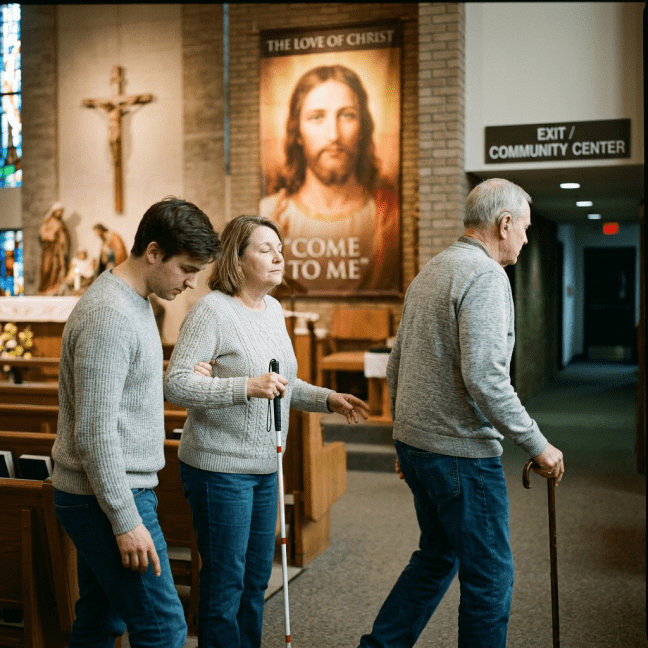
Woman with white cane being guided by two people in a church aisle

“Then I heard the Lord asking, “Whom should I send as a messenger to this people? Who will go for us?” I said, “Here I am. Send me.” And he said, “Yes, go, and say to this people, ‘Listen carefully, but do not understand. Watch closely, but learn nothing.’ Harden the hearts of these people. Plug their ears and shut their eyes. That way, they will not see with their eyes, nor hear with their ears, nor understand with their hearts and turn to me for healing.””
Isaiah 6:8-10 NLT

The Greek version of the Old Testament (Septuagint) puts a slightly different interpretation on verses 9-10 today, with: “And he said, Go and say to this people, ‘When you hear what I say, you will not understand. When you see what I do, you will not comprehend.’ For the hearts of these people are hardened, and their ears cannot hear, and they have closed their eyes— so their eyes cannot see, and their ears cannot hear, and their hearts cannot understand, and they cannot turn to me and let me heal them”. Regardless of the translation, however, Isaiah’s job was not going to be easy. He was ordained and commissioned to take God’s message to his people, but they were already predisposed to ignore what he said. So perhaps you ask, “What was the point”?

But what else could Isaiah do? The vision of the Lord and His holiness in the Temple had brought Isaiah to his knees in the realisation that he was a sinful man and, worse, his people were sinful as well. What followed was Isaiah’s atonement for his guilt and sin, as, symbolically, the burning coal touched his lips. Freed from sin, Isaiah was eager to answer the call of the Lord and to be His messenger to the people. No matter how hard it would be, Isaiah was God’s man for the impossible task of reaching the people, preaching a message given him by God.

What was this message that Isaiah was to say to his people, the inhabitants of Judah? Well, the first one would seem to be, “Listen carefully, but do not understand”. A strange message? What were the people supposed to be listening out for, and why would it be so hard to understand? There was only one message, and it was the same one that Isaiah received in the Temple. Compared to God’s holiness, Isaiah’s guilt and sin became exposed, and the only remedy was repentance. So Isaiah was commissioned to tell the people of Judah that their sins were so great that, unless they repented, they would be destroyed. A simple message, but the people were so steeped in their sin that they were unable to recognise God’s voice anymore. Yes, some form of worship was continuing in the Temple, but it had become corrupted and distorted by idolatrous practices that made it totally pointless. The people were deaf and blind to God’s message and ignored it as though it didn’t apply to them. But before we climb up onto the moral high ground, it might be worth asking God if we have any blind and deaf spots regarding sin in our own lives. It is quite likely that we do, and we need to deal with it, under God’s loving and gracious gaze.

Consider the following analogy. We all have smoke detectors installed in our homes, but consider the person who ignores theirs. After a while, they become so used to the loud sound that they learn to tune it out entirely. They hear the noise, but they refuse to understand the danger. Because the people of Judah had tuned out God’s message of the upcoming danger to themselves and their nation, they couldn’t hear it anymore.

Jesus’ disciples asked Him a question, “… Why do you use parables when you talk to the people?” (Matthew 13:10). Jesus replied, “To those who listen to my teaching, more understanding will be given, and they will have an abundance of knowledge. But for those who are not listening, even what little understanding they have will be taken away from them. That is why I use these parables, For they look, but they don’t really see. They hear, but they don’t really listen or understand” (Matthew 13:12-13). Jesus went on to quote our verses from Isaiah today, “This fulfils the prophecy of Isaiah that says, ‘When you hear what I say, you will not understand. When you see what I do, you will not comprehend. For the hearts of these people are hardened, and their ears cannot hear, and they have closed their eyes— so their eyes cannot see, and their ears cannot hear, and their hearts cannot understand, and they cannot turn to me and let me heal them’”.

We pilgrims have the same commission and message that Isaiah had, even though the occasions are separated by nearly three thousand years. Our Gospel message is readily available to the people around us, but as the people in the societies in which we live become more secular, it is increasingly tuned out by those who dispute its relevance. I often meet people who, in their defence, say that they are “good people” and God will never send them to hell. I can’t prejudge what will happen to these people one day before the Great White Throne (Revelation 20) – only God knows what the outcome will be – but the message we preach to those around us is the same as the one preached by Peter in Acts 2:38, “… Each of you must repent of your sins and turn to God, and be baptised in the name of Jesus Christ for the forgiveness of your sins. Then you will receive the gift of the Holy Spirit”. 

So we pray that God will lead us to the people who need to hear about His love and grace, but always aware that our message will mostly fall on deaf ears. Regarding His message, Jesus said, “To those who listen to my teaching, more understanding will be given, and they will have an abundance of knowledge. But for those who are not listening, even what little understanding they have will be taken away from them” (Matthew 13:12). As we know, even Jesus’ message was ignored by most of His people. But we pilgrims are obedient servants of our wonderful Saviour, and continue to share God’s love regardless of how it is received.

Dear Heavenly Father. Thank You for our salvation and for Jesus, who made it possible. Please help us and lead us to those who need to hear about You and Your saving grace, this day and every day. Amen.

Isaiah’s Call: Responding to God’s Message Today

Wheat field at sunset with orange and purple clouds and distant hills

“He touched my lips with it and said, “See, this coal has touched your lips. Now your guilt is removed, and your sins are forgiven.” Then I heard the Lord asking, “Whom should I send as a messenger to this people? Who will go for us?” I said, “Here I am. Send me.” And he said, “Yes, go, and say to this people, ‘Listen carefully, but do not understand. Watch closely, but learn nothing.’””
Isaiah 6:7-9 NLT

Imagine the relief that would have flooded over Isaiah, now that he was aware that his guilt was gone. That his sins had been forgiven. But he didn’t have much time to enjoy the occasion, because he heard the Lord speaking. God was asking a question, “Whom should I send as a messenger to this people? Who will go for us?” Isaiah couldn’t wait to respond to the question, and he immediately said, “Here I am. Send me.” 

We notice the “us” in the Lord’s question. Yet another example of our triune God, to add to other Scriptures such as Genesis 1:26a, “Then God said, ‘Let us make human beings in our image, to be like us.’ …”. The other thing that we notice is that, although God is all-powerful and can do all things, He asked for someone, a human being, to do His work for Him. God asked for a messenger, someone who would take His message to a people who were hard of spiritual hearing, who were unable to listen to a Word from God and act upon it. Sound familiar?

Isaiah had been cleansed of his guilt and sin by the Lord Himself that day in the Temple. He went there in a time of political upheaval and instability, perhaps hoping for some direction and insight from God about what would happen now, and instead, he came out a totally transformed man with a message from God that not only encouraged him, but would encourage others, if they would listen, that is.

Did we pilgrims experience an overpowering sense of relief when we discovered that Jesus had forgiven us for all our sins? Many Christians do, and some go on to be active messengers for God, hearing the call to take His message to a people who are hard of hearing. Spiritual deafness is prevalent in the 21st-century, just as it was in Isaiah’s day.

I can think of two men who were involved in drugs and who were released from their addiction through the power of God. Each of them was so overwhelmed by what God had done for them that they became evangelists, one on a foreign mission field, and the other in the very area of Glasgow where he had become involved in drugs in the first place. But we pilgrims are called to take God’s message to those around us as well. The same question that God asked in the Temple still hangs in the air today. We read what Jesus said about evangelism in Matthew 9:36-38, “When he saw the crowds, he had compassion on them because they were confused and helpless, like sheep without a shepherd. He said to his disciples, “The harvest is great, but the workers are few. So pray to the Lord who is in charge of the harvest; ask him to send more workers into his fields””. 

I meet many people who are “confused and helpless” inside, even though on the outside they are full of self-confidence. A few gentle questions, if an opportunity arises, soon expose a deep yearning for something more. Some people will object almost angrily to the idea that there is a God with a message of hope. They know the truth of course, but a reminder is often not well received.

So, I would encourage all pilgrims everywhere to respond to the call of God. Instead of responding, “Here I am. Send me”, we must answer with our names, personalising the call and confirming our willingness to take the Good News about Jesus to those who are “confused and helpless, like sheep without a shepherd”. Jesus could see the need. He knows where there is a harvest, and He also knows that there are willing helpers, fellow pilgrims like you and I, just needing a little push, some encouragement, to get out there and do something for God. 

Dear Lord Jesus. The harvest is waiting for the workers to bring it in. Please guide us to the right places, the right people, so that we can do what You have asked us to. In Your precious name. Amen.

Isaiah’s Vision: The Power of Forgiveness and Transformation

“Then I said, “It’s all over! I am doomed, for I am a sinful man. I have filthy lips, and I live among a people with filthy lips. Yet I have seen the King, the Lord of Heaven’s Armies.” Then one of the seraphim flew to me with a burning coal he had taken from the altar with a pair of tongs. He touched my lips with it and said, “See, this coal has touched your lips. Now your guilt is removed, and your sins are forgiven.””
Isaiah 6:5-7 NLT

The vision of God in the Temple was a life-changing experience for Isaiah, and the first thing he encountered was his sin. His vision of the Lord included seraphim, six-winged beings who were constantly calling out to each other, “… Holy, holy, holy is the Lord of hosts; The whole earth is full of His glory!” (Isaiah 6:3), and the sound and presence of their voices “shook the Temple to its foundations”. A scary experience, but instead of a terror response in fear and trembling, Isaiah becomes very aware of his sin. In the presence of our holy God, everyone, sooner or later, will be confronted by their sin. But Isaiah also became aware of his “filthy lips”, a condition that also impacted all the people he lived with. As we considered yesterday, it is through a person’s lips that come the thoughts and desires of their hearts, and in his innermost being, Isaiah became aware that he was corrupted by sin, and the fruit of that came from his sinful lips. Rightly, without a remedy, he concluded that he was “doomed”

But burning coals as a remedy? The temple would have had a fire burning on the altar, as we know from Leviticus 6:13, from the instructions given to Aaron, “Remember, the fire must be kept burning on the altar at all times. It must never go out”. Was the coal a real ember from the fire or was it a spiritual experience? In this context, I think the coal was taken from the Heavenly altar, which represents the place of sacrifice, atonement, and the presence of God. The book of Revelation contains several references to an altar in Heaven, such as Revelation 8:3, 5, “Then another angel with a gold incense burner came and stood at the altar. And a great amount of incense was given to him to mix with the prayers of God’s people as an offering on the gold altar before the throne. … Then the angel filled the incense burner with fire from the altar and threw it down upon the earth; and thunder crashed, lightning flashed, and there was a terrible earthquake”. The altar in the Temple, complete with its fire, was no more than an earthly copy, a “type” of what was in Heaven. 

The act of touching Isaiah’s lips with the burning coal was life-changing because it cleansed him from his guilt and sin. His guilt was removed, and his sins were forgiven. But were Isaiah’s lips permanently damaged by the contact with the coal? We don’t know, but we do know that this was the point when he was ordained to a prophetic ministry to his people.

We pilgrims of the New Covenant are in a different season than that of Isaiah’s, nearly three thousand years ago. No Temple, no animal sacrifices, and a society that was very different to ours. But there are similarities: people then and today are burdened by their guilt and sin. Jesus said to Nicodemus, “God sent his Son into the world not to judge the world, but to save the world through him” (John 3:17). He also said, “For the Son of Man came to seek and save those who are lost” (Luke 19:10). Jesus’ mission was clear, and He constantly reached out in compassion to those who were sinners. We think of Zacchaeus, or the woman caught in adultery and others. He told the parable of the lost sheep, and we read in Luke 15:4, “If a man has a hundred sheep and one of them gets lost, what will he do? Won’t he leave the ninety-nine others in the wilderness and go to search for the one that is lost until he finds it?” In the parable of the Lost Son, we read that the Father constantly looked out for the return of the prodigal, and when he saw that he was coming, He ran to meet and greet him, something even more significant when we realise that running was considered undignified in those days. God will go to extraordinary lengths to ease the transition from guilt and sin to forgiveness and spiritual cleansing. 

The people around us are burdened by their guilt and sin, and we pilgrims know the remedy. Our encounters with the risen Jesus changed us from the inside, and we are now able to stand in God’s presence, with our guilt removed and our sins forgiven.

Dear Heavenly Father. Thank You for Jesus, without whom we would still be lost in our sins. Thank You for Your love and grace. Amen.

From Filthy Lips to Grace: A Biblical Reflection

“They were calling out to each other, “Holy, holy, holy is the Lord of Heaven’s Armies! The whole earth is filled with his glory!” Their voices shook the Temple to its foundations, and the entire building was filled with smoke. Then I said, “It’s all over! I am doomed, for I am a sinful man. I have filthy lips, and I live among a people with filthy lips. Yet I have seen the King, the Lord of Heaven’s Armies.””
Isaiah 6:3-5 NLT

Faced with a vision of God and His holiness, Isaiah immediately could see how sinful he was. It was as though he held up a mirror and immediately saw himself through God’s eyes, his sin being displayed before him and leading him to exclaim, “I am doomed”. But he continued with the realisation that he had “filthy lips”. Other translations are a little more genteel and refer to “unclean lips”, but the meaning is the same. In ancient Hebrew thought, the mouth revealed what was truly inside a person. By admitting his words were corrupt, Isaiah was confessing that his own heart—and the rebellious society of Judah he lived among—was spiritually defiled. 

We can read in Matthew’s Gospel what Jesus said about “filthy lips”: “Then Jesus called to the crowd to come and hear. “Listen,” he said, “and try to understand. It’s not what goes into your mouth that defiles you; you are defiled by the words that come out of your mouth”” (Matthew 15:10-11). A little later, His disciples asked Him to explain further, and we read, ““Don’t you understand yet?” Jesus asked. “Anything you eat passes through the stomach and then goes into the sewer. But the words you speak come from the heart—that’s what defiles you. For from the heart come evil thoughts, murder, adultery, all sexual immorality, theft, lying, and slander. These are what defile you. Eating with unwashed hands will never defile you”” (Matthew 15:16-20). 

Isaiah was brought face-to-face with his uncleanness and sin because he could see what he was like from God’s perspective. But regardless of that, he had received a vision of “the King, the Lord of Heaven’s Armies”. Consequently, he could see no remedy for his uncleanness and considered himself “doomed”. Presumably, he expected to be zapped on the spot and find himself in a place where sinners will eventually end up. But what a revelation! 

Today, we pilgrims have “filthy lips, and … live among a people with filthy lips” as well. We know that, and we haven’t even seen the Lord as Isaiah did. In his day, Isaiah would have obeyed all the traditions and rituals defined in the Law of Moses and would have assumed his righteousness. So it must have been a bit of a shock to be suddenly exposed to his real state before God. But we pilgrims have a remedy for sin that was not available to Isaiah. We are the children of a New Covenant, brought to us by the love and grace of God and the sacrifice of Jesus, who took on board Himself the punishment we deserve for our sins and “filthy lips”

We must never take such grace for granted, becoming blasé and almost over-familiar with God. What Jesus did for us was an act of love and grace so far-reaching and mind-boggling that, had Isaiah been in our shoes. He would immediately have fallen prostrate before the Lord in worship. Have we pilgrims had a vision of the Lord “high and lifted up” in a church somewhere, or is our vision one of a cross in a corner of Jerusalem two thousand years ago? A cross where the Son of God was crucified by a sinful people with the same “filthy lips” that we have. Were we there in that crowd calling for His death? 

The old Negro spiritual had these words, Were you there when they crucified my Lord? / Were you there when they crucified my Lord? / Oh, sometimes it causes me to tremble, tremble, tremble. / Were you there when they crucified my Lord? The people who penned those words got it. They knew how much it cost God to send His Son to die for us. They “trembled” and so must we, in a place of deep gratitude and worship. On our knees or even prostrate in worship if necessary, because that is what God deserves. 

O Lord. Please forgive us for our sins and “filthy lips”. Your grace and love is without limit and we worship You today. Amen.

The Vision of Isaiah: God’s Eternal Authority

Glowing angels flying around a golden throne inside an ornate cathedral

It was in the year King Uzziah died that I saw the Lord. He was sitting on a lofty throne, and the train of his robe filled the Temple. Attending him were mighty seraphim, each having six wings. With two wings they covered their faces, with two they covered their feet, and with two they flew. They were calling out to each other, “Holy, holy, holy is the Lord of Heaven’s Armies! The whole earth is filled with his glory!” Their voices shook the Temple to its foundations, and the entire building was filled with smoke.”
Isaiah 6:1-4 NLT

Isaiah went to the Temple. Probably nothing unusual about that because I’m sure that he had been there many times before. But there were two things that were significant. King Uzziah had died, and Isaiah saw a vision of the Lord.

Who was King Uzziah? 2 Chronicles 26:3-5, “Uzziah was sixteen years old when he became king, and he reigned in Jerusalem fifty-two years. His mother was Jecoliah from Jerusalem. He did what was pleasing in the Lord’s sight, just as his father, Amaziah, had done. Uzziah sought God during the days of Zechariah, who taught him to fear God. And as long as the king sought guidance from the Lord, God gave him success”. Uzziah was one of the good kings of Judah, and his reign from 790 to 739 BC was long and successful. But on his death, Isaiah would not have been alone in feeling a bit wobbly after such a long time of political stability and prosperity. So what did he do? Isaiah went to the temple. 

In his Temple vision, the first thing that Isaiah saw was the Lord sitting on a throne. A “lofty throne”. A throne signifies a seat of power and authority, and the first message from his vision was that God was still in control. He was still the Creator of the Universe. He was still the God who had the world and its people in the palm of His hand. It was only through Him that world events could happen. In his vision, Isaiah saw that the Lord was wearing a robe, the “train” of which filled the entire space. God is complete and can fill every corner of our lives, should we let Him. The message to Isaiah was that although human beings, including kings, live and then die, God lives forever. He is eternal. He is the all-powerful Omnipresent, Omniscient and Omnipotent God. Three words that describe how complete God is. 

The vision continued with seraphim (literally “fiery ones”), each attending the Lord. They had six wings, two covering their faces (showing God the proper respect and awe), two covering their feet (signifying humility) and two with which to fly, enabling their work of service to the Lord. And they called out to each other, “Holy, holy, holy is the Lord of Heaven’s Armies! The whole earth is filled with his glory!” Why did they say “Holy” three times? To emphasise the absolute, supreme perfection of God’s character. Something perhaps to remember when we sing Heber’s hymn “Holy, Holy, Holy, Lord God Almighty”. Finally, and for good measure, the Temple shook and filled with smoke, signifying the awe-inspiring, unapproachable weight and power of God’s glory. What a vision! What an experience! Nothing man-made then or now could ever have replaced what Isaiah experienced that day. 

As we fast forward to the 21st Century, we consider our nation here in the UK and thank God that we have had a period of relative stability since the end of the Second World War, eighty years or so of living in a war-free society. But we live in a different age now. Technology has changed dramatically, impacting every aspect of our lives. Medical advances are now able to do amazing things in curing all sorts of conditions and diseases. But on the downside, modern weapons of war have the capability to destroy the whole world several times over, should they be used. Are we in an age of stability? Or should we be finding our equivalent of the Jerusalem Temple? 

As we will discover, the vision totally changed and supercharged Isaiah’s life and ministry. In the Bible, there are recorded occasional miraculous revelations that brought about a new move of God. Paul was another example, as the light of Jesus flooded around Him and a voice spoke out that day on the Damascus Road. Paul’s life was totally turned around, and he went from persecuting the early Christians to being their biggest proponent, establishing churches throughout the Middle East. 

Have we pilgrims had such a revelation as Isaiah’s? Do we have the faith to expect one? In years past, God has graciously revealed Himself to me, once through a vision and, on another occasion, through a voice, but nowhere near what Isaiah saw. But in these days of global insecurity, we should be praying for our nation, that God’s peace will prevail. That politicians will emerge with the vision to lead the nations God’s way and not the devil’s. That we will find opportunities to reach out to the people around us with God’s message of hope. And we must keep praying because God hears our prayers, and our fervour in their delivery. Age and health are no barrier to our service in prayer – after all, the Hebridean revival started with the prayers of two old ladies in their eighties, one blind and the other crippled with arthritis. And we never know – God may answer our prayers with a vision of Him so powerful that we will be, like Isaiah, changed forever. 

Dear Father God. In awe and worship, we bow before You today, putting aside our fears because we know that You are still on Your throne. Thank You. Amen. 

Exile and Captivity

“He will send a signal to distant nations far away and whistle to those at the ends of the earth. They will come racing toward Jerusalem. They will not get tired or stumble. They will not stop for rest or sleep. Not a belt will be loose, not a sandal strap broken. Their arrows will be sharp and their bows ready for battle. Sparks will fly from their horses’ hooves, and the wheels of their chariots will spin like a whirlwind. They will roar like lions, like the strongest of lions. Growling, they will pounce on their victims and carry them off, and no one will be there to rescue them. They will roar over their victims on that day of destruction like the roaring of the sea. If someone looks across the land, only darkness and distress will be seen; even the light will be darkened by clouds.”
Isaiah 5:26-30 NLT

A scene of devastation marks Isaiah’s vision, as God calls upon foreign nations to administer His judgment over Judah. Wonderfully poetic language graphically describes the invading forces and their motivation to complete the day of destruction, leaving the land full of darkness and distress. Miraculously, in a way, the invading army will not suffer the usual irritations, like breakdowns in military equipment. What a terrible day that would be for the Judaeans, but we know from our historians that the exile took place in 586 BC, because the people never turned from their sinful ways. 

Did the people of Judah, languishing in captivity, ever regret what happened to them? Did they remember their sinful ways once more and long again for their parties, their drunken orgies, and their idol worship? Or did they finally come to their senses and decide to turn back to God? Psalm 137 provides a partial answer: “Beside the rivers of Babylon, we sat and wept as we thought of Jerusalem. We put away our harps, hanging them on the branches of poplar trees. For our captors demanded a song from us. Our tormentors insisted on a joyful hymn: “Sing us one of those songs of Jerusalem!” But how can we sing the songs of the Lord while in a pagan land?” (Psalm 137:1-4). 

Jesus Himself could see what would happen to Jerusalem much later in history. He knew what was going to happen within a few years of His death, as recorded in Matthew 24:1-2, “As Jesus was leaving the Temple grounds, his disciples pointed out to him the various Temple buildings. But he responded, “Do you see all these buildings? I tell you the truth, they will be completely demolished. Not one stone will be left on top of another!”” Jesus entered Jerusalem on the day we now call Palm Sunday. In the Jewish calendar, this took place just before the Passover festival. He wept over Jerusalem, as we read in Luke 19:41-44, “But as he came closer to Jerusalem and saw the city ahead, he began to weep. “How I wish today that you of all people would understand the way to peace. But now it is too late, and peace is hidden from your eyes. Before long your enemies will build ramparts against your walls and encircle you and close in on you from every side. They will crush you into the ground, and your children with you. Your enemies will not leave a single stone in place, because you did not recognise it when God visited you””. Once again, the Jewish people had rejected God’s care and compassion, even to the extent, as we know, of killing His Son.

But God never gave up on His Covenant with His chosen people. There will be another day, yet to come, when an invading army will once again approach Jerusalem. In Revelation 19:19-21, we read, “Then I saw the beast and the kings of the world and their armies gathered together to fight against the one sitting on the horse and his army. And the beast was captured, and with him the false prophet who did mighty miracles on behalf of the beast—miracles that deceived all who had accepted the mark of the beast and who worshipped his statue. Both the beast and his false prophet were thrown alive into the fiery lake of burning sulphur. Their entire army was killed by the sharp sword that came from the mouth of the one riding the white horse. And the vultures all gorged themselves on the dead bodies”

We pilgrims worship a faithful God, who has throughout history always loved His people, first the Jews and now the Gentiles. We know that He sent His Son, Jesus, to be the One who saved us from our sins, an act of love that sets Christianity apart from any other religion. Jesus said He was “the way, the truth and the life” and still is today. We pilgrims have the opportunity to extend God’s love to those around us in this season of grace, secure in the knowledge that His mercies are new every morning to those who love him.

Dear Father God. We praise and worship You today, the God of love and grace. Amen.