Understanding Our Identity as God’s Temple

And what union can there be between God’s temple and idols? For we are the temple of the living God. As God said: “I will live in them and walk among them. I will be their God, and they will be my people. 
Therefore, come out from among unbelievers, and separate yourselves from them, says the Lord. Don’t touch their filthy things, and I will welcome you. 
And I will be your Father, and you will be my sons and daughters, says the Lord Almighty”.
2 Corinthians 6:16-18 NLT

Paul’s knowledge of the Bible was extraordinary. Here, at the end of 2 Corinthians 6, he quoted three Old Testament verses in succession, all focused on the relationship that believers have with their Heavenly Father. The first was from Leviticus 26:12, “I will walk among you; I will be your God, and you will be my people”. The second was taken from Isaiah 52:11, “Get out! Get out and leave your captivity, where everything you touch is unclean. Get out of there and purify yourselves, you who carry home the sacred objects of the Lord”. And the last was taken from 2 Samuel 7:14, “I will be his father, and he will be my son. If he sins, I will correct and discipline him with the rod, like any father would do”. It is interesting that Paul’s quotations were not word perfect by a long way, but allowance has to be made for the translations from one language to another, and the context in which they were quoted. How many of us have a memory like Paul’s?

We remember that, in the context in which Paul was writing, these verses referred to believers as God’s Temple, and this will have a significant impact on their relationship with God. Think about it for a moment. God lives within us. He walks with us as we go about our daily lives. He is there in our thoughts, and He feels our pain when we hurt. Being God’s Temple is all about our relationship with our Heavenly Father. 

But in all of that, there is one thing that must prevail, and that is that being in a relationship with God means that other relationships must be discarded. These verses that Paul quoted paint a picture of separation from the things of the world, things incompatible with God and His Kingdom. We live in the world, but we do not belong to its values, its idols, or its compromises. When Paul speaks of not touching “their filthy things,” he is calling believers away from the spiritual contamination of idolatry, moral compromise, and divided loyalty. Jesus said, “I’m not asking you to take them out of the world, but to keep them safe from the evil one. They do not belong to this world any more than I do” (John 17:15-16). In some ways, it is preferable to be taken out of this world because it is hard to live here as a Christian sometimes. But God has given us a job to do on His behalf, and in the process, He provides the opportunity for us to grow in the faith and become more like Jesus. This life is a training ground for the life to come.

Paul wrote, “I will be your Father, and you will be my sons and daughters, says the Lord Almighty”. Look at the tender welcome in God’s statement. His love and grace are palpably present and are a promise for all those who come to Him. Separation from the world, from sin and evil, is no loss when we realise it opens the door to a deep relationship with the Creator of the Universe. In Romans 8:15, Paul wrote, “So you have not received a spirit that makes you fearful slaves. Instead, you received God’s Spirit when he adopted you as his own children. Now we call him, “Abba, Father””. The relationship we have with God is so intimate that we can call Him “Daddy” (Abba is the Aramaic word for Daddy). 

Now we call him, “Abba, Father“”

If we truly grasp that we are God’s temple, we guard what we allow into our hearts. Our “eye gates” can be a problem so we need to be careful about what we watch on TV or in the cinema. Similarly, we carefully examine what influences shape us. These days, news reports and social media posts can be an evil and disruptive factor in our thoughts and decisions. Because we love God, we pursue living a life of separation from worldliness, conscious of how debilitating that can be to our spiritual lives. And through all that we do, we are conscious that God Himself walks with us. Let’s pause for a moment and focus our thoughts. The Lord Almighty—the sovereign, all-powerful God—chooses to dwell in and with His people and call them His sons and daughters. What greater privilege could there be? We pilgrims are truly a blessed people.

Dear loving Heavenly Father, thank You that You dwell within us by Your Spirit. Help us to live as Your holy temple. Give us courage to separate from anything that dishonours You, and draw us deeper into the joy of being Your sons and daughters. For Jesus’ sake. Amen.

Understanding Our Role as God’s Temple

“What harmony can there be between Christ and the devil? How can a believer be a partner with an unbeliever? And what union can there be between God’s temple and idols? For we are the temple of the living God. As God said: “I will live in them and walk among them. I will be their God, and they will be my people.”
2 Corinthians 6:15-16 NLT

The Temple in Jerusalem was sacred to the Jews. The first one, built by Solomon, David’s son, and using materials David had accumulated in the last years of his reign and life, was magnificent. It was built around 959 BC and lasted for 400 years until it was destroyed by Nebuchadnezzar and his forces in 586 BC. The second Temple was built under the guidance of Zerubbabel about 70 years later and lasted until 70 AD, when the Romans destroyed it. And that is the situation that still stands today. There will be a future Temple in the New Jerusalem, but this one will be very different. Revelation 21:22, “I saw no temple in the city, for the Lord God Almighty and the Lamb are its temple”. Jews today have mixed views about the Temple, with some of the orthodox persuasions expecting such a building to appear through Divine providence, perhaps with the coming of the Messiah.

Early in His ministry, Jesus visited the Temple in Jerusalem and cleared the merchants from the courtyard. John 2:16, “Then, going over to the people who sold doves, he told them, “Get these things out of here. Stop turning my Father’s house into a marketplace!”” The Jewish leaders weren’t too happy about this and in the following verses in John we read, “But the Jewish leaders demanded, “What are you doing? If God gave you authority to do this, show us a miraculous sign to prove it.” “All right,” Jesus replied. “Destroy this temple, and in three days I will raise it up.” “What!” they exclaimed. “It has taken forty-six years to build this Temple, and you can rebuild it in three days?” But when Jesus said “this temple,” he meant his own body”. And that introduces us to Paul’s New Covenant pronouncement that “we are the temple of the living God”. Paul said to the Corinthians in his first letter, “Don’t you realise that your body is the temple of the Holy Spirit, who lives in you and was given to you by God? You do not belong to yourself” (1 Corinthians 6:19). 

In our verses today, Paul asked the question, “How can a believer be a partner with an unbeliever? And what union can there be between God’s temple and idols?” The picture emerges of the Temple, pure and holy, the place where God lives, and then someone brings in an idol and starts worshipping it. Those who knew the law of Moses would immediately declare such a person as being worthy of death under the laws of the nation of Israel. Worshipping idols in the Temple would have been unthinkable to a Jew, but Paul associated this picture with the partnership between a believer and an unbeliever. Those of us who are believers, pilgrims like us who are in Christ, are now God’s temple on earth. His Spirit occupies every believer in Jesus. With that understanding, Paul’s meaning is clear. Any believer who participates in the worship of an idol is guilty of betraying God in the same way as someone worshiping an idol in the Jewish temple.

There are two implications of being God’s Temple, where the Holy Spirit lives. Personally, each believer has a responsibility to maintain a Temple free of idolatry, immorality, and all manner of sin. We call that being sanctified. The Temple within us is a place where God is glorified. Each believer is also part of a Temple that consists of all believers. 1 Corinthians 3:16-17, “Don’t you realise that all of you together are the temple of God and that the Spirit of God lives in you? God will destroy anyone who destroys this temple. For God’s temple is holy, and you are that temple. ” Peter also wrote about this in 1 Peter 2:5, “And you are living stones that God is building into his spiritual temple. What’s more, you are his holy priests. Through the mediation of Jesus Christ, you offer spiritual sacrifices that please God”

Paul continued to quote Leviticus 26:12, “I will walk among you; I will be your God, and you will be my people”. It is an awesome and holy situation to be the place where God dwells. No more of a physical building, an entity outside of us. Instead, through our own holiness, we become “living stones”, a corporate building full of God and His Spirit. However, if that was the case, what is stopping the church from being a force far beyond anything ever seen on this planet? God walking around this world inside a huge human Temple? But of course, this is a spiritual Temple, unrecognisable by the secular society in which we live. We “living stones” do God’s work in the lives and communities of people around us. We are the “salt and light”, ensuring that God’s Temple continues to live and hold back the forces of evil that would otherwise overwhelm and destroy this world in which we live. 

So, fellow pilgrims and “living stones”, what strategy do we have in place to ensure that the Holy Spirit will continue to dwell within us? It is sin that destroys that union, but we know that, and we do our utmost to live lives worthy of the One who died for us.

Dear Heavenly Father. We thank You for all that You have done for us. Help us, we pray, to live in a way that is worthy of You and Your Spirit. Amen.

The House of God

“Because of your unfailing love, I can enter your house; I will worship at your Temple with deepest awe. Lead me in the right path, O Lord, or my enemies will conquer me. Make your way plain for me to follow.
Psalm 5:7-8 NLT

David was perhaps on a bit of an emotional roller coaster as he wrote this Psalm. He woke up crying for help and groaning in misery. He then reminded God of the wicked people around and how God could not entertain any contact with them, and he then relaxed into familiar territory, with thoughts of the Temple, the House of God. There, David knew he could find a place where there was spiritual solace and security with His Lord and God. David recognised that the reason he could go to the Temple was because of God’s “unfailing love”. And it was there that he could worship the Lord “with deepest awe”. Touching base again with God, David found that his perspective changed and he saw the need to trust the Lord in the difficult military and political situations before him.

There is of course much here that is of help to us pilgrims. Because God loves us, we can enter His presence at any time. But are we sure of that? Psalm 24:3-4, “Who may climb the mountain of the Lord? Who may stand in his holy place? Only those whose hands and hearts are pure, who do not worship idols and never tell lies”. There are of course prerequisites to entering into God’s presence. But once there, and assured of His love, our spirits turn to worship. Worship of our wonderful Heavenly Father and no-one else. In His presence the reality of who He is floods over us, and with the “deepest awe” we bow at His feet. We of course do not need to be in Jerusalem, in the Temple as David was. Neither do we need to enter one of the many churches and cathedrals that abound in our nation. In the quiet of our closets we find God and the opportunity for worship. My “closet” is often the natural world around me, where the Creator can be found in His creation. 

We also find that out of our worship experience God speaks to us through His Spirit. He gently nudges us towards the right paths. He reviews with us our current perspectives and offers alternatives. He points out anything within us that shouldn’t be there. A spiritual cleansing results and “makes [His] way plain for [us] to follow”. 

Love and worship. The very essence of our relationship with God. The powerhouse of pilgrim life. There is no better way.

Dear Heavenly Father. Please forgive us for the times when we try and exclude You from our lives and stumble into error, and places where we shouldn’t be. Amen.

The Holy City (4)

“I saw no temple in the city, for the Lord God Almighty and the Lamb are its temple. And the city has no need of sun or moon, for the glory of God illuminates the city, and the Lamb is its light.”
‭Revelation‬ ‭21‬:‭22‬-‭23‬ ‭NLT

There will be three things missing from the New Jerusalem. No temple, no sun and no moon. As we think about the implications of this, our minds start to struggle a bit. To Western Christians, the lack of the Temple, or even any churches, would not seem to be too much of a big deal. But to the Jews, the Temple was the focal point of their experience of God. So for there not to be one, in theory it could be a great disappointment for them. 

The lack of a sun and moon would be a problem for everyone. We look at the sun as a celestial body that has always been there, a fundamental object providing us with light and warmth, and the presence of the moon a reassuring constancy during the dark and sun-less hours. But we have to remember that earlier in this chapter John “ … saw a new heaven and a new earth, for the old heaven and the old earth had disappeared. And the sea was also gone.” (Revelation‬ ‭21‬:‭1‬ ‭NLT‬‬). We don’t know if all the celestial objects that fill the universe disappeared as well. But we do know that there will be a new Heaven and a new earth. There will be a New Jerusalem there and “the glory of God illuminates the city, and the Lamb is its light”. 

So what does the glory of God look like? If we are thinking of a sun or moon replacement, then we have fallen far short of what the glory of God is. It’s not a natural light and heat source that will be illuminating the Holy City. Our perception of the sun is bounded by our human senses – our eyes for the light and our nerves within our skin to detect heat. If we look in the Bible we can get a glimpse of what the glory of God is. It’s His beauty, and His character, for starters. It says in Isaiah 43:7, that we are His glory – “Bring all who claim me as their God, for I have made them for my glory. It was I who created them”.  Hebrews 1:3a tells us about the glory of God’s Son, Jesus. We read, “The Son radiates God’s own glory and expresses the very character of God, … ”. And in a sense, His glory is within us. We read in 2 Corinthians 4:6, “For God, who said, “Let there be light in the darkness,” has made this light shine in our hearts so we could know the glory of God that is seen in the face of Jesus Christ.” There was an intriguing dialogue between Jesus and His Father, that John recorded in his Gospel. Jesus said, “Father, bring glory to Your name.” Then a voice spoke from heaven, saying, “I have already brought glory to My name, and I will do so again.”” (John 12:28). But all of this hardly scratches the surface of what God’s glory is. We may be able to have a go at listing all the attributes and adjectives that describe God’s glory, but what will be lacking from our words is that complete experience of what it means to see at first hand the glory of God.

When we pilgrims consider the glory of God I’m sure we agree that it is something far beyond anything we can get our minds around. The Apostle Paul perceptively summed up our limited God-experience, as we read in 1 Corinthians 13:12, “Now we see things imperfectly, like puzzling reflections in a mirror, but then we will see everything with perfect clarity. All that I know now is partial and incomplete, but then I will know everything completely, just as God now knows me completely“. 

But we pray that we will get to know God better. One day we will find out what His glory is really like and I suspect we will be saying “Wow!” for all eternity.

Father God. What can we say or do other than fall on our knees in worship to You. words cannot describe Your wonder, Your glory. Amen.

The Temple of the Holy Spirit

“Then I looked and saw that the Temple in heaven, God’s Tabernacle, was thrown wide open. The seven angels who were holding the seven plagues came out of the Temple. They were clothed in spotless white linen with gold sashes across their chests.”
Revelation‬ ‭15:5-6 NLT

God’s house in Heaven is open. Wide open. But why should there be a Temple in Heaven? One reason could be that it has been ordained by God. He gave Moses detailed instructions about what would be a suitable place for Him to live in when on earth. It’s a fascinating set of ancient blueprints delivered, not as a set of architectural drawings, complete with material specifications and fabric requirements, but as a written set of instructions, embellished with guidance from the Holy Spirit when needed. In Exodus 25:8-9, God said to Moses, “Have the people of Israel build me a holy sanctuary so I can live among them. You must build this Tabernacle and its furnishings exactly according to the pattern I will show you”. Perhaps God gave Moses a picture of how the Tabernacle would look and he wrote down the “pattern” for subsequent generations to follow, if necessary. But notice it wasn’t either God or Moses who built the original Tabernacle – it was the people. Ordinary, everyday, people who used to be slaves in Egypt. The instructions that God gave Moses for building the Tabernacle were incredibly detailed, even down to the quantities of materials. Don’t forget that Moses was not a qualified architect, designer or quantity surveyor – he had been a sheep farmer for most of his life. But God is our Heavenly Architect who knows everything. So Moses, and the obedient people, built a home for God.

Are we pilgrims Tabernacle builders or do we lack interest in doing such a thing? Do we need a Tabernacle today, to act as a home for God, or do we find such a concept unnecessary? Of course, in these times of the New Covenant, there is no need for a physical building to focus our worship, though this has not always been the case. Just look at the amazing cathedrals and churches that have been built over the centuries, to act as places of worship. That fact that so many of them are still standing today is a testimony to the skills of the architects and construction workers of bygone years. 

So we can, rather smugly perhaps, look back at the paraphernalia of the Old Testament accounts of the Tabernacle and the Temple and think such things are of no relevance for modern day pilgrims. That is, until we read in 1 Corinthians 6:19, “Don’t you realise that your body is the temple of the Holy Spirit, who lives in you and was given to you by God? You do not belong to yourself,”. The Temple of the Old Testament becomes our bodies in the New Covenant. And all of a sudden, as the penny drops, as the implications of what this means hits us, we see the importance of the Temple, God’s Tabernacle. There was nothing impure and unholy in the Old Testament Tabernacle and Temple. And the Temple within us has the same requirement. We are called to be pure and holy, a fit place in which God can dwell. In 1 Peter 1:14-16 we read, “So you must live as God’s obedient children. Don’t slip back into your old ways of living to satisfy your own desires. You didn’t know any better then. But now you must be holy in everything you do, just as God who chose you is holy. For the Scriptures say, “You must be holy because I am holy””. Of course, no-one can ever achieve this holy state, totally conforming to God’s definition of holiness, through their own efforts. It is only through faith in the cleansing power of Jesus’ blood that we can stand righteous and holy before our Heavenly Father, becoming a temple fit for Him to live in.

Dear Lord, how can we ever thank You enough? You gave up Heaven to join mankind on earth so that You could show us the way home. Thank You. Amen.

The Temple in Heaven

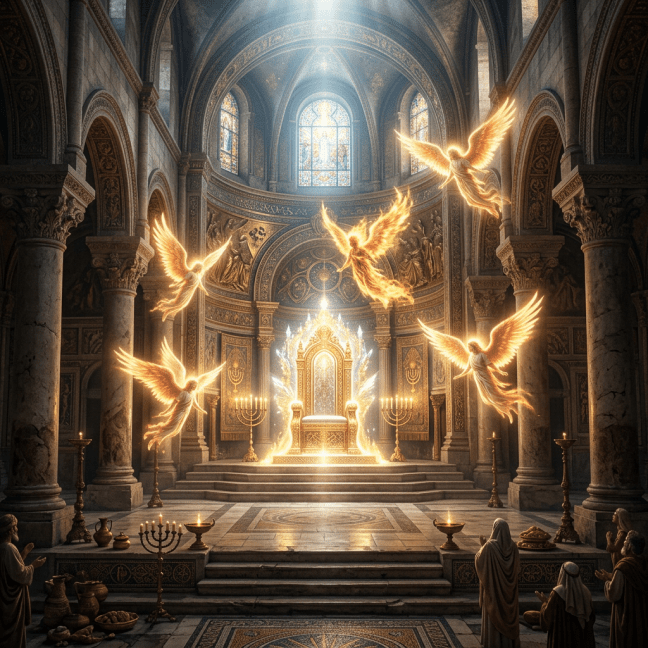
“Then I looked and saw that the Temple in heaven, God’s Tabernacle, was thrown wide open. The seven angels who were holding the seven plagues came out of the Temple. They were clothed in spotless white linen with gold sashes across their chests.”
Revelation‬ ‭15:5-6 NLT

For anyone who is of a religiously non-conformist outlook, all these references to the Temple, “God’s Tabernacle”, may seem a bit strange. Particularly if their church-going involves a rented room in a hotel or conference centre, or even a bare utilitarian building of the Presbyterian faith. But to the Jews of old, the Temple had a significance far beyond its architecture.

John’s vision of Heaven was incredibly detailed and he seemed to be able to zoom in and out picking up details of this wonderful place. So far we have seen God’s throne there, with other thrones occupied by twenty four elders. We have seen a glassy sea intermingled with fire. Countless martyrs with harps. Four “living beings” of a form unknown in our earth-bound experiences. And the music and song emanating from Heavenly choirs was breathtakingly beautiful. But now John’s vision exposes the Temple. John rubbed the spiritual sleep from his eyes as he noticed that the Temple was wide open. A bit like one of these artist’s impressions of how a building looks inside but from without. Even like a film set, where the cameras have unfettered access from outside a room but giving the impression that the viewer is inside along with the actors. The Temple was wide open. God’s Tabernacle was internally visible to all those qualified to be in Heaven with Him – and of course John through his vision.

There was another time when God exposed His earthly home. When Jesus died on the cross, something significant happened in the Temple, the building in Jerusalem at that time. We pick up the narrative in Matthew 27:50-51, “Then Jesus shouted out again, and he released his spirit. At that moment the curtain in the sanctuary of the Temple was torn in two, from top to bottom…”. The curtain was a very heavy and thick piece of fabric that hid the Most Holy Place from outside scrutiny. It was only entered once a year by the priest on duty. He entered with considerable fear and trepidation, to the extent that he had a cord tied to one of his ankles, so that he could be pulled out by those outside the curtain, in the event that God had zapped him because of some misdemeanour. There’s a fascinating story about one of the priests in Luke 1, called Zechariah. He was the father of John the Baptist. We read, “One day Zechariah was serving God in the Temple, for his order was on duty that week. As was the custom of the priests, he was chosen by lot to enter the sanctuary of the Lord and burn incense. While Zechariah was in the sanctuary, an angel of the Lord appeared to him, standing to the right of the incense altar….. Meanwhile, the people were waiting for Zechariah to come out of the sanctuary, wondering why he was taking so long. When he finally did come out, he couldn’t speak to them. Then they realised from his gestures and his silence that he must have seen a vision in the sanctuary.” (‭‭Luke‬ ‭1:8-9, 11, 21-22‬ ‭NLT). The Jews expected something significant to be associated with the Temple, God’s Tabernacle.

But here we have in John’s vision God’s Temple exposed for all those in Heaven to see. God and His presence totally transparent and visible. Any relevance here for 21st Century pilgrims? Yes there is, because when Jesus died, the veil, that heavy and dense curtain, was torn in two. Not just a little tear in a corner, but a total schism from top to bottom. I visualise it as the complete disintegration of the curtain, which ended up as a pile of dust on the Temple floor. We read about the significance of this in Hebrews 10:20-22, “By his death, Jesus opened a new and life-giving way through the curtain into the Most Holy Place. And since we have a great High Priest who rules over God’s house, let us go right into the presence of God with sincere hearts fully trusting him. For our guilty consciences have been sprinkled with Christ’s blood to make us clean, and our bodies have been washed with pure water.” There is now no veil to stop blood-bought Christians from entering God’s presence. Through Jesus’ death at Calvary, He took on board our sins and instead made us righteous in God’s sight, to the extent that we can enter His space, and refer to Him as “Abba”. We read in Galatians 4:6, “And because we are his children, God has sent the Spirit of his Son into our hearts, prompting us to call out, “Abba, Father.”” What does this word “Abba” mean? It means “Daddy” or “Papa”. Folks, we have the opportunity to enter into the very presence of our Heavenly Dad. How amazing is that? Let’s not hold back. Let’s rush in and grasp all that He has for us. He’s the perfect Dad!

Dear Dad, thank You for allowing us to enter the presence of the One who loves us and cares for us. We may hold back in awe from You but nothing delights You more than to welcome us in to Your very home. We are so grateful. Amen.

The Ark

“Then, in heaven, the Temple of God was opened and the Ark of His covenant could be seen inside the Temple. Lightning flashed, thunder crashed and roared, and there was an earthquake and a terrible hailstorm.”
Revelation‬ ‭11:19 NLT

Look at the sequence of events in Revelation 11 regarding the third and last terror. The trumpet sound penetrated loud and clear over the earth. Then shouts were heard in Heaven, declaring that the time for the rule and reign of Christ had come. The elders gave praise to God, thanking Him that together with Christ’s reign comes the judgement of the bad and rewards for the good. And this chapter in Revelation then bows out with another confirmation of what is about to happen. We read that the Heavenly Temple of God is exposed for all to see, and, even more, the inner place where the Ark of His covenant is kept, will also became visible. But who will be able to see it?

All those residing in Heaven would have been no strangers to God’s Temple. They were in Heaven with God Himself. So this mighty Temple edifice must have become visible to all those on the earth. Imagine the process of looking up and seeing the Temple of God, and its inner parts, even those parts that were the most sacred. And as though to emphasise the event, there was a terrible tropical storm, complete with thunder, lightning, and hail. An earthquake completed the impact of this amazing event. But is that really what John saw in his vision?

In the beginning of chapter 11 in Revelation, John wrote about being asked to measure the Temple. And we concluded in a blog a few days ago that the Temple referred to God’s people. But we know that from 1 Peter 2:5, “And you are living stones that God is building into his spiritual temple… “. As an aside, we thank Him that all we have to do is make ourselves available as living stones. He is the Master Builder. He will do the building. Making us fit into the living stones either side, above and below takes a lifetime of diligent attention. Thankfully God is very patient!

The elders, in their prayer in the previous verse, defined the people who make up the Temple – “…Your servants the prophets, as well as Your holy people, and all who fear Your name, from the least to the greatest…”. So at long last, by the visibility of God’s Temple, we have a public demonstration of who God’s people really are. And their relationship with God is exposed, as portrayed by His Ark. Presumably within the “Temple” there would also be all of God’s attributes there to see. His grace and mercy. His love and kindness. But also His righteousness and awesome presence, enough to instil a deep sense of foreboding, even fear, in those who don’t know Him. God’s holy people will experience the thunder, lightning and earthquake as well, but with a joy because of what was coming.

Is it too late for all those who didn’t know God to turn to Him? Having lasted this long through all the terrors and woes, perhaps they have become even more hardened of heart. But in this pre-End-Times season of grace, we have the time to turn to God, if we haven’t done so already. God’s love will always soften hearts, if we let Him.

Paul wrote in Romans 13, “Owe nothing to anyone—except for your obligation to love one another. If you love your neighbour, you will fulfil the requirements of God’s law“. And, “This is all the more urgent, for you know how late it is; time is running out. Wake up, for our salvation is nearer now than when we first believed. The night is almost gone; the day of salvation will soon be here. So remove your dark deeds like dirty clothes, and put on the shining armour of right living“. (Romans 13:8,11-12). If Paul wrote two thousand years or so ago that the time for salvation was limited, how much more that must be the case today. God’s patience with mankind will one day come to an end, and the season of grace in which we live will end. We don’t know when the seventh trumpet blast will be heard. But it’s coming.

Father God. We thank You for Your love, always there and available for us to embrace. We join together in praying for our neighbours and friends, that they too will feel Your loving touch, while there is still time. In Jesus’ name. Amen.

God’s House

So now you Gentiles are no longer strangers and foreigners. You are citizens along with all of God’s holy people. You are members of God’s family. Together, we are His house, built on the foundation of the apostles and the prophets. And the cornerstone is Christ Jesus himself. We are carefully joined together in Him, becoming a holy temple for the Lord. Through Him you Gentiles are also being made part of this dwelling where God lives by His Spirit.”
‭‭Ephesians‬ ‭2:19-22‬ ‭NLT‬‬

Can we imagine what it must have felt like? Knowing that there was a God in Heaven but being excluded from being able to know Him. It was like a religious apartheid, with signs saying “No Gentiles” plastered everywhere. Life would have been much like those racially segregated times in South Africa and the US. The Jews claimed that God was exclusively their God. No-one else’s. But an amazing thing happened. God had a plan, as we read earlier in this Epistle. Through the wonderful act of mercy of Jesus’ sacrifice at the Cross, all of a sudden, God was accessible to everyone. No exceptions. But Paul was now saying to the Gentiles, the “strangers and foreigners“, that they were citizens of the Kingdom of God. However, we know that this new and wonderful status comes with some responsibilities. 

Paul said that as members of the same family, God’s family, we become His house. And we get this foundational picture of Jesus being the main support, the “cornerstone” with the apostles and prophets completing the substratum, the bedrock. Solid stuff, certainly. And Paul completes the house building analogy by saying that God’s people are carefully and exactly joined together forming the house. A house which then, through the presence of the Holy Spirit, becomes “a holy temple for the Lord”. And Paul couldn’t resist pointing out the Gentiles forming the Ephesian church were also made part of it.

But coming back to the responsibilities. A bit scary really. Any member of a house and family, has responsibilities. We all know what it must be like to have a rebellious and aggressive person in our houses. My wife and I fostered difficult children with challenging behaviour for many years. When everyone of them was following the house rules and were doing and behaving as they should, peace reigned and all was well. But when one of them decided to smash up his or her bedroom, all mayhem broke loose. It’s the same with God’s Temple. We are each “bricks” that dovetail into the next “bricks”. A brick that decides to be something else will cause some difficulties for the house. In today’s verses, we see that “we are carefully joined together in Him”.  And that is the secret of being part of God’s Temple. Our relationship with Jesus. Our constant referral to, and our relationship with, the master builder, who is carefully joining us together in Him, will ensure a Holy Temple. And God lives with us by His Spirit. 

In 1 Corinthians 6:19-20, Paul wrote,  “Don’t you realise that your body is the temple of the Holy Spirit, who lives in you and was given to you by God? You do not belong to yourself, for God bought you with a high price. So you must honour God with your body.” So God is using “bricks” that are in themselves places where the Holy Spirit lives. 

At this point, we would be forgiven for thinking that we can never measure up to these standards. And in our own strength that is right. But we serve a loving and gracious Heavenly Father who understands our human frailties, and who has given us the means to become suitable building material. As we read earlier in this Epistle, through Jesus we are made anew. So in humble thankfulness we praise and worship Him. There is no alternative.