
Bringing the Light of God to a Nation in Darkness

After the Lord has used the king of Assyria to accomplish his purposes on Mount Zion and in Jerusalem, he will turn against the king of Assyria and punish him—for he is proud and arrogant. He boasts, “By my own powerful arm I have done this. With my own shrewd wisdom I planned it. I have broken down the defences of nations and carried off their treasures. I have knocked down their kings like a bull. 
Therefore, the Lord, the Lord of Heaven’s Armies, will send a plague among Assyria’s proud troops, and a flaming fire will consume its glory. 
The Lord will consume Assyria’s glory like a fire consumes a forest in a fruitful land; it will waste away like sick people in a plague. Of all that glorious forest, only a few trees will survive— so few that a child could count them!”
Isaiah 10:12-13, 16, 18-19 NLT

In the short term, the king of Assyria and his armies would be successful, but only until they have achieved God’s purposes in the judgement of His people. The Assyrians had no clue at all about why they are being so successful in battles: instead, their king claimed, with pride and arrogance, that it was all about his “powerful arm” and his “shrewd wisdom” and planning. It seems that it was not only the Israelites being conquered, as there were other nations overrun by the Assyrian armies as well.

There were three Old Testament prophets who prophesied about the Assyrians and their capital city, Nineveh. Jonah’s ministry took place between 790 and 750 BC, and as we know, he was given the message, “Get up and go to the great city of Nineveh. Announce my judgment against it because I have seen how wicked its people are” (Jonah 1:2). We know the outcome – “When God saw what they had done and how they had put a stop to their evil ways, he changed his mind and did not carry out the destruction he had threatened” (Jonah 3:10). Why did He do this? Apart from showing His mercy and compassion to a foreign nation, it was perhaps because God could see a time when He would need the Assyrians to do His bidding. 

Isaiah’s ministry took place after King Uzziah died in 740 BC. We have previously considered the applicable verses in Isaiah 6, where we read, “Then I heard the Lord asking, “Whom should I send as a messenger to this people? Who will go for us?” I said, “Here I am. Send me””. What a dramatic and effective call, but Isaiah responded in a time when the people of Judah were coming under God’s judgment for their wickedness and refusal to turn to God. It was about 680 BC when Isaiah ceased his prophetic ministry.

Then we have the prophet Nahum, who ministered between 663 and 612 BC. His book commences, “This message concerning Nineveh came as a vision to Nahum, who lived in Elkosh”, and it continues for three chapters. We read, “This is what the Lord says: “Though the Assyrians have many allies, they will be destroyed and disappear. O my people, I have punished you before, but I will not punish you again” (Nahum 1:12). 

The rise and fall of the Assyrians occurred in accordance with the prophetic messages of faithful men, and this serves as a warning to proud and arrogant leaders today. As soon as a leader starts to claim that his success in battle or some other occasion is due to his “shrewd wisdom” and his “powerful arm,” pride and arrogance abound, and a laugh can be heard in the Heavens. Psalm 2:2, “The kings of the earth prepare for battle; the rulers plot together against the Lord and against his anointed one”. But the Lord’s response is, “But the one who rules in heaven laughs. The Lord scoffs at them. Then in anger he rebukes them, terrifying them with his fierce fury” (Psalm 2:4-5). 

Today, we pilgrims can look back over the past century or two and can see how seemingly unstoppable, powerful men have come to grief because of their evil ways. We consider men such as Hitler, whose dream of the Third Reich dissipated with Germany’s defeat in the Second World War, and whose life ended by suicide in his Berlin bunker. Then there was a king in the Bible called Nebuchadnezzar, and with pride and arrogance, and “as he looked out across the city, he said, ‘Look at this great city of Babylon! By my own mighty power, I have built this beautiful city as my royal residence to display my majestic splendour’” (Daniel 4:30). He next finds himself living out God’s punishment, eating grass in a field. There are consequences to pride and arrogance.

Lessons for us pilgrims from these verses in Isaiah include the importance of never minimising God and His power and strength. Our proud and arrogant leaders may think that they succeed by their own efforts, but in reality, God looks on and patiently gives them time to see the error of their ways. And one day they will be called to account for their thoughts and actions. But we thank God for our Christian lawmakers, who introduce salt and light into dark places. We pilgrims must continually pray for our government and political leaders that God will guide them in all that they do.

Dear Father God. As our nation grows darker, we pray that we shine brighter, bringing Your light to bear wherever we find ourselves. In Jesus’ name. Amen.

Isaiah’s Message: Called to the Deafening Silence

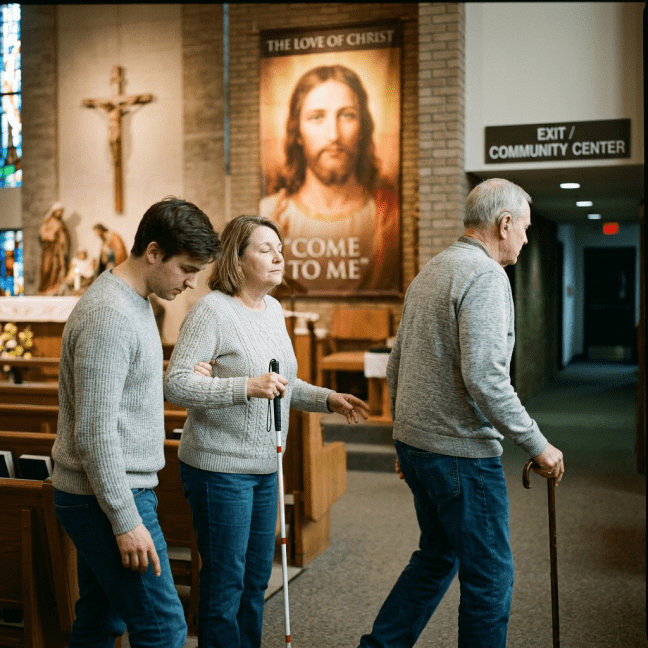
Woman with white cane being guided by two people in a church aisle

“Then I heard the Lord asking, “Whom should I send as a messenger to this people? Who will go for us?” I said, “Here I am. Send me.” And he said, “Yes, go, and say to this people, ‘Listen carefully, but do not understand. Watch closely, but learn nothing.’ Harden the hearts of these people. Plug their ears and shut their eyes. That way, they will not see with their eyes, nor hear with their ears, nor understand with their hearts and turn to me for healing.””
Isaiah 6:8-10 NLT

The Greek version of the Old Testament (Septuagint) puts a slightly different interpretation on verses 9-10 today, with: “And he said, Go and say to this people, ‘When you hear what I say, you will not understand. When you see what I do, you will not comprehend.’ For the hearts of these people are hardened, and their ears cannot hear, and they have closed their eyes— so their eyes cannot see, and their ears cannot hear, and their hearts cannot understand, and they cannot turn to me and let me heal them”. Regardless of the translation, however, Isaiah’s job was not going to be easy. He was ordained and commissioned to take God’s message to his people, but they were already predisposed to ignore what he said. So perhaps you ask, “What was the point”?

But what else could Isaiah do? The vision of the Lord and His holiness in the Temple had brought Isaiah to his knees in the realisation that he was a sinful man and, worse, his people were sinful as well. What followed was Isaiah’s atonement for his guilt and sin, as, symbolically, the burning coal touched his lips. Freed from sin, Isaiah was eager to answer the call of the Lord and to be His messenger to the people. No matter how hard it would be, Isaiah was God’s man for the impossible task of reaching the people, preaching a message given him by God.

What was this message that Isaiah was to say to his people, the inhabitants of Judah? Well, the first one would seem to be, “Listen carefully, but do not understand”. A strange message? What were the people supposed to be listening out for, and why would it be so hard to understand? There was only one message, and it was the same one that Isaiah received in the Temple. Compared to God’s holiness, Isaiah’s guilt and sin became exposed, and the only remedy was repentance. So Isaiah was commissioned to tell the people of Judah that their sins were so great that, unless they repented, they would be destroyed. A simple message, but the people were so steeped in their sin that they were unable to recognise God’s voice anymore. Yes, some form of worship was continuing in the Temple, but it had become corrupted and distorted by idolatrous practices that made it totally pointless. The people were deaf and blind to God’s message and ignored it as though it didn’t apply to them. But before we climb up onto the moral high ground, it might be worth asking God if we have any blind and deaf spots regarding sin in our own lives. It is quite likely that we do, and we need to deal with it, under God’s loving and gracious gaze.

Consider the following analogy. We all have smoke detectors installed in our homes, but consider the person who ignores theirs. After a while, they become so used to the loud sound that they learn to tune it out entirely. They hear the noise, but they refuse to understand the danger. Because the people of Judah had tuned out God’s message of the upcoming danger to themselves and their nation, they couldn’t hear it anymore.

Jesus’ disciples asked Him a question, “… Why do you use parables when you talk to the people?” (Matthew 13:10). Jesus replied, “To those who listen to my teaching, more understanding will be given, and they will have an abundance of knowledge. But for those who are not listening, even what little understanding they have will be taken away from them. That is why I use these parables, For they look, but they don’t really see. They hear, but they don’t really listen or understand” (Matthew 13:12-13). Jesus went on to quote our verses from Isaiah today, “This fulfils the prophecy of Isaiah that says, ‘When you hear what I say, you will not understand. When you see what I do, you will not comprehend. For the hearts of these people are hardened, and their ears cannot hear, and they have closed their eyes— so their eyes cannot see, and their ears cannot hear, and their hearts cannot understand, and they cannot turn to me and let me heal them’”.

We pilgrims have the same commission and message that Isaiah had, even though the occasions are separated by nearly three thousand years. Our Gospel message is readily available to the people around us, but as the people in the societies in which we live become more secular, it is increasingly tuned out by those who dispute its relevance. I often meet people who, in their defence, say that they are “good people” and God will never send them to hell. I can’t prejudge what will happen to these people one day before the Great White Throne (Revelation 20) – only God knows what the outcome will be – but the message we preach to those around us is the same as the one preached by Peter in Acts 2:38, “… Each of you must repent of your sins and turn to God, and be baptised in the name of Jesus Christ for the forgiveness of your sins. Then you will receive the gift of the Holy Spirit”. 

So we pray that God will lead us to the people who need to hear about His love and grace, but always aware that our message will mostly fall on deaf ears. Regarding His message, Jesus said, “To those who listen to my teaching, more understanding will be given, and they will have an abundance of knowledge. But for those who are not listening, even what little understanding they have will be taken away from them” (Matthew 13:12). As we know, even Jesus’ message was ignored by most of His people. But we pilgrims are obedient servants of our wonderful Saviour, and continue to share God’s love regardless of how it is received.

Dear Heavenly Father. Thank You for our salvation and for Jesus, who made it possible. Please help us and lead us to those who need to hear about You and Your saving grace, this day and every day. Amen.

The Judgment to Come

“Therefore, as tongues of fire lick up straw and as dry grass sinks down in the flames, so their roots will decay and their flowers blow away like dust; for they have rejected the law of the Lord Almighty and spurned the word of the Holy One of Israel. Therefore, the Lord’s anger burns against his people; his hand is raised, and he strikes them down. The mountains shake, and the dead bodies are like refuse in the streets. Yet for all this, his anger is not turned away, his hand is still upraised.”
Isaiah 5:24-25 NIVUK

If people reject God, there are dire consequences. Helped by Isaiah’s wonderfully poetic and descriptive language, we easily make the connection between the people’s sin, rebellion and idolatry, and their ultimate lot. Isaiah used graphic language with references to fire and decay, all in connection with judgement for the sins of the people in Judah. In the current dry weather, there are reports of wildfires here in the UK, and most people here are aware of the dangers and the horrors of what can happen when fires get out of control. And just after the local cherry blossom trees have shed their flowers, the petals are everywhere, turning brown and gradually disappearing as the winds blow them into corners and beyond. Decaying roots are a sign of a plant or tree’s demise; it will, sooner or later, die off or come crashing down, finally rotting and disappearing into the ground that once supported it. God’s judgment of the people who have “rejected the law of the Lord Almighty and spurned the word of the Holy One of Israel” is to be feared, and yet, as we have seen in the previous verses of Isaiah 5, the people were unrepentant and even defiant. God is angry with them and “His hand is raised, and He strikes them down”. But we read that even then, His anger is unabated, and “His hand is still upraised”. 

Isaiah’s description of what is going to happen to Judah is horrifying, and yet the people of his day couldn’t see what was coming, and, if they did, they chose to ignore it, such was the hold that their sinful lifestyles had over them. Were all people in Judah guilty of sinful behaviour, or was there a remnant of people who remained faithful to God? The historians think so, and it has always been the case that God has preserved a faithful lineage through which He would eventually bring restoration and fulfil His promises. The Babylonian judgment fell in 586 BC, and while the invading army exiled the royal family, the religious elite, and skilled craftsmen to Babylon, they left behind a portion of the poorer population to tend the vineyards and fields. Worthy of note was that the prophet Jeremiah chose to stay with the remnant: “When the commander of the guard found Jeremiah, he said to him, ‘The Lord your God decreed this disaster for this place. And now the Lord has brought it about; he has done just as he said he would. All this happened because you people sinned against the Lord and did not obey him. But today I am freeing you from the chains on your wrists. Come with me to Babylon, if you like, and I will look after you; but if you do not want to, then don’t come. Look, the whole country lies before you; go wherever you please.’ … So Jeremiah went to Gedaliah son of Ahikam at Mizpah and stayed with him among the people who were left behind in the land” (Jeremiah 40:2-4, 6). 

There is no difference between people’s attitudes in 586 BC and those of people today. Sin and evil abound everywhere but the difference is that God has not sent specific prophesies about an imminent judgment that is about to take place. Instead, we have the warnings for sinful behaviour well reported in the Biblical passages. Jesus was a prophet, and Matthew 24 recorded His words about what was going to happen in the run-up to the End of the Age. And then the end will come: “But about that day or hour no one knows, not even the angels in heaven, nor the Son, but only the Father. … Therefore keep watch, because you do not know on what day your Lord will come” (Matthew 24:36, 42). In the days before Christ in Judah, the people had enjoyed a long period of peace that, however, was marked by sinful behaviour, and they chose to ignore Isaiah’s warnings that there were going  to be consequences. Today, unbelievers everywhere choose to heed the Biblical warnings and carry on with their lives regardless. Yes, nothing bad may happen to them in this life (though we don’t know for sure, because the world could end at any time), but it surely will at the End of the Age.

We, pilgrims, are effectively part of the remnant of God’s people in our generation. It is through us that God has preserved “a faithful lineage through which He would eventually bring restoration and fulfil His promises”. In our secular nation, we are the people about whom Ezekiel wrote. “I will give you a new heart and put a new spirit in you; I will remove from you your heart of stone and give you a heart of flesh” (Ezekiel 36:26). That happened on that wonderful day when we were reborn through the Spirit of God. How are we pilgrims living out our responsibilities as God’s people, a faithful remnant in our generation? Are we like Isaiah, warning our generation about the judgment to come, or are we a passive minority huddled in our pews and afraid to put our heads above the parapets in case we are rejected and vilified? Jesus said, “In the same way, let your light shine before others, that they may see your good deeds and glorify your Father in heaven” (Matthew 5:16). And so we will, at every opportunity that comes our way.

Dear God. Thank You that You have entrusted to us the mission of being salt and light in our communities. Lead us we pray in Your ways and help us show others the path to everlasting life. In Jesus’ name. Amen.