The Vision of Isaiah: God’s Eternal Authority

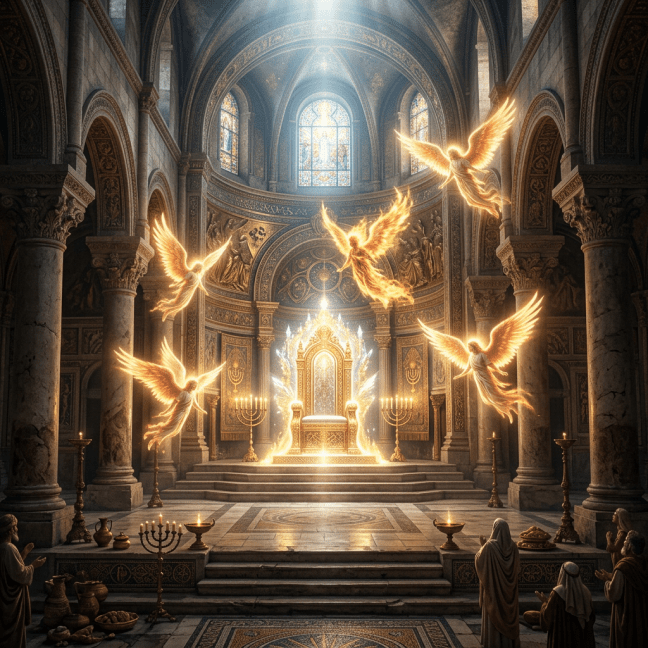
Glowing angels flying around a golden throne inside an ornate cathedral

It was in the year King Uzziah died that I saw the Lord. He was sitting on a lofty throne, and the train of his robe filled the Temple. Attending him were mighty seraphim, each having six wings. With two wings they covered their faces, with two they covered their feet, and with two they flew. They were calling out to each other, “Holy, holy, holy is the Lord of Heaven’s Armies! The whole earth is filled with his glory!” Their voices shook the Temple to its foundations, and the entire building was filled with smoke.”
Isaiah 6:1-4 NLT

Isaiah went to the Temple. Probably nothing unusual about that because I’m sure that he had been there many times before. But there were two things that were significant. King Uzziah had died, and Isaiah saw a vision of the Lord.

Who was King Uzziah? 2 Chronicles 26:3-5, “Uzziah was sixteen years old when he became king, and he reigned in Jerusalem fifty-two years. His mother was Jecoliah from Jerusalem. He did what was pleasing in the Lord’s sight, just as his father, Amaziah, had done. Uzziah sought God during the days of Zechariah, who taught him to fear God. And as long as the king sought guidance from the Lord, God gave him success”. Uzziah was one of the good kings of Judah, and his reign from 790 to 739 BC was long and successful. But on his death, Isaiah would not have been alone in feeling a bit wobbly after such a long time of political stability and prosperity. So what did he do? Isaiah went to the temple. 

In his Temple vision, the first thing that Isaiah saw was the Lord sitting on a throne. A “lofty throne”. A throne signifies a seat of power and authority, and the first message from his vision was that God was still in control. He was still the Creator of the Universe. He was still the God who had the world and its people in the palm of His hand. It was only through Him that world events could happen. In his vision, Isaiah saw that the Lord was wearing a robe, the “train” of which filled the entire space. God is complete and can fill every corner of our lives, should we let Him. The message to Isaiah was that although human beings, including kings, live and then die, God lives forever. He is eternal. He is the all-powerful Omnipresent, Omniscient and Omnipotent God. Three words that describe how complete God is. 

The vision continued with seraphim (literally “fiery ones”), each attending the Lord. They had six wings, two covering their faces (showing God the proper respect and awe), two covering their feet (signifying humility) and two with which to fly, enabling their work of service to the Lord. And they called out to each other, “Holy, holy, holy is the Lord of Heaven’s Armies! The whole earth is filled with his glory!” Why did they say “Holy” three times? To emphasise the absolute, supreme perfection of God’s character. Something perhaps to remember when we sing Heber’s hymn “Holy, Holy, Holy, Lord God Almighty”. Finally, and for good measure, the Temple shook and filled with smoke, signifying the awe-inspiring, unapproachable weight and power of God’s glory. What a vision! What an experience! Nothing man-made then or now could ever have replaced what Isaiah experienced that day. 

As we fast forward to the 21st Century, we consider our nation here in the UK and thank God that we have had a period of relative stability since the end of the Second World War, eighty years or so of living in a war-free society. But we live in a different age now. Technology has changed dramatically, impacting every aspect of our lives. Medical advances are now able to do amazing things in curing all sorts of conditions and diseases. But on the downside, modern weapons of war have the capability to destroy the whole world several times over, should they be used. Are we in an age of stability? Or should we be finding our equivalent of the Jerusalem Temple? 

As we will discover, the vision totally changed and supercharged Isaiah’s life and ministry. In the Bible, there are recorded occasional miraculous revelations that brought about a new move of God. Paul was another example, as the light of Jesus flooded around Him and a voice spoke out that day on the Damascus Road. Paul’s life was totally turned around, and he went from persecuting the early Christians to being their biggest proponent, establishing churches throughout the Middle East. 

Have we pilgrims had such a revelation as Isaiah’s? Do we have the faith to expect one? In years past, God has graciously revealed Himself to me, once through a vision and, on another occasion, through a voice, but nowhere near what Isaiah saw. But in these days of global insecurity, we should be praying for our nation, that God’s peace will prevail. That politicians will emerge with the vision to lead the nations God’s way and not the devil’s. That we will find opportunities to reach out to the people around us with God’s message of hope. And we must keep praying because God hears our prayers, and our fervour in their delivery. Age and health are no barrier to our service in prayer – after all, the Hebridean revival started with the prayers of two old ladies in their eighties, one blind and the other crippled with arthritis. And we never know – God may answer our prayers with a vision of Him so powerful that we will be, like Isaiah, changed forever. 

Dear Father God. In awe and worship, we bow before You today, putting aside our fears because we know that You are still on Your throne. Thank You. Amen. 

Prayer for Pilgrims

“May he grant your heart’s desires and make all your plans succeed. May we shout for joy when we hear of your victory and raise a victory banner in the name of our God. May the Lord answer all your prayers.
Psalm 20:4-5 NLT

Psalm 20 is a “Psalm of David” so to whom is this prayer directed? The Bible scholars call this a “Royal Psalm” as it is written, they say, by the people about their King, David himself. So perhaps a better title would be a “Psalm about David”, with “about” replacing “of”. But from this perspective the Psalm makes more sense, and David merely recorded the Psalm from the prayers and other sentiments said about him. So, is this a Psalm we can discard as just being about David or does it have some helpful content for us today?

Yesterday we looked at God’s response to His people in their “times of trouble” and today we consider a more positive perspective as we look forward beyond any current problems to what lies ahead. What plans have we pilgrims made? What are our “heart’s desires” as we journey onwards in our lives? We must have some, because otherwise we will quickly die in our faith. Remember the verse, “Where there is no vision, the people perish …” (Proverbs 29:18a)? What we hope to do, and how we are going to make it happen, becomes our vision for the future. In the natural, we make plans for holidays, or employment. For where we live or who we are going to marry. But what about our spiritual lives, a part of us that is even more important? Sadly, many people become pew warmers, going through the motions of Christianity, but failing to leverage its potential in their live. A verse of advice from Paul to Timothy – 2 Timothy 3:5, “They will act religious, but they will reject the power that could make them godly. Stay away from people like that!” I’m sure we have all come across religious people in our lives – I met two men yesterday who were more interested in looking after their church building than the Person who should be worshiped there.

There is much written in the Bible about what a pilgrim should be doing. Jesus said that we should follow Him, but what does that look like? To find out we must read the Bible over and over again, and allow the Holy Spirit to reveal to us what Jesus wants us to do and how we are to do it. As an example, we read the Great Commission in Matthew 28:19-20, “Therefore, go and make disciples of all the nations, baptizing them in the name of the Father and the Son and the Holy Spirit. Teach these new disciples to obey all the commands I have given you. And be sure of this: I am with you always, even to the end of the age“. On my prayer walks each morning I speak to people, looking for an opportunity to share the Gospel, but I’m sure all of us pilgrims do the same. Jesus’ Commission is not just for missionaries traveling to remote parts of the world. Jesus also wants us to pray. Matthew 6:6, “But when you pray, go away by yourself, shut the door behind you, and pray to your Father in private. Then your Father, who sees everything, will reward you“. Notice that Jesus said “When you pray” not “If you pray”. 

And we pilgrims pray for each other. The Apostle Paul was a great prayer warrior – Colossians 1:9, “So we have not stopped praying for you since we first heard about you. We ask God to give you complete knowledge of his will and to give you spiritual wisdom and understanding”. And we cannot overlook Paul’s wonderful and touching prayer in Ephesians 3, “When I think of all this, I fall to my knees and pray to the Father, the Creator of everything in heaven and on earth. I pray that from his glorious, unlimited resources he will empower you with inner strength through his Spirit”. It’s a prayer that rises to a crescendo, rich with vision and purpose, as Paul prayed, “Now all glory to God, who is able, through his mighty power at work within us, to accomplish infinitely more than we might ask or think“. The challenge to all believers is, does our vision extend to allowing God to “accomplish infinitely more …”  in our lives. 

The prayer over David included asking God to grant him success for his plans, for answered prayers, victory, and the fulfilment of his heart’s desires. And the same prayer hangs in the air over all God’s people. God’s Word is eternal, not just for one man on one occasion. In excitement today, we need to grab hold of all that God has for us, because that was why He sent His Son, Jesus. One day we will be with Him, and hope to hear those words, “well done, good and faithful servant” (Matthew 25:23).

Dear Father God. We are citizens in Your Kingdom, workers for You on Planet Earth. Please lead and guide us in Your ways. And we pray for our fellow believers, that You will envision them with power in all they do. In Jesus’ name. Amen.

Mounted Troops

“Then the sixth angel blew his trumpet, and I heard a voice speaking from the four horns of the gold altar that stands in the presence of God. And the voice said to the sixth angel who held the trumpet, “Release the four angels who are bound at the great Euphrates River.” Then the four angels who had been prepared for this hour and day and month and year were turned loose to kill one-third of all the people on earth. I heard the size of their army, which was 200 million mounted troops.”
‭‭Revelation‬ ‭9:13-16‬ ‭NLT

The starting gun is fired. The four angels who had been prepared for this very time were “turned loose”. They had a vast army at their disposal, consisting of mounted troops implying they were well equipped. And they killed one third of the people alive on earth at that time. Tragic. John continued his narrative, recorded in Revelation 9:17-19. We read, “And in my vision, I saw the horses and the riders sitting on them. The riders wore armour that was fiery red and dark blue and yellow. The horses had heads like lions, and fire and smoke and burning sulphur billowed from their mouths. One-third of all the people on earth were killed by these three plagues—by the fire and smoke and burning sulphur that came from the mouths of the horses. Their power was in their mouths and in their tails. For their tails had heads like snakes, with the power to injure people.

Again, in his vision, John was able to zoom in to see more details of the main players. The vast army were identically dressed and armed. Colours of red, blue and yellow. Lion-headed horses. From their mouths was emitted “fire and smoke and burning sulphur”. And they had snake-headed tails. It all sounded like the description of a scene from a fantasy or horror movie.

Did John really see lion-headed horses breathing fire and brimstone? Or was this just a vision displaying something he could relate to? For example, it would have been no good for John to see a modern battle tank, because he wouldn’t have been able to understand what it was. In the same way, if we had the vision, what would have been shown to us would have to be understandable, so that we could receive the message in terms that relate to the knowledge we have. Weapons of war have changed over the centuries, and in particular over the past century or so. What new weapons of descruction are still to come? A scary thought?

The verses describe the “fire and smoke and burning sulphur” as three separate plagues. And for good measure, the snake-tails injured people. And the three plagues killed a third of the population. But we now come to an extremely sad fact. We read about it in Revelation 9:20-21. “But the people who did not die in these plagues still refused to repent of their evil deeds and turn to God. They continued to worship demons and idols made of gold, silver, bronze, stone, and wood—idols that can neither see nor hear nor walk! And they did not repent of their murders or their witchcraft or their sexual immorality or their thefts.” How sad is that? What is there about people that even when faced with the consequences of their rebellion and sin, “their murders or their witchcraft or their sexual immorality or their thefts”, they still refused to repent and turn to God. 

I have had conversations with people and have been struck by the apparent intransigence, even in the face of adversity, of some of them. They hold an angry and almost violent attitude towards anything to do with God. They speak out that they would rather end up in hell than have anything to do with God. Even if He exists, they say. How they can be so angry towards a loving, merciful, compassionate and gracious God totally beats me. But then I remember how I was before my heart melted in the warmth of God’s love. When I realised that Jesus was and is the ultimate loving Saviour. Paul wrote in Ephesians 2:1-2, “Once you were dead because of your disobedience and your many sins. You used to live in sin, just like the rest of the world, obeying the devil—the commander of the powers in the unseen world. He is the spirit at work in the hearts of those who refuse to obey God.” But a couple of verses on (Ephesians 2:4-5), there is a description of what happened to me, “But God is so rich in mercy, and he loved us so much, that even though we were dead because of our sins, he gave us life when he raised Christ from the dead. (It is only by God’s grace that you have been saved!)”.

Those people, the two-thirds, who escaped the killing spree of the vast army, still refused to turn to God. Human nature being what it is, rather than soberly realise that they had had a lucky escape and had better now do something about it, they rationalised that they couldn’t have been so bad after all. Perhaps God had missed what they were up to. Surely He couldn’t have seen their misdemeanours – after all, they think, He can’t be everywhere can He? Perhaps their “demons and idols made of gold, silver, bronze, stone, and wood”  had kept them safe after all. In Isaiah 55:6-7 we read, “Seek the Lord while you can find him. Call on him now while he is near. Let the wicked change their ways and banish the very thought of doing wrong. Let them turn to the Lord that he may have mercy on them. Yes, turn to our God, for he will forgive generously.” That is the message we pilgrims must propagate through out communities. Because today God is near. Tomorrow He might not be. Our message is focused and urgent. Let’s grab the moment.

Dear Father God. Once again we offer up our thanks for Your grace and mercy. Where would we be without You? Please lead us to those who are worried and harassed, that we can speak words of peace and grace to help them. In Jesus’ Name. Amen.