
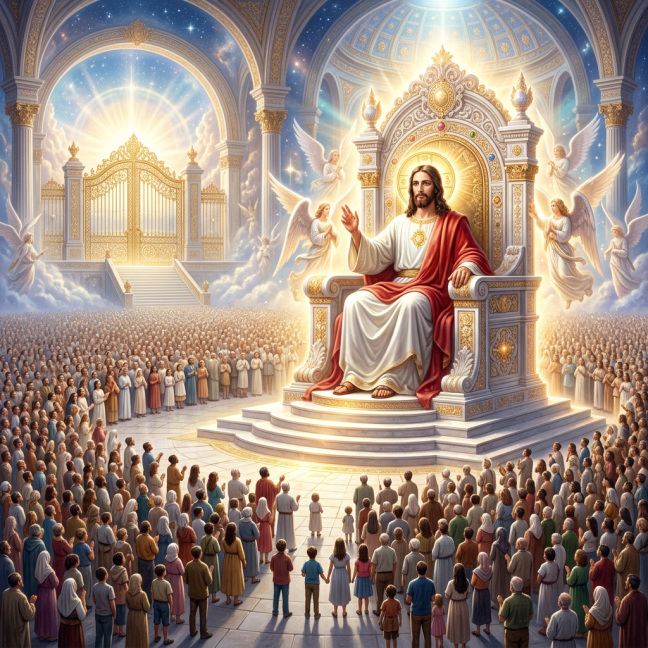
Facing the Righteous Judge and the Hope of the Book of Life

Jesus seated on a jeweled throne before angels and a large worshiping crowd

Isaiah 33:21-24 NLT

“21 The Lord will be our Mighty One.
    He will be like a wide river of protection
that no enemy can cross,
    that no enemy ship can sail upon.
22 For the Lord is our judge,
    our lawgiver, and our king.
    He will care for us and save us.
23 The enemies’ sails hang loose
    on broken masts with useless tackle.
Their treasure will be divided by the people of God.
    Even the lame will take their share!
24 The people of Israel will no longer say,
    “We are sick and helpless,”
    for the Lord will forgive their sins.”

Verse 22 in our reading today declares that ” … the LORD is our judge, the LORD is our lawgiver, the LORD is our king; it is he who will save us”. This description of three of God’s attributes is one that will either delight or dismay people on earth. But at the thought of laws and judges, the sin within us rises, and rebellious thoughts against anything or anyone that would restrict our “freedom” emerge, out of fear that they will bring a quality of life more restrictive than we want. All human beings face undesired or unlikeable restrictions and laws, at one time or another, and politicians or policemen are resented, especially when they pass or apply unpopular and restrictive laws. But the law is the law, and we have to abide by it for the good of ourselves and our societies. On top of that, many believers in God picture Him as a cosmic policeman, wielding a truncheon and waiting for His children to step out of line. Some years ago, I worked in an office with three Muslims, very intelligent and capable software specialists but also very devout in their faith. One of them suggested that Christians and Muslims worship the same God, but there are many differences and, in connection with today’s reading, Allah, the god of Islam, is an unforgiving master and judge, and humans are His servants, providing a stern, uncompromising picture of a god who is remote and unforgiving, and certainly one that fits more with the cosmic policeman imagery. But it is a shame that some Christians think the same of our wonderful God.

But as we pilgrims know, the God we worship is compassionate and loving to the extent He adopted human form through His Trinitarian Son, Jesus, to be with us and show us the way to eternal life, and it is a joy to worship such a Being who ultimately “will save us”. God is, and ultimately will be, the Judge of every human being, past, present and future. But He is nothing like a human judge who sits in a human court, judging the rights or wrongs of a person accused of a crime. Psalm 9:7-8: “But the LORD reigns forever, executing judgment from his throne. He will judge the world with justice and rule the nations with fairness.” This confirms that our righteous Judge is totally and absolutely fair, and no one can ever accuse Him of anything otherwise. No hint of bias or any other human condition could skew a judgment passed down in His Heavenly courts. There is recorded a conversation between Abraham and God, during which the Lord shared what was going to happen with Sodom, and in this exchange, a horrified Abraham said, “Surely you wouldn’t do such a thing, destroying the righteous along with the wicked. Why, you would be treating the righteous and the wicked exactly the same! Surely you wouldn’t do that! Should not the Judge of all the earth do what is right?” (Genesis 18:25). And that is exactly who God is – righteous, always doing “what is right”.

Hebrews 4:13: “Nothing in all creation is hidden from God. Everything is naked and exposed before his eyes, and he is the one to whom we are accountable”. This means that God does not merely judge what we do; He knows why we do it. He confirmed this to Samuel as he selected a new king of Israel to replace the wayward Saul. 1 Samuel 16:7, “But the LORD said to Samuel, “Don’t judge by his appearance or height, for I have rejected him. The LORD doesn’t see things the way you see them. People judge by outward appearance, but the LORD looks at the heart””. There is perhaps a warning here for us pilgrims: we may think we are putting on a deceptive “face” to hide what is going on in our hearts, but God sees all, and that is really all that matters.

The Bible tells us a Day of Judgment is coming. Paul wrote, “This will take place on the day when God judges people’s secrets through Jesus Christ, as my gospel declares” (Romans 2:16). There will be no need for a dossier supporting the indictment against the person in the dock. Jesus will judge every last secret contained within a person’s heart. There is a familiar verse in Revelation 20:12 which reads, “And I saw the dead, great and small, standing before the throne, and books were opened. Another book was opened, which is the book of life. The dead were judged according to what they had done as recorded in the books“. Everything that a person does is written down for posterity. There must be a huge library of books accessible from the Great White Throne, each one marked with a person’s name on the spine. But no information about the person will be omitted, and so the righteous Judge, Jesus, will have access to everything about the person, good things and bad things. Thankfully, for us pilgrims, another book will be present: the Book of Life, and within it our names will be written. The wonder of our faith is that while God holds all people accountable, the gospel offers forgiveness and pardon through faith in Jesus, who took the penalty of judgment we deserved upon himself.

So we pilgrims worship a Judge, who is righteous and fair. As we go about our daily business, we tell people about our God of Love, and His Son Jesus, who died in our place as a punishment for our sins. But to the unbeliever, we must always present a balanced view of God, and remember that as well as being a God of love, He is also a God of justice and righteousness. One day all people will be judged “according to what they had done” in this life. None will escape. Jesus said to His disciples, “Do not be afraid of those who kill the body but cannot kill the soul. Rather, be afraid of the One who can destroy both soul and body in hell” (Matthew 10:28). A healthy fear of God must always accompany our appreciation of His love and compassion. To the believer, nothing should make us afraid of our wonderful Heavenly Father, but to the unbeliever, the One on the Great White Throne must be a terrifying prospect.

Dear Heavenly Father. Thank You for Your love and grace, as we stumble through our lives, journeying towards Glory. In Psalm 36, David wrote, “Your unfailing love, O LORD, is as vast as the heavens; your faithfulness reaches beyond the clouds. Your righteousness is like the mighty mountains, your justice like the ocean depths. You care for people and animals alike, O LORD”. Thank You for Your love, righteousness, justice and care. Amen.

The God of Righteousness and Justice

“What sorrow awaits Assyria, the rod of my anger. I use it as a club to express my anger. I am sending Assyria against a godless nation, against a people with whom I am angry. Assyria will plunder them, trampling them like dirt beneath its feet. But the king of Assyria will not understand that he is my tool; his mind does not work that way. His plan is simply to destroy, to cut down nation after nation. 
After the Lord has used the king of Assyria to accomplish his purposes on Mount Zion and in Jerusalem, he will turn against the king of Assyria and punish him, for he is proud and arrogant.”
Isaiah 10:5-7, 12 NLT

Isaiah’s prophecy moves on from detailing the woes that will strike a proud and arrogant Israel, an Israel that practised idolatry and was governed by corrupt and unjust leaders, and an Israel that seemed ignorant of how the extent of their wickedness was going to lead to a terrible judgement by a nation so much stronger than theirs. There are several places detailed in the Bible where God uses an unbelieving king and nation to either punish or bless His people. In the verses today, we see Assyria, a cruel and strong nation that terrified the nations that it trampled on in its quest for military domination, being used by God to punish His recalcitrant and wicked people. But Isaiah’s message fell on deaf ears because he was saying things that were widely unpopular and, in any case, we remember what God said to the prophet in Isaiah 6:9-10, “And He said, “Yes, go, and say to this people, ‘Listen carefully, but do not understand. Watch closely, but learn nothing.’ Harden the hearts of these people. Plug their ears and shut their eyes. That way, they will not see with their eyes, nor hear with their ears, nor understand with their hearts and turn to me for healing””. As today, an unpopular message that people don’t want to hear will be ignored until they are brought face-to-face with the reality that they have rejected. In Israel’s case, perhaps they rationalised that God would never treat His people in such a way. Today, unbelievers dismiss the warnings that unless they repent of their sin and turn to God, He will reject them and they will end up in hell, because they say that, even if God exists, He would never do that. After all, He is a God of love, they say, forgetting or ignoring the fact that He is also a God of righteousness and judgment. 

Then there was a king called Cyrus, whom Isaiah prophesied about over a hundred years before he was born. Isaiah 44:28, “When I say of Cyrus, ‘He is my shepherd,’ he will certainly do as I say. He will command, ‘Rebuild Jerusalem’; he will say, ‘Restore the Temple’”. In the next verse, God even referred to Cyrus as His anointed one, a rare title for a heathen king. And we can read the fruition of the prophecy in the last verse of 2 Chronicles, “This is what King Cyrus of Persia says: ‘The Lord, the God of heaven, has given me all the kingdoms of the earth. He has appointed me to build him a Temple at Jerusalem, which is in Judah. Any of you who are his people may go there for this task. And may the Lord your God be with you!’”

People in Israel forgot that God was all-powerful and had put in place a Covenant that had blessings but also curses. They liked the blessings bit but ignored the curses, although they would soon face the reality of them. God was very much on His throne and was about to use the Assyrians to punish His disobedient and wicked people.

What can we pilgrims learn from these verses today? The same thing that the Israelites had forgotten, or conveniently ignored. God is on His throne. He is not sleeping, as the Psalmist implied in Psalm 44:23, “Wake up, O Lord! Why do you sleep? Get up! Do not reject us forever”. We know from Psalm 145 that God’s anger is slow to be raised: “The Lord is merciful and compassionate, slow to get angry and filled with unfailing love” (Psalm 145:8). In our times, we also know that God is being very patient: “The Lord isn’t really being slow about his promise, as some people think. No, he is being patient for your sake. He does not want anyone to be destroyed, but wants everyone to repent” (2 Peter 3:9). One thing that I’m sure we fail to understand or appreciate is how much God is holding back the forces of evil in our times. Yes, we have concerns about international politics and the wars that can affect us so badly, but they could be much worse. As was the case with the Israelites, there is a tendency to be complacent and maintain that God would never allow the destruction of our nation.

And so, we pilgrims must pray for our government and those ruling our country. We must also pray for organisations such as the Christian Institute and Christian Concern, which are so active in lobbying for righteousness in the corridors of power. We must never forget that our God is never sleeping and that He is always prepared to listen to our prayers. As we give Him our concerns and anxieties, His peace is always available and will flood over us in our times of need.

Dear Heavenly Father. Thank You for Your love and compassion. We thank You for keeping us safe in these troubled times, and we pray for our government and political leaders, that You will lead and guide them as they lead our country. In Jesus’ name. Amen.

Jesus’ Judgement is Just

“Don’t be so surprised! Indeed, the time is coming when all the dead in their graves will hear the voice of God’s Son, and they will rise again. Those who have done good will rise to experience eternal life, and those who have continued in evil will rise to experience judgment. I can do nothing on my own. I judge as God tells me. Therefore, my judgment is just, because I carry out the will of the one who sent me, not my own will.”
John 5:28-30 NLT

In His discourse with the Jewish leaders, Jesus spoke much about the life to come, after people have physically died, and how this life would be fairly and righteously compartmentalised into a future either in Heaven of hell. Simply put, those people who believe in Jesus will end up experiencing eternal life, and those people who continue in their sinful and evil ways will experience judgement. But what else is God to do? Our spirits will live forever, and somehow God has to determine how they should be separated. As a holy and righteous God, He cannot have any evil introduced into Heaven. The purity and holiness of the place where eternal life will be experienced cannot be violated. So what else can He do with all these people who refuse to accept His free gift of salvation and prefer to stay in their sinful and evil ways? They have made a choice, which is that they don’t want to be with Him in Heaven.

There are of course those people who mistakenly claim that regardless of their behaviour they will end up in Heaven anyway. They prefer to follow and believe their feelings rather than the hard facts and truths contained within God’s only written work, the Bible. There are others who claim that if there is a Christian God, then He is too loving to consign anyone to eternal death and punishment. Some people feel that the punishment of eternal death does not fit the crime of a finite time spent in a human life of sin, so God cannot be fair at all. Even others claim that being thrown into the lake of fire results in instant annihilation, much as what would happen if someone was thrown into a pool of molten lava. But most people seem to be unengaged and disinterested about their post-death life, and don’t even want to think about it; a head in the sand response.

There may be some people who have created in their minds the thought that there is a third area between Heaven and hell, reserved for people who don’t think they have been bad enough to warrant eternal punishment. People like my neighbour who is convinced that he will just join the “big party downstairs”. After all, he hasn’t stolen anything significant, or murdered anyone, so his thoughts go. But it is significant that this intermediate place is not supported at all in Scripture. It doesn’t exist.

So, we end up with the words of Jesus. Those “who have continued in evil will rise to experience judgment“. And Jesus told the Jewish leaders two things – He does the will of His father in Heaven, and His judgement is just. We know from Revelation 20 that God has books that record every action and thought committed by people. So, we have nothing to fear about false testimony or legal loopholes. Everything will be exposed exactly as it happened before God, and everyone else standing there, and there can therefore be no complaint at all that the process lacks justice. The outcome might not be what people want, but the choice is their’s.

Dear Father God. We praise and worship You here on earth for Your love and justice. As the psalmist wrote, “Your righteousness, O God, reaches to the highest heavens. You have done such wonderful things. Who can compare with you, O God?“ Amen.