
The Dangers in Living for Christ

“I’m ashamed to say that we’ve been too “weak” to do that! But whatever they dare to boast about—I’m talking like a fool again—I dare to boast about it, too. Are they Hebrews? So am I. Are they Israelites? So am I. Are they descendants of Abraham? So am I. Are they servants of Christ? I know I sound like a madman, but I have served him far more! I have worked harder, been put in prison more often, been whipped times without number, and faced death again and again. Five different times the Jewish leaders gave me thirty-nine lashes. Three times I was beaten with rods. Once I was stoned. Three times I was shipwrecked. Once I spent a whole night and a day adrift at sea. I have travelled on many long journeys. I have faced danger from rivers and from robbers. I have faced danger from my own people, the Jews, as well as from the Gentiles. I have faced danger in the cities, in the deserts, and on the seas. And I have faced danger from men who claim to be believers but are not. I have worked hard and long, enduring many sleepless nights. I have been hungry and thirsty and have often gone without food. I have shivered in the cold, without enough clothing to keep me warm.”
2 Corinthians 11:21-27 NLT

A longer passage of Scripture than usual today, but it has been difficult to consider in anything other than its whole. The first-century world to the east of the Mediterranean and associated lands was fiercely resistant to the preaching of the Gospel, even to the point that Paul and the rest of the Apostles suffered much for its message. The original Apostles, with the exception of John, all suffered violent deaths at the hands of their enemies, but while alive, they willingly put up with the privations and abuse that came their way. Why? Because they considered it all worthwhile because of their love for Jesus. In modern parlance, what Paul suffered came with the territory.

In a way, Paul’s suffering confirms the authenticity of the Gospel. Here is a quote from Charles Colson, a lawyer caught up, and eventually imprisoned, for his role in the Watergate scandal, although he subsequently became a Christian. “I know the resurrection is a fact, and Watergate proved it to me. How? Because 12 men testified they had seen Jesus raised from the dead, then they proclaimed that truth for 40 years, never once denying it. Every one was beaten, tortured, stoned and put in prison. They would not have endured that if it weren’t true. Watergate embroiled 12 of the most powerful men in the world, and they couldn’t keep a lie for three weeks. You’re telling me 12 apostles could keep a lie for 40 years? Absolutely impossible”

What do we pilgrims think when we read our verses from 2 Corinthians today? Personally, it strengthens my faith because I know that although Paul suffered much, he did so for Jesus. So why should I complain if living for Jesus denies me the pleasures of the world around me and becomes inconvenient at times? I have never suffered for Christ as Paul did. Would I be willing to? It is a difficult question to answer, but I believe God would give me the grace and fortitude should that be needed, but I pray that I won’t have to.

Jesus is all to me. There is no one else in my life who could replace Him. There is no worldly possession that is more important. And I’m sure that this is the case for those reading this today. Jesus said, “…  ‘You must love the Lord your God with all your heart, all your soul, and all your mind’” (Matthew 22:37). Paul was a living example of another of Jesus’ sayings, “Then he said to the crowd, “If any of you wants to be my follower, you must give up your own way, take up your cross daily, and follow me. If you try to hang on to your life, you will lose it. But if you give up your life for my sake, you will save it” (Luke 9:23-24). And finally, from Paul, “And so, dear brothers and sisters, I plead with you to give your bodies to God because of all he has done for you. Let them be a living and holy sacrifice—the kind he will find acceptable. This is truly the way to worship him” (Romans 12:1). Paul was a man who “walked the walk and talked the talk”. There was no hypocrisy with Paul, and there shouldn’t be with us either.

Dear Heavenly Father. We thank You for Your servant Paul and his willingness to suffer for spreading the Gospel. It may have even been instrumental in my faith today. Thank You for Your grace and love, and all that You have done for us. Amen.
Paul’s Warning: Beware of Persuasive Fools

“Again I say, don’t think that I am a fool to talk like this. But even if you do, listen to me, as you would to a foolish person, while I also boast a little. Such boasting is not from the Lord, but I am acting like a fool. And since others boast about their human achievements, I will, too. After all, you think you are so wise, but you enjoy putting up with fools! You put up with it when someone enslaves you, takes everything you have, takes advantage of you, takes control of everything, and slaps you in the face. I’m ashamed to say that we’ve been too “weak” to do that! But whatever they dare to boast about—I’m talking like a fool again—I dare to boast about it, too.”
2 Corinthians 11:16-21 NLT

There is something deeply unsettling about listening to someone who is clearly confident—but quietly wrong. Confidence has a way of persuading us. It carries weight, presence, and often admiration. Yet in 2 Corinthians 11:16–21, the Apostle Paul exposes a sobering truth: not everything that appears wise truly is. In this passage, Paul does something unusual. He begins to “boast”, but he does so reluctantly, even apologetically. He calls it what it is: foolishness. “Again I say, don’t think that I am a fool to talk like this. But even if you do, listen to me, as you would to a foolish person, while I also boast a little” (2 Corinthians 11:16). It’s clear that Paul is not comfortable with this approach. Boasting, in his mind, is not the way of Christ. And yet, he adopts this tone for a reason.

The church in Corinth had become enamoured with a different kind of leadership. Certain individuals, whom Paul later describes as “super-apostles”, had arrived with impressive credentials, persuasive speech, and a commanding presence. They measured success by outward standards. They spoke with confidence. They looked the part. And the Corinthians were captivated. Paul’s irony exposes the flaws in the Corinthian mindsets: “After all, you think you are so wise, but you enjoy putting up with fools!” (2 Corinthians 11:19). In other words, he wrote, you think you are being discerning, but you are tolerating what is actually foolish. In accepting their new leaders, they were taken in by their polished, persuasive words and outward appearances. The problem was that the Corinthians were taken in by these men, lacking discernment, and resulting in them ending up in a dangerous situation

The problem in Corinth is not confined to the first century. If anything, it has intensified in our own time. We live in an age saturated with voices in sermons, podcasts, videos, and books, with each one competing for attention. And often, the voices that rise to the top are not necessarily the most faithful, but the most compelling. We are drawn to confidence and apparent clarity, with the speaker or writer being a charismatic person who seems to say all the right things and who even comes across as a source of truth. But Paul reminds us that confidence is not the same as truth. It is entirely possible for someone to speak boldly, persuasively, and even attractively, and yet be fundamentally misaligned with the Gospel. The Corinthians fell into this trap. They confused charisma with authority, eloquence with truth, and self-promotion with spiritual maturity. And before we get on our high horses and claim that would never happen to us, we are no less vulnerable.

One of the striking elements of our verses today is how willingly the Corinthians accepted these “foolish” voices. Paul says they “enjoy putting up with fools”. We almost get the impression that they were very comfortable and accepting of what the “super-apostles” had to offer. There is almost a sense of eagerness and an appetite for what these teachers had to say, and that raises an uncomfortable question for us, because what do we, as Christians, tend to celebrate and promote? I know someone who spends a lot of time watching Christian speakers on TV, big names who tick all the charisma and charm boxes and confidently speak about Bible verses, even relating them to world events and what they believe is coming. They may even include appeals for donations, thereby manipulating their viewers’ emotions. It is easy for such people to present themselves with confidence and polish, but these are not the marks Paul points to as evidence of true ministry. In 1 Corinthians 2:2-5, Paul wrote, “For I decided that while I was with you I would forget everything except Jesus Christ, the one who was crucified. I came to you in weakness—timid and trembling. And my message and my preaching were very plain. Rather than using clever and persuasive speeches, I relied only on the power of the Holy Spirit. I did this so you would trust not in human wisdom but in the power of God.”

At the heart of Paul’s irony in our verses today is a call to discernment. The Corinthians believed themselves to be wise, yet their discernment was compromised. They were not testing what they heard carefully enough. They were not looking beneath the surface. And so Paul, almost reluctantly, met them on their own terms. If they valued boasting, then he would “boast” as well, but in doing so, he exposed how empty that standard really was.

What do we pilgrims make of all this? I think that Paul has put his finger on something we all need to consider – how discerning are we? When a speaker preaches a sermon, or engages with us in a Bible Study or prayer meeting, do we accept at face value what is said, or do we critically test and examine his or her words? Do we ask ourselves questions such as, “Is this teaching faithful to Scripture?” Or “Does this reflect the character of Christ?” And does the presenter provide the message with a spirit of humility, or is there a brashness or overconfidence present? In James 1:5-6, we read, “If you need wisdom, ask our generous God, and he will give it to you. He will not rebuke you for asking. But when you ask him, be sure that your faith is in God alone. Do not waver, for a person with divided loyalty is as unsettled as a wave of the sea that is blown and tossed by the wind”. We need wisdom whenever we hear messages or read books that contain confident, and even dogmatic, statements, and we should discard anything that has a whiff of falseness or overemphasis.

Paul ironically wrote, “After all, you think you are so wise, but you enjoy putting up with fools!” (2 Corinthians 11:19). This verse is a warning as much as it is a rebuke. In a world full of confident voices, the greatest danger is not always obvious error; it is persuasive foolishness. Beware the kind of message that sounds right, feels compelling, and gains traction, yet subtly leads us away from the simplicity and humility of Christ.

Dear Heavenly Father, we pray for wisdom in our world, where strident and competing voices clamour for our attention with messages of falseness and error. Guide us into all truth we pray, and we do so by looking to Jesus, who is the Author of truth. Amen

Beware of False Apostles: Insights from 2 Corinthians

“But I will continue doing what I have always done. This will undercut those who are looking for an opportunity to boast that their work is just like ours. These people are false apostles. They are deceitful workers who disguise themselves as apostles of Christ. But I am not surprised! Even Satan disguises himself as an angel of light. So it is no wonder that his servants also disguise themselves as servants of righteousness. In the end they will get the punishment their wicked deeds deserve.”
2 Corinthians 11:12-15 NLT

The Corinthian church seemed to have been infiltrated by men who called themselves apostles but weren’t, because they made false claims. They were first-century equivalents of fraudsters who found a way to fleece a gullible congregation with the smooth, eloquent words they used. In their approach, they created what was effectively a different Jesus, because they preached a false gospel with content that perhaps watered down the bits the Corinthians were struggling with or even one that contained errors that were more aligned with the Gnostics or Docetism, or perhaps even encouraging the congregation to adopt the Jewish practices that some of them had abandoned. Paul associated these men with being the devil’s servants, men who followed in the footsteps of the serpent in the Garden, with plausible arguments such as the one that deceived Eve. “Surely God didn’t say” was perhaps replaced by “surely Paul didn’t say”, leading to a subtle but significant change in the Gospel that Paul preached, the one given to him by Jesus Himself. 

These men have modern-day equivalents in the form of those people who wheedle their way into the confidence of gullible people and end up defrauding them of their savings or performing unnecessary work on their houses. There are all sorts of scams out there, and often they sound so convincing that even tech-savvy people are tricked into installing malware on their smartphones or computers. And it begs the question that if the fraudsters can be so successful in their modern-day scams, what is stopping the devil from doing the same in the spiritual world? 

Jesus warned His disciples, and by extension all disciples ever since, about the dangers of false apostles. He said, “Beware of false prophets who come disguised as harmless sheep but are really vicious wolves” (Matthew 7:15). Jesus continued in the next verse with “You can identify them by their fruit, that is, by the way they act. Can you pick grapes from thornbushes, or figs from thistles?” In today’s church, with its established denominations, there are fewer opportunities for false apostles, prophets, and other forms of leadership to enter a church. I belong to the Elim Movement, a Pentecostal organisation, with churches dotted all over the UK and beyond. Anyone able to preach at one of these churches has been carefully vetted and will usually have been through some formal training at an Elim-recognised Bible college. Error or falseness is a rare event. In addition, the Elim congregations usually have a sufficient number of mature Christians who will soon weed out any form of false teaching. However, some years ago, I was briefly in an independent church with a pastor who seemed to preach all the right messages and was well respected by the congregation. There were a few anomalies with his leadership team, but all seemed good. But then a problem emerged – the pastor had a gambling addiction, and the church collapsed soon afterwards when it came to light. So Jesus’ warning about good and bad fruit was spot on. 

In Revelation 2:2, Jesus commended the church in Ephesus for dealing with false apostles. “I know all the things you do. I have seen your hard work and your patient endurance. I know you don’t tolerate evil people. You have examined the claims of those who say they are apostles but are not. You have discovered they are liars”. It might have been helpful to know more about how they weeded out the false apostles, but the devil is subtle in his approaches, and he will erode the margins of doctrine and theology, even Bible verses, introducing error drip by drip. 

There was an episode during Jesus’ ministry when His disciples became concerned that someone outside His group was using Jesus’ name to cast out demons. Mark 9:38, “John said to Jesus, ‘Teacher, we saw someone using your name to cast out demons, but we told him to stop because he wasn’t in our group’”. We read what Jesus said in response in the next two verses, ““Don’t stop him!” Jesus said. “No one who performs a miracle in my name will soon be able to speak evil of me. Anyone who is not against us is for us”. From this example, we discern that there may be men and women in other denominations who are preaching the same Gospel we do without error. They may have a different approach or use different words, but their fruit is all good. 

Paul ended our verses today with the warning that the spiritual fraudsters, the false apostles who had infiltrated the Corinthian church, would receive “the punishment their wicked deeds deserve”. One day, we will all have to stand before God to give an account of our lives, and anyone who has peddled a false gospel will suffer severe consequences. The minister preaching Universalism at a Glasgow funeral I referred to in an earlier blog would possibly fall into this category. Of course, there are men and women in this world who sincerely fall into error and propagate it through their messages and prophecies. They are not fraudsters, as we understand the term, but they are still promoting a false gospel. 

How do we pilgrims avoid falling into error? We do what the people of Berea did. Acts 17:11, “And the people of Berea were more open-minded than those in Thessalonica, and they listened eagerly to Paul’s message. They searched the Scriptures day after day to see if Paul and Silas were teaching the truth”. That is the only way to avoid the subtle and persuasive words of the false apostles. By reading our Bibles.

Dear Father God. Thank You for Your Word, the Bible, and the Holy Spirit within us who is able to lead us into all truth. Help us to keep our eyes fixed upon Jesus, who is the Truth. Amen. 

Paul’s Ministry: Humility and Financial Integrity

“Was I wrong when I humbled myself and honoured you by preaching God’s Good News to you without expecting anything in return? I “robbed” other churches by accepting their contributions so I could serve you at no cost. And when I was with you and didn’t have enough to live on, I did not become a financial burden to anyone. For the brothers who came from Macedonia brought me all that I needed. I have never been a burden to you, and I never will be. As surely as the truth of Christ is in me, no one in all of Greece will ever stop me from boasting about this. Why? Because I don’t love you? God knows that I do.”
2 Corinthians 11:7-11 NLT

While Paul was establishing the church in Corinth, he initially met up with a couple called Aquila and Priscilla, Jews who were expelled from Rome by Emperor Claudius just a few years before. “Paul lived and worked with them, for they were tentmakers just as he was” (Acts 18:3). But Paul didn’t just spend his time making tents, the next verse reads, “Each Sabbath found Paul at the synagogue, trying to convince the Jews and Greeks alike”. When he was rejected by most of the Jews, “… he left and went to the home of Titius Justus, a Gentile who worshipped God and lived next door to the synagogue” (Acts 18:7). So in those early days, Paul never asked for money from the embryonic church and instead supported himself with his work. Perhaps this became a point of contention among the early Christians in Corinth, because tent-making was not exactly up there with the more respected forms of employment, and they may have been a bit ashamed of him. Did Paul sin in their eyes by not asking for money or some other reward for his preaching? In those days, a visiting rabbi or some other man of God would be expected to be supported by the congregation he was speaking to. As in many other places, Paul challenged the status quo and introduced a new order in more ways than one.

In this situation, we see a bit of sarcasm from Paul when he said he “robbed” other churches. Of course, he didn’t do that literally, but he made the point that through his tent-making and donations from other churches, he was able to avoid being a burden to the Corinthians. In it all, Paul was not intent on making a living from the Corinthian congregation; rather, he wanted to avoid being a burden to them. Earlier in the chapter, Paul referred to men who called themselves apostles – he referred to them as “super apostles” – and who he was sure were seeking reward for their service from the believers, but perhaps Paul was pointing out that he was prepared to preach the word of the Gospel without reward, because by doing so it was reward enough. There was, and still is, no material value that can be placed on the Gospel. It is priceless, eternal and life-changing. Paul’s motivation was to do God’s work in leading unbelievers to faith in Christ. Since taking money from those unbelievers may have raised questions about Paul’s motives and the truthfulness of his message, he refused to do so.

Paul wrote that “the brothers who came from Macedonia brought me all that [he] needed”. We know that the Macedonian churches of Thessalonica, Berea, and Philippi were quite poor, and it was very humbling for Paul to accept money from them. He knew that those donations would have been given sacrificially by the congregations there. But while he was establishing the Corinthian church, he was preaching the Gospel, and he wasn’t prepared to take any reward for doing so. He never wanted to cloud the purity of the Gospel message with any niggling thoughts in the hearers’ minds that he was doing it for money. 

What can we pilgrims learn from this message from Paul today? One thing is the importance of transparency in financial matters. In our established churches, the congregation supports their leader or leaders through the tithes and offerings collected every Sunday. Today, innovative ways of giving have emerged, including bank transfers, standing orders, and even phone apps that can transfer funds to the right place. One church I know displays a QR code on the screen at the front, and congregants can scan it to open a giving app where they make their offering. But regardless of the way money is collected, and in his first letter, Paul wrote, “In the same way, the Lord ordered that those who preach the Good News should be supported by those who benefit from it” (1 Corinthians 9:14). 

So we pilgrims pray for and financially support our church leaders. We read in Hebrews 13:17, “Obey your spiritual leaders, and do what they say. Their work is to watch over your souls, and they are accountable to God. Give them reason to do this with joy and not with sorrow. That would certainly not be for your benefit”. The joy they experience may perhaps be linked to the meal on their tables. 

Dear Heavenly Father. Please bless our leaders in all that they do and help us to do our part to support them in their work. For Jesus’ sake. Amen. 

The “Knowledge”

“You happily put up with whatever anyone tells you, even if they preach a different Jesus than the one we preach, or a different kind of Spirit than the one you received, or a different kind of gospel than the one you believed. But I don’t consider myself inferior in any way to these “super apostles” who teach such things. I may be unskilled as a speaker, but I’m not lacking in knowledge. We have made this clear to you in every possible way.”
2 Corinthians 11:4-6 NLT

Regarded as one of the toughest memory and navigation exams in the world, the “Knowledge” is a test every London black cab driver has to pass. London is a complex matrix of streets and roads with traffic considerations and restrictions, and yet it requires detailed knowledge of the city by London taxi drivers to efficiently navigate the streets and conditions that change almost daily, and sometimes even hourly. While a student, I took a similar, but much simpler, test in Southampton to obtain a “Hackney Carriage” licence from the authorities, enabling me to drive a minicab. But all employment requires some form of knowledge to do the job properly. It is rare to find an occupation that requires no experience or knowledge at all. 

But a taxi licence was obviously not the sort of knowledge that Paul was talking about. Paul’s knowledge was far more important because it not only enabled him to live his life in the Kingdom of God while he was alive, but it also gave him insight into the life to come. Paul’s knowledge was based on the Jewish Bible, broadly similar to our Old Testament, and enhanced by his encounter with the risen Jesus on the Damascus Road. The Holy Spirit did the rest, because “When the Spirit of truth comes, he will guide you into all truth. He will not speak on his own but will tell you what he has heard. He will tell you about the future. He will bring me glory by telling you whatever he receives from me” (words of Jesus recorded in John 16:13-14). 

Paul declared that he was a rubbish speaker. Fair enough, because oratorical skills are not available to everyone. But being able to communicate is important because all the knowledge in the world is useless unless there is a way to convey it to the listener. I have an external hard drive in a drawer somewhere that contains backups of old files and photos, but in its current state, it is useless and will remain so until I plug it into a computer, at which point its treasures become accessible. Paul’s head was full of knowledge, as recognised by Governor Festus in Acts 26:24, “And as he was saying these things in his defence, Festus said with a loud voice, ‘Paul, you are out of your mind; your great learning is driving you out of your mind'”. Paul wasn’t out of his mind at all, but instead he had a mind full of knowledge.

But perhaps Paul’s speaking skills were illustrated when he visited Troas. There, Paul and his companions gathered with the local believers, shared in the Lord’s Supper, and then “…  since he was leaving the next day, [Paul] kept talking until midnight” (Acts 20:7b). Tragically, “As Paul spoke on and on, a young man named Eutychus, sitting on the windowsill, became very drowsy. Finally, he fell sound asleep and dropped three stories to his death below” (Acts 20:9). That probably said it all about Paul’s message delivery, because I’m sure we have all been in a pew listening to a long sermon and have struggled to keep awake, even if the subject matter was of great importance, possibly through the poor speaking skills of the preacher. To complete the story, though, regarding Eutychus, “Paul went down, bent over him, and took him into his arms. “Don’t worry,” he said, “he’s alive!”” (Acts 20:10). But there was no relief for the Troas believers because the next verse reads, “Then they all went back upstairs, shared in the Lord’s Supper, and ate together. Paul continued talking to them until dawn, and then he left”. That must have been quite a sermon! In fact, it must have amounted to a “brain dump”, where Paul shared all his knowledge. 

What knowledge do we pilgrims have, and how have we acquired it? Obviously, it comes from a number of sources, depending on what sort of knowledge we are considering, but for Christians, the knowledge about God and His Kingdom comes from the Bible and through the Holy Spirit, through study and prayer. To assist with interpretation, knowledgeable men and women share their insights from the pulpit, and we can pick up a book or watch a Christian video, but the Source of all knowledge is God Himself. Proverbs 2:6, “For the Lord grants wisdom! From his mouth come knowledge and understanding”. Do we have ears to hear what God is saying to us? So often, we have filters in place that process what we are hearing in a way that either helps us forget what was said or translates it into something that it wasn’t.  At the end of the parable of the sower, Jesus said, “Anyone with ears to hear should listen and understand” (Matthew 13:9). The problem in Isaiah’s day, and it is still a problem, today, was the situation we find in Isaiah 6:9-10, “And he said, “Yes, go, and say to this people, ‘Listen carefully, but do not understand. Watch closely, but learn nothing.’ Harden the hearts of these people. Plug their ears and shut their eyes. That way, they will not see with their eyes, nor hear with their ears, nor understand with their hearts and turn to me for healing””. The devil is good at doing just that.

We pilgrims require knowledge to help us in our own walk with God and also to be able to communicate with the needy people who live around us. We must never neglect our Bible Study or times of prayer. 

Dear Heavenly Father. Thank You for revealing to us the truths about You and Your Kingdom. Give us open minds, we pray, to receive all the knowledge that You have for us. In Jesus’ name. Amen.

The Eve Syndrome

“But I am afraid that just as Eve was deceived by the snake’s cunning, your minds may somehow be led astray from your sincere and pure devotion to Christ. For if someone comes to you and preaches a Jesus other than the Jesus we preached, or if you receive a different spirit from the Spirit you received, or a different gospel from the one you accepted, you put up with it easily enough.”
2 Corinthians 11:3-4 NIVUK

The human mind can be easily deceived by arguments and propositions that sound right but are not true. The situation with Eve is the classic example. God gave Adam a specific instruction: “And the Lord God commanded the man, ‘You are free to eat from any tree in the garden; but you must not eat from the tree of the knowledge of good and evil, for when you eat from it you will certainly die’” (Genesis 2:16-17). But along came the serpent, saying, “… Did God really say, “You must not eat from any tree in the garden””? (Genesis 3:1b). Eve initially made the right response, “The woman said to the snake, ‘We may eat fruit from the trees in the garden, but God did say, “You must not eat fruit from the tree that is in the middle of the garden, and you must not touch it, or you will die” ’” (Genesis 3:2-3), although she failed to identify the specific tree to be avoided. Then, in the next two verses, came the serpent’s lie, “‘You will not certainly die,’ the snake said to the woman. ‘For God knows that when you eat from it your eyes will be opened, and you will be like God, knowing good and evil’”. Then came the very verse that sealed their’s, and mankind’s ever since, doom: “When the woman saw that the fruit of the tree was good for food and pleasing to the eye, and also desirable for gaining wisdom, she took some and ate it. She also gave some to her husband, who was with her, and he ate it”. Yes, neither Adam nor Eve physically died because of that act, but spiritually, mankind has been dead ever since. God’s design and order were destroyed through a single piece of fruit, but thankfully, He didn’t give up at that point and decide to let Adam and the human race get on with their sinful lives, instead creating another planet somewhere and starting again. As we read the Bible, we find a love story of God wooing back His rebellious and sin-ridden creation, even to the extent of sending His Son, Jesus, to be the ultimate Saviour. 

Paul was concerned that the Corinthians had let down their guard and had allowed any random person with a seemingly plausible message to occupy their pulpit. It didn’t matter what “Jesus” they preached as long as the message sounded plausible. The same with the Holy Spirit they claimed to know. Perhaps the Gospel message being preached by these men was also plausible, as they, with the serpent’s cunning, twisted it, even subtly, to appear and sound plausible to the Corinthian ears. Paul warned Timothy about such a thing as well, as we read in 2 Timothy 4:3-4, “For the time will come when people will not put up with sound doctrine. Instead, to suit their own desires, they will gather round them a great number of teachers to say what their itching ears want to hear. They will turn their ears away from the truth and turn aside to myths”. I heard of a funeral service that took place in a crematorium in Glasgow some years ago, where the officiating Presbyterian minister used as his text John 3:16. Somehow, he managed to distort this verse to become a platform for Universalism, by saying that Jesus said that everyone would get to Heaven, including, by extension, the people gathered for the service and the unbelieving lady who occupied the coffin before them. The phenomenon of men and women preaching a false Jesus and a false Gospel wasn’t just a problem in Paul’s day.

How do we pilgrims guard ourselves from such aberrations? As the wars in different parts of the world rumble on, and as different global events continue to disturb the world order, it is easy to find preachers who deliver a message that sounds right but is instead of the wrong spirit. Just open YouTube and all sorts of strange and fictitious messages will appear if searched for. The same with other social media platforms. And before we know it distortions will creep into society in the form of ideologies and theories that will lure away even people of faith, even reaching new forms of social policies. There is only one remedy for such lies, and that is to recognise them for what they are. We pilgrims know that when faced with the Eve syndrome, we turn to our Heavenly Father and His Word where we will find the truth. We turn to the Words of Jesus because we know that He is “the way the truth and the life” (John. 14:6). Through prayer and the armour that Paul taught about (Ephesians 6), we stand firm, recognising that someone preaching a different Jesus from the one in the bible, or promoting a different spirit to the Holy Spirit, or encouraging us to accept a different Gospel to the one we find in the Bible, are all ploys of the devil. And if we find a false preacher in our pulpits, we immediately find somewhere else where the purity of the Word is sacrosanct.

Heavenly Father. Please “lead us not into temptation and deliver us from evil” we pray. In Jesus’ name. Amen.

Understanding God’s Jealousy: A Biblical Perspective

“I hope you will put up with a little more of my foolishness. Please bear with me. For I am jealous for you with the jealousy of God himself. I promised you as a pure bride to one husband—Christ.”
2 Corinthians 11:1-2 NLT

What do we think about God being jealous? There are the Scriptures such as Exodus 20:4-6, “You shall not make for yourself an image in the form of anything in heaven above or on the earth beneath or in the waters below. You shall not bow down to them or worship them; for I, the Lord your God, am a jealous God, punishing the children for the sin of the parents to the third and fourth generation of those who hate me, but showing love to a thousand generations of those who love me and keep my commandments”. We also read Exodus 34:14, “Do not worship any other god, for the Lord, whose name is Jealous, is a jealous God”. Then there is Deuteronomy 4:23-24, “Be careful not to forget the covenant of the Lord your God that he made with you; do not make for yourselves an idol in the form of anything the Lord your God has forbidden. For the Lord your God is a consuming fire, a jealous God”. We might puzzle over these verses for a bit, wondering what they mean, but the clue is in Deuteronomy 4:23, where the word “covenant” emerges. God made several covenants with His people. The first was after the Flood and was made with Noah. We read what God said in Genesis 9:9, “I now establish my covenant with you and with your descendants after you”. However, this was a covenant of grace in which God promised never again to bring a flood to destroy all the creatures on the earth. It was a promise God made that, regardless of mankind’s behaviour, He would never do such a thing again. The covenant that applied to His people can be found in Exodus 19 and was the one He made through Moses. This was a covenant that bound both God and His people into a special, eternal relationship that has stood ever since. We read what God said to Moses, “Now if you obey me fully and keep my covenant, then out of all nations you will be my treasured possession. Although the whole earth is mine, you will be for me a kingdom of priests and a holy nation.” These are the words you are to speak to the Israelites” (Exodus 19:5-6). The Israelites agreed to this covenant: “The people all responded together, ‘We will do everything the Lord has said.’ So Moses brought their answer back to the Lord” (Exodus 19:8). It is because of this covenant, which still stands intact today, that the nations in our world need to take a special note of it. God never breaks His promises, and, regardless of the behaviour of the Jews and the nation of Israel, they are His “treasured possession“, and God will not tolerate it for long if other nations treat them badly. Yes, Israel will have to stand before God to give an account of their actions one day, but that has nothing to do with the covenant God has made with them.

So what does it mean when God says He is jealous? It is not that God is jealous or envious because someone has something He wants or needs. He is jealous when someone gives to another something that rightly belongs to Him. In the Old Testament verses we read above, He is jealous of people who make idols and bow down to and worship them instead of giving God the worship that belongs to Him alone. God is possessive of the worship and service that belong to Him. It is a sin (as God points out in Exodus 20:4-6) to worship or serve anything other than God. God’s jealousy is not about possessiveness but reflects His deep love and desire for a faithful relationship with His people. God made an eternal covenant to protect His followers from the dangers of idolatry and unfaithfulness. 

In our human context, it is a sin to desire, envy, or be jealous of someone because the other person has something we do not. It is a different use of the word “jealous” when God says He is jealous. Being jealous of something that God declares to belong to you is good and appropriate. Jealousy is a sin when it is a desire for something that does not belong to you. Worship, praise, honour, and adoration belong to God alone, for only He is truly worthy of it. Therefore, God is rightly jealous when worship, praise, honour, or adoration is given to idols. This is precisely the jealousy the apostle Paul wrote, “For I am jealous for you with the jealousy of God himself“. What is an idol? It is not necessarily a carved statuette or some other religious artefact, although it could be. It is anything that takes the place of God Himself. It could, but not necessarily, be a set of golf clubs or a classic car. It could be another person (consider the saying “He worships the ground she walks on”). The list of possibilities is long and comprehensive.

Paul wrote to the Corinthians saying that he was “jealous for [them] with the jealousy of God Himself”. As the one who founded the church in Corinth and led many of them to Christ, Paul sees himself as their spiritual father. But in the next verse, Paul builds on the metaphor of a father promising, or betrothing, his daughter to her future husband, as a picture of the church being betrothed to Christ as His bride. While betrothed, the future bride’s father ensured that his daughter was kept pure and undefiled until the big day. It is a metaphor that doesn’t hold much weight today, but in Paul’s day, it was the societal norm. Of course, the Corinthian church was not Paul’s personal possession, but he took on the responsibility for their purity and holiness, and he confronted those in Corinth who were peddling false teaching about God’s grace and faith in Christ. Our church leaders will feel a similar burden as they seek to pastor our churches.

Are we pilgrims supportive of our leaders, as they seek to pastor their flock, ensuring the spiritual well-being of the congregation? About them, Peter wrote, “Care for the flock that God has entrusted to you. Watch over it willingly, not grudgingly—not for what you will get out of it, but because you are eager to serve God. Don’t Lord it over the people assigned to your care, but lead them by your own good example” (1 Peter 5:2-3). But about us pilgrims, the writer to the Hebrews wrote, “Obey your spiritual leaders, and do what they say. Their work is to watch over your souls, and they are accountable to God. Give them reason to do this with joy and not with sorrow. That would certainly not be for your benefit” (Hebrews 13:17). So, today, our committed and diligent leaders shepherd us “with the jealousy of God himself. We thank God for them.

Dear Father God. Thank You for our church leaders, and I have in mind the lovely man who pastors the church of which I am a member. Please bless them, encourage them, and help them in their work. In Jesus’ name. Amen.

Understanding God’s Commendation: Our True Worth

“Nor do we boast and claim credit for the work someone else has done. Instead, we hope that your faith will grow so that the boundaries of our work among you will be extended. Then we will be able to go and preach the Good News in other places far beyond you, where no one else is working. Then there will be no question of our boasting about work done in someone else’s territory. As the Scriptures say, “If you want to boast, boast only about the Lord.” When people commend themselves, it doesn’t count for much. The important thing is for the Lord to commend them.”
2 Corinthians 10:15-18 NLT

What does God think about us, and whatever it is, how do we know? Paul wrote that it is no good “commend[ing] ourselves” because “it doesn’t count for much. “The important thing is for the Lord to commend [us]”, he wrote. But the question is still there: if the Lord is commending us, how would we know, and what is He commending us for? 

The Bible is full of encouraging verses answering this question, such as Ephesians 2:10, “For we are God’s masterpiece. He has created us anew in Christ Jesus, so we can do the good things he planned for us long ago”. The picture behind this verse portrays our Master Creator God seeing us and our lives through the corridor of time and planning out our lives of service to Him. He could see if we would marry and who the spouse would be. He could see our giftings and how they would be used in our jobs or in our leisure. He would even have known about the church we would attend, the date of our decision to believe in Jesus and so on. The picture continues with our lives being created just as He intended. But the fact emerges that even though God created everyone in the miracle of birth, He could also see many who would reject Him, and it must have broken His heart. Through His grace, He ordained the creation and provided the opportunities for created beings full of potential yet riven by sin, and He loved them all. God’s plans for human beings continue today, as new births are announced all the time. But for us pilgrims, each one of us is “God’s masterpiece”; can we boast about this? 

Another verse worthy of note is Ephesians 8:38, “And I am convinced that nothing can ever separate us from God’s love. Neither death nor life, neither angels nor demons, neither our fears for today nor our worries about tomorrow—not even the powers of hell can separate us from God’s love”. God loves us and He always will, because nothing can ever come between us. In all our thoughts and deeds, in our lives, in what we do and don’t do, His love and grace is always there for us, unstoppable, unmovable, and inviolable. But for us pilgrims, each one of us loved by God, can we boast about this? 

We have a hope for the future. Jeremiah 9:11, “For I know the plans I have for you,” says the Lord. “They are plans for good and not for disaster, to give you a future and a hope”. The plans God has for us are not just limited to our school years or perhaps our employment. His plans apply to the whole of our lives and, here’s the thing, our lives in eternity. God created us body, soul and spirit, and we know that when we pilgrims come to the end of our physical lives, our spirits will live on forever. Beyond the grave, God will still continue to love us and have good things for us to do. Heaven won’t be a time of drudgery and boredom. It will be a place where our spirits will experience “good things” beyond our wildest dreams. But for us pilgrims, each one of us loved by God, can we boast about this? 

We pilgrims have much to thank God for, if we stop to think about it, even for a moment. God has commended us, and we are always before Him, in His thoughts. Isaiah 49:16a, “See, I have written your name on the palms of my hands …”. God also considers us precious, as His own eyes. Psalm 17:8, “Keep me as the apple of your eye; hide me in the shadow of your wings”. These verses must surely cause us to rush out and stop every passerby, telling them of what we mean to God, and what He thinks of us. We surely must shout it out from every rooftop so that the world knows and understands the way in which the Lord has commended us. There is a line in the hymn “Praise, my soul, the King of Heaven” which reads, “ransomed, healed, restored, forgiven”. That’s who we are. The world out there will not consider this anything to boast about, but we surely do.

Father God. We praise and worship You today, secure in the knowledge that You love us and care for us, each and every day of our lives and beyond in the place where we will be with You. Thank You. Amen.

No Lone Rangers

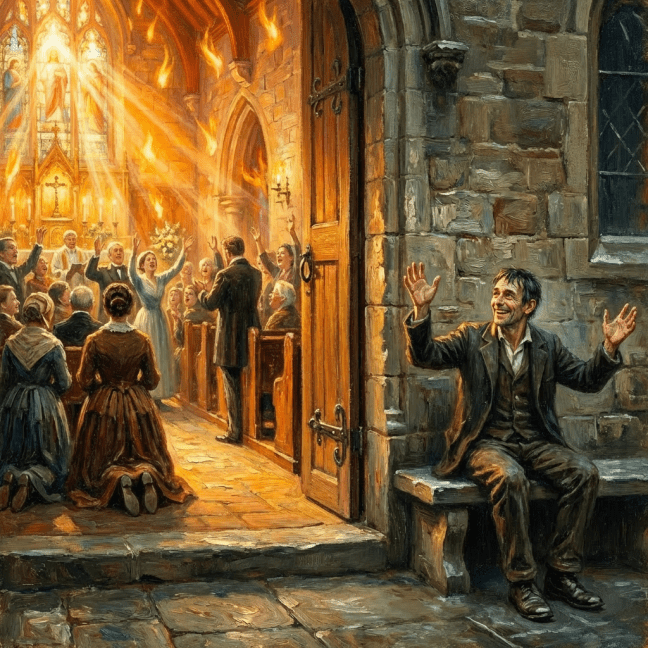
People praying in a warm church while a man sits alone outside in the rain.

“Nor do we boast and claim credit for the work someone else has done. Instead, we hope that your faith will grow so that the boundaries of our work among you will be extended. Then we will be able to go and preach the Good News in other places far beyond you, where no one else is working. Then there will be no question of our boasting about work done in someone else’s territory.”
2 Corinthians 10:15-16 NLT

Paul established the Corinthian church during his second missionary journey, around about 50 AD, and he spent about eighteen months there establishing the church with the help of a Jewish couple, Aquila and Priscilla. He started his mission in the local synagogue, but, not getting very far, he left and went next door to the home of Titius Justus, a Gentile believer. We can read all about it in Acts 18. But in his first letter to the Corinthians, Paul addressed the issue of divisions and quarrelling, “Some of you are saying, “I am a follower of Paul.” Others are saying, “I follow Apollos,” or “I follow Peter,” or “I follow only Christ”” (1 Corinthians 1:12). From this, we can assume that Paul was not the only preacher in Corinth, with Apollos and Peter making their contribution. In our verses today from his second letter, Paul was clear to point out that he was not going to take any credit “for the work someone else has done”. Instead, generously, he recognised that “the boundaries of [his] work” would be extended by different men ministering there. It is a fact of life that people will follow leaders whom they can relate to, and that is not always the same person, and the men we know about, Paul, Apollos and Peter, each had their own followings. In fact, Paul effectively told the Corinthians that it was good to have an open pulpit, because it would free him to pioneer the preaching of the Gospel in places where people had not heard about Jesus. On the one hand, Paul was very jealous of his church plant in Corinth, but on the other, he realised that he couldn’t be in all places at the same time. Paul’s basic motivation was being an Apostle to the Gentiles, which was the driving force behind his mission to preach the Gospel. 

Today, we pilgrims go to churches that may or may not have an open pulpit. I have been in a church where there was only one preacher, someone who was very good, but inevitably, the delivery style and subject matter skewed the reception amongst the congregation. In another church I attended, back in the early days of my faith, the congregation was ministered to by three men: one a pastor and teacher, one a prophet, and the third an evangelist. A good mix of messages followed, and the congregation grew in a more balanced way. 

In Ephesians 4:11-12, we read about the different ministry gifts present in God’s order: “Now these are the gifts Christ gave to the church: the apostles, the prophets, the evangelists, and the pastors and teachers. Their responsibility is to equip God’s people to do his work and build up the church, the body of Christ”. We call this the “Five-fold ministry”. It is obvious, really, that if the church of which we are a member only has one of these gifts, then some aspects of spiritual teaching will be neglected. The church, which I described as having one leader, mainly heard teachings on the Christian life, with an emphasis on healing. So the other ministries were neglected. In some cases, the church leader has more than one gift and fills in some of the gaps, but, as Paul wrote to the Ephesians, the purpose of these ministries is to “equip God’s people to do His work” and “build up the church”

I suspect Paul would have been the first person to admit that he did not hold the positions of all these ministries, and visits from Apollos and Peter would have filled in a few gaps. Titus was another gifted man who visited Corinth, as we read earlier in the second letter, and Paul was not going to claim credit for their work.

The church of Jesus Christ, in its universal sense, is not there for individuals in splendid isolation, but it is a “body” of people who are being built into a spiritual temple. 1 Peter 2:4-5, “You are coming to Christ, who is the living cornerstone of God’s temple. He was rejected by people, but he was chosen by God for great honour. And you are living stones that God is building into his spiritual temple. What’s more, you are his holy priests. Through the mediation of Jesus Christ, you offer spiritual sacrifices that please God”. Paul wrote, “So now you Gentiles are no longer strangers and foreigners. You are citizens along with all of God’s holy people. You are members of God’s family. Together, we are his house, built on the foundation of the apostles and the prophets. And the cornerstone is Christ Jesus himself. We are carefully joined together in him, becoming a holy temple for the Lord” (Ephesians 2:19-21). Paul went further about this “body” when he wrote, “He makes the whole body fit together perfectly. As each part does its own special work, it helps the other parts grow, so that the whole body is healthy and growing and full of love” (Ephesians 4:16). It is also a fact that Jesus is coming back a second time to meet His bride, the church. Ephesians 5:25b-27, “… Christ loved the church. He gave up his life for her to make her holy and clean, washed by the cleansing of God’s word. He did this to present her to himself as a glorious church without a spot or wrinkle or any other blemish. Instead, she will be holy and without fault”

We pilgrims are part of a much larger body of people. Some we will get on with; others we won’t. But together we make up the “body of Christ”. In this body, we are all responsible for acts of service, and with these the body grows “without a spot or wrinkle”. And it is our leaders who help us in this process by their teaching and encouragement. We must always encourage them in their ministries and help them in any way we can. As Paul said in his first letter, there will be different leaders with different gifts, but through them “[our] faith will grow”. Yes, it is possible for Christians to be individuals outside the body: in fact, there are some of our brothers and sisters who have little choice in the matter, and for them God provides a special blessing through His Spirit, but for the majority of us, we find out that we are in a body of believers, all heading in the same direction. We will all be at different stages in our journeys, but we are all looking forward to the day when we will meet the Lord Himself, glorified and home at last.

Dear Heavenly Father. You have kindly placed us in a family, made up of Your children. Please help us to build up our spiritual siblings, and support our leaders as they do the work You have asked them to do. In Jesus’ name. Amen.

Understanding Spiritual Boundaries in Christian Life

“We will not boast about things done outside our area of authority. We will boast only about what has happened within the boundaries of the work God has given us, which includes our working with you. We are not reaching beyond these boundaries when we claim authority over you, as if we had never visited you. For we were the first to travel all the way to Corinth with the Good News of Christ.”
2 Corinthians 10:13-14 NLT

As Christians, what do we pilgrims think about boundaries, the areas of authority that we believe we have? In a worldly sense, we know that there are many things that we can’t, or shouldn’t do, things such as burgle someone’s house or other property. Things such as pretending to be someone we aren’t, such as a Police Officer, or a doctor (unless we’re qualified as such, of course). Most people can’t fly a plane, or would even want to, come to that. Some people find boundaries because of their physical limitations, such as Nick Vujicic, who has no arms or legs. Or a blind man unable to see a sunset or a painting of beauty. Human beings have many limitations that form boundaries in their lives. We know all of that, and we don’t fret about it because we accept where we are at.

But what about spiritual boundaries? Paul was very sure about his “area of authority”, which he defined as “the work God has given [him], which includes [his] working with” the Corinthians. Are we similarly sure of where there are limitations to the work we should be doing? Having said that, there are many Christians, I fear, who don’t do any work at all! But as followers of Christ, there is a “sweet spot” of service to Him, where we know and understand exactly what our individual mission in life is, within the boundaries tailor-made just for us. Perhaps we should start with the Great Commission, which we find in Matthew 28:19-20, “Therefore, go and make disciples of all the nations, baptising them in the name of the Father and the Son and the Holy Spirit. Teach these new disciples to obey all the commands I have given you. And be sure of this: I am with you always, even to the end of the age”. This is a “work God has given us” and is the responsibility of every Christian, not just the minister or pastor, or the evangelist on the church leadership team. So in our sphere of family, friends, and community, we are authorised to make disciples. 

In the episode of Peter and John healing the lame man at the Temple gate, we read the time-honoured words, “But Peter said, “I don’t have any silver or gold for you. But I’ll give you what I have. In the name of Jesus Christ the Nazarene, get up and walk!”” (Acts 3:6). Peter also said about Jesus, “He is the one all the prophets testified about, saying that everyone who believes in him will have their sins forgiven through his name” (Acts 10:43). The name of Jesus implies that with it we are invoking His authority. John 14:13, “You can ask for anything in my name, and I will do it, so that the Son can bring glory to the Father”. We know, of course, that using the name of Jesus will only be effective if it aligns with His will and purposes. If Jesus wants something to happen, then we are authorised to use His name to fulfil His will. In the story of the Centurion with a sick servant, we read about Christ’s authority being understood by a Gentile with faith. “But the officer said, “Lord, I am not worthy to have you come into my home. Just say the word from where you are, and my servant will be healed. I know this because I am under the authority of my superior officers, and I have authority over my soldiers. I only need to say, ‘Go,’ and they go, or ‘Come,’ and they come. And if I say to my slaves, ‘Do this,’ they do it”” (Matthew 8:8-9). We have that authority as well, as pilgrims faithfully following our Master.

Another area of authority is that we are Christ’s ambassadors. 2 Corinthians 5:20, “So we are Christ’s ambassadors; God is making his appeal through us. We speak for Christ when we plead, “Come back to God””. An ambassador is someone who represents their country when they are sent to another. There, they look after the affairs of their country in dealings with foreign countries, and in particular the interests of their fellow citizens. We pilgrims are ambassadors for the Kingdom of God, and we are assigned to represent the interests of this Kingdom in the worldly nation of which we are a part. So I am Christ’s ambassador to the part of Scotland where I live, and it is here that I represent Christ in all my dealings with the people around me. As we read through the Bible, we soon find out how we should behave as ambassadors for Christ. Ephesians 4:21-24, “Since you have heard about Jesus and have learned the truth that comes from him, throw off your old sinful nature and your former way of life, which is corrupted by lust and deception. Instead, let the Spirit renew your thoughts and attitudes. Put on your new nature, created to be like God—truly righteous and holy”. Ambassadors for Christ are led by the Holy Spirit in all that they do, empowered by communication directly with God, much like the way an earthly ambassador can receive instructions from his or her mother nation. 

Our boundaries are also based on servanthood. “But Jesus called them together and said, “You know that the rulers in this world Lord it over their people, and officials flaunt their authority over those under them. But among you it will be different. Whoever wants to be a leader among you must be your servant, and whoever wants to be first among you must become your slave” (Matthew 20:25-27). In humility and with the same attitude Jesus had, we serve our fellow believers and those around us. We do not aspire to a position of authority, because it is only Christ who appoints such a person. Any worldly appointments are of no consequence to those in God’s family.

Dear Father God. As Your children, we are Your ambassadors in this world around us. Please help us to realise our boundaries, in what we can and cannot do, so that we can be effective in all that we do. In Jesus’ name. Amen.