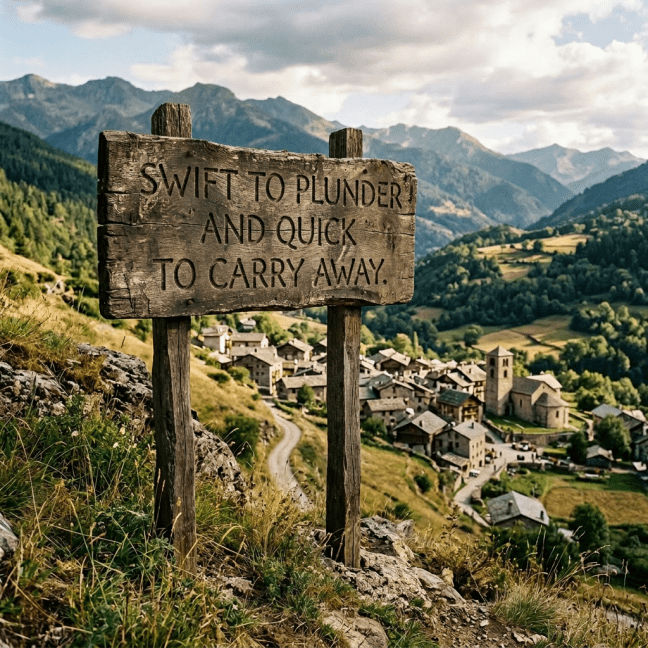
“Then the Lord said to me, “Make a large signboard and clearly write this name on it: Maher-shalal-hash-baz.” I asked Uriah the priest and Zechariah son of Jeberekiah, both known as honest men, to witness my doing this. Then I slept with my wife, and she became pregnant and gave birth to a son. And the Lord said, “Call him Maher-shalal-hash-baz. For before this child is old enough to say ‘Papa’ or ‘Mama,’ the king of Assyria will carry away both the abundance of Damascus and the riches of Samaria.””
Isaiah 8:1-4 NLT
Isaiah 7:17-25 outlines the prophecy about what will happen to Judah because of King Ahaz’s stubbornness and lack of faith in God. It is grim reading, as “ … the Lord … whistle[s] for the army of southern Egypt and for the army of Assyria. They will swarm around you like flies and bees” (Isaiah 7:18), and the picture develops of a land, desolate and unpopulated. “The entire land will become a vast expanse of briers and thorns, a hunting ground overrun by wildlife” (Isaiah 7:24). There are a few people remaining, however, and with the abandoned sheep, cattle and goats, they will have sufficient food to sustain them. But the land of finery, prosperity, rich people and the partying and drunkenness is no more.
We now move over to Isaiah 8 and find Isaiah doing something strange. He makes a signboard with the slogan “Maher-shalal-hash-baz” written on it. To emphasise his message, he enlisted the witness of two honest men, Uriah and Zechariah. He didn’t include what he then did with his signboard, but the message was “Swift to plunder and quick to carry away”. Imagine today if someone had such a placard with those words written on it, and they started to walk down the local High Street. At best, people would stop them and ask what the message was all about. But I suspect that, in today’s society, most people would hurry past them and ignore them. Messages written on placards as part of our seemingly frequent demonstrations and marches today are mostly understandable and convey the message behind the event, so a cryptic message or statement with no apparent meaning would be unusual.
Perhaps the signboard was to be located in a prominent place in Jerusalem, where passers-by would be constantly reminded of the warning Isaiah had written. But almost to emphasise the message, Isaiah and his wife had a son, and they gave him the same name. Poor wee chap, we think, having to be called that name for the rest of his life, but the message was clear. A time was coming when Israel would be plundered, and all the spoil carried away with the people into exile. “Damascus” and “Samaria” refer to the Syrian and Israeli kings.
Isaiah wasn’t slow in proclaiming God’s message to His people, who had lapsed into apostasy, idolatry and sin. They were living lives of luxury, apparently unaware of the storm clouds gathering on their borders and of the warning Isaiah had issued. Were all the people living sinful lives, or were there some who “had not bowed the knee to Baal”? Throughout history there has always been a remnant of people faithful to God, and Isaiah’s prophecy at the end of Isaiah 6 records, “… But as a terebinth or oak tree leaves a stump when it is cut down, so Israel’s stump will be a holy seed”, and in the verse 22 in the next chapter we read, “Nevertheless, there will be enough milk for everyone because so few people will be left in the land. They will eat their fill of yogurt and honey”.
Today, we pilgrims mostly live in an increasingly secular society where there are many parallels with society in Isaiah’s day. Many people live a life of plenty and luxury, but fail to acknowledge the One who has blessed them with the means to enjoy what they have. Talk of God and who He is falls largely on deaf ears. But it wasn’t so long ago when people everywhere here in the UK flocked to their churches without a thought of denying God. Here in the centre of the city where I live, there were fourteen churches and congregations in the 17th and 18th centuries, and most of the buildings remain today as “signboards” of a past move of God. The remaining churches are marked by a small number of people in large buildings. But God is still on the move, with new congregations springing up in out-of-town warehouses and industrial buildings. God always has a remnant of people faithful to Him.
We pilgrims are representatives of God, and we pray that there will once again be a new awakening to God, and that people will reach out to Him as their Creator and their God. We are the “signboards” in our generation and communities proclaiming a message similar to that of Isaiah. Perhaps ours would be “Repent for the end is nigh”, or “Jesus is the answer”, or something more scriptural like “Jesus came to save the lost”. Even John 3:16 might be an appropriate message for our “signboard”. Or, as a friend of mine does quite frequently, we try to engage people and give them a copy of the Gospel or a simple tract that might lead to their salvation. But however we proclaim the message about our wonderful God to our society, we realise that what we have to say will go largely misunderstood or ignored altogether. The same hindrance that Isaiah was warned about still applies today (Isaiah 6:9-10).
Father God. The message we proclaim to the people around us, repentance and belief in Jesus, contains words and actions as we live out our pilgrim life in our communities and families. Please lead and guide us in Your ways, and to the people who You want us to reach. In Jesus’ name. Amen.

