
The Farmer’s Wisdom: Understanding Spiritual Growth

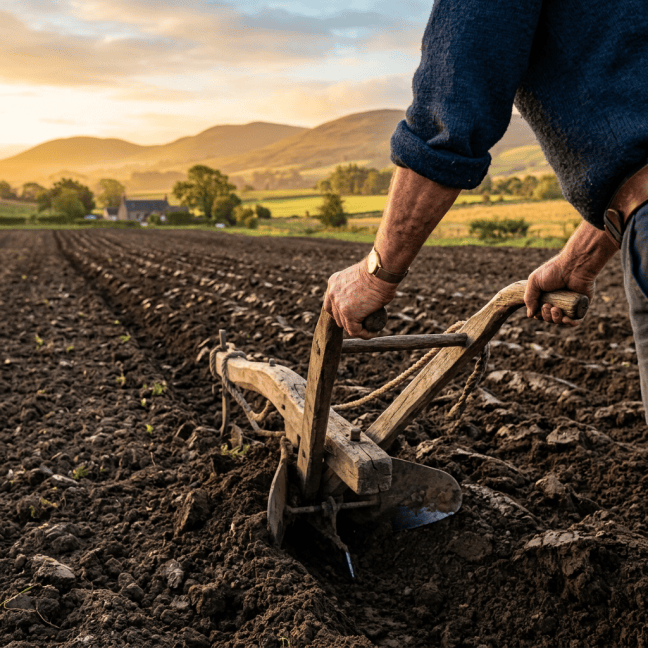
Farmer guiding a wooden plow through a freshly tilled field

“Listen to me; listen, and pay close attention. Does a farmer always plough and never sow? Is he forever cultivating the soil and never planting? Does he not finally plant his seeds— black cumin, cumin, wheat, barley, and emmer wheat— each in its proper way, and each in its proper place? The farmer knows just what to do, for God has given him understanding. A heavy sledge is never used to thresh black cumin; rather, it is beaten with a light stick. A threshing wheel is never rolled on cumin; instead, it is beaten lightly with a flail. Grain for bread is easily crushed, so he doesn’t keep on pounding it. He threshes it under the wheels of a cart, but he doesn’t pulverize it. The LORD of Heaven’s Armies is a wonderful teacher, and he gives the farmer great wisdom.”
Isaiah 28:23-29 NLT

A farmer knows what he is doing. Perhaps he learned the art of ploughing from his father, who learnt it from his father before that. He knows that he does it for a purpose, that of preparing the ground for the next part of the process, sowing the seeds. This was a picture that would resonate well with the largely agricultural population in Judah at that time. In those days, the ground was broken up with a sharp device, not like the ploughs of today, which are impressive in their capability to not only break up the ground but turn it over so that anything still growing, usually weeds, becomes buried, unable to grow anymore. Although I live in a city in Scotland, the arable fields around are quickly discovered after a short drive, and at this time of year (September) are being ploughed, getting them ready for the sowing of a winter crop, and the brown and reddish-brown soil compares starkly with the green fields around them.  But although the nature of ploughing has changed, the purpose hasn’t, with the next part of the process being the planting of seeds. Isaiah mentioned five possibilities, “black cumin, cumin, wheat, barley, and emmer wheat”. Isaiah made the point, however, that no farmer ploughs just for the sake of ploughing. What’s the point? It would just be a waste of effort. And he devotes a whole verse to stating the obvious, “The farmer knows just what to do, for God has given him understanding”. And he ends the chapter with, “The LORD of Heaven’s Armies is a wonderful teacher, and he gives the farmer great wisdom”.

Perhaps Isaiah was pointing out to the religious leaders in Judah that if even a farmer knows how to do his job, why did they find it so difficult to do theirs? They had a wealth of religious literature to lead them in God’s ways. Available to them were the Torah (the first five books of the Bible we know today), the Books of the Psalms and Proverbs, and even some of the early prophets such as Hosea and Amos. But the leaders had become like farmers who had forgotten what to do. Farmers who failed to farm the land would put themselves in danger of starvation. But the analogy extends to the religious leaders, because if they failed to do what God had asked them to do, then they would die spiritually, and in the process eventually take down the whole population. 

The word “ploughing” can be extended to anything that is hard and requires breaking up a bit. In several places in the Bible, we have the analogy of ploughing up hearts that had become hardened. Hosea 10:12, “I said, ‘Plant the good seeds of righteousness, and you will harvest a crop of love. Plough up the hard ground of your hearts, for now is the time to seek the LORD, that he may come and shower righteousness upon you’”. Jeremiah wrote,“This is what the LORD says to the people of Judah and Jerusalem, “Plough up the hard ground of your hearts! Do not waste your good seed among thorns“” (Jeremiah 4:3). He went on to describe why this was necessary in the next verse, “O people of Judah and Jerusalem, surrender your pride and power. Change your hearts before the LORD, or my anger will burn like an unquenchable fire because of all your sins“. The analogy continues with a picture of spiritual hearts covered in a hard layer (the skin of sin), through which God’s precepts could not penetrate. It is very difficult, if not impossible, for a sinner to do the things that God has asked of them before they first deal with their sins through confession and repentance. 

Paul wrote, “Do not be deceived, God is not mocked; for whatever a man sows, that he will also reap” (Galatians 6:7). Even to us “townies”, the meaning of this verse is very clear. Early in their school years, children will learn practically what seeds are and if they are placed in soil, are watered and sunlit, then something will grow, first a green shoot and then, after a bit, a plant and even a flower. A wonderful, God-created process that the evolutionists and atheists try to fob off as something that happened by accident. But the same principle applies to our spiritual lives. In the next verse in Galatians, Paul explained this very clearly, “For he who sows to his flesh will of the flesh reap corruption, but he who sows to the Spirit will of the Spirit reap everlasting life”. Another translation (NLT) puts it this way, “Those who live only to satisfy their own sinful nature will harvest decay and death from that sinful nature. But those who live to please the Spirit will harvest everlasting life from the Spirit“.

The spiritual principle is clear, and we pilgrims must listen and follow it carefully. Human beings naturally lapse into ways that can grow into something that is bad for our spirits, for our “hearts”. James wrote, “Temptation comes from our own desires, which entice us and drag us away. These desires give birth to sinful actions. And when sin is allowed to grow, it gives birth to death” (James 1:14-15). The death he referred to is spiritual death, which is exclusion from God for eternity. 

It begs the following question, really. “Why would we pilgrims prepare our hearts to receive God’s Word, only to then sow seeds of sin that lead to destruction?” Why indeed.

Dear Heavenly Father. Please help us today to prepare our hearts once again to receive Your Words of eternal life. Please forgive us for our sins, the “weeds” we sow far too often. Please help us walk in Your ways, this day and forever. In Your precious name. Amen.

The Church and Money

“Now regarding your question about the money being collected for God’s people in Jerusalem. You should follow the same procedure I gave to the churches in Galatia. On the first day of each week, you should each put aside a portion of the money you have earned. Don’t wait until I get there and then try to collect it all at once. When I come, I will write letters of recommendation for the messengers you choose to deliver your gift to Jerusalem. And if it seems appropriate for me to go along, they can travel with me.”
1 Corinthians 16:1-4 NLT

In his first letter to the Corinthians, Paul has covered a lot of ground, much of it apparently in response to a letter the Corinthians had written to him. As we turn the page into the last chapter, Paul addresses their practical question about how to collect money “for God’s people in Jerusalem”. What he suggested has become the norm in Christian churches. “On the first day of each week,” money was to be collected from the congregation and used as the Holy Spirit leads. For us pilgrims, the week starts on a Sunday, with corporate and public worship meetings held in churches, community centres, schools, wherever a room is available. Such gatherings even take place in people’s homes, if the numbers are small. But an important part of worship is taking a collection, in which every person present gives money for the work of the church. Of course, in today’s internet age, many give online by scanning a QR code or similar, or through the banking system with standing orders, but the same principle remains. 

Paul wrote this letter to the Corinthians in about 55 AD, during the period before the Temple in Jerusalem was destroyed by the Romans in 70 AD. In the middle of all the political unrest, the Christians in Jerusalem were going through a terrible time of persecution and were desperately in need of help with their poverty. As we read in Acts 12, the Apostle James was martyred, and Herod Agrippa went on to imprison Peter, intending to put him on trial. Christians were not at all popular with the Jews in those days, and the Judean Christians were not the only believers suffering persecution. In his first letter to the Thessalonians, Paul acknowledged how much they, too, were suffering. 1 Thessalonians 2:14, “And then, dear brothers and sisters, you suffered persecution from your own countrymen. In this way, you imitated the believers in God’s churches in Judea who, because of their belief in Christ Jesus, suffered from their own people, the Jews”. By contributing from their resources, the believers in Corinth were able to help other believers who were in need, but there was a spin-off benefit that was important. The Corinthians were mostly Gentiles not of Jewish ancestry, and it provided for them the opportunity to heal any rifts that had developed between Jews and Gentiles. It also established the principle of unity between Christian churches, wherever they were, and regardless of the ethnicity of their congregants.

Today, we collect money from our congregations and use it for God’s work as well as for practical requirements, such as the upkeep of the church building or renting alternative space. Then we have the church leaders to provide for. Some churches struggle to do even that because of their numbers, but others have a surplus and can budget to use it to support evangelical work, missionaries, food banks, and other philanthropic work as God leads. Paul suggested that the believers “should each put aside a portion of the money [they] have earned”. How much that should be is often debated, with some proposing ten per cent of earnings, others suggesting different amounts. But whatever decision is reached, it should be between the believer and God, who sees what is going on inside a person and in their bank accounts. 

A Christian is a believer who obeys the Lord, who follows Him and His teachings, and who is a citizen of the Kingdom of God. Such a life is very different from that of unbelievers, and there will be sacrifices accordingly. We pilgrims devote our time and resources to God, because we love Him and want to please Him in all that we do. There is a principle of sowing and reaping that applies in God’s economy, and the agricultural analogy covers many aspects of a believer’s life. Money, time, our behaviour, hospitality, and so on. The principle means that if we sow sparingly in any of these areas, then the harvest that we reap, will be equally sparse. Galatians 6:7, “Do not be deceived: God cannot be mocked. A man reaps what he sows“. Jesus Himself taught, “Give, and it will be given to you. A good measure, pressed down, shaken together and running over, will be poured into your lap. For with the measure you use, it will be measured to you”.

In these verses today, Paul wasn’t suggesting that the Corinthians believers were a bit stingey with their money. Rather, Paul was suggesting a way to budget their giving so there wasn’t a problem with collecting it all at once. Good practical advice and one that has followed him into the twenty-first century.

Dear Father God. Thank You for the resources You have given us, and for helping us to use them wisely. Amen.

Sowing and Reaping

“You know the saying, ‘Four months between planting and harvest.’ But I say, wake up and look around. The fields are already ripe for harvest. The harvesters are paid good wages, and the fruit they harvest is people brought to eternal life. What joy awaits both the planter and the harvester alike! You know the saying, ‘One plants and another harvests.’ And it’s true. I sent you to harvest where you didn’t plant; others had already done the work, and now you will get to gather the harvest.”
John 4:35-38 NLT

Jesus once again used an analogy that would be well understand in that culture – the process involved in the growing of crops. But Jesus was using a natural analogy to represent the spiritual world, a world where the harvest is not grain but souls.

As Jesus pointed out, there was a delay of four months between sowing seed, and harvesting the resulting crops, and this was a time of anxiety for the farmer, because any adverse weather events could ruin the crops and destroy his livelihood. In extreme times, even famine could result. The farmer also had to withhold some of the seed so that he had something to sow in the ground the following year. In my early years, “Harvest Festivals” were held both in my school and in the local churches. These were times when we brought food items to school or church and sung hymns such as “We plough the fields and scatter, the good seed on the ground”. And all in celebration of the importance of the natural sowing and harvesting process. In those services we thanked God for His blessings, for providing us with the food we required for our very existence. 

Jesus told us the parable of the soils, which we can read in Matthew 13. But the fruit of the process, when good soil was found, was a multiplication of the seed originally planted. In Matthew 13:8 we read, “Still other seeds fell on fertile soil, and they produced a crop that was thirty, sixty, and even a hundred times as much as had been planted!” Near where I live, the farmer often plants a field of barley, and sometimes I select an ear of grain and estimate the crop yield. God’s blessings are there for all to see, though we take His multiplying provision for granted most of the time. But Jesus was using the analogy of sowing and reaping to illustrate a spiritual principle to His disciples. He equated the variety of soil conditions with people’s hearts.

Jesus said to His disciples, “wake up and look around. The fields are already ripe for harvest“. The “seed” had already been planted in the hearts of the people by others, the prophets and the religious leaders, and Jesus said that the people were ready to hear the message that would produce in them a spiritual harvest. And in the following years, the disciples saw the establishment of the first century church. Peter’s sermon in Acts 2 resulted in 3000 people being added to the church. That is harvesting!

So today, we pilgrims have an opportunity. There is still a spiritual harvest waiting for the reaping. I meet people who know about God, who even recognise and believe in His existence, and who are just waiting for someone to help them bring to life that knowledge and introduce them, perhaps once again, to the Saviour Jesus Christ. But I meet others who have no ideas about God at all. Their spiritual knowledge seems to come from social media and occasional encounters with news reports about other religions. They perhaps wonder about the churches dotted around our country, perhaps seeing more and more of them closing, perhaps having a perception that they are only relevant to elderly people. These are the people who may be good soil, just waiting for a seed to be planted, a seed coming straight out of God’s unlimited storehouses. Once planted, we can see the outcome as the Holy Spirit encourages the growth. Sometimes we may have the opportunity to be harvesters. Sometimes others will have that privilege.

The church I attend meets every Sunday morning in a leisure centre, and often people passing by in the corridor outside will look in, in apparent wonder and puzzlement. They sometimes stop for a few moments, perhaps receiving a seed that will start within them the process of germination. God is always at work.

We pilgrims are engaged in the farming business. Spiritual agriculture is our calling. The church goes through seasons of growth and decline as the years go by. But we are in the thick of it, sowing and reaping whenever we have the opportunity. There are never a lack of opportunities. We just need to pray for boldness and have our messages of hope ready and waiting.

Dear Father God. We pray today for divine encounters, enabling us to plant seeds whenever we have the opportunity. And lead us, we pray, to those who are just waiting for someone to introduce them to You. In Jesus’ name. Amen.