
The Farmer’s Wisdom: Understanding Spiritual Growth

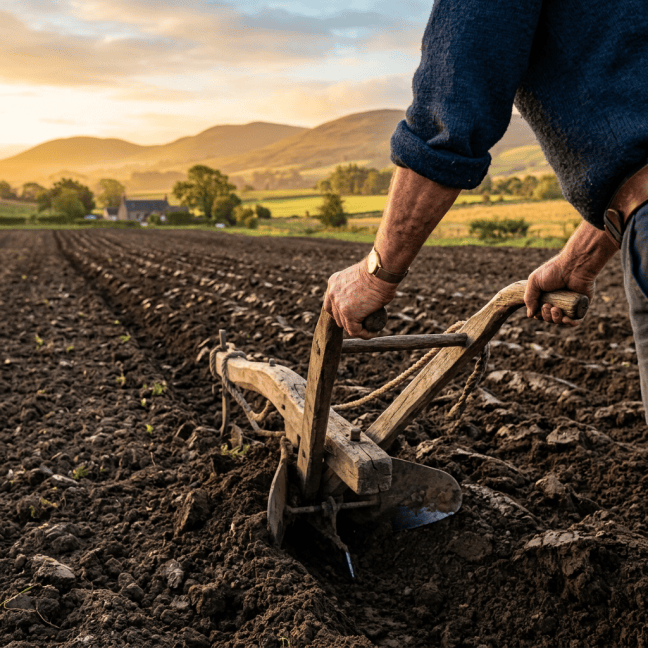
Farmer guiding a wooden plow through a freshly tilled field

“Listen to me; listen, and pay close attention. Does a farmer always plough and never sow? Is he forever cultivating the soil and never planting? Does he not finally plant his seeds— black cumin, cumin, wheat, barley, and emmer wheat— each in its proper way, and each in its proper place? The farmer knows just what to do, for God has given him understanding. A heavy sledge is never used to thresh black cumin; rather, it is beaten with a light stick. A threshing wheel is never rolled on cumin; instead, it is beaten lightly with a flail. Grain for bread is easily crushed, so he doesn’t keep on pounding it. He threshes it under the wheels of a cart, but he doesn’t pulverize it. The LORD of Heaven’s Armies is a wonderful teacher, and he gives the farmer great wisdom.”
Isaiah 28:23-29 NLT

A farmer knows what he is doing. Perhaps he learned the art of ploughing from his father, who learnt it from his father before that. He knows that he does it for a purpose, that of preparing the ground for the next part of the process, sowing the seeds. This was a picture that would resonate well with the largely agricultural population in Judah at that time. In those days, the ground was broken up with a sharp device, not like the ploughs of today, which are impressive in their capability to not only break up the ground but turn it over so that anything still growing, usually weeds, becomes buried, unable to grow anymore. Although I live in a city in Scotland, the arable fields around are quickly discovered after a short drive, and at this time of year (September) are being ploughed, getting them ready for the sowing of a winter crop, and the brown and reddish-brown soil compares starkly with the green fields around them.  But although the nature of ploughing has changed, the purpose hasn’t, with the next part of the process being the planting of seeds. Isaiah mentioned five possibilities, “black cumin, cumin, wheat, barley, and emmer wheat”. Isaiah made the point, however, that no farmer ploughs just for the sake of ploughing. What’s the point? It would just be a waste of effort. And he devotes a whole verse to stating the obvious, “The farmer knows just what to do, for God has given him understanding”. And he ends the chapter with, “The LORD of Heaven’s Armies is a wonderful teacher, and he gives the farmer great wisdom”.

Perhaps Isaiah was pointing out to the religious leaders in Judah that if even a farmer knows how to do his job, why did they find it so difficult to do theirs? They had a wealth of religious literature to lead them in God’s ways. Available to them were the Torah (the first five books of the Bible we know today), the Books of the Psalms and Proverbs, and even some of the early prophets such as Hosea and Amos. But the leaders had become like farmers who had forgotten what to do. Farmers who failed to farm the land would put themselves in danger of starvation. But the analogy extends to the religious leaders, because if they failed to do what God had asked them to do, then they would die spiritually, and in the process eventually take down the whole population. 

The word “ploughing” can be extended to anything that is hard and requires breaking up a bit. In several places in the Bible, we have the analogy of ploughing up hearts that had become hardened. Hosea 10:12, “I said, ‘Plant the good seeds of righteousness, and you will harvest a crop of love. Plough up the hard ground of your hearts, for now is the time to seek the LORD, that he may come and shower righteousness upon you’”. Jeremiah wrote,“This is what the LORD says to the people of Judah and Jerusalem, “Plough up the hard ground of your hearts! Do not waste your good seed among thorns“” (Jeremiah 4:3). He went on to describe why this was necessary in the next verse, “O people of Judah and Jerusalem, surrender your pride and power. Change your hearts before the LORD, or my anger will burn like an unquenchable fire because of all your sins“. The analogy continues with a picture of spiritual hearts covered in a hard layer (the skin of sin), through which God’s precepts could not penetrate. It is very difficult, if not impossible, for a sinner to do the things that God has asked of them before they first deal with their sins through confession and repentance. 

Paul wrote, “Do not be deceived, God is not mocked; for whatever a man sows, that he will also reap” (Galatians 6:7). Even to us “townies”, the meaning of this verse is very clear. Early in their school years, children will learn practically what seeds are and if they are placed in soil, are watered and sunlit, then something will grow, first a green shoot and then, after a bit, a plant and even a flower. A wonderful, God-created process that the evolutionists and atheists try to fob off as something that happened by accident. But the same principle applies to our spiritual lives. In the next verse in Galatians, Paul explained this very clearly, “For he who sows to his flesh will of the flesh reap corruption, but he who sows to the Spirit will of the Spirit reap everlasting life”. Another translation (NLT) puts it this way, “Those who live only to satisfy their own sinful nature will harvest decay and death from that sinful nature. But those who live to please the Spirit will harvest everlasting life from the Spirit“.

The spiritual principle is clear, and we pilgrims must listen and follow it carefully. Human beings naturally lapse into ways that can grow into something that is bad for our spirits, for our “hearts”. James wrote, “Temptation comes from our own desires, which entice us and drag us away. These desires give birth to sinful actions. And when sin is allowed to grow, it gives birth to death” (James 1:14-15). The death he referred to is spiritual death, which is exclusion from God for eternity. 

It begs the following question, really. “Why would we pilgrims prepare our hearts to receive God’s Word, only to then sow seeds of sin that lead to destruction?” Why indeed.

Dear Heavenly Father. Please help us today to prepare our hearts once again to receive Your Words of eternal life. Please forgive us for our sins, the “weeds” we sow far too often. Please help us walk in Your ways, this day and forever. In Your precious name. Amen.

Embracing the Open Door: Paul’s Call to Evangelism

“In the meantime, I will be staying here at Ephesus until the Festival of Pentecost. There is a wide-open door for a great work here, although many oppose me. When Timothy comes, don’t intimidate him. He is doing the Lord’s work, just as I am. Don’t let anyone treat him with contempt. Send him on his way with your blessing when he returns to me. I expect him to come with the other believers.”
1 Corinthians 16:8-11 NLT

Paul was staying in Ephesus when he wrote 1 Corinthians, and a substantial distance of over 500 kilometres across the Aegean Sea separated the two congregations. Without a postal system, Paul would have relied on a merchant or some other traveller to transport the letter. But Paul was apparently reluctant to leave Ephesus at that time because there was a “wide-open door for a great work” in that city. We note that this “great work” was not easy for Paul because many opposed him. But that was never going to stop Paul from doing the Lord’s work, no matter the consequences. We can read about one of the dangers Paul faced in Acts 19, when the silversmiths in Ephesus started a riot because they feared their business would suffer from Paul’s evangelism. There was fierce opposition to the Good News about Jesus in those days, as the devil tried desperately to stop his worldly kingdom from being eroded.

If we fast-forward to today, to our 21st-century Western societies, we find a distinct lack of emotion expressed toward the Gospel. But resistance to the things of God is still here in the UK, as we are increasingly finding out that British Christians are being persecuted for “crimes” such as silent prayer and, as a recent case exposed, for preaching the Gospel from John 3:16, both within the abortion clinic buffer zones that have been established in this country. Sadly, we have had a series of governments that have passed laws that go against Biblical truth, and even more sadly, Christians here have let it happen. 

“The harvest is great”

But as we look around our cities, villages and towns, what do we see? Churches with dwindling congregations? Worldliness abounding through a plethora of betting shops and drinking houses? People pursuing hedonistic activities but neglecting their souls? I’m sure Paul looked around Ephesus and observed much the same, because human nature hasn’t changed much over the times in between. But rather than view what was happening as a negative, Paul instead considered the opportunities for preaching the Gospel, describing the city of Ephesus as a “wide-open door”. Jesus looked around at the people in Galilee and saw an opportunity. We read in Matthew 9:36-38,  “When he saw the crowds, he had compassion on them because they were confused and helpless, like sheep without a shepherd. He said to his disciples, “The harvest is great, but the workers are few. So pray to the Lord who is in charge of the harvest; ask him to send more workers into his fields””. When Jesus was in Samaria, He felt the same way, and He said to His disciples, “You know the saying, ‘Four months between planting and harvest.’ But I say, wake up and look around. The fields are already ripe for harvest”. So, the problem with reaching our societies for Christ might not lie so much with the message as with the lack of people preaching it. So, as we look at the people around us, what do we see? A mission field just waiting for someone to bring in a harvest of souls, or a place of barrenness incapable of producing any fruit?

“The Lord opened her heart”

Even Christians will discourage their fellow believers from reaching out to those around them. There are many excuses offered, and I was recently told by a minister’s wife that there is little point in reaching out to strangers during my morning walks because evangelism is only really effective with people we already know. But such thoughts didn’t stop Paul, and they won’t stop me either. We read about Paul and Silas’ visit to Philippi in Acts 16:13-14, “On the Sabbath we went a little way outside the city to a riverbank, where we thought people would be meeting for prayer, and we sat down to speak with some women who had gathered there. One of them was Lydia from Thyatira, a merchant of expensive purple cloth, who worshipped God. As she listened to us, the Lord opened her heart, and she accepted what Paul was saying”. God went before Paul and prepared the way. And He will do the same for us, as we commit our ways to Him.

Today, we must always be prepared to share the Gospel and our testimonies. The “wide-open door” is still there, and God is still in the business of preparing the way. How prepared are we, though? What stops us from reaching out to people? Fear of what they might say? Fear of rejection? Paul experienced all of this and worse. Yes, we will experience knockbacks, but even in contact with others, we might just plant a seed that will grow over time into someone finally accepting Jesus for themselves. So today, we must look at the day ahead and commit it to God, asking Him to show us who He wants us to share Jesus with. 

Dear Father God. There are many people around us who, in their spirits, desperately need to hear about You and Your saving grace. Please go before us, preparing the way, and please give us the courage we need to share Your Good News. In Jesus’ name. Amen.

Planting Seed

Those who plant in tears
will harvest with shouts of joy.
They weep as they go to plant their seed,
but they sing as they return with the harvest.
Psalm 126:5-6 NLT

What are we planting? I don’t mean physical seeds, like carrots for a crop later in the year. Or perhaps an orange pip, in the forlorn hope it will grow into a tree here in Scotland. No, we can plant lots of other things. Positive things like good advice. A school teacher instilling an education into often unwilling pupils. A minister preaching the good seed of the Kingdom from the pulpit. But we can also plant negatives in the way we speak to people, or the opinions we populate social media with. There has been many a child, or adult even,  driven into depression or a poor opinion of themselves, or worse, by bullies and trolls planting negative seeds about them on Facebook or the like.

When I read these two verses I immediately thought of the times parents plant seeds in their children. Seeds of good advice. Seeds of discipline. Seeds of life. And so often they are planted in tears, to a rebellious child or teenager exhibiting all the qualities of stony ground. Planting in tears. My wife and I fostered difficult children for many years. We certainly shed many tears as we tried to plant good seeds in lives so overgrown by the harvest from bad seed that there was little room for a good harvest. But with some, the good seed prevailed and we are in contact with several children, now grown up, who have produced a good harvest. Harvesting in joy indeed.

In our pilgrimage through life, we will come up against many attempts by others to plant seeds in us. Both good and bad. We need discernment and faith, to ensure that we only receive good seed. But we also need to be careful about what seeds we are planting in others.  The Bible is a book full of good seed. And we plant this seed in any opportunity that comes our way. Tell someone that Jesus loves them. Good seed. Tell someone that Jesus heals. More good seed. And these seeds will grow in someone’s heart, producing a harvest of great joy. We need to start in our spiritual potting sheds, culturing seeds through prayer, through Scripture, getting ready for the season of planting. Afterwards, we may never see the harvest – someone else will perhaps experience the joy. But we plant anyway. One day we may be very surprised seeing people in whom we tearfully planted seeds standing with us in Jesus’ presence. A good harvest worthy of a song or two?