
“Listen to me; listen, and pay close attention. Does a farmer always plough and never sow? Is he forever cultivating the soil and never planting? Does he not finally plant his seeds— black cumin, cumin, wheat, barley, and emmer wheat— each in its proper way, and each in its proper place? The farmer knows just what to do, for God has given him understanding. A heavy sledge is never used to thresh black cumin; rather, it is beaten with a light stick. A threshing wheel is never rolled on cumin; instead, it is beaten lightly with a flail. Grain for bread is easily crushed, so he doesn’t keep on pounding it. He threshes it under the wheels of a cart, but he doesn’t pulverize it. The LORD of Heaven’s Armies is a wonderful teacher, and he gives the farmer great wisdom.”
Isaiah 28:23-29 NLT
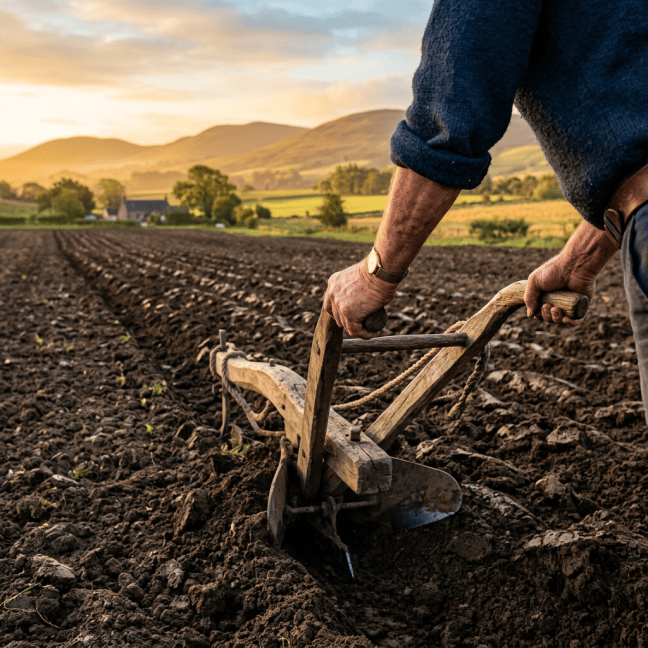
A farmer knows what he is doing. Perhaps he learned the art of ploughing from his father, who learnt it from his father before that. He knows that he does it for a purpose, that of preparing the ground for the next part of the process, sowing the seeds. This was a picture that would resonate well with the largely agricultural population in Judah at that time. In those days, the ground was broken up with a sharp device, not like the ploughs of today, which are impressive in their capability to not only break up the ground but turn it over so that anything still growing, usually weeds, becomes buried, unable to grow anymore. Although I live in a city in Scotland, the arable fields around are quickly discovered after a short drive, and at this time of year (September) are being ploughed, getting them ready for the sowing of a winter crop, and the brown and reddish-brown soil compares starkly with the green fields around them. But although the nature of ploughing has changed, the purpose hasn’t, with the next part of the process being the planting of seeds. Isaiah mentioned five possibilities, “black cumin, cumin, wheat, barley, and emmer wheat”. Isaiah made the point, however, that no farmer ploughs just for the sake of ploughing. What’s the point? It would just be a waste of effort. And he devotes a whole verse to stating the obvious, “The farmer knows just what to do, for God has given him understanding”. And he ends the chapter with, “The LORD of Heaven’s Armies is a wonderful teacher, and he gives the farmer great wisdom”.
Perhaps Isaiah was pointing out to the religious leaders in Judah that if even a farmer knows how to do his job, why did they find it so difficult to do theirs? They had a wealth of religious literature to lead them in God’s ways. Available to them were the Torah (the first five books of the Bible we know today), the Books of the Psalms and Proverbs, and even some of the early prophets such as Hosea and Amos. But the leaders had become like farmers who had forgotten what to do. Farmers who failed to farm the land would put themselves in danger of starvation. But the analogy extends to the religious leaders, because if they failed to do what God had asked them to do, then they would die spiritually, and in the process eventually take down the whole population.
The word “ploughing” can be extended to anything that is hard and requires breaking up a bit. In several places in the Bible, we have the analogy of ploughing up hearts that had become hardened. Hosea 10:12, “I said, ‘Plant the good seeds of righteousness, and you will harvest a crop of love. Plough up the hard ground of your hearts, for now is the time to seek the LORD, that he may come and shower righteousness upon you’”. Jeremiah wrote,“This is what the LORD says to the people of Judah and Jerusalem, “Plough up the hard ground of your hearts! Do not waste your good seed among thorns“” (Jeremiah 4:3). He went on to describe why this was necessary in the next verse, “O people of Judah and Jerusalem, surrender your pride and power. Change your hearts before the LORD, or my anger will burn like an unquenchable fire because of all your sins“. The analogy continues with a picture of spiritual hearts covered in a hard layer (the skin of sin), through which God’s precepts could not penetrate. It is very difficult, if not impossible, for a sinner to do the things that God has asked of them before they first deal with their sins through confession and repentance.
Paul wrote, “Do not be deceived, God is not mocked; for whatever a man sows, that he will also reap” (Galatians 6:7). Even to us “townies”, the meaning of this verse is very clear. Early in their school years, children will learn practically what seeds are and if they are placed in soil, are watered and sunlit, then something will grow, first a green shoot and then, after a bit, a plant and even a flower. A wonderful, God-created process that the evolutionists and atheists try to fob off as something that happened by accident. But the same principle applies to our spiritual lives. In the next verse in Galatians, Paul explained this very clearly, “For he who sows to his flesh will of the flesh reap corruption, but he who sows to the Spirit will of the Spirit reap everlasting life”. Another translation (NLT) puts it this way, “Those who live only to satisfy their own sinful nature will harvest decay and death from that sinful nature. But those who live to please the Spirit will harvest everlasting life from the Spirit“.
The spiritual principle is clear, and we pilgrims must listen and follow it carefully. Human beings naturally lapse into ways that can grow into something that is bad for our spirits, for our “hearts”. James wrote, “Temptation comes from our own desires, which entice us and drag us away. These desires give birth to sinful actions. And when sin is allowed to grow, it gives birth to death” (James 1:14-15). The death he referred to is spiritual death, which is exclusion from God for eternity.
It begs the following question, really. “Why would we pilgrims prepare our hearts to receive God’s Word, only to then sow seeds of sin that lead to destruction?” Why indeed.
Dear Heavenly Father. Please help us today to prepare our hearts once again to receive Your Words of eternal life. Please forgive us for our sins, the “weeds” we sow far too often. Please help us walk in Your ways, this day and forever. In Your precious name. Amen.

