
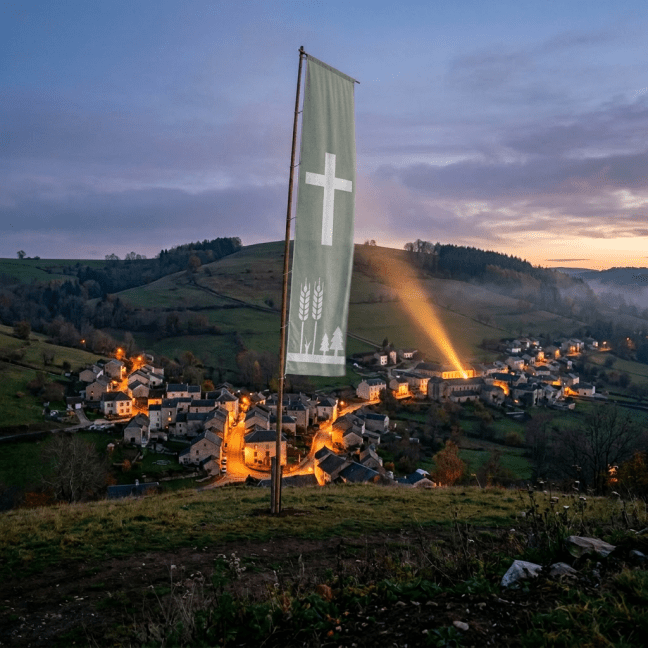
Gathering Under the Banner of Christ

Banner reading 'Harvest Festival Welcome' with a village lit up at dusk in the background

“Nothing will hurt or destroy in all my holy mountain, for as the waters fill the sea, so the earth will be filled with people who know the Lord. In that day the heir to David’s throne will be a banner of salvation to all the world. The nations will rally to him, and the land where he lives will be a glorious place. In that day the Lord will reach out his hand a second time to bring back the remnant of his people— those who remain in Assyria and northern Egypt; in southern Egypt, Ethiopia, and Elam; in Babylonia, Hamath, and all the distant coastlands. He will raise a flag among the nations and assemble the exiles of Israel. He will gather the scattered people of Judah from the ends of the earth.”
Isaiah 11:9-12 NLT

These verses today introduce the climax of what will be in the world to come. The previous verses in Isaiah 11 gave us a picture of the peace that will come when Jesus reigns on His throne. They spoke of restored relationships in the animal kingdom, to the point of the “wolf and the lamb [living] together,” a situation that is unimaginable today in our sinful world, skewed by so much wickedness. In fact, Paul wrote, “For all creation is waiting eagerly for that future day when God will reveal who his children really are. Against its will, all creation was subjected to God’s curse. But with eager hope, the creation looks forward to the day when it will join God’s children in glorious freedom from death and decay” (Romans 8:19-21). But any observant person will see the pain of our cursed world if they only open their eyes during countryside walks, to find a world where the vegetation struggles to display the beauty of its creation. A natural world where even groans can be heard on occasion.

But Isaiah’s vision moves from inner peace to global restoration, from the transformed creation to the gathering of God’s people. One of the deepest pains we experience is separation. I often meet people whose children and siblings are separated from their family origins and family home by many miles. I have a friend with three daughters, one of whom lives close by within forty miles, but of the other two, one lives three hundred miles away and the other on the other side of the world in New Zealand. Yes, modern technology can eliminate distance through video calls, but it is not the same as giving a loved one a hug. Another friend has siblings in Canada, again, many miles away from the town where they were brought up. But there have always been times and occasions of separation. Adam and Eve were driven from their comfortable home in the Garden through their sin. The people in Babel came to grief after they sinfully tried to build a tower that reached the sky. “Then they said, “Come, let’s build a great city for ourselves with a tower that reaches into the sky. This will make us famous and keep us from being scattered all over the world”” (Genesis 11:4). “Scattered all over the world” was what happened when God “confused the people with different languages”. And of course, we mustn’t forget God’s chosen people, the Jews, taken into captivity and exile. We share their pain when we read verses such as Psalm 137:1, “Beside the rivers of Babylon, we sat and wept as we thought of Jerusalem”.

In our world today, families are scattered across countries, and friendships are broken. People feel isolated and alone, and even churches experience division. But the Bible tells the story of a God who gathers, because His heart has always been to bring His people home. Isaiah looks beyond the immediate return from exile to a greater gathering under the reign of the Messiah. God Himself raises a flag, a banner—a signal that the way home is open. Isaiah wrote, “He will raise a flag among the nations” That flag ultimately points to Jesus Christ. He said, “And when I am lifted up from the earth, I will draw everyone to myself” (John 12:32). The cross became God’s rallying point for the nations, and people from every race, language, and culture are invited into one family through Jesus. 

Isaiah wrote, “… for as the waters fill the sea, so the earth will be filled with people who know the Lord” (Isaiah 11:9). Isaiah didn’t merely predict that more people will know about God. He wrote that the earth will be filled with the knowledge of the Lord. There is a difference between knowing facts about God and knowing God Himself. As we know, many people know Bible stories and the Christian traditions. I often meet a man whose knowledge of the Bible and its themes would put many a believer to shame. And yet, when challenged, he confesses that he doesn’t really believe that what he is reading would make a difference to his life. To him, it is just a good storybook, detailing the history of a bygone age. But eternal life is knowing Christ personally. One day, that knowledge will cover the earth as completely as water covers the ocean floor. Nothing will be more complete. What an encouragement this is for those who pray for family members who have yet to believe, for missionaries serving in difficult places, and for churches that sometimes feel small and insignificant. God’s purpose has not changed. His kingdom continues to advance, and His promise still stands.

Ancient armies raised flags and banners so soldiers knew where to gather during the confusion of battle. But there is a message to us pilgrims from this, because life often feels chaotic and confusing. There is a seemingly unstoppable clamour for more and more of our attention. Social media, advertising, and so much more conspire to pull us away from the battle we are fighting against the forces of evil. Yet God has raised one unmistakable banner: Jesus Christ. He remains the centre around whom His people gather. Whenever we lose our direction, we do not need a new message—we need to return to the banner God has already raised. Whenever we feel a bit lost and rudderless in the seas of life, is it time to return to basics, to come once again to the Cross, and lay down our confusion at Christ’s feet? Is it time once again to get on our knees before God, with a repentant heart and open hands, reaching out to the Rock that will never change? Also, perhaps we need to increase our efforts to help those around us, people who are floundering in our hostile world. There are too many people searching for a banner that is not Christ, and it is destroying them.

The promise that “the earth will be filled with the knowledge of the Lord” reminds us that history is moving toward God’s glorious purpose. Evil does not have the final word; God’s glory does. God knows where every one of His children is. Whether scattered by suffering, failure, grief, or distance, none are beyond His reach. The Shepherd who seeks the lost still gathers His flock.

Dear Lord Jesus, thank You for raising the banner of Your salvation for the whole world. Thank You that Your desire is not to scatter but to gather, not to divide but to unite. Fill our hearts with a deeper knowledge of You, and make us instruments through whom others are drawn to Your love. Help us to live with confidence in the truth that Your kingdom is advancing and that one day the whole earth will be filled with the knowledge of Your glory. Amen.

The Heavenly Shepherd

“The Lord is my shepherd; I have all that I need. He lets me rest in green meadows; he leads me beside peaceful streams. He renews my strength. He guides me along right paths, bringing honour to his name. Even when I walk through the darkest valley, I will not be afraid, for you are close beside me. Your rod and your staff protect and comfort me.”
Psalm 23:1-4 NLT

We now move onto Psalm 23, that well known and incredibly comforting Psalm, containing “must read” verses often spoken out at a funeral or in difficult times when someone is facing into seemingly insurmountable problems. Just the thought of the Lord being a Shepherd can bring feelings of comfort that help dispel any feelings of loneliness or despair. But to us Western pilgrims, mostly living in an urban or city environment, the profession of “Shepherd” is relatively unknown. We don’t have flocks of sheep wandering around our town centres munching the grass in our green and open spaces these days, and the only contact we have with them would tend to be on the supermarket meat counter. But there are supposed to be 31 million sheep populating the rural parts of the UK and they need many shepherds. On long journeys cross country, however, we will notice the fluffy white animals and while I am writing this many of them are producing lambs, that run and play and amuse us with their gambolling. I’m sure we could soon work out a job spec for a shepherd, but the reality is a long way from a paper description. Many sheep live on farms in inhospitable parts of our country, and the shepherds role is hard and often lonely. Sheep have a tendency to get into bother, woolly coats caught in bushes, or getting stuck in muddy places and the presence of their shepherd can be life-saving for them. 

And all that brings us to the point of this Psalm, because David was a shepherd in his early years and he honed his craft in the presence of the Lord, giving him insight into the work of the Heavenly Shepherd Himself. It was easy for David to imagine people as a flock of sheep, knowing their tendency for sin and doing wrong things, and he knew that the Lord Himself would lead and guide them out of trouble – if they let Him. At first sight, verse 1 could be interpreted as the Lord meeting physical needs. In David’s day, the shepherd would lead his flock between pastures containing the food needed for the physical well being of his sheep. But today, us townies would mostly fail to connect God with our food. We might say grace before a meal but that would be about as far as we would go. In a restaurant in Fife near where I live there is the Selkirk grace written on the wall in large letters, a grace written by Scotland’s well known poet, Rabbie Burns. “Some hae meat and canna eat, And some wad eat that want it, But we hae meat and we can eat, Sae let the Lord be Thankit!” A naval chaplain I used to know was famous amongst sailors who knew him for the briefest grace possible – “Heavenly Pa, Ta!” But how many of us really look at the plate before us and realise that what we see is all down to God’s grace? He created a world on which all the food we need has been grown. The trouble is that we don’t tend to dwell on the complexities of our lives on this planet and we have forgotten what Jesus said about concerns we may have about our food and drink. He said, “That is why I tell you not to worry about everyday life—whether you have enough food and drink, or enough clothes to wear. Isn’t life more than food, and your body more than clothing? Look at the birds. They don’t plant or harvest or store food in barns, for your heavenly Father feeds them. And aren’t you far more valuable to him than they are?” (Matthew 6:25-26).‭‭ 

But the first verse of Psalm 23 contains the phrase “I have all I need”. The Lord’s prayer includes the words, “Give us this day our daily bread” and as we ponder on the meaning of these words, we soon realise that God’s provision for our bodies is a complete food, that nourishes body, soul and spirit. Our cornflakes for breakfast may fill an empty stomach but did we remember our spiritual food this morning, the Word of God? How many times have we set off on the activities of the day hungry and unsatisfied souls, our spirits shrivelled and unable to cope with the pressures of life, our spiritual resilience missing and leaving us forgetful of the Heavenly Shepherd. He holds in His hands the food that we need but have we decided to go without for another day?

Our Lord and Shepherd knows what we need, just as David knew what his flock needed each day. But wouldn’t it have been strange if his sheep arrived at a lush pasture and then refused to eat, instead just lying down and ignoring the feast before them? We can be a bit like that some days. We have the richness of God’s Word, loaded with a veritable banquet of food for our souls, and yet we instead pick up a newspaper, full of sin and evil reports, bad news that will do our spirits and souls more harm than good In fact, the world’s news will sap all the strength remaining in our souls, leaving us with no resilience to face the day before us. All the media will do is to introduce fears and anxieties that turn us away from God and His Kingdom.

So, today, we reach for our Bibles in anticipation that there are some rich and nourishing morsels there to fill the needs of our souls. As we ponder and meditate upon them, we won’t be disappointed or hungry in the day ahead. In the strength of the spiritual food we have received, we will find that our Heavenly Shepherd, Jesus Himself, will lead and guide us through the minefields of life.

Dear Lord Jesus, our Heavenly Shepherd. Thank You for Your complete provision for us and the strength to face into the day ahead. Amen.

Jesus the Door

“I tell you the truth, anyone who sneaks over the wall of a sheepfold, rather than going through the gate, must surely be a thief and a robber! But the one who enters through the gate is the shepherd of the sheep. The gatekeeper opens the gate for him, and the sheep recognise his voice and come to him. He calls his own sheep by name and leads them out. After he has gathered his own flock, he walks ahead of them, and they follow him because they know his voice. They won’t follow a stranger; they will run from him because they don’t know his voice.”
John 10:1-5 NLT

Jesus continues to tell His listeners a bit more about who He was, why He had come and what His message to His immediate world was. To do this He used another illustration that would have been very familiar and relevant to the people of His day. As He described it, the life of sheep and shepherds was accurately portrayed, but in a later blog we will find out the spiritual meaning behind His story. The people of His society knew all about sheep and shepherds so we can almost see them nodding and hearing their words of approval at what Jesus described. 

If Jesus came in to 21st Century Western societies, what illustration would he have been able to use? Our society seems so much more complex and there are so many professions and lifestyles, and then some only apply to certain age groups. But throughout His ministry, Jesus related the everyday life of the Jewish people to spiritual equivalents. Sheep, fields, shepherds, farmers, family life, all relevant to the generation in that place at that time. God’s timing for when He sent His Son was perfect.

Today, we pilgrims have a challenge in finding something relevant to those around us. Urban city dwellers are unaware of the lives of sheep and shepherds, so how can we reach them with the Gospel message appropriate to them, and then present it in a way that connects them with the Master Himself? Perhaps we can use an analogy of Jesus being the door to God’s house. The people around us may not relate easily to the professions we find in our societies, but we can imagine and describe a house, and to most people it offers a degree of security, much like the sheepfold described in this parable.

We share the Gospel message across a relational bridge to those around us and God will help us as we allow His love and grace to flow into the lives of those we know and love. There are so many needy people in our societies and God’s message is just as relevant today as it was two thousand years ago. The sheep in Jesus’ day knew the voice of their shepherd, and that was the person they followed. Jesus is still calling out the ones He knows and who are yet to know Him today. People who would otherwise be lost in their sinful lives. As Jesus’ hands and feet today, we deliver that message, and the Holy Spirit will provide us with the keys, the illustrations, even intimate details, to unlock the door into their hearts. We pray too for God to provide us with the words we need to derive a spiritual meaning from everyday natural lives so that a connection can be made to God’s Kingdom. Jesus is the Door and we know where to bring people so that they can find it. And as we do so, we are reminded that the Door is there for us to walk through as well.

We pilgrims are not believers who fail to participate in the happenings behind the Door, where we find God Himself and His ways. We leave our dirty linen, our sins, at the foot of the cross and then walk through into God’s very presence, worshipping the One who made it all happen at Calvary. What a Saviour! Perhaps today we can find a quiet moment when we can imagine that door and pass through into God’s presence once again. And what we find there will overwhelm us as we fall at the feet of our Lord and God, with deeply grateful hearts full of worship.

Dear Lord God. Thank You for Your grace, love, and protection through Your Son Jesus. We worship You today. Amen.