
Hearing God in a Noisy World: The Signal from Isaiah

“Isaiah son of Amoz received this message concerning the destruction of Babylon: “Raise a signal flag on a bare hilltop. Call up an army against Babylon. Wave your hand to encourage them as they march into the palaces of the high and mighty. I, the Lord, have dedicated these soldiers for this task. Yes, I have called mighty warriors to express my anger, and they will rejoice when I am exalted.” Hear the noise on the mountains! Listen, as the vast armies march! It is the noise and shouting of many nations. The Lord of Heaven’s Armies has called this army together.”
Isaiah 13:1-4 NLT

Our verses today mark a significant change in the book of Isaiah. With chapter 13, the prophet began a series of prophecies concerning the nations, starting with Babylon. Although Babylon was powerful and proud, Isaiah reminded us that no earthly power operates beyond the sovereignty of God. Babylon was one of the great cities of the ancient world. It was especially glorious during the time of the Babylonian Empire under Nebuchadnezzar, following the downfall of the Assyrian Empire. Its ruins can be visited today in modern Iraq, south of Baghdad.

The main idea behind this prophecy was that God is Lord over all people and cultures of the earth. He directs their coming and going, their victories and defeats, and their prosperity and poverty. The audience for this prophecy was not the nations themselves, but Israel. The message was clear: Do not look to other nations, or their gods, for salvation. Trust in the Lord alone. The idea that God is still on His throne will be a great comfort to so many people as they weather their own storms of anxiety over the instability and threats of conflict to their own nations. The war in Europe, between Russia and Ukraine, drags on in its fifth year, with little territorial progress being made, but its proximity to nations that previously enjoyed a lengthy period of peace is very worrying for many.

The prophecy in Isaiah 13 described God’s judgment against Babylon for the current and future sins of its people and leaders. Their defining sin was pride. Babylonian culture became famous worldwide for its sophistication and elegance. The important people of Babylon became arrogant and haughty. They were elevating themselves in their own eyes, but the Lord hates human pride, as we know. Isaiah began by calling for a banner, a “signal flag”, to be raised on a bare hilltop. A large banner could be seen from great distances and was raised as a message, one of which was the signal to begin a battle. However, it is crucial to note that those attacking Babylon would not consider themselves to be fighting for the God of Israel. Nor was God robotically controlling their every movement or action, even on a small scale. He was the one arranging events, so they occur His way; God does not require anyone’s permission to determine their fate or function. He “dedicated these soldiers for this task”, consecrating them for the task of attacking Babylon.

But what does our reading today mean for us pilgrims? Is there a message we can glean from the aggressive context of these verses? Perhaps the Lord is grabbing our attention, with an equivalent of the noise coming from the mountains, the “shouting of many nations”. Sometimes in life all we can hear is noise. The noise of worry. The noise of conflicting opinions. The noise of difficult circumstances. The noise of unanswered questions. When life becomes noisy, it can become difficult to recognise what God is doing. But we pilgrims are a people of faith, and faith looks beyond the noise. Faith remembers that God is still on the throne. Faith trusts that even when we cannot understand His purposes, He has not lost control.

There is another important truth in these verses. God calls His chosen ones to accomplish His purposes. In Isaiah’s prophecy, we read, “Raise a signal flag on a bare hilltop”. Is there a possibility that God is trying to grab our attention? We can find many examples in Bible times of God performing a miracle to draw the attention of an ordinary person He wanted to commission for an important purpose. The story of Moses comes to mind, and we can read it in Exodus 3. Moses, at that time, was a shepherd tending to his flock in the wilderness near Sinai, “the mountain of God”, and he suddenly found a bush that had caught fire but didn’t burn up. Moses went over to see what this strange phenomenon was, only to hear “… God [calling] to him from the middle of the bush, “Moses! Moses!” “Here I am!” Moses replied” (Exodus 3:4). We notice that Moses’ response was “Here I am”. Isaiah’s response to the call of God in Isaiah 6 was “Here I am”. In both cases, a man, chosen by God, was given a mission to fulfil His purposes at that time in history. 

What about today? There are many Christians who refuse to do anything until they “see the writing on the wall”, a much misused phrase from the Book of Daniel. They demand a sign from God before they will do anything for Him. But ordinary Christians today will be called to do all sorts of things for God, and the only sign they have is a “signal flag on a bare hilltop”. In a spiritual sense, perhaps that is a call that originates in God speaking to us through His Word, calling us to service, prayer, and to encourage others and to share the love of God with those around us. Perhaps, the “signal flag on a bare hilltop” comes through a series of circumstances, such as a passing comment from a friend, followed by an email or letter, followed by a sermon in church, followed by …Or, as in my case, a path was prepared by God, that took me from the South of England to a job in Scotland, to a house close to a Pentecostal minister and his family, and so on. Did I see a “signal flag on a bare hilltop”? No, but the end result was just as profound as the vision Isaiah received in the temple, or the burning bush that grabbed Moses’ attention.

The issue is not whether God is still working, but whether we are listening. Perhaps, amid all the noise of life, God is still speaking. He is still sovereign even through a world that lurches from one war to the next. There are many needs around us, and God is calling His people, pilgrims like us, to participate in His purposes. Is there a “signal flag” in our lives drawing our attention to something that we have previously ignored? I’m sure “The Lord of Heaven’s Armies” is still calling His army today, as He did so many years ago.

Dear Lord God, when the world around us seems noisy and uncertain, help us to remember that You are still sovereign. Give us the faith to trust Your purposes, even when we cannot understand what You are doing. Open our ears to hear Your voice and give us courage to respond when You call. Help us to look beyond the noise, see Your hand at work, and faithfully take the next step of obedience. Amen
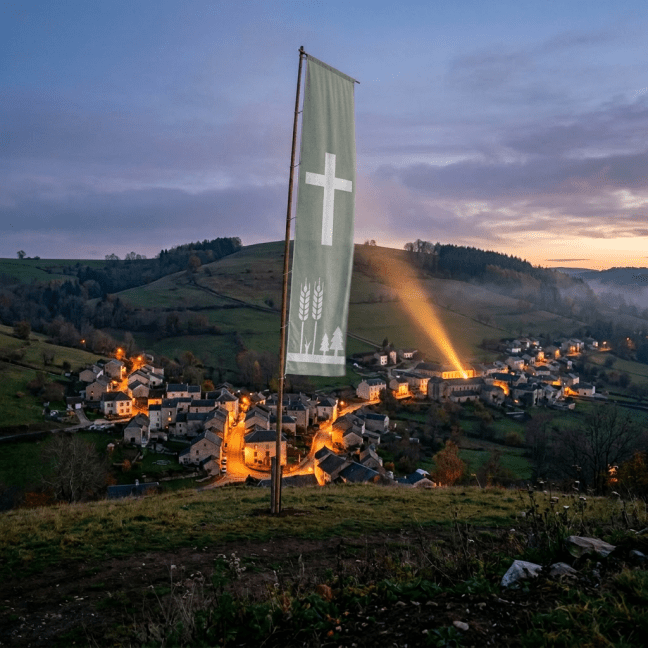
Gathering Under the Banner of Christ

Banner reading 'Harvest Festival Welcome' with a village lit up at dusk in the background

“Nothing will hurt or destroy in all my holy mountain, for as the waters fill the sea, so the earth will be filled with people who know the Lord. In that day the heir to David’s throne will be a banner of salvation to all the world. The nations will rally to him, and the land where he lives will be a glorious place. In that day the Lord will reach out his hand a second time to bring back the remnant of his people— those who remain in Assyria and northern Egypt; in southern Egypt, Ethiopia, and Elam; in Babylonia, Hamath, and all the distant coastlands. He will raise a flag among the nations and assemble the exiles of Israel. He will gather the scattered people of Judah from the ends of the earth.”
Isaiah 11:9-12 NLT

These verses today introduce the climax of what will be in the world to come. The previous verses in Isaiah 11 gave us a picture of the peace that will come when Jesus reigns on His throne. They spoke of restored relationships in the animal kingdom, to the point of the “wolf and the lamb [living] together,” a situation that is unimaginable today in our sinful world, skewed by so much wickedness. In fact, Paul wrote, “For all creation is waiting eagerly for that future day when God will reveal who his children really are. Against its will, all creation was subjected to God’s curse. But with eager hope, the creation looks forward to the day when it will join God’s children in glorious freedom from death and decay” (Romans 8:19-21). But any observant person will see the pain of our cursed world if they only open their eyes during countryside walks, to find a world where the vegetation struggles to display the beauty of its creation. A natural world where even groans can be heard on occasion.

But Isaiah’s vision moves from inner peace to global restoration, from the transformed creation to the gathering of God’s people. One of the deepest pains we experience is separation. I often meet people whose children and siblings are separated from their family origins and family home by many miles. I have a friend with three daughters, one of whom lives close by within forty miles, but of the other two, one lives three hundred miles away and the other on the other side of the world in New Zealand. Yes, modern technology can eliminate distance through video calls, but it is not the same as giving a loved one a hug. Another friend has siblings in Canada, again, many miles away from the town where they were brought up. But there have always been times and occasions of separation. Adam and Eve were driven from their comfortable home in the Garden through their sin. The people in Babel came to grief after they sinfully tried to build a tower that reached the sky. “Then they said, “Come, let’s build a great city for ourselves with a tower that reaches into the sky. This will make us famous and keep us from being scattered all over the world”” (Genesis 11:4). “Scattered all over the world” was what happened when God “confused the people with different languages”. And of course, we mustn’t forget God’s chosen people, the Jews, taken into captivity and exile. We share their pain when we read verses such as Psalm 137:1, “Beside the rivers of Babylon, we sat and wept as we thought of Jerusalem”.

In our world today, families are scattered across countries, and friendships are broken. People feel isolated and alone, and even churches experience division. But the Bible tells the story of a God who gathers, because His heart has always been to bring His people home. Isaiah looks beyond the immediate return from exile to a greater gathering under the reign of the Messiah. God Himself raises a flag, a banner—a signal that the way home is open. Isaiah wrote, “He will raise a flag among the nations” That flag ultimately points to Jesus Christ. He said, “And when I am lifted up from the earth, I will draw everyone to myself” (John 12:32). The cross became God’s rallying point for the nations, and people from every race, language, and culture are invited into one family through Jesus. 

Isaiah wrote, “… for as the waters fill the sea, so the earth will be filled with people who know the Lord” (Isaiah 11:9). Isaiah didn’t merely predict that more people will know about God. He wrote that the earth will be filled with the knowledge of the Lord. There is a difference between knowing facts about God and knowing God Himself. As we know, many people know Bible stories and the Christian traditions. I often meet a man whose knowledge of the Bible and its themes would put many a believer to shame. And yet, when challenged, he confesses that he doesn’t really believe that what he is reading would make a difference to his life. To him, it is just a good storybook, detailing the history of a bygone age. But eternal life is knowing Christ personally. One day, that knowledge will cover the earth as completely as water covers the ocean floor. Nothing will be more complete. What an encouragement this is for those who pray for family members who have yet to believe, for missionaries serving in difficult places, and for churches that sometimes feel small and insignificant. God’s purpose has not changed. His kingdom continues to advance, and His promise still stands.

Ancient armies raised flags and banners so soldiers knew where to gather during the confusion of battle. But there is a message to us pilgrims from this, because life often feels chaotic and confusing. There is a seemingly unstoppable clamour for more and more of our attention. Social media, advertising, and so much more conspire to pull us away from the battle we are fighting against the forces of evil. Yet God has raised one unmistakable banner: Jesus Christ. He remains the centre around whom His people gather. Whenever we lose our direction, we do not need a new message—we need to return to the banner God has already raised. Whenever we feel a bit lost and rudderless in the seas of life, is it time to return to basics, to come once again to the Cross, and lay down our confusion at Christ’s feet? Is it time once again to get on our knees before God, with a repentant heart and open hands, reaching out to the Rock that will never change? Also, perhaps we need to increase our efforts to help those around us, people who are floundering in our hostile world. There are too many people searching for a banner that is not Christ, and it is destroying them.

The promise that “the earth will be filled with the knowledge of the Lord” reminds us that history is moving toward God’s glorious purpose. Evil does not have the final word; God’s glory does. God knows where every one of His children is. Whether scattered by suffering, failure, grief, or distance, none are beyond His reach. The Shepherd who seeks the lost still gathers His flock.

Dear Lord Jesus, thank You for raising the banner of Your salvation for the whole world. Thank You that Your desire is not to scatter but to gather, not to divide but to unite. Fill our hearts with a deeper knowledge of You, and make us instruments through whom others are drawn to Your love. Help us to live with confidence in the truth that Your kingdom is advancing and that one day the whole earth will be filled with the knowledge of Your glory. Amen.