Lessons from Isaiah: Trusting God’s Protection

“So the Lord will spell out his message for them again, one line at a time, one line at a time, a little here, and a little there, so that they will stumble and fall. They will be injured, trapped, and captured. Therefore, listen to this message from the Lord, you scoffing rulers in Jerusalem. You boast, “We have struck a bargain to cheat death and have made a deal to dodge the grave. The coming destruction can never touch us, for we have built a strong refuge made of lies and deception.” Therefore, this is what the Sovereign Lord says: “Look! I am placing a foundation stone in Jerusalem, a firm and tested stone. It is a precious cornerstone that is safe to build on. Whoever believes need never be shaken.”
Isaiah 28:13-16 NLT

Isaiah repeats again the words of a previous verse that made a parody of his attempts to proclaim the Lord’s message, speaking as if he were teaching simple ideas to children. But God would use the Assyrians to teach the childish Israelites a hard lesson. A time was coming when they would be “injured, trapped, and captured”, the surviving people being carried off into exile. Isaiah now turns his attention to “the scoffing rulers of Jerusalem”, the Southern Kingdom of Judah. The warnings were much the same. Judah may have been pleased to hear what Isaiah had to say about the Israelites, but their complacency ended quickly when Isaiah called them “scoffers”. As we saw a few days ago, “A scoffer does not like to be reproved; he will not go to the wise” (Proverbs 15:12). Later in the book of Proverbs, there is a helpful definition of who a “scoffer” is. Proverbs 21:24, ““Scoffer” is the name of the arrogant, haughty man who acts with arrogant pride“. That was how Isaiah addressed the “rulers in Jerusalem”, and they wouldn’t have been pleased. As we will find in a later chapter in Isaiah, Judah had made a pact with Egypt: ““What sorrow awaits my rebellious children,” says the Lord. “You make plans that are contrary to mine. You make alliances not directed by my Spirit, thus piling up your sins. For without consulting me, you have gone down to Egypt for help. You have put your trust in Pharaoh’s protection. You have tried to hide in his shade”” (Isaiah 30:1-2). The people in Judah thought that they were safe from attack, but Isaiah called out the error of their ways. They had put their trust in a foreign power rather than in the Lord. 

This is something that has happened throughout history, so the Judeans were not doing anything unusual. Except, of course, these were God’s people. The Psalmist wrote, “Don’t put your confidence in powerful people; there is no help for you there. When they breathe their last, they return to the earth, and all their plans die with them. But joyful are those who have the God of Israel as their helper, whose hope is in the Lord their God” (Psalm 146:3-5). Then we have Psalm 20:7, “Some nations boast of their chariots and horses, but we boast in the name of the Lord our God”. The promises of protection from the Lord are scattered throughout Scripture, such as in Isaiah 41:10-11, “Don’t be afraid, for I am with you. Don’t be discouraged, for I am your God. I will strengthen you and help you. I will hold you up with my victorious right hand. See, all your angry enemies lie there, confused and humiliated. Anyone who opposes you will die and come to nothing“.

I suppose there is a question about God’s protection today. Would He protect, for example, the UK if the people living here turned to Him for help? In some ways this question is academic, because the UK is becoming increasingly secular, but I believe that if the entire nation turned to Him, He would. God will never reject a contrite and repentant person – just look at the thief on the cross – and I’m sure that would extend to a nation. But instead there is an alliance of Western countries who rely instead on their “chariots and horses”. The question for the Judeans was: “Do you think your pact with the Egyptians will save you?” Unfortunately, they would find out the hard way that the Egyptians had no intention of helping them out. 

Isaiah continued in the next verse in today’s reading by saying that God alone is the trustworthy footing on which Judah should rest all its confidence. In an often-quoted statement, the Lord says He has established a “foundation in Zion,” meaning Jerusalem. In several places we can read that God confirmed that Jerusalem would be His home. Psalm 132:13-14 is just one. “For the Lord has chosen Jerusalem; he has desired it for his home. “This is my resting place forever,” he said. “I will live here, for this is the home I desired“”. Zion was a fortress, as we read in 2 Samuel 5:7, “But David captured the fortress of Zion, which is now called the City of David”. Ancient buildings relied on large, sturdy corners to keep a building upright. These “cornerstones” were essential, and one was always the most important. References to “the” cornerstone imply something on which the entire structure depends. God has verified this “stone”. It will bear the needed weight as the keystone for the entire building. The Lord says that anyone who believes in this stone won’t “be in haste” in the sense of being panicked or alarmed. Instead, they will experience security and confidence. They “need never be shaken“. 

It is no exaggeration to call Jesus the Cornerstone of our faith. Without Him upholding His followers, the whole structure would come tumbling down, and as we know, Christianity is alive and well in this world. Peter wrote, “You are coming to Christ, who is the living cornerstone of God’s temple. He was rejected by people, but he was chosen by God for great honour. And you are living stones that God is building into his spiritual temple. What’s more, you are his holy priests. Through the mediation of Jesus Christ, you offer spiritual sacrifices that please God. As the Scriptures say, “I am placing a cornerstone in Jerusalem, chosen for great honour, and anyone who trusts in him will never be disgraced”” (1 Peter 2:4-6). There will one day be a new Jerusalem, which we can read about in Revelation 21, where God Himself will live, along with His people. There will be no shaking there in the lives of believers, because “nothing evil will be allowed to enter … but only those whose names are written in the Lamb’s Book of Life” (Revelation 21:27). 

That is the future and the hope that we pilgrims have faith for. All those who believe in Jesus will be gifted eternal life with Him. But are we ready? Will Jesus find us doing His will in the life we have now? A sobering thought, and we must take it seriously. Of course, He is gracious enough to forgive our sins, and we come into His presence this morning, reaching out to Him again with our prayers and supplications.

Dear Father God. Thank You for Jesus. We love You, Lord. You are indeed our refuge and strength, as we depend on none other than You. As we face the day ahead, we pray that You go before us, straighten our paths, and show us the way through the minefields of life. In. Your precious name, we pray. Amen.
The Great Trumpet Will Sound

“The people are like the dead branches of a tree, broken off and used for kindling beneath the cooking pots. Israel is a foolish and stupid nation, for its people have turned away from God. Therefore, the one who made them will show them no pity or mercy. Yet the time will come when the Lord will gather them together like handpicked grain. One by one he will gather them—from the Euphrates River in the east to the Brook of Egypt in the west. In that day the great trumpet will sound. Many who were dying in exile in Assyria and Egypt will return to Jerusalem to worship the Lord on his holy mountain.”
Isaiah 27:11-13 NLT

Isaiah chapters 24-27 form a prophecy some have called the “Isaiah Apocalypse”, and he wrote it around 700 BC. Isaiah is now bringing it to an end by prophesying the return of the exiles from captivity. This happened in three waves: the first with Zerubbabel in 538 BC, the second around 458 BC led by Ezra the Scribe, and the third and final return with Nehemiah in 445 BC. In a time of increasing national instability through the incursions of the Assyrian armies, it is extraordinary that Isaiah could see such an event in the future, but, of course, we know he was led in his writings by the Holy Spirit, as God revealed the future to him. 

In the first chapter of the Book of Ezra, we read how God used a heathen king to do His will. Ezra 1:1-2, “In the first year of King Cyrus of Persia, the Lord fulfilled the prophecy he had given through Jeremiah. He stirred the heart of Cyrus to put this proclamation in writing and to send it throughout his kingdom: “This is what King Cyrus of Persia says: “The Lord, the God of heaven, has given me all the kingdoms of the earth. He has appointed me to build him a Temple at Jerusalem, which is in Judah“. He granted permission for any exiles who desired it to return to Jerusalem to rebuild the Temple, and Ezra 2 lists all those who made the journey, and they numbered over 42,000. This was the first wave led initially by Sheshbazzar, and, once the exiles had returned, Zerubbabel continued with organising the rebuilding of the Temple.

God then used a second heathen king, Artaxerxes, to commission another return, this time led by Ezra. The king blessed the returning exiles with all sorts of donations, and in his letter of instructions, the king wrote, “Be careful to provide whatever the God of heaven demands for his Temple, for why should we risk bringing God’s anger against the realm of the king and his sons?” (Ezra 7:23). Around 5,000 men and their families returned at this time.

Artaxerxes was still on the throne when Nehemiah journeyed to Jerusalem a few years after Ezra, and it is believed others returned with him at the same time, although no records exist of who these were. But in the three waves, God’s prophecy through Isaiah, “Yet the time will come when the Lord will gather them together like handpicked grain. One by one he will gather them—from the Euphrates River in the east to the Brook of Egypt in the west” (Isaiah 27:12), was fulfilled. That is how much God loved His people, a love that went to extraordinary lengths to purge their sins. 

What key messages does Isaiah 27 offer us pilgrims? We started the chapter with a reference to Leviathan, a terrifying, uncontrollable sea monster representing chaos. We read more about this monster in the Book of Revelation, identifying the sea monster as a serpent or dragon, representing Satan. For us pilgrims today, this serves as a reminder that no matter how overwhelming or chaotic the world feels, evil operates on borrowed time. God’s final victory is already guaranteed. I am reminded this morning about the Apostle Paul, under house arrest, chained to Roman guards as he awaited his final fate. His world up until then had been anything but peaceful, and we can read the list of what he had to endure in 2 Corinthians 11. And yet, in Philippians 1, we read how he rejoiced over the preaching of the Gospel, and he wrote, “For to me, living means living for Christ, and dying is even better” (Philippians 1:21). The world around him was oppressed by evil. It was chaotic and unstable, but Paul lived in a haven of peace and joy. No sea monster would ever affect Paul. Nothing would disturb his joy and peace.

Back in Isaiah 27, we read about the vineyard, as an analogy for God’s people, and how the Lord watches over it, weeding out the briars and thorns. That took us to John 15, and the importance for us pilgrims to live our lives connected to the Vine, who is Jesus. And, more, we read how God’s people would “blossom and fill the whole earth with fruit”. Pilgrims who are connected to the Vine will inevitably produce the Galatians 5 fruit of the Holy Spirit. I can remember a preacher in the late 1970’s, at a Bible conference, pointing out to the people gathered that they were producing plenty of “leaves” but no “fruit”. In other words, all the froth and bubble, the excesses of the Charismatic Renewal, was pointless unless the Holy Spirit fruit of “love, joy, peace, patience, kindness, goodness, faithfulness, gentleness and self-control”, could be found growing within them as well. 

Also in Isaiah 27, Isaiah pointed out that God’s disciplining His people is vastly different from His destruction of evil. When we pilgrims experience seasons of suffering or spiritual “pruning” (John 15), is it not a sign of God’s displeasure? Instead, like a wise gardener, God uses these moments to deconstruct any modern-day idols that we have allowed into our lives (” … all the pagan altars will be crushed to dust. No Asherah pole or pagan shrine will be left standing”), and prompt deep and genuine repentance. 

Finally, Isaiah 27 ends with a trumpet blast. What started as a localised promise to Israel ultimately points to the global body of believers filling the earth with the “fruit” of the Holy Spirit and the Gospel. Additionally, the chapter concludes with a “great trumpet” sounding to gather the outcasts and the perishing (Isaiah 27:13). This foreshadows the final, inclusive gathering of believers from every tribe and nation to worship God together.

Isaiah 27 offers much to guide us pilgrims, but the call is to remain connected to the Vine, Jesus Himself. There is no other way for His people, because Jesus is the Way. The only Way. Is that a trumpet I can hear? Probably not, but an angel will be holding one in his hands, ready and waiting.

Dear Lord Jesus. You are the Way, the Truth and Life, and this is the foundation of our lives as pilgrims in this evil world. Not for us the strange ideologies that have permeated our societies, leaving a people who have lost their God-given compass in life. Keep us near You, we pray. This day and forever. Amen.

Judeans Living In The Moment

“This message came to me concerning Jerusalem—the Valley of Vision: What is happening? Why is everyone running to the rooftops? The whole city is in a terrible uproar. What do I see in this revelling city? Bodies are lying everywhere, killed not in battle but by famine and disease. All your leaders have fled. They surrendered without resistance. The people tried to slip away, but they were captured, too. That’s why I said, “Leave me alone to weep; do not try to comfort me. Let me cry for my people as I watch them being destroyed.” Oh, what a day of crushing defeat! What a day of confusion and terror brought by the Lord, the Lord of Heaven’s Armies, upon the Valley of Vision! The walls of Jerusalem have been broken, and cries of death echo from the mountainsides. 
Judah’s defences have been stripped away. You run to the armoury for your weapons. You inspect the breaks in the walls of Jerusalem. You store up water in the lower pool. You survey the houses and tear some down for stone to strengthen the walls. Between the city walls, you build a reservoir for water from the old pool. But you never ask for help from the One who did all this. You never considered the One who planned this long ago.”
Isaiah 22:1-5, 8-11 NLT

Isaiah provides a prophecy, an oracle, in chapter 22 addressed to Jerusalem. One possible event here is the siege of Jerusalem by King Sennacherib and the Assyrians in 701 BC, since Isaiah experienced it firsthand. Another option is the Babylonian siege of Jerusalem in 586 BC, during which Isaiah could have prophesied about events yet to occur. Some scholars suggest that Isaiah’s oracle is intended to speak to both events. But this chapter commences with the city in uproar; in fact, it was a “terrible uproar”. There was much revelling going on, as the people within Jerusalem’s walls were partying, eating, drinking and making merry. Some event had occurred to warrant such a celebration, but Isaiah could see something else coming – “Bodies are lying everywhere, killed not in battle but by famine and disease”. So Isaiah’s message was that they should not be “revelling”, but instead they should be sober-minded because of what was to come.

History informs us that the nation of Judah had been overrun and destroyed by Assyrian sieges of the towns. Everyone of any importance had fled to Jerusalem and had been trapped inside the walls by the siege. Isaiah tells the people not to look at him while he is weeping for those who have died. He recalls how loud the noise became from outside the walls as the siege was being established. There was a great racket and loud shouting. Mass confusion fills the air, perhaps inside the city as well as outside. The valleys around Jerusalem were filled with war chariots. The enemy horsemen were right outside the city gates. Judah was uncovered and helpless. What did the leaders do when they knew the siege was coming? They inventoried and distributed the weapons from the armoury. They found breaches in the walls and repaired them. They diverted springs from outside the walls into the city for a water supply. They even tore down houses between the inner and outer walls and flooded that area as a reservoir. They did all they could except for one thing: call out to their Lord God. Isaiah wrote, “But you never ask for help from the One who did all this. You never considered the One who planned this long ago”. 

All the preparations carried out by the Judeans were not wrong. In fact, it was wise to do what they did. But their sin was that they trusted in their preparations rather than in the God who had given them wisdom and who ultimately ruled over their future. There is a message for us pilgrims in this as well. There is a difference between preparation and dependence, because God expects us to act wisely, but never independently of Him. The danger is that we can organise our lives so efficiently that prayer becomes an afterthought. There is a proverb that is well worth writing on a Post-it note to stick on our fridges, and that’s “Trust in the Lord with all your heart; do not depend on your own understanding. Seek his will in all you do, and he will show you which path to take” (Proverbs 3:5-6). There is another verse that applies both to the Judeans and to ourselves, and that is Psalm 127:1, “Unless the Lord builds a house, the work of the builders is wasted. Unless the Lord protects a city, guarding it with sentries will do no good”. And here’s a bit of wisdom from James, “Look here, you who say, “Today or tomorrow we are going to a certain town and will stay there a year. We will do business there and make a profit.” How do you know what your life will be like tomorrow? Your life is like the morning fog—it’s here a little while, then it’s gone. What you ought to say is, “If the Lord wants us to, we will live and do this or that.” Otherwise you are boasting about your own pretentious plans, and all such boasting is evil” (James 4:13-16). Of course, James’ advice was too late for Jerusalem in 700 BC, but it is there for our benefit, as we navigate the highways and byways of life in our 21st-century societies. 

Isaiah’s picture of a city that is living in the moment, rejoicing one minute because of battlefield successes, but mourning the next when adversity strikes, is just as applicable today as it was then. We pilgrims are heading for a new world, where the rules and outcomes are different. It would seem to make sense to start living God’s way, but then I’m sure we are already. But nevertheless, when we are tempted to live the way the world around us does, we should pause and find a quiet spot to take stock and pray. As we read a Psalm such as Psalm 23, it sets the scene for the life we should lead, under the direction of the Good Shepherd. His closeness will strengthen us as we rest in His presence. He will lead and guide us and one day will welcome us into “the house of the Lord forever”. And with the Psalmist, we declare, “Surely your goodness and unfailing love will pursue [us] all the days of [our] life…”. It surely will.

Dear Heavenly Father. Thank You for Your care and compassion for us pilgrims. Without You life in this world is impossible. We pray for Your guidance as we journey on, day by day.Amen.

The Prophecy of Zion: A Vision of Justice and Renewal

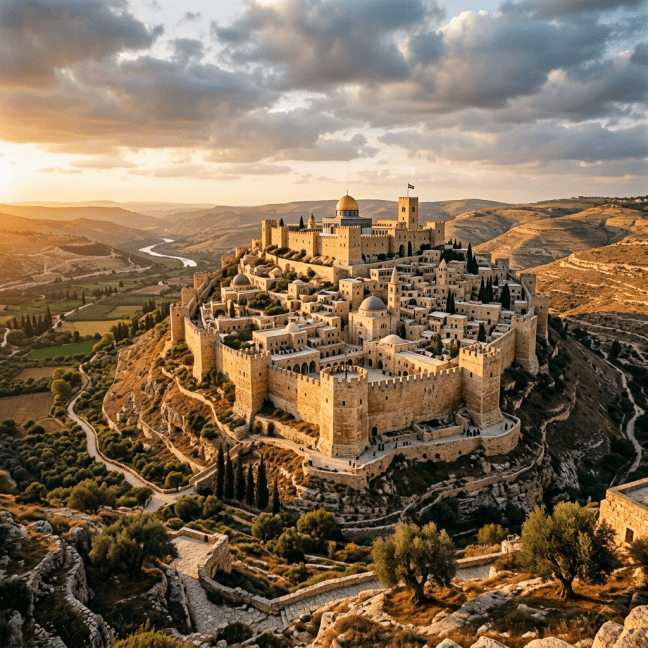
Ancient fortified hilltop city with stone walls and domed roofs at sunset

“Zion will be restored by justice; those who repent will be revived by righteousness. But rebels and sinners will be completely destroyed, and those who desert the Lord will be consumed.”
Isaiah 1:27-28 NLT

In our journey through the first chapter of Isaiah, we should perhaps pause and consider the use of the word “Zion”. Today, some anti-semites refer to “Zion” as a descriptor and focus of their hate and anger against the Jews, and some nations and people groups want nothing more than to eliminate “Zionists” wherever they are. In the context of Isaiah 1:27, Zion and Jerusalem are synonyms, but originally, Zion was the Jebusite fortress captured by King David, and Mount Zion is a hill located within Jerusalem. Zion often serves as a synonym for Jerusalem, the Land of Israel, or the Jewish people, appearing 158 times in the Old Testament as a reference to the city.

Jerusalem was in a sorry state, being compared in Isaiah’s prophetic vision to a prostitute and being a city full of murderers, thieves, rebels, and corruption of every kind. God promised to refine it like silver, removing the dross slowly but completely, to restore Jerusalem as a city of justice and righteousness.

In his vision, Isaiah prophesied that “Zion will be restored by justice”. Note the future tense. This was something that was not going to happen quickly, and even today, we see a modern Jerusalem that still fails to meet God’s expectations. So, when would God bring about the restoration of Jerusalem in the future? In this context, perhaps Isaiah’s vision foresaw the restored Jerusalem after the exile, and as we read the book of Nehemiah, we can see that the rebuilding of Jerusalem began well. But was that God’s view?

Before we consider that question, a process of refinement and restoration had to take place. To restore justice, it was necessary to remove corrupt judges and leaders and to install in their place righteous judges, leaders, and counsellors. That was going to take time. In addition, the restoration of Jerusalem would require religious and spiritual refinement through repentance and a turning back to God. And the result? Zion will be transformed from a desolate “lean-to in a cucumber field” (Isaiah 1:8) into a secure, flourishing city that will serve as a beacon of truth and a joy to all nations. Has that yet happened?

Some theologians think that Jerusalem will not be a true city of justice and righteousness until Jesus returns, bringing the rule and reign of the Kingdom of God. Others look to Revelation 21:2, “And I saw the holy city, the new Jerusalem, coming down from God out of heaven like a bride beautifully dressed for her husband”. What a wonderful day that will be, with God living on the new earth in the new Jerusalem. 

In Isaiah 1:28, the prophet wrote, “But rebels and sinners will be completely destroyed, and those who desert the Lord will be consumed.” In the new Jerusalem, there will be no such people. Revelation 21:8, “But cowards, unbelievers, the corrupt, murderers, the immoral, those who practice witchcraft, idol worshipers, and all liars—their fate is in the fiery lake of burning sulphur. This is the second death”. Complete destruction for the rebels and sinners will not be a pretty sight and will take place in an eternity accompanied by the devil and his minions. 

We pilgrims can perhaps consider the reformed and refined Jerusalem as a spiritual state for ourselves. A place of holiness where we become the Temple of the Holy Spirit. Paul wrote in 1 Corinthians 6:19-20, “Don’t you realise that your body is the temple of the Holy Spirit, who lives in you and was given to you by God? You do not belong to yourself, for God bought you with a high price. So you must honour God with your body”. Peter wrote, “And you are living stones that God is building into his spiritual temple. What’s more, you are his holy priests. Through the mediation of Jesus Christ, you offer spiritual sacrifices that please God. As the Scriptures say, “I am placing a cornerstone in Jerusalem, chosen for great honour, and anyone who trusts in him will never be disgraced” (1 Peter 2:5-6). 

The picture emerges that we pilgrims are perhaps becoming the spiritual Jerusalem that Isaiah prophesied in Isaiah 1:27, a Jerusalem refined, reformed and restored, with Jesus as the Cornerstone for the focus of God within it, the Temple. A place of true justice and righteousness once again.

Heavenly Father. We look forward to being a part of the Jerusalem You desire with Jesus present there with us. What a wonderful place that will be! Thank You. Amen.

Salvation Comes Through the Jews

“Sir,” the woman said, “you must be a prophet. So tell me, why is it that you Jews insist that Jerusalem is the only place of worship, while we Samaritans claim it is here at Mount Gerizim, where our ancestors worshiped?” Jesus replied, “Believe me, dear woman, the time is coming when it will no longer matter whether you worship the Father on this mountain or in Jerusalem. You Samaritans know very little about the one you worship, while we Jews know all about him, for salvation comes through the Jews.“
John 4:19-22 NLT

‭Jesus said to the Samaritan woman, “salvation comes through the Jews“. Of course, what Jesus said was totally true and accurate. The Old Testament was all about God’s plan for the salvation of mankind and it focused on one Person, the Messiah. Isaiah 53 sets out a graphic prophecy of the coming Messiah, and about Him we read, “But it was the Lord’s good plan to crush him and cause him grief. Yet when his life is made an offering for sin, he will have many descendants. He will enjoy a long life, and the Lord’s good plan will prosper in his hands. When he sees all that is accomplished by his anguish, he will be satisfied. And because of his experience, my righteous servant will make it possible for many to be counted righteous, for he will bear all their sins“. The Messiah, Jesus, finally came with a lineage that stretched all the way back to Abraham, as we read in Matthew 1. Jesus was, and still is, a Jew. He still is, because He is alive today.

But to many today, the thought, the reality, the truth, that through the Messiah and His crucifixion at Calvary, God finally completed His plan for the salvation of mankind, is a problem. Jesus, the Son of God, said in John 14:6, “Jesus told him, “I am the way, the truth, and the life. No one can come to the Father except through me“. The reality is that there is only one way to Heaven and that is through Jesus. Only He can save us from the punishment we deserve for our sins. And He was, and is, a Jew.

As the war between Israel and Hamas rages on, the devil has been stoking up anti-Semitism on a scale never seen for many years. Most people correlate being a Jew and being an Israelite as one and the same thing, and Jews everywhere in the world have found that persecution has increased. But God promised to protect His people. We read in Deuteronomy 33:29, “How blessed you are, O Israel! Who else is like you, a people saved by the Lord? He is your protecting shield and your triumphant sword! Your enemies will cringe before you, and you will stomp on their backs!” In spite of many times of unfaithfulness, God has remained faithful to His people, because He made a covenant with them. And in many ways the Hebrew Scriptures read like a love story between God and His people.

The enemies of Israel walk a dangerous path, and if we want to know what will happen to them we only have to read the book of Revelation. Of course, this does not justify actions taken by the Israelites, as they too will have to stand before God one day and give an account for all that they have done in this life.

So what should we pilgrims do about the Jews, God’s chosen people? We pray. Psalm 122:6, “Pray for peace in Jerusalem. May all who love this city prosper“. And we keep praying in the certainty that we are in the will of God for His people. And we give thanks for the Jewish Son of God, who died for the sins of the world at Calvary so that many will be counted righteous.

Dear Father God. We thank You for Your plan of salvation delivered through Your people, the Jews, and through Jesus Your Son. We pray for Your people and for peace not only in Jerusalem, but in Palestine as well. We pray for the innocent people caught up in the conflict and pray that these days will be cut short. In Jesus’ name. Amen.

Jerusalem

“As the Scriptures say, “I am placing a cornerstone in Jerusalem, chosen for great honour, and anyone who trusts in him will never be disgraced.””
1 Peter 2:6 NLT

In his letter, Peter quoted Isaiah 28:16, “Therefore, this is what the Sovereign Lord says: “Look! I am placing a foundation stone in Jerusalem, a firm and tested stone. It is a precious cornerstone that is safe to build on. Whoever believes need never be shaken.” Isaiah’s prophecy in his chapter 28 was scathing about the rulers in Jerusalem, and he foretold their fate. Isaiah could see coming a time when there would be a righteous Ruler in Jerusalem but his prophecy is still to be fulfilled of course. Other prophets foretold of Jesus ruling in Jerusalem – we can read their prophecies in Zechariah 14 and Jeremiah 3. We refer to this coming of Jesus as His second coming, because we already know about His first coming, as a baby, born in a stable located in Bethlehem. Some 50 days after the resurrection, Jesus went out with His disciples to the Mount of Olives, located just outside Jerusalem, from where He ascended into Heaven. But Jesus is returning to this world, and we read about His return from the angels’ message in Acts 1:11, ““Men of Galilee,” they said, “why are you standing here staring into heaven? Jesus has been taken from you into heaven, but someday he will return from heaven in the same way you saw him go!”” We knew this was at Jerusalem, because the next verse in Acts reads, “Then the apostles returned to Jerusalem from the Mount of Olives, a distance of half a mile”. Jesus Himself foretold of His return to Planet Earth in Matthew 24:30, “And then at last, the sign that the Son of Man is coming will appear in the heavens, and there will be deep mourning among all the peoples of the earth. And they will see the Son of Man coming on the clouds of heaven with power and great glory.”

But why Jerusalem? Surely there are better places for Jesus to return to? Places where He could be a “cornerstone” far more effectively. Jerusalem is riven by conflict between Jew and Gentile, Israeli and Palestinian, Muslim and Jew. There are many more peaceful places on earth, we could argue. But it will be as God has ordained it. And we also need to remember that one day there will be a New Jerusalem that Jesus Himself foretold about, as recorded by John in Revelation 3:12, “All who are victorious will become pillars in the Temple of my God, and they will never have to leave it. And I will write on them the name of my God, and they will be citizens in the city of my God—the new Jerusalem that comes down from heaven from my God. And I will also write on them my new name.” In Revelation 21:2 we read, “And I saw the holy city, the new Jerusalem, coming down from God out of heaven like a bride beautifully dressed for her husband”. The names Jerusalem and Zion are synonymous and the author of the Hebrews wrote, “No, you have come to Mount Zion, to the city of the living God, the heavenly Jerusalem, and to countless thousands of angels in a joyful gathering. You have come to the assembly of God’s firstborn children, whose names are written in heaven. You have come to God himself, who is the judge over all things. You have come to the spirits of the righteous ones in heaven who have now been made perfect” (Hebrews 12:22-23). 

There is something special about Jerusalem. It figures greatly throughout the Bible as God’s home and one in which we too will live one day. Whether we consider it as a physical place or a spiritual condition, we must never discount it, and must always be obedient to the Scripture, “Pray for peace in Jerusalem. May all who love this city prosper. O Jerusalem, may there be peace within your walls and prosperity in your palaces. For the sake of my family and friends, I will say, “May you have peace.” For the sake of the house of the Lord our God, I will seek what is best for you, O Jerusalem” (Psalm 122:6-9). There is much strife in 21st Century Jerusalem, but God will one day answer our prayers.

Dear God. We pray for the Holy City Jerusalem today, that peace will reign and Your Word upheld. In Jesus’ name. Amen.

Peace in Jerusalem

“Pray for peace in Jerusalem. 
May all who love this city prosper. 
O Jerusalem, may there be peace within your walls 
and prosperity in your palaces. 
For the sake of my family and friends, I will say, 
“May you have peace.” 
For the sake of the house of the Lord our God, 
I will seek what is best for you, O Jerusalem.”
Psalms‬ ‭122:6-9‬ ‭NLT‬‬

Why should I pray for peace in Jerusalem? After all, I don’t live there; in fact I live a long way from it. The city of Jerusalem appears in news reports every now and then, usually in a context of war, strife and civil unrest. The alternative name, Zion, is a name that invokes hatred in other parts of the world. Surely this is a place to avoid.

The Psalmist probably intended for his thoughts and prayers to apply to peace and prosperity in his society; Jerusalem was often the focus of strife even all those years ago, but when it enjoyed times of peace the people flourished. So he prayed for peace in Jerusalem, much as we would pray for peace in our lands, in our societies. A land at peace flourishes.

If we transpose the theme here into spiritual terms, we are very much a part “of the house of the Lord our God“. And there will come a new Jerusalem, that we read about in Revelation 21 and 22. In John 14, Jesus encouraged His disciples that He was going ahead to prepare a place for them. So as Christians we have a very strong connection to Jerusalem. One day, in its reincarnation, we will be part of it. And we pray for peace to be there, both now and in the future. For the sake of the family of God in all its facets, in all its peoples, whatever nation or ethnic groups they come from. As we pray, God’s peace permeates all levels of His family, all over the world. Persecuted Christians in North Korea, Iraq, Afghanistan, wherever. And our prayers will lift the yoke of hardship from their shoulders, bringing to them “what is best“.

As a pilgrim through this life, we trudge on, come what may. But ever in our gaze is the New Jerusalem, the Heavenly home of our Lord and God. And somehow as we lift our eyes toward it, our steps are lifted. Our spirits are encouraged. Our journey becomes a concatenation of joy and hope, faith and trust, peace and prosperity. And as we meet fellow travellers we share the “peace of Jerusalem” with them. Enriching their lives as we have been enriched “seeking what is best for you, O Jerusalem“.