The Prophecy of Zion: A Vision of Justice and Renewal

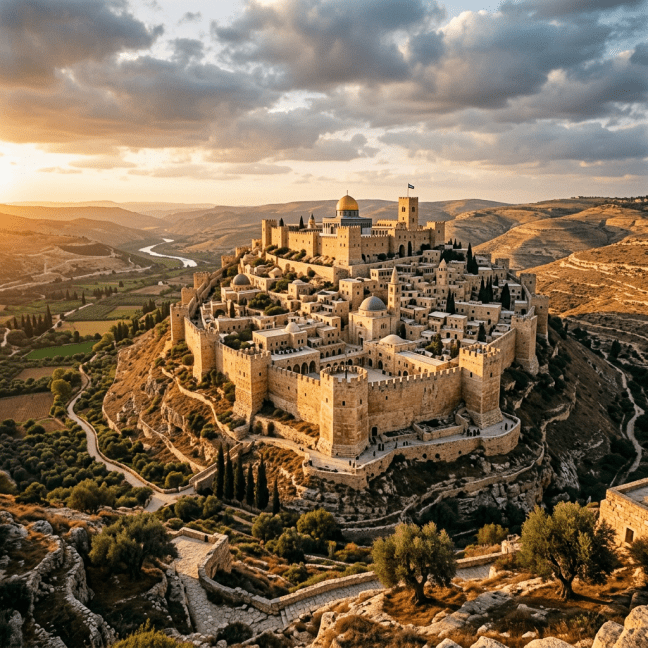
Ancient fortified hilltop city with stone walls and domed roofs at sunset

“Zion will be restored by justice; those who repent will be revived by righteousness. But rebels and sinners will be completely destroyed, and those who desert the Lord will be consumed.”
Isaiah 1:27-28 NLT

In our journey through the first chapter of Isaiah, we should perhaps pause and consider the use of the word “Zion”. Today, some anti-semites refer to “Zion” as a descriptor and focus of their hate and anger against the Jews, and some nations and people groups want nothing more than to eliminate “Zionists” wherever they are. In the context of Isaiah 1:27, Zion and Jerusalem are synonyms, but originally, Zion was the Jebusite fortress captured by King David, and Mount Zion is a hill located within Jerusalem. Zion often serves as a synonym for Jerusalem, the Land of Israel, or the Jewish people, appearing 158 times in the Old Testament as a reference to the city.

Jerusalem was in a sorry state, being compared in Isaiah’s prophetic vision to a prostitute and being a city full of murderers, thieves, rebels, and corruption of every kind. God promised to refine it like silver, removing the dross slowly but completely, to restore Jerusalem as a city of justice and righteousness.

In his vision, Isaiah prophesied that “Zion will be restored by justice”. Note the future tense. This was something that was not going to happen quickly, and even today, we see a modern Jerusalem that still fails to meet God’s expectations. So, when would God bring about the restoration of Jerusalem in the future? In this context, perhaps Isaiah’s vision foresaw the restored Jerusalem after the exile, and as we read the book of Nehemiah, we can see that the rebuilding of Jerusalem began well. But was that God’s view?

Before we consider that question, a process of refinement and restoration had to take place. To restore justice, it was necessary to remove corrupt judges and leaders and to install in their place righteous judges, leaders, and counsellors. That was going to take time. In addition, the restoration of Jerusalem would require religious and spiritual refinement through repentance and a turning back to God. And the result? Zion will be transformed from a desolate “lean-to in a cucumber field” (Isaiah 1:8) into a secure, flourishing city that will serve as a beacon of truth and a joy to all nations. Has that yet happened?

Some theologians think that Jerusalem will not be a true city of justice and righteousness until Jesus returns, bringing the rule and reign of the Kingdom of God. Others look to Revelation 21:2, “And I saw the holy city, the new Jerusalem, coming down from God out of heaven like a bride beautifully dressed for her husband”. What a wonderful day that will be, with God living on the new earth in the new Jerusalem. 

In Isaiah 1:28, the prophet wrote, “But rebels and sinners will be completely destroyed, and those who desert the Lord will be consumed.” In the new Jerusalem, there will be no such people. Revelation 21:8, “But cowards, unbelievers, the corrupt, murderers, the immoral, those who practice witchcraft, idol worshipers, and all liars—their fate is in the fiery lake of burning sulphur. This is the second death”. Complete destruction for the rebels and sinners will not be a pretty sight and will take place in an eternity accompanied by the devil and his minions. 

We pilgrims can perhaps consider the reformed and refined Jerusalem as a spiritual state for ourselves. A place of holiness where we become the Temple of the Holy Spirit. Paul wrote in 1 Corinthians 6:19-20, “Don’t you realise that your body is the temple of the Holy Spirit, who lives in you and was given to you by God? You do not belong to yourself, for God bought you with a high price. So you must honour God with your body”. Peter wrote, “And you are living stones that God is building into his spiritual temple. What’s more, you are his holy priests. Through the mediation of Jesus Christ, you offer spiritual sacrifices that please God. As the Scriptures say, “I am placing a cornerstone in Jerusalem, chosen for great honour, and anyone who trusts in him will never be disgraced” (1 Peter 2:5-6). 

The picture emerges that we pilgrims are perhaps becoming the spiritual Jerusalem that Isaiah prophesied in Isaiah 1:27, a Jerusalem refined, reformed and restored, with Jesus as the Cornerstone for the focus of God within it, the Temple. A place of true justice and righteousness once again.

Heavenly Father. We look forward to being a part of the Jerusalem You desire with Jesus present there with us. What a wonderful place that will be! Thank You. Amen.

Body Parts

“Just as our bodies have many parts and each part has a special function, so it is with Christ’s body. We are many parts of one body, and we all belong to each other.”
Romans 12:4-5 NLT

Paul describes what “Christ’s body”, the Church, is like, with a comparison with the human body. In 1 Corinthians 12:12-13 he writes, “The human body has many parts, but the many parts make up one whole body. So it is with the body of Christ. Some of us are Jews, some are Gentiles, some are slaves, and some are free. But we have all been baptised into one body by one Spirit, and we all share the same Spirit”. The common bond that binds together the body of Christ is the baptism in the Spirit, the Holy Spirit who is shared amongst all of us pilgrims. Paul goes on to give more examples. 1 Corinthians 12:18-21, “But our bodies have many parts, and God has put each part just where he wants it. How strange a body would be if it had only one part! Yes, there are many parts, but only one body. The eye can never say to the hand, “I don’t need you.” The head can’t say to the feet, “I don’t need you””. He builds a picture of a group of people, each constructed in an autonomous way with all the body parts they need, who then come together to build a different kind of body, with each part being made up of individual people. A lovely analogy and obviously one much favoured by Paul.

Paul emphasises the “special function” of each part of the human bodies. Our kidneys don’t function in the same way as our livers. Our toes aren’t as dexterous as our fingers, but important none the less. We see with our eyes and hear with our ears. None of this should be a surprise to anyone. But what might be more of a challenge is when we take all the individual people and put them together in our churches. The body of Christ, His Church, also has different body parts. So we have our pastors and evangelists, people engaged in very different functions. And there will be those who perform different parts of the administration, or handling the finance. We have the prophets in our midst, who encourage and build up the people with their messages of love and hope. There are the musicians and singers. The list grows and grows. But imagine the chaos if everyone wanted to be a preacher, or worship leader or …

Do we pilgrims recognise this picture? Are we very much involved and connected to our fellowship of believers? Or are we occasional visitors, who only decide to pay our church a visit when there is nothing else to do? Perhaps it’s raining that day, so the car can’t be washed, or the golf course visited. Paul quite firmly said that we are all parts of the church and, here’s the thing, “we all belong to each other”. We have a responsibility to be committed to a church fellowship. Holding on even when things appear to be difficult. We may not feel we have much of a contribution to make, but, while we are there, God can use us to further and build up His body, the Church. Imagine the impact on a human body if, suddenly, the eyes disappeared. Well, it’s the same with Jesus’ body – imagine what would happen if, one Sunday, the worship leader or preacher fails to turn up. However, the less high profile people in a church are also missed when they fail to appear. Perhaps God wanted to use them that week to provide a simple piece of encouragement, such as a smile or a compliment. 

To be blunt, without us faithfully supporting our local church, it will shrivel and die, something we are danger of seeing in these days. As an example, the Church of Scotland has declined by 34% over the past decade to 60,000 members, with an average age of 62, and hundreds of church buildings will need to be closed because they are non-viable. In the West of Fife, where I live, 3 churches have closed in recent years, with another under threat. And unless there is a reversal of this decline, this denomination will be in danger of disappearing over the next 2 or 3 generations.

But it is not all doom and gloom. G. K. Chesterton once famously said, “On five occasions in history the Church has gone to the dogs, but on each occasion, it was the dogs that died”. We need to remember that Jesus said He will build His church. Matthew 16:18, “Now I say to you that you are Peter (which means ‘rock’), and upon this rock I will build my church, and all the powers of hell will not conquer it”. Jesus used Peter as an example of the foundational basis for the Church, His Body. We are all “rocks” if we are rooted and grounded in Jesus, and it is upon us, in this generation, in our communities, that the responsibility for church building lies. Not the physical structures, ornately built with bricks and mortar, populated by stained glass windows and statues, but the living church made up of us believers. In 1 Peter 2:4-5 we read, “You are coming to Christ, who is the living cornerstone of God’s temple. He was rejected by people, but he was chosen by God for great honour. And you are living stones that God is building into his spiritual temple. What’s more, you are his holy priests. Through the mediation of Jesus Christ, you offer spiritual sacrifices that please God“. So, fellow living stones, we are all constituent parts of God spiritual temple. What an honour! What a God!

Dear Father. We pray for Your forgiveness for those times when we have sat at home rather than join our brothers and sisters in our fellowships. Please help us to find our places in the local church where You have placed us, and where we can flourish, building a Temple where You can live and find a home. In Jesus’ name. Amen.