The Prophecy of Zion: A Vision of Justice and Renewal

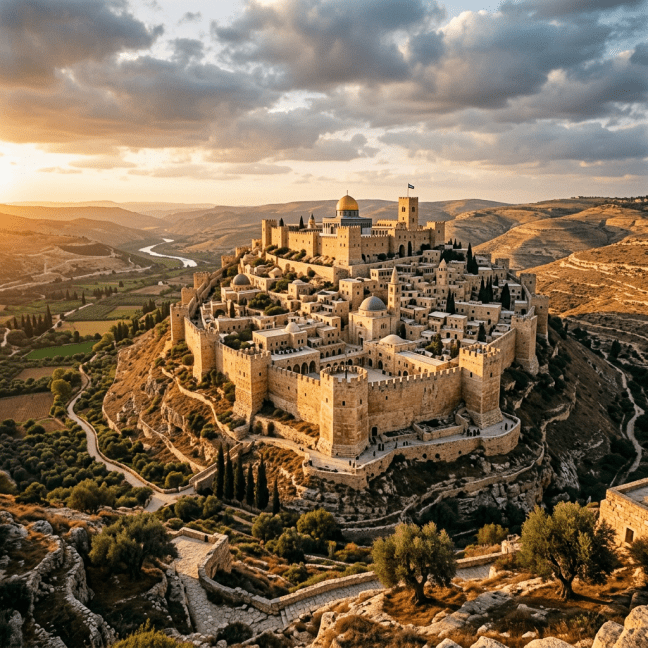
Ancient fortified hilltop city with stone walls and domed roofs at sunset

“Zion will be restored by justice; those who repent will be revived by righteousness. But rebels and sinners will be completely destroyed, and those who desert the Lord will be consumed.”
Isaiah 1:27-28 NLT

In our journey through the first chapter of Isaiah, we should perhaps pause and consider the use of the word “Zion”. Today, some anti-semites refer to “Zion” as a descriptor and focus of their hate and anger against the Jews, and some nations and people groups want nothing more than to eliminate “Zionists” wherever they are. In the context of Isaiah 1:27, Zion and Jerusalem are synonyms, but originally, Zion was the Jebusite fortress captured by King David, and Mount Zion is a hill located within Jerusalem. Zion often serves as a synonym for Jerusalem, the Land of Israel, or the Jewish people, appearing 158 times in the Old Testament as a reference to the city.

Jerusalem was in a sorry state, being compared in Isaiah’s prophetic vision to a prostitute and being a city full of murderers, thieves, rebels, and corruption of every kind. God promised to refine it like silver, removing the dross slowly but completely, to restore Jerusalem as a city of justice and righteousness.

In his vision, Isaiah prophesied that “Zion will be restored by justice”. Note the future tense. This was something that was not going to happen quickly, and even today, we see a modern Jerusalem that still fails to meet God’s expectations. So, when would God bring about the restoration of Jerusalem in the future? In this context, perhaps Isaiah’s vision foresaw the restored Jerusalem after the exile, and as we read the book of Nehemiah, we can see that the rebuilding of Jerusalem began well. But was that God’s view?

Before we consider that question, a process of refinement and restoration had to take place. To restore justice, it was necessary to remove corrupt judges and leaders and to install in their place righteous judges, leaders, and counsellors. That was going to take time. In addition, the restoration of Jerusalem would require religious and spiritual refinement through repentance and a turning back to God. And the result? Zion will be transformed from a desolate “lean-to in a cucumber field” (Isaiah 1:8) into a secure, flourishing city that will serve as a beacon of truth and a joy to all nations. Has that yet happened?

Some theologians think that Jerusalem will not be a true city of justice and righteousness until Jesus returns, bringing the rule and reign of the Kingdom of God. Others look to Revelation 21:2, “And I saw the holy city, the new Jerusalem, coming down from God out of heaven like a bride beautifully dressed for her husband”. What a wonderful day that will be, with God living on the new earth in the new Jerusalem. 

In Isaiah 1:28, the prophet wrote, “But rebels and sinners will be completely destroyed, and those who desert the Lord will be consumed.” In the new Jerusalem, there will be no such people. Revelation 21:8, “But cowards, unbelievers, the corrupt, murderers, the immoral, those who practice witchcraft, idol worshipers, and all liars—their fate is in the fiery lake of burning sulphur. This is the second death”. Complete destruction for the rebels and sinners will not be a pretty sight and will take place in an eternity accompanied by the devil and his minions. 

We pilgrims can perhaps consider the reformed and refined Jerusalem as a spiritual state for ourselves. A place of holiness where we become the Temple of the Holy Spirit. Paul wrote in 1 Corinthians 6:19-20, “Don’t you realise that your body is the temple of the Holy Spirit, who lives in you and was given to you by God? You do not belong to yourself, for God bought you with a high price. So you must honour God with your body”. Peter wrote, “And you are living stones that God is building into his spiritual temple. What’s more, you are his holy priests. Through the mediation of Jesus Christ, you offer spiritual sacrifices that please God. As the Scriptures say, “I am placing a cornerstone in Jerusalem, chosen for great honour, and anyone who trusts in him will never be disgraced” (1 Peter 2:5-6). 

The picture emerges that we pilgrims are perhaps becoming the spiritual Jerusalem that Isaiah prophesied in Isaiah 1:27, a Jerusalem refined, reformed and restored, with Jesus as the Cornerstone for the focus of God within it, the Temple. A place of true justice and righteousness once again.

Heavenly Father. We look forward to being a part of the Jerusalem You desire with Jesus present there with us. What a wonderful place that will be! Thank You. Amen.

Mount Zion

“Who will come from Mount Zion to rescue Israel? When the Lord restores his people, Jacob will shout with joy, and Israel will rejoice.”
Psalm 14:7 NLT

The place “Zion” produces emotions in people ranging from joy to loathing. The Jews associate “Zion” with Jerusalem, and “Mount Zion” is a hill on the south east side of Jerusalem, where once King David built a citadel. But there are Muslim nations who regard the “Zionists”, the Jews, with contempt, and continue to profess a desire to eliminate them from the face of the earth. 

To the Jews, Zion has both a physical and spiritual meaning. After Solomon built the first Temple in Jerusalem, it became the place about which Jeremiah wrote, “For there will be a day when the watchmen on the hills of Ephraim cry out, ‘Arise, and let us go up to Zion, To the Lord our God’ ” (Jeremiah 31:6). The Temple acquired a special significance because after its dedication we read, “The Lord said to him [Solomon], “I have heard your prayer and your petition. I have set this Temple apart to be holy—this place you have built where my name will be honoured forever. I will always watch over it, for it is dear to my heart” (1 Kings 9:3). Where else could the Jewish nation go to worship God than in the place where He could be found? Isaiah went further and associated the Israelites with the name “Zion” – Isaiah 60:14, “The sons of those who oppressed you will come bowing down to you [in submission], And all those who despised you and treated you disrespectfully will bow down at the soles of your feet, And they will call you the City of the Lord, The Zion of the Holy One of Israel.” So many refer to the Jews by their alternative name, “Zionists”. 

There are many references to “Zion” in the Bible but we pilgrims associate “Mount Zion” with the place from which Jesus will rule and reign. We read in Revelation 14:2 something that John observed in his vision, “Then I saw the Lamb standing on Mount Zion, and with him were 144,000 who had his name and his Father’s name written on their foreheads”. We will one day find ourselves at Mount Zion, “No, you have come to Mount Zion, to the city of the living God, the heavenly Jerusalem, and to countless thousands of angels in a joyful gathering” (Hebrews 12:22). Wonderful things will happen there, as we will find out one day.

So, what do we pilgrims make of “Mount Zion”? Most of us do not have a Jewish heritage, so the geographical place, “Mount Zion”, or the Temple once located in Jerusalem, will not have the same significance. But we look forward, with anticipation, to a future “Zion” where we will find Jesus. John, in his vision, ” … saw the holy city, the new Jerusalem, coming down from God out of heaven like a bride beautifully dressed for her husband” (Revelation 21:2). And there will find God Himself, who ” …will wipe every tear from their eyes, and there will be no more death or sorrow or crying or pain. All these things are gone forever” (Revelation 21:4). We have read the end of the Book and we know what will happen. And so we look forwards and upwards, as the vision of “Mount Zion”, and God Himself, start to appear over the horizon. The Heavenly clock is ticking. One day we will be in His presence, with Him on “Mount Zion”.

Dear Lord Jesus. What else can we pray than the single word “Maranatha – Come Lord Jesus”? Amen.

Peace in Jerusalem

“Pray for peace in Jerusalem. 
May all who love this city prosper. 
O Jerusalem, may there be peace within your walls 
and prosperity in your palaces. 
For the sake of my family and friends, I will say, 
“May you have peace.” 
For the sake of the house of the Lord our God, 
I will seek what is best for you, O Jerusalem.”
Psalms‬ ‭122:6-9‬ ‭NLT‬‬

Why should I pray for peace in Jerusalem? After all, I don’t live there; in fact I live a long way from it. The city of Jerusalem appears in news reports every now and then, usually in a context of war, strife and civil unrest. The alternative name, Zion, is a name that invokes hatred in other parts of the world. Surely this is a place to avoid.

The Psalmist probably intended for his thoughts and prayers to apply to peace and prosperity in his society; Jerusalem was often the focus of strife even all those years ago, but when it enjoyed times of peace the people flourished. So he prayed for peace in Jerusalem, much as we would pray for peace in our lands, in our societies. A land at peace flourishes.

If we transpose the theme here into spiritual terms, we are very much a part “of the house of the Lord our God“. And there will come a new Jerusalem, that we read about in Revelation 21 and 22. In John 14, Jesus encouraged His disciples that He was going ahead to prepare a place for them. So as Christians we have a very strong connection to Jerusalem. One day, in its reincarnation, we will be part of it. And we pray for peace to be there, both now and in the future. For the sake of the family of God in all its facets, in all its peoples, whatever nation or ethnic groups they come from. As we pray, God’s peace permeates all levels of His family, all over the world. Persecuted Christians in North Korea, Iraq, Afghanistan, wherever. And our prayers will lift the yoke of hardship from their shoulders, bringing to them “what is best“.

As a pilgrim through this life, we trudge on, come what may. But ever in our gaze is the New Jerusalem, the Heavenly home of our Lord and God. And somehow as we lift our eyes toward it, our steps are lifted. Our spirits are encouraged. Our journey becomes a concatenation of joy and hope, faith and trust, peace and prosperity. And as we meet fellow travellers we share the “peace of Jerusalem” with them. Enriching their lives as we have been enriched “seeking what is best for you, O Jerusalem“.

Zion

“He has founded His city on the holy mountain. 
The Lord loves the gates of Zion 
     more than all the other dwellings of Jacob. 
Indeed, of Zion it will be said, 
     ‘This one and that one were born in her, 
     and the Most High himself will establish her.’ 
The Lord will write in the register of the peoples: 
     ‘This one was born in Zion.’”
Psalms‬ ‭87:1-2, 5-6‬ ‭NIVUK‬‬

This Psalm is very short and written by “The Sons of Korah”, who were musical and choral leaders in the time of King David. So they probably wrote this Psalm as a song, to be used in worship in the temple. But what was all this about “Zion”, a word that has come to describe the nation of Israel. A word associated with the Jewish nationalistic movement. A word hated passionately by certain adjacent countries in the Middle East.

Zion was a place, geographically situated in Jerusalem, but spiritually, God’s home. And the importance of Zion to the Jews cannot be underestimated. As we can see from these verses today, people born in Zion were contained in God’s Register of Births. Obviously a special place. But can we draw any conclusions from Psalm 87 that will help us in our pilgrimage through life today? Although Zion described a place and a movement in the Old Testament, in the New Testament Zion has become a word associated with the Kingdom of God, our spiritual kingdom. We see this particularly in Hebrews 12:22, “But you have come to Mount Zion, to the city of the living God, the heavenly Jerusalem. You have come to thousands upon thousands of angels in joyful assembly,”. One day we will find ourselves living in this city, our ultimate spiritual home. But isn’t that too far in the future to bother about? Do we need to be aware of it today, when bills fall through the letterbox, when the washing machine breaks, when we sit at our office desk, earning enough to live on? Whatever we think though, we need a focus. We need to know where we are going. What we are working towards. Sometimes a vision of Jesus, of our future home, of the new life to come, will sustain us through the valleys encountered in our pilgrimage through life. Otherwise we will just flounder, perishing in the “now” and losing sight of “tomorrow”.

John Newton wrote a hymn in 1779 entitled, “Glorious things of thee are spoken, Zion, city of our God” based in part on verse 3 of today’s Psalm. The last verse is:

Saviour, if of Zion’s city,
I through grace a member am,
Let the world deride or pity,
I will glory in Thy name;
Fading is the worldling’s pleasure,
All his boasted pomp and show;
Solid joys and lasting treasure
None but Zion’s children know.

‭‭A great hymn – I’m looking forward to “solid joys and lasting treasure” – how about you?

Memories of Zion

“Great is the Lord, and most worthy of praise, in the city of our God, His holy mountain.
Walk about Zion, go round her, count her towers, consider well her ramparts, view her citadels, that you may tell of them to the next generation.”

Psalms‬ ‭48:1, 12-13‬ ‭NIVUK‬‬

Many years we used to sing the song derived from the first two verses of Psalm 48, and written by Steve McEwan in 1985. It’s one of my favourites still, over 30 years later. The contemporary Christian music genre is full of good songs, from worship powerhouses such as Bethel and Hillsongs, but also from individuals hearing from God and writing down what they receive through the Spirit. In it all, though, there is something significant about singing Scripture. It has already been “God-breathed” through Godly men and women, many centuries ago, and has stood the test of time in one of the most important written works mankind has ever had the privilege to hold, The Holy Bible.

Psalm 48, though, enthuses over Zion, the city of God. But what is all this about this place called Zion? It initially appeared in the Bible as a fortified part of Jerusalem, to which was added the Temple area, but became extended in scope to eventually mean a figurative description of the people of Israel, the Jews. And then in the New Testament it took on a spiritual significance as God’s spiritual kingdom. Today the word “Zionist” has become synonymous with the Jewish nation, and sadly has become a derogatory term for Jews adopted by anti-Semites everywhere. A situation which is not really surprising because the enemy of God’s people, Satan, does not like to think that there is a physical and spiritual domain belonging to God in this world, which he claims for himself. And so he whips up anti-Jewish feelings among other nations and peoples everywhere.

However, the Psalmist ends his Psalm with the instruction to “walk about Zion”. Imagine if someone had said to you that they want you to walk around, say, Edinburgh Castle or Westminster Abbey, observing and recording the layout, with all its artefacts and architectural features, making notes so that you can share everything that you have seen with your children, your next generation? It could be quite a project, I think you will agree. But what about doing the same with our spiritual Zion? Where God lives? That would be a project that will take a lifetime and more, because no matter how hard we try, and how much time we can devote, we will never plumb the depths of God and His Kingdom. We will never find the limits of His domain. But we can share the glimpses of His home that the Holy Spirit reveals to us. Sharing a physical picture of an earthly edifice is only of limited value to the next generation, but sharing a spiritual picture of God’s Kingdom, particularly through our own experiences of His grace and love, will save their lives.

So today, join me in “walking around Zion”. I find my “Zion” in the pages and verses of Scripture. In the highways and byways of my local prayer walks in Dean Woods. In the company of God’s people. But where do you find your “Zion”? The amazing fact about God’s Kingdom is that it is everywhere. No matter where we are, where we live, who we are with, even when using technology such as WhatsApp or Zoom, we will find God and His presence. If we look for Him.