Understanding the Rock: God’s Eternal Strength in a Chaotic World

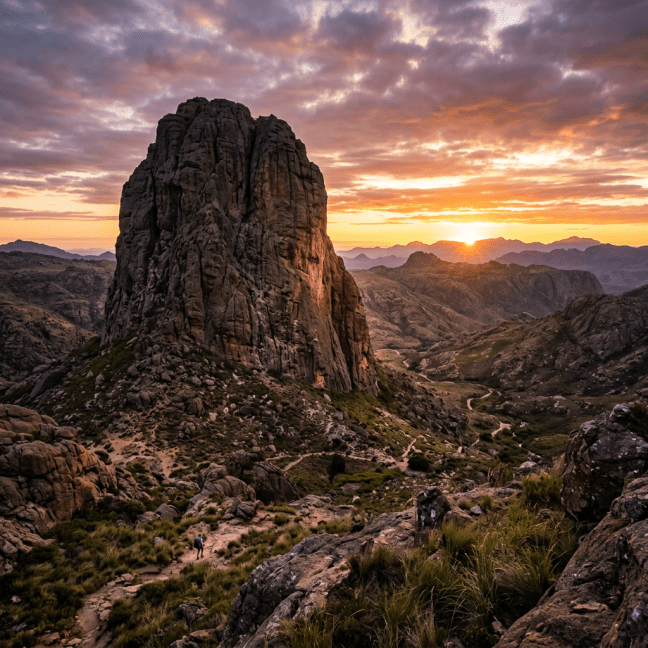
Hiker on a rocky trail near a large monolithic rock formation with a colorful sunset sky

“Make the Lord of Heaven’s Armies holy in your life. He is the one you should fear. He is the one who should make you tremble. He will keep you safe. But to Israel and Judah, he will be a stone that makes people stumble, a rock that makes them fall. And for the people of Jerusalem, he will be a trap and a snare. Many will stumble and fall, never to rise again. They will be snared and captured.”

Isaiah 8:13-15 NLT

Our planet is made of rocks presented in different forms. We have the dust and small particles that can cover large areas, such as in our deserts and seashores. There are pebbles used for roads and paths, and for decorative purposes.  There are even heavy monoliths forming structures like Stonehenge, a monument to a bygone religious custom. Rocks are dressed and used for building purposes, walls and houses, and even the Egyptian pyramids. But much of our planet consists of rock, solid and immovable. But, fascinatingly, these rocks have formed in different ways; however, a lesson in geology is beyond my abilities and the scope of this blog. 

The Lord is described as being a Rock, because He is unchangeable, a secure foundation and a place of safety. Malachi 3:6 reads, “I am the Lord, and I do not change. That is why you descendants of Jacob are not already destroyed”. Psalm 18:2, “The Lord is my rock, my fortress, and my saviour; my God is my rock, in whom I find protection. He is my shield, the power that saves me, and my place of safety”. We have these lovely words that fill us with a sense of security, words such as ”fortress”, “protection”, “rock”, and “Saviour”. But why should we feel so? In our world, in our societies, and in our towns, cities and villages, there seems to be no place of ultimate security. Yes, we can visit our churches and cathedrals and find a little peace, but then we find that even the insecurities of our world have penetrated within their doors.

Today, there is a hunger in society, particularly amongst young people, for peace and security. The world around us is fast-changing. New customs, more technology, and changes in government that never seem to make any improvements. Just more of the same old problems with promises that they will be fixed, but they never are. Jobs are not secure any more. The list of woes seems endless. Such societal distress calls for a solution, and our churches are seeing an upsurge in people seeking meaning in our meaningless world. But in all the chaos, there is a Rock who never changes and who promises an eternity that will be marked by the peace and security that cannot be found in the kingdoms of the world. 

The people in Judah found that they ignored the Rock, who is the Lord, at their peril. God is like a large, stable rock: a secure foundation and place of safety. To those who do not honour the Lord as holy, that same Rock, a cornerstone, becomes something of a tripping hazard. God’s truth cannot be denied, any more than a person can walk through a boulder. For those who reject Him, God becomes a “stumbling rock.” He’s something they cannot help but trip over. Everyone who tries to succeed and thrive apart from the Lord eventually falls and does not prosper. And for everyone who honours Him as holy, He is the solid rock on which they build their life.

Isaiah declared that the Lord would become the stumbling stone for both houses of Israel. That meant that both the northern ten tribes, Israel, and the southern two tribes, Judah, would be destroyed. The Lord would become a trap and a snare even to the people of Jerusalem in the end. They refused to honour Him, and that would ultimately bring them misery and destruction.

In Matthew, we find the account of a conversation between Jesus and the Pharisees, and at one point, He told the parable of the Evil Farmers. Jesus engaged the religious leaders by asking them the question, ““When the owner of the vineyard returns,” Jesus asked, “what do you think he will do to those farmers?”” (Matthew 21:40). Having drawn an answer from the Pharisees, Jesus quoted the verses from Psalm 118, “Then Jesus asked them, “Didn’t you ever read this in the Scriptures? ‘The stone that the builders rejected has now become the cornerstone. This is the Lord’s doing, and it is wonderful to see.’ I tell you, the Kingdom of God will be taken away from you and given to a nation that will produce the proper fruit. Anyone who stumbles over that stone will be broken to pieces, and it will crush anyone it falls on”” (Matthew 21:4-44). The Pharisees quickly caught on to what Jesus meant, realising that it was they He was referring to as the evil farmers. But there had been no change in attitudes to God since the days of Isaiah, and the Jews would once again experience what it meant that God was a Rock over which they would stumble, and it would ultimately fall upon them. In AD 70, the Temple in Jerusalem was destroyed, and many Jews perished.

There is a simple principle that applies to all mankind and has always done so. There is a God in Heaven, who is eternal and real and who put human beings on this planet for one purpose: “to glorify God and enjoy Him forever” (Westminster Short Catechism). The people hearing Isaiah’s prophecies chose to ignore that and suffered the consequences of stumbling over the Rock, ending up “snared and captured”. We pilgrims have a mission as builders, building on the Rock that is the Lord in ways that will bring order into this chaotic world. Only God has the answer for those who intuitively know that he is there, but for many, they cannot find Him unless someone opens the door into His Kingdom, where they will find Jesus, and His saving grace, a fount of blood that will cleanse all from their sins. 

Dear Heavenly Father. You are the only Source of peace and security. Only You are the Rock on which we can be founded. In today’s chaotic world, we choose to stand firm on a foundation that will never move, and we give You all the glory and all the praise. All the thanks and all the worship. Amen.

The Rock of Stumbling

“Yes, you who trust him recognise the honour God has given him. But for those who reject him, “The stone that the builders rejected has now become the cornerstone.” And, “He is the stone that makes people stumble, the rock that makes them fall.” They stumble because they do not obey God’s word, and so they meet the fate that was planned for them.”
1 Peter 2:7-8 NLT

In these two verses, Peter again quoted from the Old Testament. The first was a verse from Psalm 118:22, “The stone that the builders rejected has now become the cornerstone”. This Psalm was very much associated with the Passover celebrations and encouraged the congregation to “Praise the Lord” – “Hallelujah!”. The Passover was all about the time when the Israelite slaves were released from the Egyptians and when they embarked on their long journey in the wilderness before they reached the Promised Land. So there was much to thank God for and the Feast of Passover was celebrated every year. But dropped into the middle of this Psalm was the verse about the cornerstone. A thought that a common item, such as a stone used for building, was thrown away by the builders because they thought it unsuitable. A prophetic glimpse that Jesus remembered and wove into the parable of the wicked farmers. They were the leaseholders of a vineyard, and when the landlord, the owner of the vineyard, sent servants to collect his rent, they were beaten up, even killed. Jesus continued the story, “Finally, the owner sent his son, thinking, ‘Surely they will respect my son.’ “But when the tenant farmers saw his son coming, they said to one another, ‘Here comes the heir to this estate. Come on, let’s kill him and get the estate for ourselves!’ So they grabbed him, dragged him out of the vineyard, and murdered him” (Matthew 21:37-39). Jesus was of course foretelling His death, and He reminded the Pharisees, to whom the parable was aimed, that they were rejecting their Messiah, the Cornerstone, by quoting Psalm 118:22, “Then Jesus asked them, “Didn’t you ever read this in the Scriptures? ‘The stone that the builders rejected has now become the cornerstone. This is the Lord’s doing, and it is wonderful to see‘” (Matthew 21:42).

Peter went on to quote another Old Testament scripture, Isaiah 8:14. Referring to the Lord Himself, we read, “He will keep you safe. But to Israel and Judah he will be a stone that makes people stumble, a rock that makes them fall. And for the people of Jerusalem he will be a trap and a snare”. The context of this verse was a warning about the Assyrians. The Jews had become complacent and Isaiah prophesied that they will come to grief as a result of the Assyrian invasion because they had turned away from God. Isaiah 8:13-14a, “Make the Lord of Heaven’s Armies holy in your life. He is the one you should fear. He is the one who should make you tremble. He will keep you safe … ”. The people were exhorted to trust God for their salvation, but for those who didn’t, they will trip over Him, falling to their destruction.

So what about today? What is the message in all this for us pilgrims? Just as it was in those days long ago, God is always there for us. He is the solution to our problems. As we trust in Him we will find security and safety. The world may rage around us, going to and fro between secular ideologies, staggering from one conflict to another, and if we get caught up in all of that we too will “trip” over the Rock that is God. Instead of being a solution He will become a problem to us. Instead of a foundation to keep our souls safe for eternity, we will find that failing to trust in the Rock will lead to our eternal destruction. Back to Isaiah 8, “Look to God’s instructions and teachings! People who contradict his word are completely in the dark. They will go from one place to another, weary and hungry. And because they are hungry, they will rage and curse their king and their God. They will look up to heaven” (Isaiah 8:20-21).

Back to Psalm 118, the Hallelujah Psalm. We remember when we wake every morning, “This is the day the Lord has made. We will rejoice and be glad in it” (Psalm 118:24). Let us vow not to stumble over any “rocks” in our path today.

Father God. We thank You that in the storms of life You are always there for us, the Rock on who we stand. Amen.

Suffering

“Yet what we suffer now is nothing compared to the glory he will reveal to us later.”
Romans 8:18 NLT

Paul compares the suffering being experienced by both him and the early Christians with the wonderful benefits of the future life spent with God. The persecution suffered by the first followers of the Way is well documented, and it frequently included torture and death, particularly during Nero’s reign after the major fire in Rome. Paul himself suffered much during his missionary journeys, as we read in 2 Corinthians 11:23b-27, “… I have worked harder, been put in prison more often, been whipped times without number, and faced death again and again. Five different times the Jewish leaders gave me thirty-nine lashes. Three times I was beaten with rods. Once I was stoned. Three times I was shipwrecked. Once I spent a whole night and a day adrift at sea. I have traveled on many long journeys. I have faced danger from rivers and from robbers. I have faced danger from my own people, the Jews, as well as from the Gentiles. I have faced danger in the cities, in the deserts, and on the seas. And I have faced danger from men who claim to be believers but are not. I have worked hard and long, enduring many sleepless nights. I have been hungry and thirsty and have often gone without food. I have shivered in the cold, without enough clothing to keep me warm”. Now that is suffering and those early Christians were not unaware of what Paul had been through, because many of them experienced physical and economical hardship as well. We Western Christians have never experienced persecution on that scale, and we hope we never will.

Having said that, however, persecution is growing in the Western societies. Secularisation is well advanced and Christians are being increasingly marginalised. Congregations are dwindling. In Scotland we are currently going through a leadership election for a new First Minister, and one of the candidates, a committed Christian, has received terrible abuse because of her beliefs – she has even been told that Christian beliefs are incompatible with government in 21st Century Scotland. Persecution in the West is more subtle. A creeping erosion of Christian values. Verbal and societal attacks on individuals who dare to speak out a defence of their faith are becoming increasingly common. Globally, Christian persecution is increasing, but we shouldn’t be surprised about this because Jesus Himself warned about such things – we read in Matthew what He said to His disciples about the end times. Matthew 24:9-10 reads, “Then you will be arrested, persecuted, and killed. You will be hated all over the world because you are my followers. And many will turn away from me and betray and hate each other”. Sound familiar?

But – thankfully, there is always a “but” – Paul reassured his readers with the truth that one day they will be with God in Glory. From the perspective of eternity, the time spent on Planet Earth is insignificant. A mere blip, a microcosm of time, too small to register. We don’t really know the extent of God’s glory. We can guess that it will be wonderful and amazing, even more so when we think that we too will share in it. We do know, though, that we cannot see God’s glory in this life. Moses was prevented from seeing even a glimpse of God’s face, as we read in Exodus 33, “But you may not look directly at my face, for no one may see me and live.” The Lord continued, “Look, stand near me on this rock. As my glorious presence passes by, I will hide you in the crevice of the rock and cover you with my hand until I have passed by. Then I will remove my hand and let you see me from behind. But my face will not be seen”” (Exodus 33:20-23).

We pilgrims must stay the course. We must not give up, no matter how much opposition and abuse we receive. In an age when many are falling away from the faith, it is even more important that we stand firm, on the Rock that is the Lord. 

Dear Father God. We know the You are the only dependable foundation in a world that is shaking. We cling to the Rock – there is no other way. Amen.