
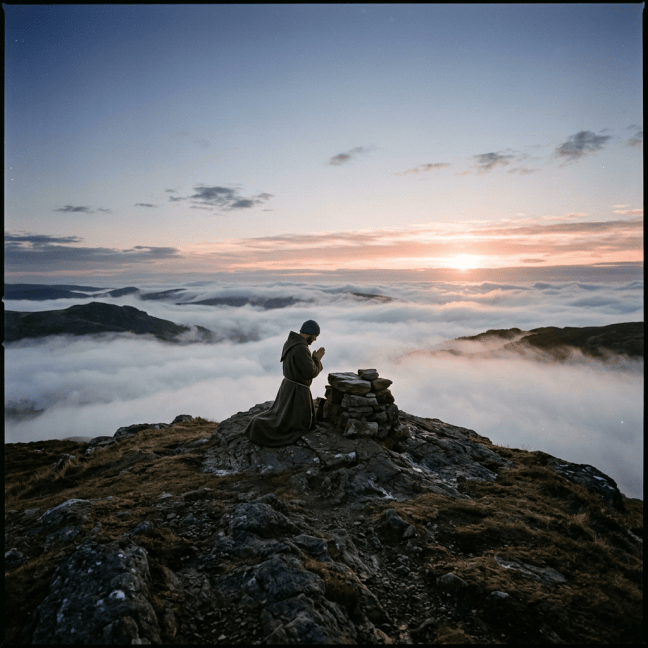
“O Lord, I will honour and praise your name, for you are my God. You do such wonderful things! You planned them long ago, and now you have accomplished them. You turn mighty cities into heaps of ruins. Cities with strong walls are turned to rubble. Beautiful palaces in distant lands disappear and will never be rebuilt. Therefore, strong nations will declare your glory; ruthless nations will fear you.”
Isaiah 25:1-3 NLT
We leave the devastation of God’s judgments in Isaiah 24, and move on to the next chapter. Isaiah 25 is one of the most hope-filled chapters in Isaiah’s writings, and here the prophet suddenly turns to praise. The chapter looks beyond immediate historical events to God’s ultimate victory, the salvation of His people, and the coming Messianic kingdom. It also contains one of the clearest Old Testament prophecies of the resurrection. But in many ways this chapter follows on from the previous verse at the end of chapter 24, which ended on a note of hope, “for the Lord of Heaven’s Armies will rule on Mount Zion. He will rule in great glory in Jerusalem, in the sight of all the leaders of His people”. It is almost as though Isaiah turns in a different direction, away from looking at the destruction of the earth, to God Himself, the One who destroyed all because of the “sins of the people, for they have twisted [His] instructions, violated His laws, and broken His everlasting covenant … its people must pay the price for their sin”. Isaiah understood well the consequences of sin.
So, Isaiah turned to God Himself, bursting into a personal outpouring of his praise. You see, God’s purposes had been completed in the previous chapter, the end of the story leaving Isaiah free to look at what God means to Him. Today, we pilgrims look on as life around us seems to reflect a maelstrom of chaos, both near and afar, but Isaiah knew that nothing was going to happen that God had not already planned. World events, on the one hand, and even personal happenings when we walk out of our front doors, all fit in with God’s plans for mankind. This is a hard statement to believe, because we have to face into the reality that sooner or later God will have to act because of mankind’s sin. Many people today are very worried and concerned that someone will push the nuclear button and the world will self-destruct, but we can be assured that nothing like this will happen unless God allows it. For other people, there is a huge cry of “why!” when a baby dies, or a plane crash kills all on board. They shake their fists in God’s face in anger and frustration, that is, if they ever believe He exists in the first place. Could God stop such occurrences? Of course, He could, and one day God will judge the world and its sin, bringing righteousness to bear when there is now only evil and sin. In the perfect to come, we read that there will be no more crying and no more death. Revelation 21:4, “He will wipe every tear from their eyes, and there will be no more death or sorrow or crying or pain. All these things are gone forever”. Through the resurrection of Jesus, we received a message of hope, because He was the first to defeat death. And this one event sealed our faith in God and His plan for the future, a future to be enjoyed by us pilgrims as we live with God forever.
Isaiah saw in his vision what the judgment would look like, but we never find him remonstrating with God with a “why”. Instead, he said, “O Lord, I will honour and praise your name, for you are my God”. Isaiah referred to what had happened as “wonderful things … planned … long ago”. Isaiah praises God for dealing with Israel’s enemies, and those nations that stand against God will one day have to praise Him. But we know that from Paul’s writings in Philippians 2:10-11, “that at the name of Jesus every knee should bow, in heaven and on earth and under the earth, and every tongue declare that Jesus Christ is Lord, to the glory of God the Father”. That’s a very complete count of everyone who has, or will, ever live. No exceptions at all. Paul echoes the same confidence as Isaiah. He wrote, “And we know that God causes everything to work together for the good of those who love God and are called according to His purpose for them“.
For us pilgrims, there is a principle we do well to follow. When life makes little sense, then we look upwards into the Heavenly realms, where we find the One who has all under control. We may not understand what is going on, but we do know the One who does. So, when life makes little sense, and we are tempted to look at the circumstances around us, it is more profitable instead to get on our knees in praise and worship. Faith trusts God’s plan before seeing God’s purpose.
Dear Heavenly Father. When all around us is descending into ever deepening depths of evil and sin, we instead look to You, the Rock upon whom we stand. Amen.

