The Church and Money

Now regarding your question about the money being collected for God’s people in Jerusalem. You should follow the same procedure I gave to the churches in Galatia. On the first day of each week, you should each put aside a portion of the money you have earned. Don’t wait until I get there and then try to collect it all at once. When I come, I will write letters of recommendation for the messengers you choose to deliver your gift to Jerusalem. And if it seems appropriate for me to go along, they can travel with me.”
1 Corinthians 16:1-4 NLT
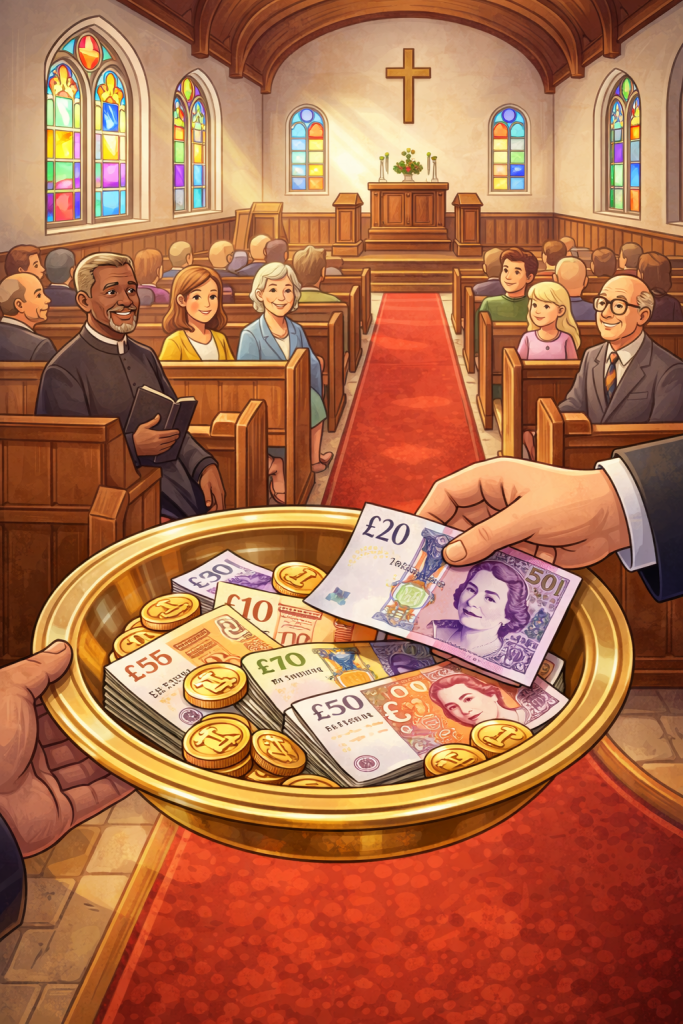
In his first letter to the Corinthians, Paul has covered a lot of ground, much of it apparently in response to a letter the Corinthians had written to him. As we turn the page into the last chapter, Paul addresses their practical question about how to collect money “for God’s people in Jerusalem”. What he suggested has become the norm in Christian churches. “On the first day of each week,” money was to be collected from the congregation and used as the Holy Spirit leads. For us pilgrims, the week starts on a Sunday, with corporate and public worship meetings held in churches, community centres, schools, wherever a room is available. Such gatherings even take place in people’s homes, if the numbers are small. But an important part of worship is taking a collection, in which every person present gives money for the work of the church. Of course, in today’s internet age, many give online by scanning a QR code or similar, or through the banking system with standing orders, but the same principle remains. 

Paul wrote this letter to the Corinthians in about 55 AD, during the period before the Temple in Jerusalem was destroyed by the Romans in 70 AD. In the middle of all the political unrest, the Christians in Jerusalem were going through a terrible time of persecution and were desperately in need of help with their poverty. As we read in Acts 12, the Apostle James was martyred, and Herod Agrippa went on to imprison Peter, intending to put him on trial. Christians were not at all popular with the Jews in those days, and the Judean Christians were not the only believers suffering persecution. In his first letter to the Thessalonians, Paul acknowledged how much they, too, were suffering. 1 Thessalonians 2:14, “And then, dear brothers and sisters, you suffered persecution from your own countrymen. In this way, you imitated the believers in God’s churches in Judea who, because of their belief in Christ Jesus, suffered from their own people, the Jews”. By contributing from their resources, the believers in Corinth were able to help other believers who were in need, but there was a spin-off benefit that was important. The Corinthians were mostly Gentiles not of Jewish ancestry, and it provided for them the opportunity to heal any rifts that had developed between Jews and Gentiles. It also established the principle of unity between Christian churches, wherever they were, and regardless of the ethnicity of their congregants.

Today, we collect money from our congregations and use it for God’s work as well as for practical requirements, such as the upkeep of the church building or renting alternative space. Then we have the church leaders to provide for. Some churches struggle to do even that because of their numbers, but others have a surplus and can budget to use it to support evangelical work, missionaries, food banks, and other philanthropic work as God leads. Paul suggested that the believers “should each put aside a portion of the money [they] have earned”. How much that should be is often debated, with some proposing ten per cent of earnings, others suggesting different amounts. But whatever decision is reached, it should be between the believer and God, who sees what is going on inside a person and in their bank accounts. 

A Christian is a believer who obeys the Lord, who follows Him and His teachings, and who is a citizen of the Kingdom of God. Such a life is very different from that of unbelievers, and there will be sacrifices accordingly. We pilgrims devote our time and resources to God, because we love Him and want to please Him in all that we do. There is a principle of sowing and reaping that applies in God’s economy, and the agricultural analogy covers many aspects of a believer’s life. Money, time, our behaviour, hospitality, and so on. The principle means that if we sow sparingly in any of these areas, then the harvest that we reap, will be equally sparse. Galatians 6:7, “Do not be deceived: God cannot be mocked. A man reaps what he sows“. Jesus Himself taught, “Give, and it will be given to you. A good measure, pressed down, shaken together and running over, will be poured into your lap. For with the measure you use, it will be measured to you”.

In these verses today, Paul wasn’t suggesting that the Corinthians believers were a bit stingey with their money. Rather, Paul was suggesting a way to budget their giving so there wasn’t a problem with collecting it all at once. Good practical advice and one that has followed him into the twenty-first century.

Dear Father God. Thank You for the resources You have given us, and for helping us to use them wisely. Amen.


Understanding the Sting of Death: A Biblical Perspective

“”O death, where is your victory? O death, where is your sting?” For sin is the sting that results in death, and the law gives sin its power. But thank God! He gives us victory over sin and death through our Lord Jesus Christ.”
1 Corinthians 15:55-57 NLT

What is the “sting of death”? Perhaps we can consider the analogy of a scorpion or a bee. A bee is frightening because of its stinger; if the stinger is removed, the bee can still buzz around, but it can no longer truly harm us. The Bible teaches that death only has a sting because of sin. Without sin, death would not be a punishment or a source of spiritual “poison”—it would simply be a transition.

Paul wrote, “the law gives sin its power”, This means the Law (God’s moral standards) highlights our sin, making the “sting” feel even sharper because we realise we have fallen short of those standards. But to which law was Paul referring? Usually, when we refer to the Jews and the Old Testament, the “law” we have in mind is the Mosaic Law, as found in Exodus 20, and all the rules and regulations found in the Torah, the first five books of the Old Testament. Human beings love structure, such as that contained in the Law, because otherwise a lawless existence results. Imagine the chaos if there were no laws in our society, and everyone behaved as they saw fit. Because of sin, society would very quickly disintegrate. Moses gave the Israelites God’s Law, as revealed to him on Mount Sinai, as a covenant, to reveal His holy character, set them apart as His chosen people, teach them righteousness, reveal their inability to save themselves, and guide them in worship and daily life. An unbeliever is justly condemned in God’s sight by the Law that was given to His servant Moses. But what about those who are not Jews? Paul wrote about them in Romans 2:14-15, “Even Gentiles, who do not have God’s written law, show that they know his law when they instinctively obey it, even without having heard it. They demonstrate that God’s law is written in their hearts, for their own conscience and thoughts either accuse them or tell them they are doing right”. Jesus Himself said this about the Law, “Don’t misunderstand why I have come. I did not come to abolish the law of Moses or the writings of the prophets. No, I came to accomplish their purpose. I tell you the truth, until heaven and earth disappear, not even the smallest detail of God’s law will disappear until its purpose is achieved” (Matthew 5:17-18). 

The problem with the Law is that even when it is in place, no one can keep it in a way that fulfils God’s requirements. All it does is expose the sin that is ingrained within us. Jesus exposed the intent of the Law when He taught, “You have heard that our ancestors were told, ‘You must not murder. If you commit murder, you are subject to judgment’” (Matthew 5:21). The Pharisees were very good at keeping the outward aspects of the Law, and in this case claimed a tick in the “do not murder” box. But Jesus pricked their righteous bubble when He said, “But I say, if you are even angry with someone, you are subject to judgment! If you call someone an idiot, you are in danger of being brought before the court. And if you curse someone, you are in danger of the fires of hell” (Matthew 5:22). In Matthew 5:20 Jesus said, “But I warn you—unless your righteousness is better than the righteousness of the teachers of religious law and the Pharisees, you will never enter the Kingdom of Heaven!

Paul wrote that “the law gives sin its power” and regardless of the law, human beings, Jews or otherwise, can never be good enough to meet God’s standard on their own. We all know the verse in Romans 3:23, “For everyone has sinned; we all fall short of God’s glorious standard”. But rather than leave us in a hopeless situation, God sent His Son, Jesus, to take on the punishment for sin that we deserve. Paul wrote, “He gives us victory over sin and death through our Lord Jesus Christ.” God’s plan was for mankind to be reconciled to God. Jesus took on Himself our sins and gave us His righteousness so that we can truly be God’s children, able to enter His presence.

This is exciting for us pilgrims because we have the assurance that one day we can enter Heaven, crossing the Great Divide free from the sting of sin and death. We lived a life that started when we responded to God’s call and repented of our sins, believing in our wonderful Saviour. A quote from “Gotquestions.org”, “Christ became the end of the Law by virtue of what He did on earth through His sinless life and His sacrifice on the cross. So, the Law no longer has any bearing over us because its demands have been fully met in the Lord Jesus Christ. Faith in Christ, who satisfied the righteous demands of the Law, restores us into a pleasing relationship with God and keeps us there. No longer under the penalty of the Law, we now live under the law of grace in the love of God”

O death, where is your victory? O death, where is your sting?

The sting of sin and death no longer appears in the hearts and minds of us pilgrims. Can we feel the flood of God’s love and grace pouring over us? Can we truly claim that the “things of earth go strangely dim, in the light of His glory and grace”? According to what we believe, Jesus took the “sting” (the penalty of sin) upon himself. Because Jesus rose from the dead, death is viewed as a defeated enemy. It may still happen physically, but its “poison” (eternal separation from God) is gone. Forever.

Father God. We thank You that we never die but instead transition from this life into eternal life, where we will be in Your presence. “O death, where is your victory? O death, where is your sting?” Amen.

A Wonderful Secret

“But let me reveal to you a wonderful secret. We will not all die, but we will all be transformed! It will happen in a moment, in the blink of an eye, when the last trumpet is blown. For when the trumpet sounds, those who have died will be raised to live forever. And we who are living will also be transformed. For our dying bodies must be transformed into bodies that will never die; our mortal bodies must be transformed into immortal bodies.”
1 Corinthians 15:51-53 NLT

There is something amazing coming for us pilgrims. Our bodies are going to experience a transformation into immortality. Although it was always God’s intention to grant immortality through the Tree of Life, sin corrupted mortal bodies. So there is a problem with our natural, physical bodies, because they cannot exist in God’s domain. “What I am saying, dear brothers and sisters, is that our physical bodies cannot inherit the Kingdom of God. These dying bodies cannot inherit what will last forever” (1 Corinthians 15:50). But anyone of advancing years will know all about the limitations of our physical bodies. The aches and pains increase with age and bring some to the point where they don’t want to carry on. Some experience a constant merry-go-round of hospital visits, GP appointments, and calls upon the local pharmacist, all of which combine to dictate a way of life that never appeared in God’s plan for humans. Sooner or later, God’s people will need a new body, one suitable for spending eternity with God. A new body that will never die.

We don’t know when this event will happen, of course. But the Bible includes many references to the End Times, and when the end of the world was going to happen was one of the last questions the disciples asked of Jesus. His response was, “And you will hear of wars and threats of wars, but don’t panic. Yes, these things must take place, but the end won’t follow immediately. … And the Good News about the Kingdom will be preached throughout the whole world, so that all nations will hear it; and then the end will come” (Matthew 24:6, 14). There have been many predictions of when the world will end, and in 2015, apparently, 22% of the UK population believed that such an event would happen in their lifetimes. Even religious men and women, like John Wesley, were tempted to make a prediction (1836, in his case). Charles Russell, a forerunner of the JW’s, proposed that Jesus would return in 1874, and when He didn’t, Russell then suggested that Jesus had indeed returned but invisibly. But Jesus was clear that no one knew when the world would end except God Himself. Matthew 24:36, “However, no one knows the day or hour when these things will happen, not even the angels in heaven or the Son himself. Only the Father knows”

Some in the Corinthian church were puzzled because, in their number, a few deaths had apparently occurred. How will these believers, therefore, experience a transformed body? So Paul put their minds at rest by saying, “those who have died will be raised to live forever“. Not an illogical suggestion at all, because of what happened to Jesus. He was dead, graveyard dead, and yet was resurrected that first Easter Sunday morning. We pilgrims know that one day Jesus will come and take us to be with Him. John 14:3, “When everything is ready, I will come and get you, so that you will always be with me where I am“. We know how that will happen, because Jesus told us. Matthew 24:30-31, “And then at last, the sign that the Son of Man is coming will appear in the heavens, and there will be deep mourning among all the peoples of the earth. And they will see the Son of Man coming on the clouds of heaven with power and great glory. And he will send out his angels with the mighty blast of a trumpet, and they will gather his chosen ones from all over the world—from the farthest ends of the earth and heaven“.

All this was a mystery to the Corinthians, but with the benefit of the Bible, we know better. I don’t know about you, fellow pilgrims, but I’m looking forward to receiving a new body. A transformed and resurrected body just like Jesus’. No more tears, no more sickness, no more death, and in God’s presence forever.

Dear Heavenly Father. We all pray together, “Come Lord Jesus”. Amen.

The Heavenly Man

“The Scriptures tell us, “The first man, Adam, became a living person.” But the last Adam—that is, Christ—is a life-giving Spirit. What comes first is the natural body, then the spiritual body comes later. Adam, the first man, was made from the dust of the earth, while Christ, the second man, came from heaven. Earthly people are like the earthly man, and heavenly people are like the heavenly man. Just as we are now like the earthly man, we will someday be like the heavenly man.”
1 Corinthians 15:45-49 NLT

At first sight, these verses seem to be a bit confusing. But Paul was simply comparing two separate bodies, an earthly, physical body, of which we are all very acquainted, and the heavenly, spiritual body that we are yet to acquire. We know that the original body given to Adam was formed from “dust” – Genesis 2:7, “Then the Lord God formed the man from the dust of the ground. He breathed the breath of life into the man’s nostrils, and the man became a living person”. I imagine a sculptor forming a statue of a man from a lump of clay (a big lump!). We don’t have to look far to see statues in our churches and city environments. But only God can bring them to life with the “breath of life”. In the Valley of the Dry Bones in Ezekiel’s vision, he saw the bones rattling together and forming skeletons. “Then as I watched, muscles and flesh formed over the bones. Then skin formed to cover their bodies, but they still had no breath in them” (Ezekiel 37:8). In the next verse, we read, “[God] said to me, “Speak a prophetic message to the winds, son of man. Speak a prophetic message and say, ‘This is what the Sovereign Lord says: Come, O breath, from the four winds! Breathe into these dead bodies so they may live again’””. It is only God who can bring life to an inanimate object, life that is His to command. 

I am fearfully and wonderfully made

It is interesting to ponder the progress being made by engineers and scientists in creating humanoid robots. They can produce objects that are superficial copies of human bodies, but without the extraordinary complexity of God’s creation that includes His breath. The devil cannot create anything, but one wonders if this is him trying his best. The first Adam had a physical body containing products of the earth on which he lived, but he, and we, are more than a bag of different chemicals, regardless of what the evolutionists tell us. As the psalmist David wrote, “I will praise You, for I am fearfully and wonderfully made; Marvellous are Your works, And that my soul knows very well” (Psalm 139:14). 

Paul wrote, “What comes first is the natural body, then the spiritual body comes later”. We will not receive our spiritual bodies until we have finished with our natural bodies. The old cartoonists sometimes depicted a person’s spirit leaving his body and floating off somewhere to do something in accordance with the storyline. But this doesn’t work because the two types of body, natural and spiritual, are formed in different places. The natural body is earthly, and the spiritual body is Heavenly. Consider two totally different universes, each made of totally incompatible materials. We only know about worldly matter, and we have senses that can detect it, analyse it and use it to continue our lives here on earth. An unbeliever will find the limits of his knowledge here because his natural mind will ignore any thoughts of there being a universe made of materials that don’t exist on earth. But God created human beings with an embryonic spiritual body inside, a body that will never be found with a surgeon’s knife. The inner spirit within all human beings manifests in vague stirrings that point to something or someone outside of themselves to whom they owe their gift of life. Our spirits empower our souls with emotions that form the essence of how human beings behave and respond to others. But there is no surprise about this to a believer in God, people like us, pilgrims who know that God created us and all that we are, body, soul and spirit.

One day, Paul wrote, our natural bodies will die, and then we will receive our spiritual bodies. It is then that we will become Heavenly bodies, just like Christ’s. Paul wrote, “heavenly people are like the heavenly man“. He also wrote in Philippians 3:21, “He will take our weak mortal bodies and change them into glorious bodies like his own, using the same power with which he will bring everything under his control”. Jesus is in Heaven just now, complete in His resurrected body. It is a spiritual body and we will be given a body just like His. We can’t ask for more!

Dear Heavenly Father. We don’t know exactly what we will be like in Heaven, but we do know that You desire the best for us. We worship You today. Amen.

Different Bodies

“It is the same way with the resurrection of the dead. Our earthly bodies are planted in the ground when we die, but they will be raised to live forever. Our bodies are buried in brokenness, but they will be raised in glory. They are buried in weakness, but they will be raised in strength. They are buried as natural human bodies, but they will be raised as spiritual bodies. For just as there are natural bodies, there are also spiritual bodies.”
1 Corinthians 15:42-44 NLT

I’m always fascinated by the life cycle of a moth. There are four stages: an egg, a caterpillar, a pupa, and then the adult moth, which lays more eggs, and the process continues. But the fascination to me is that the caterpillar eventually forms a cocoon, where it metamorphoses into an adult moth. But we are all aware that the caterpillar looks nothing like the final moth, an insect that, for some species, is really beautiful with the colours and design of its wings. Within the caterpillar is everything required to produce the moth, DNA and all, and the transformation that takes place is nothing short of a miracle, designed and created by our amazing God.

When human beings are conceived, another miracle takes place. The unique fusion of a male and female cell provides everything required for the birth and growth of the resulting human being. But within each human being, as well as the physical or material part of the body, there is an immaterial part we call a soul or spirit (some maintain we have both). A surgeon’s knife will never find the spirit within a person because it is not a physical entity. Such a division between body and spirit is described several times within the Bible, with scriptures such as Ecclesiastes 12:7, explaining what happens after death: “For then the dust will return to the earth, and the spirit will return to God who gave it”. We also have the reference to the cutting-edge nature of God’s Word, as in Hebrews 4:12, “For the word of God is alive and powerful. It is sharper than the sharpest two-edged sword, cutting between soul and spirit, between joint and marrow. It exposes our innermost thoughts and desires“.

In Genesis 2, we read about how Adam was created, “Then the Lord God formed the man from the dust of the ground. He breathed the breath of life into the man’s nostrils, and the man became a living person” (Genesis 2:7). What is the “breath of life” other than God putting within us something unique to humans, which is God’s spirit? In the Genesis account, we find no reference to a similar spiritual content being placed in the animals God created. 

So we have a physical body, containing all the body parts that a surgeon can find, and a spiritual part, which is our intellect, will, conscience, mind, emotions, etc. But here’s the thing. Our spirits never die; they live on forever. The Apostle Paul came to a point in his life when he faced the very real prospect of his death. There he was, chained to two Roman soldiers in a prison, and he wrote, “I’m torn between two desires: I long to go and be with Christ, which would be far better for me. But for your sakes, it is better that I continue to live” (Philippians 1:23-24). Paul had no doubts at all about the eternal nature of his spirit. 

So in our verses today, Paul points out that we have a physical body and a spiritual body, and the latter continues eternally, in glory and strength. Of course, we look after our physical bodies, with food and drink supplying all that our bodies require. We wear clothes to keep us warm. A vast industry has developed to heal any of the body’s ailments, and hardly a day goes past without some new discovery of a drug, a new piece of equipment, or a procedure that can fix a physical body’s problems. But inevitably, there comes a day when our physical bodies can no longer sustain life, and we die. However, our spirits continue to live, living in a way that depends greatly on how we looked after them while they resided within our physical bodies. 

Do we feed our spirits? Most people are aware of their spiritual side and do much to please it in various ways. When distressed, people engage in visits to counsellors, or undertake some “retail therapy” or consume a quantity of alcohol or drugs, in the hope and expectation that they can do something about the hunger pains in their spirits. The spiritual state they are aiming for is a “high” that permeates through their physical bodies, bringing feelings of well-being. We refer to this state as “happiness”.

Give us this day our daily bread”

But Christians are aware that their spirits need to be fed in the way that God intended, using the “food” that He has supplied. Following their new spiritual birth, a believer must feed their spirit so that it may grow. 1 Peter 2:2-3, “Like newborn babies, you must crave pure spiritual milk so that you will grow into a full experience of salvation. Cry out for this nourishment, now that you have had a taste of the Lord’s kindness“. But it is no good heading for a supermarket for a bottle of “pure spiritual milk“. We have to look to God Himself, because He is the only Source of the spirit-food that we need. Just as He supplied food called manna to the Israelite slaves in the wilderness, a food so complete that it contained every element and vitamin necessary to sustain human life, God also supplies the food necessary to maintain our spirits. Where will we find it? In His Word and in His company, spending time with Him through prayer and meditation. Like many things about God’s Kingdom, there is no instant solution.

Dear Father God. We pray, “Give us this day our daily bread”, and testify to Your goodness in supplying all that we need, body, soul, and spirit. Thank You. Amen.

Bad Company

Don’t be fooled by those who say such things, for “bad company corrupts good character.” Think carefully about what is right, and stop sinning. For to your shame I say that some of you don’t know God at all.”
1 Corinthians 15:33-34 NLT

Sooner or later, all Christians will encounter the thorny problem of “bad company”. We might like to be protected from the sin and evil that is so prevalent around us, but we have little choice because we rely on the world and its resources for our livelihood. We have to work somewhere to earn the money to live, we have to buy food in a supermarket, and in the process, we are in contact with people who do not share our faith. Worse, we have a government that has currently abandoned the Christian roots that founded this country. So we believers are forced to live in a world we don’t really want to be in. Everywhere we go, we are in contact with sin and evil shown by the people we encounter, and the results of years of rebellion against God can be found in the society and infrastructure around us. And then we have the problem of having friends who are not believers. In many ways, we are intricately involved in a world with no escape. Jesus said to His disciples, “I have given them your word. And the world hates them because they do not belong to the world, just as I do not belong to the world. I’m not asking you to take them out of the world, but to keep them safe from the evil one. They do not belong to this world any more than I do” (John 17:14-16). We don’t belong here any more, but Jesus was clear; we are in the world whether or not we want to be, and He asked our Heavenly Father to keep us safe from the evil one.

Paul warned the Corinthians that some in their midst had earned the label “bad company”. These were the ones who were saying that there will be no resurrection of the dead. It also appears that the church in Corinth had been infiltrated by people who claimed to be Christians but weren’t. Paul wrote, “For to your shame I say that some of you don’t know God at all”. These were people conspicuous by their attitude to sin. In my early Christian days, I increasingly found out about what sin was, but in my spiritual immaturity, I puzzled over the behaviour of some of the believers in the church I was saved in, believers who seemed to have a strange attitude to living a sin-free life. So their use of expletives in conversation I found offensive. Their behaviour in social contexts was more worldly than I would have expected. They watched TV programmes that I definitely felt were not suitable for Christians to watch. Were they the sort of people that Paul labelled “bad company” and those that “don’t know God at all”?

In years spent working in an office, it was easy to find those who carried the label “bad company”. But these were people who knew no better, because they were fully paid-up, passport-carrying, citizens of the kingdom of the world. And so they lived lives compatible with that kingdom. But when we pilgrims discovered the narrow gate into the Kingdom of God and decided to stay there, believing in Jesus and all He did for us, we inherited a dilemma. We became a people who do not belong to the kingdom of the world. The problem is that we still have to live our physical lives there, with our spirits living in a different Kingdom. Peter wrote, “So you must live as God’s obedient children. Don’t slip back into your old ways of living to satisfy your own desires. You didn’t know any better then” (1 Peter 1:14). In some wonderful way, God has resourced us to be able to live in the world. Yet, we need not be tainted by the sin and evil we find there. The spiritual resources that are so bountiful in God’s Kingdom are ours for the asking, and they, coupled with our wills, enable us to avoid being corrupted by the “bad company” around us. 

The Apostle John wrote, “If we claim to have fellowship with him and yet walk in the darkness, we lie and do not live out the truth. But if we walk in the light, as he is in the light, we have fellowship with one another, and the blood of Jesus, his Son, purifies us from all sin” (1 John 1:6-7). Walking in the light means living a life that follows Jesus, abandoning sin and all worldly behaviour incompatible with God’s Word. Walking in the darkness means living a life of sin in an evil, secular society. There is no middle ground. Sadly, we are human and lapse into dark ways from time to time. However, in 1 John 1:9, we read, “If we confess our sins, he is faithful and just and will forgive us our sins and purify us from all unrighteousness“. Jesus is the Light of the world, and we follow Him because He knows the way to eternal life.

Dear Lord Jesus. You came to this world to show mankind the way to Heaven. Please help us to show Your light to the world around us and please help,us to avoid “bad company”. In Your precious name. Amen.

Risking Death

If the dead will not be raised, what point is there in people being baptised for those who are dead? Why do it unless the dead will someday rise again? And why should we ourselves risk our lives hour by hour? For I swear, dear brothers and sisters, that I face death daily. This is as certain as my pride in what Christ Jesus our Lord has done in you.”
1 Corinthians 15:29-31 NLT

There is no point, said Paul, to face into all the danger that being a Christian involved in those days, if there was to be no resurrection of the dead. Previously, in this chapter, in this his first letter to the Corinthians, he answered those in Corinth who were saying that there would be no resurrection of the dead. This was despite what Paul and his colleagues in ministry were teaching. And Paul made several points to them about what this would mean in practice. 

Jesus died and rose again
on the first Easter Sunday
morning

Firstly, he said, “For if there is no resurrection of the dead, then Christ has not been raised either” (1 Corinthians 15:13). To deny that Jesus rose from the dead and appeared to so many witnesses was to do what some people do today. They were trying to rewrite history because it didn’t suit their particular worldview. We have those today who deny that the Holocaust actually took place, but just to deny that something ever happened doesn’t change the facts. Jesus died and rose again on the first Easter Sunday morning. Of course, we remember the Sadducees who were around between 200BC and about 70AD. They were a rich and powerful sect of mainly businessmen who denied that the dead would be raised, and they were also very prominent in the Sanhedrin, the Jewish ruling council. Paul knew that they believed that there was no resurrection and he used this to good effect when he was brought before the Sanhedrin. Acts 23:6, “Paul realised that some members of the high council were Sadducees and some were Pharisees, so he shouted, ‘Brothers, I am a Pharisee, as were my ancestors! And I am on trial because my hope is in the resurrection of the dead!’” The Council was made up of Pharisees and Sadducees, and absolute mayhem resulted as they fought over their different beliefs about resurrection, to the extent that the local commander of the Roman forces had to send soldiers in to rescue Paul. 

Secondly, Paul made the simple statement, “And we apostles would all be lying about God—for we have said that God raised Christ from the grave. But that can’t be true if there is no resurrection of the dead” (1 Corinthians 15:15). It would be a sad place for Paul, if he had made up all the stories and facts about Christ’s resurrection. To find out that he was lying would have been a terrible place for him to be in, and totally contrary to the purity of the Good News that he preached. 

Thirdly, Paul pointed out that “ … if Christ has not been raised, then your faith is useless and you are still guilty of your sins”(1 Corinthians 15:17). The fact of Christ’s resurrection is a fundamental cornerstone of our faith. Without it we are just a deluded set of fantasists believing in fairy stories and heading for an unknown post-death fate.

Paul said, “I face death daily“.

Fourthly, and in connection with the last point, Paul said that “ … why should we ourselves risk our lives hour by hour? For I swear, dear brothers and sisters, that I face death daily. This is as certain as my pride in what Christ Jesus our Lord has done in you” (1 Corinthians 15:30-31). It would be hard enough to live out a life of denial, but to be so convinced by that lie, involving facing death, as he was doing, every day,  beggars belief. In the first century, many martyrs died for their faith, and Paul was well aware that he was in danger himself. 

We pilgrims, believers in the resurrection, will never experience the danger of death in response to our faith. But we are increasingly experiencing persecution through the passing of secular laws and through ridicule and exclusion in various places in our society. But we know that this would happen because Jesus Himself warned us about it. So we stand strong in our faith, believing in our salvation and in the One who made it all happen.

Dear Lord Jesus. You came to this world proclaiming the words of eternal life. We have nowhere else to go, and we pray for the strength to hold firm in this, our hostile, lost and evil world. In Your precious name. Amen.

Baptising the Dead

“If the dead will not be raised, what point is there in people being baptised for those who are dead? Why do it unless the dead will someday rise again?”
1 Corinthians 15:29 NLT

Here is a strange verse that has confused theologians over the years, theologians who would rather it were not there, but who have to try to explain it anyway. In addition, some religious groups have zoomed in on this verse and have used it, or are using it, as a means to give someone who has died a second chance in the afterlife. Their logic is quite simple. Referring to this verse, they believe that on behalf of a dead person, they can make a public confession of faith, essentially enabling the deceased to be baptised. They think that eternal life is unavailable for those who have not been baptised, so allowing themselves to be baptised on the dead person’s behalf opens Heaven’s doors to the soul that otherwise would not gain entry. Presumably, the aforesaid soul would have been hanging around the pearly gates, hoping that someone back on earth would have remembered them. Of the religious groups practising baptism for the dead, the Mormons are the most prominent, and the practice commenced with the heretical beliefs of Marcionism, which emerged in the second century AD.

We pilgrims know and understand that salvation is a personal matter. For example, we read Ephesians 2:8, “God saved you by his grace when you believed. And you can’t take credit for this; it is a gift from God”. In Peter’s Acts 2 sermon, he said, “ …  Each of you must repent of your sins and turn to God, and be baptised in the name of Jesus Christ for the forgiveness of your sins. Then you will receive the gift of the Holy Spirit”. The “each” emphasises the personal nature of faith, and the fact that we cannot enter Heaven on someone else’s coattails, using their faith as a means of entry. 

God saved you by his grace
when you believed“.

Is baptism essential to inherit eternal life? John 3:16 does not say ‘all who believe in Him and get baptised will not perish but have eternal life’. There have been many over the centuries who have died believing in Jesus, but because of one reason or another have not been baptised. The first was the penitent thief on the cross adjacent to Jesus’s. He had no opportunity for baptism or religious training. He had not taken Holy Communion or been to a Bible Study or prayer group. But Jesus, seeing the state of his heart, said, ‘Today you will be with me in Paradise’. And what about those from denominations that do not believe in full-immersion baptism? Without a proper full-immersion baptism, will they too be excluded from Heaven? 

So what did Paul mean when he wrote about people who were being baptised for the dead? Perhaps there was a distorted belief amongst the Corinthian Christians that there was such a possibility, and Paul was providing some correction with verse 29 of 1 Corinthians 15. We mustn’t forget that in those early days of the church, there was no Canon of Scripture as we enjoy today. In the febrile environment of spiritual gifts and the new life in Jesus, it was always possible that one or two believers became a little overenthusiastic in their beliefs. And of course, it would be natural for those still alive to worry about the whereabouts of the soul of a deceased loved one who had not been baptised. 

Regarding believers being baptised on behalf of those who are already dead, there is a theory that uses the analogy of an army, where a soldier steps up to take the place of a fallen comrade. In the first century, Christian martyrdom occurred, and there may have been a sense that another believer must step up and be baptised on behalf of the martyred Christian to maintain church numbers. Or perhaps Paul was being a bit tongue-in-cheek when he wrote that verse, presenting a view that was obviously incorrect.

We pilgrims cannot be baptised on behalf of another person; that much is clear. We will all one day have to stand before God to provide an account of our lives, and it will not be a valid position to claim salvation through someone else’s efforts. Romans 14:12, “Yes, each of us will give a personal account to God”.

Dear Father God. We know that salvation is a personal experience, and not one that we can adopt on behalf of someone else. But we pray for our loved ones, our friends and our families, that they too will embrace the wonderful Good News about Your Son, Jesus. In His precious name. Amen.

The End Will Come

“But there is an order to this resurrection: Christ was raised as the first of the harvest; then all who belong to Christ will be raised when he comes back. After that the end will come, when he will turn the Kingdom over to God the Father, having destroyed every ruler and authority and power. For Christ must reign until he humbles all his enemies beneath his feet.”
1 Corinthians 15:23-25 NLT

There seems to be an order of events set out in Paul’s writings today. 

  • Christ is resurrected
  • Christ returns
  • All who belong to Christ” will be resurrected
  • Christ reigns for a period, humbling His enemies
  • Every ruler and authority and power” is destroyed
  • The End will come
  • The Kingdom is turned over ”to God the Father”.

they will see the
Son of Man coming
on the clouds of heaven

Now we know that Christ was resurrected on that first Easter Sunday, and there are hundreds of witnesses to that fact, so the next big event that we need to look out for is His return to this earth, His Second Coming. Jesus’ disciples asked Him about when this would be. He replied, “And you will hear of wars and threats of wars, but don’t panic. Yes, these things must take place, but the end won’t follow immediately. Nation will go to war against nation, and kingdom against kingdom. There will be famines and earthquakes in many parts of the world. But all this is only the first of the birth pains, with more to come” (Matthew 24:6-8). On that basis, the “birth pangs” that precede Christ’s return have been happening since the day He left the Mount of Olives and returned to Heaven, and have continued for the past two thousand years. As we read on in Matthew 25, a number of other signs will occur, such as the time when the Gospel, the Good News about Jesus, is preached throughout the whole world (that milestone is getting ever closer). False messiahs will appear; there will be astronomical events that occur in the heavens, “and then at last, the sign that the Son of Man is coming will appear in the heavens, and there will be deep mourning among all the peoples of the earth. And they will see the Son of Man coming on the clouds of heaven with power and great glory” (Matthew 24:30). 

We can turn to other Scriptures and fill in some gaps about what is to come, but all that will be academic unless we pilgrims are ready for the next step, the return of Jesus for a second time. So, what should we be doing? The Apostle John wrote, “Beloved, now we are children of God; and it has not yet been revealed what we shall be, but we know that when He is revealed, we shall be like Him, for we shall see Him as He is. And everyone who has this hope in Him purifies himself, just as He is pure” (1 John 3:2-3). John pointed out that if we want to be like Jesus when He comes, then we need to pursue being like Him now. The message from the Parable of the Three Servants in Matthew 25 is all about being faithful to Him while He has been away. Matthew 25:21, “The master was full of praise. ‘Well done, my good and faithful servant. You have been faithful in handling this small amount, so now I will give you many more responsibilities. Let’s celebrate together! ’” 

Well done,
my good and faithful servant.
You have been faithful

We must also be aware that towards the time when Jesus returns, there may be periods and occasions of suffering. Matthew 24:9-12, “Then you will be arrested, persecuted, and killed. You will be hated all over the world because you are my followers. And many will turn away from me and betray and hate each other. And many false prophets will appear and will deceive many people. Sin will be rampant everywhere, and the love of many will grow cold”. These will be sober times, and we must be alert and faithful to the promise that we have in Jesus. We note that Jesus warned about deception from false prophets, and we can look back over the years to see that people have been deceived into following cults and movements based on a false premise or a skewed interpretation of the Bible. To save ourselves from such deception, we must faithfully read the Bible and become very familiar with what it contains. Every new idea or a message preached that we haven’t heard before, we must check it out, and, painful though it might be, we must walk away from anyone or any church that tries to deceive us. Society is awash with strange ideologies generated by people who are nothing more than useful idiots deceived by the devil. We must also be aware of the spirit of the age in which we live. It is a spirit of lawlessness summed up by the last verse in the Book of Judges, “ … all the people did whatever seemed right in their own eyes” (Judges 21:25b). The Nike spirit of “if it feels good, then just do it” prevails today. We human beings can also easily deceive ourselves in an “everyone does it” culture.

But one day, all these enemies of God will be humbled, because we read in Philippians 2:10-11, “that at the name of Jesus every knee should bow, in heaven and on earth and under the earth, and every tongue declare that Jesus Christ is Lord, to the glory of God the Father“. They will have no other option when the Lord of lords and King of kings rules over all.

Dear Father God. We look forward to the days when Your Son Jesus returns. We too pray the words in the last chapter of Revelation, “Come Lord Jesus”. Amen.

Adam and Christ

So you see, just as death came into the world through a man, now the resurrection from the dead has begun through another man. Just as everyone dies because we all belong to Adam, everyone who belongs to Christ will be given new life. But there is an order to this resurrection: Christ was raised as the first of the harvest; then all who belong to Christ will be raised when he comes back.”
1 Corinthians 15:21-23 NLT

We know from the Genesis account that Adam and Eve were expected to live forever, sustained by the fruit from the Tree of Life located in the Garden of Eden. We can only imagine what this place was like, but it would have contained all the space, vegetation and animal life that we know and enjoy, and probably much more. The Garden of Eden was a biblical paradise created by God for the benefit of the human race that He had created. The Garden would have featured abundant, beautiful, and edible fruit from trees (including the Tree of Life and the Tree of Knowledge), fresh water from a river, and harmonious animals, all existing in perfect peace, innocence, and provision before humanity’s disobedience led to expulsion and hardship. Genesis 3 tells us that after sin entered the world through Adam, a marked change happened as we read in Genesis 3:17-18, “And to the man he said, “Since you listened to your wife and ate from the tree whose fruit I commanded you not to eat, the ground is cursed because of you. All your life you will struggle to scratch a living from it. It will grow thorns and thistles for you, though you will eat of its grains”. In other words, life for Adam was going to get very hard, and his previous idyllic existence was about to be replaced by sweat and toil.

all creation [has been]
subjected to God’s curse

We tend to restrict our thoughts to the impact sin has had on mankind, but what about everything else that God created? We read in Romans 8:20-22, “Against its will, all creation was subjected to God’s curse. But with eager hope, the creation looks forward to the day when it will join God’s children in glorious freedom from death and decay. For we know that all creation has been groaning as in the pains of childbirth right up to the present time”. It is a graphic thought that what we see around us is the world under a curse, restricted and unfulfilled in every way. So, we look at a lily or a kingfisher, a valley, lush and green, and a sunset vibrant with pinks, reds and yellows, and wonder, because this is the world under a curse. We wonder, if we allow our imaginations to do so, what our world would have been like without a curse restricting all that God originally intended. 

Paul wrote in Romans 5:12, “When Adam sinned, sin entered the world. Adam’s sin brought death, so death spread to everyone, for everyone sinned”. We are all sinners, and Paul agonised over this condition, as we read again in Romans, “I have discovered this principle of life—that when I want to do what is right, I inevitably do what is wrong. But there is another power within me that is at war with my mind. This power makes me a slave to the sin that is still within me” (Romans 7:21, 23). If we pilgrims stop to think for a moment, we too can cry out Paul’s lament. But Paul didn’t finish with Romans 7:23. His next verse reads, “Oh, what a miserable person I am! Who will free me from this life that is dominated by sin and death? …”. 

“So now there is no
condemnation for those
who belong to Christ Jesus.
And because [we]

belong to him,
the power of the

life-giving Spirit has
freed [us] from the power

of sin that leads to death.”
Romans 8:1-2

We thank God for Jesus. All the damage caused by sin in the hearts and minds of human beings was at last redeemed by God Himself, through His Son, Jesus. That is, if we turn to Him, away from our sin in an act of our will and in true repentance, and believe in Him for our salvation. There is no other way to escape the curse of Adam’s sin. And all around us, the consequences of that sin are expressed in the groaning of the world. The misery, the wars, the famines, the hate, the evil, the list is endless. And all because of sin, bringing a curse to our world. But Jesus redeemed us when He came to the world He created. Romans 5 again, “Yes, Adam’s one sin brings condemnation for everyone, but Christ’s one act of righteousness brings a right relationship with God and new life for everyone. Because one person disobeyed God, many became sinners. But because one other person obeyed God, many will be made righteous” (Romans 5:18-19). 

Thank God! The answer
is in Jesus Christ our Lord

But we can’t just leave things there. If Jesus had just died on that cross, finally ending His visit to earth, then we would have no future as His followers. We would suffer the same fate and would be left mouldering in a grave somewhere. But as we know, Jesus only borrowed that tomb for a few hours. That first Easter Sunday, He rose from the dead, and appeared before many witnesses. Think about the impact of that. Quotation from Max Lucado in his book “Fearless”. “If one person claimed a post-cross encounter with Christ, disregard it. If a dozen people offered depositions, chalk it up to mob hysteria. But fifty people? A hundred? Three hundred? When one testimony expands to hundreds, disbelief becomes belief. Paul knew, not handfuls, but hundreds of eyewitnesses. Peter. James. John. The followers, the gathering of five hundred disciples, and Paul himself. They saw Jesus. They saw him physically. They saw him factually. They didn’t see a phantom or experience a sentiment”. He continued, “Jesus experienced a physical and factual resurrection. And—here it is—because he did, we will too! “Christ was raised as the first of the harvest; then all who belong to Christ will be raised when he comes back” (1 Cor. 15:23).

Through Jesus, God has given everyone a choice. We can continue in Adam’s sin, or we can embrace the Good News about the Resurrection of Jesus. He has provided a way to escape the consequences of sin because He is the Way. And there is no other way.

Dear God. Thank You for Jesus, and all that He has done for us. Amen.