
The Significance of Zebulun and Naphtali in Isaiah Prophecy

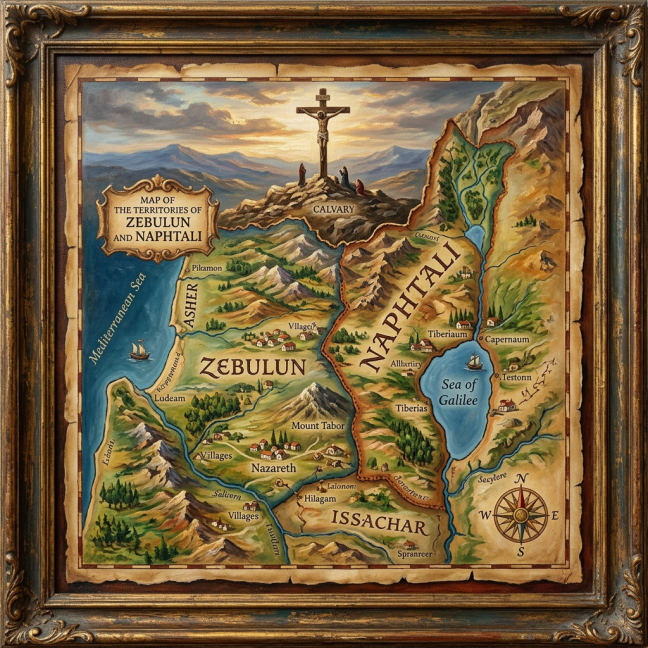
Map of Zebulun and Naphtali territories featuring Mount Calvary and surrounding biblical locations

“Nevertheless, that time of darkness and despair will not go on forever. The land of Zebulun and Naphtali will be humbled, but there will be a time in the future when Galilee of the Gentiles, which lies along the road that runs between the Jordan and the sea, will be filled with glory. The people who walk in darkness will see a great light. For those who live in a land of deep darkness, a light will shine.”
Isaiah 9:1-2 NLT

Isaiah’s message continued over the page in chapter 9. He included a theme of hope, that the darkness through which the people in Israel and Judah are stumbling will not go on forever. Something remarkable and wonderful will happen in the region of the Galilee, and the people there “will see a great light”. “The land of Zebulun and Naphtali” became highly significant in the New Testament as the setting for much of Jesus’ early life and ministry. Zebulun was the sixth son of Jacob by his wife Leah and the tenth of all Jacob’s sons, and he was one of Joseph’s brothers who sold him as a slave to traders who took him to Egypt. Jacob pronounced a blessing on each of his twelve sons before he died. To Zebulun, he said, “Zebulun will live by the seashore and become a haven for ships; his border will extend toward Sidon” (Genesis 49:13). Naphtali was Jacob’s sixth-born son and the second of two sons by Rachel’s maidservant, Bilhah. Naphtali’s older brother was Dan. Moses, when Israel was about to enter the Promised Land, pronounced a blessing on Naphtali’s tribe: “Naphtali is abounding with the favour of the LORD and is full of his blessing; he will inherit southward to the lake” (Deuteronomy 33:23). As indicated in this blessing, Naphtali settled in northern Canaan in the high regions west and northwest of the Sea of Galilee. So the reference to Zebulun and Naphtali in the Isaiah prophecy was extremely significant, and was mentioned in Matthew’s Gospel. Referring to Jesus, Matthew wrote, “He went first to Nazareth, then left there and moved to Capernaum, beside the Sea of Galilee, in the region of Zebulun and Naphtali. This fulfilled what God said through the prophet Isaiah: “In the land of Zebulun and of Naphtali, beside the sea, beyond the Jordan River, in Galilee where so many Gentiles live” (Matthew 4:13-15). 

But how did Isaiah know about the event that was coming when Jesus would become the “great light” for the people in the land where He grew up? It could only have come from God, who could see His plan working out in that very region. But why “Galilee of the Gentiles” of all places? God could see that the exact mix of people and the right political and social circumstances would collide at that point in history, and set the backdrop for what was to come. Paul wrote, “When we were utterly helpless, Christ came at just the right time and died for us sinners” (Romans 5:6). That was the “time” for Jesus’ first coming, and the “place” was in Galilee, in the region of Zebulun and Naphtali. 

There has always been speculation of Jesus coming to other places, as was written in Blake’s hymn “Jerusalem”, where he asked the question, “And did those feet in ancient time / Walk upon England’s mountains green? / And was the holy Lamb of God / On England’s pleasant pastures seen?” No, of course, Jesus didn’t personally visit the UK, at least not in person. But He did visit here through the Holy Spirit: “When the Spirit of truth comes, he will guide you into all truth. He will not speak on his own but will tell you what he has heard. He will tell you about the future” (John 16:13). Many believers and followers of Christ, have stepped on “England’s pleasant pastures” and still do as the “Spirit of truth” prevails in the places where we live. Christ’s ambassadors to a “people who walk in great darkness”.

God’s timing is always perfect, and we are so grateful for His love and care. Peter wrote, “The Lord isn’t really being slow about his promise, as some people think. No, he is being patient for your sake. He does not want anyone to be destroyed, but wants everyone to repent” (2 Peter 3:9). But Peter warned of something that would happen one day, and that is the next verse in 2 Peter 3. “But the day of the Lord will come as unexpectedly as a thief. Then the heavens will pass away with a terrible noise, and the very elements themselves will disappear in fire, and the earth and everything on it will be found to deserve judgment”. 

The starting gun for the New Covenant was fired when Jesus came to this world in the region of Zebulun and Naphtali. He ministered to a “people who walk[ed] in great darkness”, training up 12 men who carried His message into the lands further afield, performing miracles to underpin His message of the Kingdom of God, but ultimately dying on a Roman cross. But something amazing happened that weekend, and Jesus rose from the dead straight out of a rock-hewn tomb, not many miles away in Jerusalem. And then He returned to His Heavenly home, but He continues to live in the hearts and minds of His followers through the Holy Spirit, the third Person of the Trinity, gifted to us when we turn to Jesus, in repentance for our sins. Pilgrims everywhere walk in Jesus’ steps, following Him and His teaching in lives transformed. And it all started in “Galilee of the Gentiles” two thousand years ago.

Father God. Your plan for the salvation of mankind was flawless, and You implemented it at just the right time and in just the right place. Thank You. Amen.

Sinning Angels

“For God did not spare even the angels who sinned. He threw them into hell, in gloomy pits of darkness, where they are being held until the day of judgment.”
2 Peter 2:4 NLT

Peter told his readers that even angels are not immune from God’s righteousness and justice. The graphic language of this verse stimulates imaginations into all sorts of pictures. But we never think of angels as being sinners, that is until we read Genesis 6. “Then the people began to multiply on the earth, and daughters were born to them. The sons of God saw the beautiful women and took any they wanted as their wives” (Genesis 6:1-2). Theologians widely interpret the phrase “sons of God” as meaning angels in the context, and it is believed that the rebellious satan tried the strategy of mixing heavenly and earthly beings in a sexual relationship. And we find out later in this chapter in Genesis that giants resulted from the union. “In those days, and for some time after, giant Nephilites lived on the earth, for whenever the sons of God had intercourse with women, they gave birth to children who became the heroes and famous warriors of ancient times” (Genesis 6:4).

We pilgrims know of course that God desires justice. He is perfectly righteous in all His ways, as we read in Psalm 145:17, “The Lord is righteous in everything he does; he is filled with kindness“. We read in Psalm 7:11, “God is a righteous judge, a God who displays his wrath every day“. So Peter wrote in our verse today that “God did not spare even the angels who sinned”. It is widely thought that demons are fallen angels, angels who have sinned, so the timing of their incarceration in “hell” (actually in the Greek this place is called Tartarus, a holding area just for these rebellious and sinful angels). We don’t know when these angels were thrown into Tartarus, but it is probably still some time in the future. What we do know is that God didn’t “spare” them, even though they were angels. The use of this word “spare” reminds us of what Paul wrote in Romans 8:32, “Since he did not spare even his own Son but gave him up for us all, won’t he also give us everything else“? This word “spare” means not holding back. It implies a necessary, but painful, act, perhaps irrevocable. So we might give away our “spare” change into a donation box, or take a “spare” item to a charity shop. But what God refused to “spare” was precious and dear to Him. It was an act of incredible and amazing love and kindness that He even gave up His Son for us. God spared Him.

There are consequences to sin. It has to be judged and dealt with, and the spirit realm is full of the spirits of sinful angels and people, waiting for that time when they are judged for what they have done in their life. Angels are immortal beings but they, like humans, have the ability to make choices. Satan, who, from what we can see in the Bible, was also called Lucifer, was the senior angel, a worship leader in Heaven. Yet he made a choice to rebel against God and suffered the consequences, being thrown out of Heaven along with a large number of angels who sided with him. And Peter reminded his readers that they would one day come to a miserable end in a holding place called Tartarus. 

Is all this of any relevance to us pilgrims? After all, have we ever seen an angel? And aren’t they responsible for their own actions, just as we are? For me, this verse in 2 Peter that we are considering today is a warning that one day the sinful universe in which we live will be rebalanced. Sin will be no more, and all those who have made right choices in wanting to live God’s way through Jesus will find themselves living with Him forever. But all those who reject God will find out that He has rejected them. God has done everything possible to make available eternal life for all those who desire it. He of course could have created a race of robots, zombies unable to make choices for themselves, but instead He created mankind in His image (Genesis 1:27), taking a risk that they would want to live with Him forever. We know what happened, as the Genesis story unfolded. But God had a plan for the future of His creation, involving His very own Son, through whom everything was created (John 1:3). And, for that plan, we will be eternally grateful.

Father God. Once again we praise and thank You for Your grace and mercy. Through Jesus You have accepted us as righteous in Your sight. We are a truly privileged people. Amen.

The Baptismal Flood (1)

“So he went and preached to the spirits in prison— those who disobeyed God long ago when God waited patiently while Noah was building his boat. Only eight people were saved from drowning in that terrible flood. And that water is a picture of baptism, which now saves you, not by removing dirt from your body, but as a response to God from a clean conscience. It is effective because of the resurrection of Jesus Christ.”
1 Peter 3:19-21 NLT

We have this picture from Peter of Jesus preaching in the spirit to the spirits of an imprisoned generation of people who all perished in the flood. This was a catastrophic event triggered by depths of human depravity not seen since. In the days of Noah there appears a picture of, as the NLT headlines it, “A World Gone Wrong”. It appears that angels, “the sons of God”, started to have intercourse with human women, resulting in a race of giants. How that was possible, with a spiritual being mating with a human being, is beyond our understanding, but we can read the story in Genesis 6. In Genesis 6:5-6 we read, “The Lord observed the extent of human wickedness on the earth, and he saw that everything they thought or imagined was consistently and totally evil. So the Lord was sorry he had ever made them and put them on the earth. It broke his heart“. That poignant phrase “It broke [God’s] heart” tells us a lot about how much God loves and cares for us, and how disappointed He becomes with human behaviour. In Geneses 6:7 we see His decision about what to do, “And the Lord said, “I will wipe this human race I have created from the face of the earth. Yes, and I will destroy every living thing—all the people, the large animals, the small animals that scurry along the ground, and even the birds of the sky. I am sorry I ever made them””. But there is a “But” starting the next verse, “But Noah found favour with the Lord”‭‭. We must thank God because He always has a plan, no matter how bad things are. He always has a “but”!

There follows in Genesis 6 the instructions for building a boat. This was an awesome act of faith, because no-one had ever seen a boat before; apparently this happened in the days before there were any areas of open water. It took Noah a hundred years to build that boat and miraculously God filled it with pairs of animals and then eight people – him and his family. Then came the flood, the account of which we can read in Genesis 7. After the water had receded, we can read how Noah and his family finally left the boat. After this comes another poignant verse, in Genesis 8:21 – God said to Himself, “ … I will never again curse the ground because of the human race, even though everything they think or imagine is bent toward evil from childhood. I will never again destroy all living things”. Did God send Jesus to preach to the spirits of all those who drowned in the flood because He wanted then to understand why He did it? Certainly in those days mankind had not received God’s Law so perhaps the people drowned in the flood failed to understand the consequences of their sins. But we speculate. 

We pilgrims, in fact everyone since the flood, must be grateful that God never thought again about destroying mankind because of their sin. This is a deserved punishment yet to come, but in the meantime God sent His Law through Moses, as He waited for just the right time to implement the most wonderful and amazing plan ever conceived for the salvation of mankind – the arrival, life, death, and resurrection of Jesus, God’s only Son, for our sins. We know the plan, because we can look back on it’s execution with grateful hearts. The Old Testament prophets could see it coming, but never experienced it. So on our knees today, what else can we do than thank our wonderful Heavenly Father.

Dear Father God. We thank You for Your plan, and for Jesus, who so willingly did Your will. We praise and worship You today. Amen.

Respect Everyone

“Respect everyone, and love the family of believers. Fear God, and respect the king.”
1 Peter 2:17 NLT

There are four instructions in this short verse. Two refer to being respectful and the others to love and fear. So a lot to consider.

Respect is in short supply in society today. It seems that everyone has their own ideology or set of views and they insist that whatever they think is supported and affirmed to the detriment of everyone else. As an example, strident calls are being made about gender issues, and woe betide anyone who disagrees with the multi-gender adherents. Those who disagree are branded with all sorts of unpleasant and totally unfounded names. They are pilloried on social media and no-platformed in public speaking engagements. There are many other issues in which debate and mutual respect are denied. Perhaps the root cause is society’s abandonment of Christian teaching and rejection of God, with a new morality, false in its content, emerging to replace it. An anything-goes morality that is based on a form of self identification and a declaration that the person concerned is his or her own god. Scotland, where I live, has the reputation of being the most secular country in Europe, and we are starting to see the down side of that in the legislation being produced by confused and godless politicians. But where at one time people were respected for their views – not necessarily agreed with, but respected at least – now there is little or no acceptance of another’s views. Respect is a commodity in very short supply. 

Back in Exodus 20:12 we read, “Honour your father and mother. Then you will live a long, full life in the land the Lord your God is giving you”. Respect starts in the home by being implanted in children through good parenting, but with so many broken families, basic teaching like this doesn’t seem to count for much these days. And the lack of respect spills over into the classrooms, with teachers being abused just for trying to do their jobs, educating the next generation of adults in our societies. In Matthew 7:12, Jesus taught about the “Golden Rule”, “Do to others whatever you would like them to do to you. This is the essence of all that is taught in the law and the prophets”. 

Respect is based on grace. Our Heavenly Father has graciously accepted us pilgrims, warts and all. With all our funny ideas and sin-ridden ways, we can, through Jesus, approach His throne with boldness. He sees our struggles to make sense of a complex and evil world. He sees us agonising over the abuse of a child, or the ill-treatment of another human being. And we know that He is also saddened by the behaviour of mankind. But God had a plan and Jesus came for damaged and confused people, who were, as He said, like sheep without a shepherd. But we have a Shepherd now, and God’s plan is being worked out through His children, fellow pilgrims such as us.

Dear Father God. We are Your children, saved by grace. Please help us reach out to others, extending Your grace to those without. In Jesus’ name. Amen.