Isaiah 30:30-33 NLT
“30 And the Lord will make his majestic voice heard.
He will display the strength of his mighty arm.
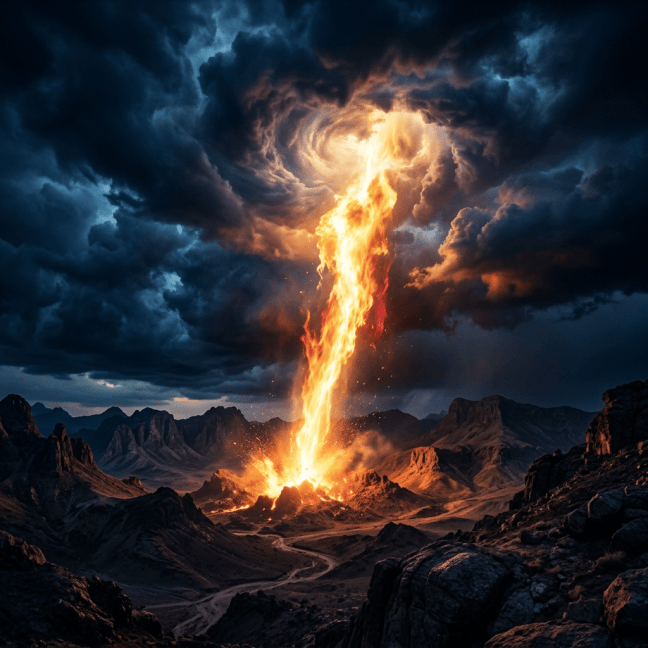
It will descend with devouring flames,
with cloudbursts, thunderstorms, and huge hailstones.
31 At the Lord’s command, the Assyrians will be shattered.
He will strike them down with his royal sceptre.
32 And as the Lord strikes them with his rod of punishment,
his people will celebrate with tambourines and harps.
Lifting his mighty arm, he will fight the Assyrians.
33 Topheth—the place of burning—
has long been ready for the Assyrian king;
the pyre is piled high with wood.
The breath of the Lord, like fire from a volcano,
will set it ablaze.”
These verses today, which bring Isaiah 30 to an end, are full of dramatic descriptions of how God will deal with the Assyrian problem. Did it ever happen? Yes, it did, in 701 BC. The King in Judah at that time was Hezekiah, and he started his reign in 715 BC, at the age of 25. We read in 2 Kings 18:3, 5, 7, “He did what was pleasing in the LORD’s sight, just as his ancestor David had done … “Hezekiah trusted in the LORD, the God of Israel. There was no one like him among all the kings of Judah, either before or after his time. … “So the LORD was with him, and Hezekiah was successful in everything he did. He revolted against the king of Assyria and refused to pay him tribute”. The Assyrians continued to overrun other parts of Judah, and finally ended up at Jerusalem, where they threatened the inhabitants with death unless they opened the gates and came out. The situation for the Judeans inside Jerusalem was dire and“When King Hezekiah heard their report, he tore his clothes and put on burlap and went into the Temple of the LORD” (2 Kings 19:1). In the next few verses, we read how Isaiah was asked to pray for the inhabitants of Jerusalem. We read, “And he sent Eliakim the palace administrator, Shebna the court secretary, and the leading priests, all dressed in burlap, to the prophet Isaiah son of Amoz. They told him, “This is what King Hezekiah says: Today is a day of trouble, insults, and disgrace. It is like when a child is ready to be born, but the mother has no strength to deliver the baby. But perhaps the LORD your God has heard the Assyrian chief of staff, sent by the king to defy the living God, and will punish him for his words. Oh, pray for those of us who are left!”” “The prophet [Isaiah] replied, “Say to your master, ‘This is what the LORD says: Do not be disturbed by this blasphemous speech against me from the Assyrian king’s messengers. Listen! I myself will move against him, and the king will receive a message that he is needed at home. So he will return to his land, where I will have him killed with a sword’””. We read what happened at the end of 2 Kings 19, “That night the angel of the LORD went out to the Assyrian camp and killed 185,000 Assyrian soldiers. When the surviving Assyrians woke up the next morning, they found corpses everywhere. Then King Sennacherib of Assyria broke camp and returned to his own land. He went home to his capital of Nineveh and stayed there. One day while he was worshipping in the temple of his god Nisroch, his sons Adrammelech and Sharezer killed him with their swords. They then escaped to the land of Ararat, and another son, Esarhaddon, became the next king of Assyria”. The account in 2 Kings 18 and 19 is a fascinating read of God’s help to a nation that called out to Him. As an aside, what happened to the 185,000 corpses? Were they all buried where they lay, or did the surviving members of the army just leave them there? There is no record of what happened to them, but perhaps the “angel of the Lord” dealt with the aftermath.
Back in our verses in Isaiah 30 today, we read about fire, devouring flames and a place of burning. In the Bible, fire represents the presence, holiness, judgment, and purifying power of God. A popular story in Sunday Schools is about Moses and his encounter with God in a burning bush. The bush wasn’t consumed by the flames, signifying God’s eternal holiness, but it was this feature that grabbed Moses’ attention, and we read, ““This is amazing,” Moses said to himself. “Why isn’t that bush burning up? I must go see it””(Exodus 3:3). That was the point when Moses was given a special mission, as we read in Exodus 3:10, “Now go, for I am sending you to Pharaoh. You must lead my people Israel out of Egypt”“.
A few chapters on in Exodus, we read about a pillar of fire, representing God’s presence. Exodus 13:21, “The LORD went ahead of them. He guided them during the day with a pillar of cloud, and he provided light at night with a pillar of fire. This allowed them to travel by day or by night”. Can we imagine what it must have been like, to continually have a physical reminder that God is with us? There is something else written about God in Hebrews 12:28-29. There we read about God’s power and majesty, “Therefore, since we are receiving a kingdom that cannot be shaken, let us be thankful, and so worship God acceptably with reverence and awe, for our ‘God is a consuming fire'”.
In Malachi 3:2-3 we read how God’s fire tests and purifies the faith of His people, just as a metal worker purifies the metal, gold or silver, that he is working with. “But who can endure the day of his coming? Who can stand when he appears? For he will be like a refiner’s fire or a launderer’s soap. He will sit as a refiner and purifier of silver; he will purify the Levites and refine them like gold and silver. Then the LORD will have men who will bring offerings in righteousness“. In a sense the Word of God, the Bible, acts in the same way, because, as Paul wrote to Timothy, “All Scripture is God-breathed and is useful for teaching, rebuking, correcting and training in righteousness” (2 Timothy 3:16). That is why it is so important that we pilgrims continually read God’s Word. We must allow ourselves to be refined, preparing us for a life with God in Heaven one day. And it is never too late to reach for our Bibles and start reading, and we ask the Holy Spirit to reveal to us what He wants us to see and act upon.
The Holy Spirit fell upon the disciples who had congregated “in one place” in Jerusalem. “They saw what seemed to be tongues of fire that separated and came to rest on each of them. All of them were filled with the Holy Spirit and began to speak in other tongues as the Spirit enabled them” (Acts 2:3-4). Yet another demonstration of the presence of God and His purifying fire. We may not have had the experience of tongues of fire visibly falling on us but we have received the gift of the Holy Spirit, empowering us to do God’s work as He leads and guides us. If we have any doubts as to what this means, we should read Ephesians 3:20, “Now to him who is able to do immeasurably more than all we ask or imagine, according to his power that is at work within us“. “His power”? I sometimes feel that we neglect the Holy Spirit’s wonderful and powerful gift within us at our peril.
But there is one source of fire that all human beings should be fearful of, and we find it in Revelation 20:15: “And anyone whose name was not found recorded in the Book of Life was thrown into the lake of fire”. We pilgrims have nothing to be afraid of, in this respect, but what about our families and friends? Once again, I remind everyone of our obligations to preach the Gospel at every opportunity. We might just be able to pluck someone from the flames.
Dear Father God. You are awesome in Your power and majesty. Please forgive us for taking You for granted and neglecting our duties as a Christian. Lead us, we pray, to the people You wish to reach. Amen.

