
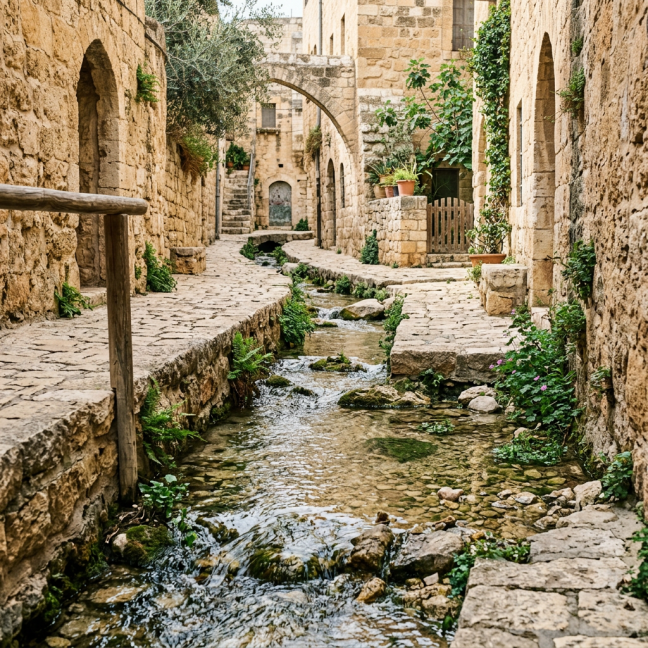
“Then the Lord spoke to me again and said, “My care for the people of Judah is like the gently flowing waters of Shiloah, but they have rejected it. They are rejoicing over what will happen to King Rezin and King Pekah. Therefore, the Lord will overwhelm them with a mighty flood from the Euphrates River—the king of Assyria and all his glory. This flood will overflow all its channels and sweep into Judah until it is chin deep. It will spread its wings, submerging your land from one end to the other, O Immanuel.”
Isaiah 8:5-8 NLT
God cared for His people. Time and time again, He offered His love and compassion to a people who consistently rejected Him, a people who preferred to rely on their own resources in times of trouble. The people could never say that they had been given no warnings about what would happen to them. Prophet after prophet brought warning messages from God, and His patience endured long after it would have been expected to. The “gently flowing waters” paint a picture of peaceful and constant care, with provision and healing implied for generation after generation. So why would the Israelites have rejected such an offer? Why indeed.
Because they decided to behave in a way like the nations around them, with their idols and evil practices, their reliance on their own armies and other resources, God had to let them face into the consequences of their choices. It beggars belief that they thought they could go their own way instead of God’s way, but that is how human beings behave. In C S Lewis’s book “The Great Divorce”, the inhabitants of hell, ghosts, were given the opportunity for a day trip to Heaven with a potential second chance. But once there, they preferred to rant and rave at the inhabitants of Paradise rather than humble themselves and repent of their sins. Fiction I know, but the point is that human nature can become so selfish that it destroys itself.
After the building of the Temple had been completed, “… the Lord appeared to Solomon and said, “I have heard your prayer and have chosen this Temple as the place for making sacrifices. At times I might shut up the heavens so that no rain falls, or command grasshoppers to devour your crops, or send plagues among you. Then if my people who are called by my name will humble themselves and pray and seek my face and turn from their wicked ways, I will hear from heaven and will forgive their sins and restore their land. My eyes will be open and my ears attentive to every prayer made in this place” (2 Chronicles 7:12-15). Perhaps, as we read in Isaiah 6, the prophet recalled this Scripture and went to the Temple in the knowledge that God would hear his prayers.
But, sadly, the Israelites’ attempts to defend their country through alliances and their own resources were not going to end well, because the Assyrians would soon overrun their land, overwhelming the inhabitants, with the result previously described in Isaiah 7:20, “In that day the Lord will hire a “razor” from beyond the Euphrates River—the king of Assyria—and use it to shave off everything: your land, your crops, and your people”. But there is a note of hope at the end of verse 8, “it will spread its wings, submerging your land from one end to the other, O Immanuel”. Despite this total destruction, God leaves a promise. The land ultimately belongs to Immanuel (which means “God with us”), offering hope for a future.
The “gently flowing waters of Shiloah” were a reference to the Pool of Siloam, the water source for Jerusalem, a spring that never ran dry. But like such things, even today, it was taken for granted. When was the last time we thanked God for the water supply that appears when we turn on a tap? Or the air we breathe? These are basic commodities that support and sustain human life, and have done so ever since Adam appeared on this planet.
But there is another source of God’s care and compassion, and that is Jesus, who shed His blood that we might have life, and life eternal. In Zecharia 13:1, we read, “On that day a fountain will be opened for the dynasty of David and for the people of Jerusalem, a fountain to cleanse them from all their sins and impurity”. What else could that have been than Jesus’ blood, that has been cleansing believers ever since the soldier plunged his spear in Jesus’ side after He had died on the cross. People in previous generations revered the unstoppable availability of Jesus’ blood for the cleansing from sin, even writing hymns such as “Come, thou Fount of every blessing, tune my heart to sing Thy grace; / Streams of mercy, never ceasing, call for songs of loudest praise,” a hymn written in the mid-18th Century. A William Cowper hymn of 1770 was, “There is a fountain filled with blood / Drawn from Emmanuel’s veins, / And sinners, plunged beneath that flood, / Lose all their guilty stains.”
Today, we hear little about the blood that Jesus shed for us, pilgrims. We worship in a more sanitised environment, it seems. But back to basics, because that is why we are here. We are God’s children, and Jesus gave His life for us.
Father God. We worship You for all You have done for us, and particularly with thanks for Jesus, who shed His blood for us. Amen.

