
“Listen to me; listen, and pay close attention. Does a farmer always plough and never sow? Is he forever cultivating the soil and never planting? Does he not finally plant his seeds— black cumin, cumin, wheat, barley, and emmer wheat— each in its proper way, and each in its proper place? The farmer knows just what to do, for God has given him understanding. A heavy sledge is never used to thresh black cumin; rather, it is beaten with a light stick. A threshing wheel is never rolled on cumin; instead, it is beaten lightly with a flail. Grain for bread is easily crushed, so he doesn’t keep on pounding it. He threshes it under the wheels of a cart, but he doesn’t pulverise it. The LORD of Heaven’s Armies is a wonderful teacher, and he gives the farmer great wisdom.“
Isaiah 28:23-29 NLT
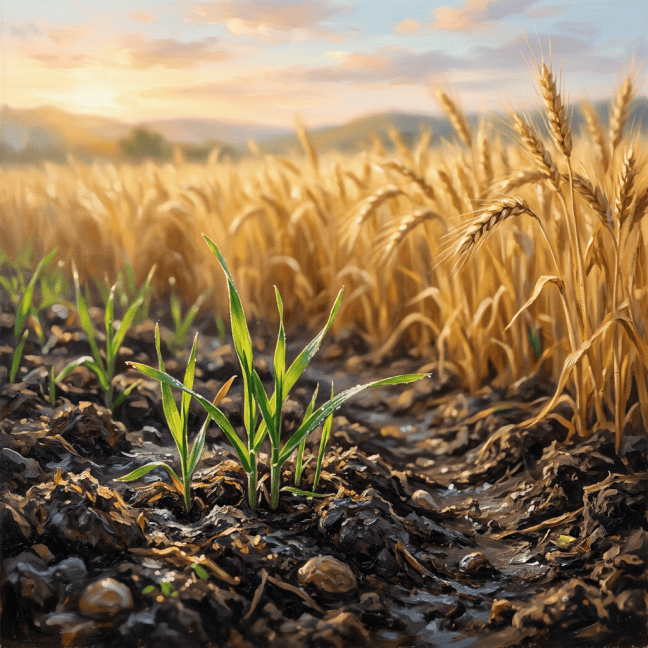
Isaiah used the practical and well-known process of farming to make a spiritual point. The farmer, he wrote, always starts with the ploughing, because, without it, seeds will have a difficult time growing. This image of ploughing could easily appear destructive if applied to a person’s heart. Just as a farmer breaks up the ground with a plough, he knows he has to do this because he wants the soil to become productive. The same is true of our hearts, because over time the stresses, strains, and sins we acquire through living can build a hard “skin” that stops us from hearing and responding to God’s message. Sometimes God allows circumstances to unsettle us. Something we relied upon may be removed. An ambition may be frustrated. A door may close. We may be forced to reconsider attitudes or priorities. It is tempting to ask, “Why is God doing this to me?” But Isaiah encourages us to ask a different question: “What might God be preparing me for?” James wrote, “Dear brothers and sisters, when troubles of any kind come your way, consider it an opportunity for great joy. For you know that when your faith is tested, your endurance has a chance to grow. So let it grow, for when your endurance is fully developed, you will be perfect and complete, needing nothing” (James 1:2-4). What he was saying was that through “troubles of any kind” and great joy (ploughing the ground), the testing of faith (sowing the seeds), the growing of endurance (tending the crop) and, finally, perfection (harvest time), a person would proceed through a season of God’s blessings, making their way towards Glory land.
Isaiah makes an interesting observation: the farmer does not treat every crop in exactly the same way. Different seeds require different methods or harvesting, and different crops require different forms of threshing. Threshing is the agricultural process of loosening and separating edible grain or seeds from the scaly chaff, husks, and straw that surround them. Some seeds need a threshing wheel while others are “beaten lightly with a flail”. Some grain is “easily crushed”, so care is required. All of this is an important human and spiritual lesson. God does not deal with every person in exactly the same way. One person may need encouragement; another may need correction. One may need patience; another may need a challenge. Any manager responsible for his staff knows he has to be careful when dealing with people. I remember in one department, there was a young woman who dissolved into floods of tears at the slightest provocation, but there was also someone else who would not accept that he was doing anything wrong and robust exchanges followed. It was exhausting sometimes, trying to hold a team together to produce the right outcomes!
When it comes to the world in which we live, there are seasons for ploughing and sowing, with others for growing and tending. And of course there is then the season of harvest and processing, so that the crop makes the transition from the field to the plate in a way that has supported life on this planet for many years. The same is true of our spiritual lives. One season may require waiting, while another requires action. So, in summary, we should be careful not to assume that because God has worked in one particular way in our lives, He must work in precisely the same way in someone else’s. In one person, God may be preparing the “soil”, ploughing up the hard “ground” so that it will be ready for receipt of the “seeds” that He knows will follow. In another’s, He may be sowing seeds, carefully choosing the right “crop” to suit that particular person’s needs. In yet another, He may be caring for the “crop”, keeping away the “weeds” and “pests” that will otherwise spoil or even destroy. Finally, there is a “harvest” to come. Paul wrote, “He who supplies seed to the sower and bread for food will supply and multiply your seed for sowing and increase the harvest of your righteousness” (2 Corinthians 9:10). We should not forget that God knows the soil, the seed, and the harvest.
A farmer does not keep ploughing forever. There comes a point when preparation is complete, and the seed must be planted. In a spiritual sense, this is a particularly encouraging truth because God knows when a difficult season has accomplished its purpose. He is our loving Heavenly Father, and He does not crush us for the sake of crushing us. Isaiah even says that the farmer does not thresh every crop in the same way or indefinitely. There is proportion and restraint in his work. Again, using this analogy in a spiritual sense, this reveals something about God’s character. His discipline is purposeful, not arbitrary, and His correction is measured, not cruel. In Lamentations 3:31-33 we read, “For no one is abandoned by the Lord forever. Though he brings grief, he also shows compassion because of the greatness of his unfailing love. For he does not enjoy hurting people or causing them sorrow“. This principle is also behind James’ words: “But the wisdom from above is first of all pure. It is also peace loving, gentle at all times, and willing to yield to others. It is full of mercy and the fruit of good deeds. It shows no favouritism and is always sincere. And those who are peacemakers will plant seeds of peace and reap a harvest of righteousness” (James 3:17-18).
Finally there will be a harvest. The farmer’s work makes sense when viewed in the light of the outcome, such as food on a table. That is perhaps the central encouragement of the passage. We often see only today’s ploughing. God sees the harvest that is to come in the lives of us pilgrims. Paul wrote, “So let’s not get tired of doing what is good. At just the right time we will reap a harvest of blessing if we don’t give up” (Galatians 6:9). We may not yet see what God is producing through our prayers, obedience, suffering, patience or service, but the absence of visible fruit does not mean the absence of God’s activity.
So, dear fellow pilgrims, let us hang in there when the going gets tough because, as the old song implied, the tough (in God) get going. No matter what we are facing today, God knows all about it, and He is only a prayer away from the revelation and answers that we need.
Dear Heavenly Father. Once again, on our knees before You, we thank You for Your love and care, as You prepare us for the harvest of righteousness that one day will be found in Your presence. Help us on our journey, we pray, as we remember that “You didn’t bring us this far to leave us”. Thank You for Your presence and Your Spirit, and we pray for a fresh infilling today, re-energising us for all that we are about to face. For all those who are sick or mourning, we pray for healing and compassion, knowing that Your care is limitless. We pray all this in Your precious name. Amen.

