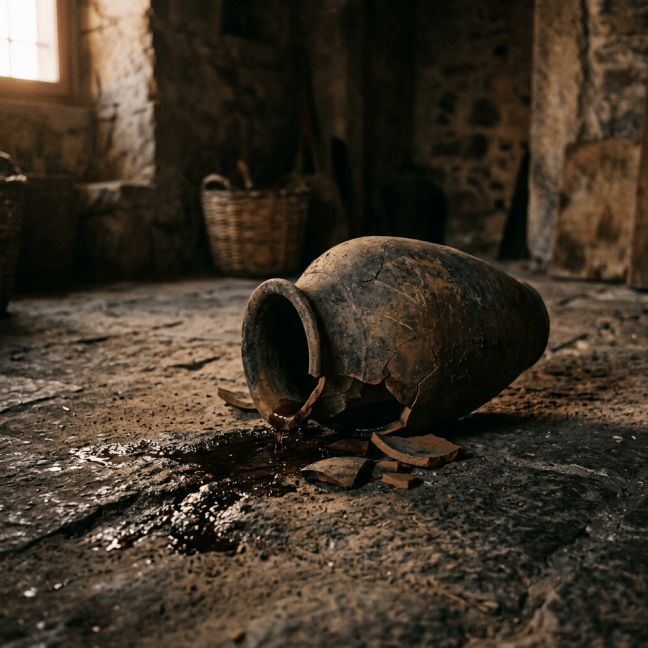
“What sorrow awaits the proud city of Samaria— the glorious crown of the drunks of Israel. It sits at the head of a fertile valley, but its glorious beauty will fade like a flower. It is the pride of a people brought down by wine. For the Lord will send a mighty army against it. Like a mighty hailstorm and a torrential rain, they will burst upon it like a surging flood and smash it to the ground.”
Isaiah 28:1-2 NLT
We will spend another day exploring the first two verses of Isaiah 28 and reflecting on the reputation of Israel’s leaders. They were known for their propensity for drinking excessively, and they had therefore acquired the name “drunks of Israel”. The problem is not simply that the people drank too much but that their drinking had become symptomatic of a deeper spiritual condition. Wine had displaced wisdom, self-control and dependence upon God. This is a spiritual warning that anything that controls us more than God does has become an idol. Alcohol may be the obvious example, but the principle is much wider. Wealth, entertainment, food, possessions, sport, social media or even work can become controlling influences. Paul wrote, “Don’t be drunk with wine, because that will ruin your life. Instead, be filled with the Holy Spirit” (Ephesians 5:18). So the question is not merely, “What, or how much, am I consuming?” but “What is consuming or controlling me?”
The leaders of Samaria were responsible for guiding the nation, yet Isaiah portrays them as intoxicated. Their physical drunkenness reflected a deeper inability to think and judge rightly. Alcohol can impair judgment, but we can also become absorbed in the things of this world and lose our spiritual perspective. Peter wrote in 1 Peter 5:8, “Stay alert! Watch out for your great enemy, the devil. He prowls around like a roaring lion, looking for someone to devour“. We pilgrims want to walk closely with God, and this needs constant spiritual alertness. We cannot afford to let anything cloud our judgment about what is right and wrong. Any alcoholic drink can have a relaxing effect, and the devil will use it to soften our resolve over sin and situations that should be avoided by believers. The problem for Israel’s leaders probably lay with their drunkenness being used by the devil to divert them from God’s ways. Samaria appears to have been living in comfort and prosperity, yet beneath the surface was spiritual decay.
Wine itself is not presented in Scripture as inherently sinful. The Bible references wine in ordinary life, and Jesus Himself turned water into wine at Cana. The clear biblical condemnation is directed particularly towards drunkenness and the loss of self-control. The danger is that something legitimate can become something controlling. Paul wrote in 1 Corinthians 6:12, “You say, ‘I am allowed to do anything’—but not everything is good for you. And even though ‘I am allowed to do anything,’ I must not become a slave to anything”. We pilgrims have freedom in Christ, but the danger is that such freedom can easily turn into licence. This can be a problem in our churches, where perhaps a new Christian, turning to Jesus after a life spent in alcohol addiction, might struggle if fellow believers do not have the same restraints and freely drink alcoholic beverages. In fact, I was once in a church where the leadership decided to become teetotal. Paul addressed this potential conflict with a few verses on food offered to idols, but the same principle can be applied to alcohol. 1 Corinthians 8:9-11, “But you must be careful so that your freedom does not cause others with a weaker conscience to stumble. For if others see you—with your “superior knowledge”—eating in the temple of an idol, won’t they be encouraged to violate their conscience by eating food that has been offered to an idol? So because of your superior knowledge, a weak believer for whom Christ died will be destroyed”.
Perhaps one reason people become dependent upon alcohol is the desire to escape anxiety, disappointment, loneliness, guilt or pain, and, for a while, alcohol can seem to provide relief, but it cannot deal with the underlying problem. But, as we know, we pilgrims have somewhere else to take life’s burdens. Peter wrote in 1 Peter 5:7, “Give all your worries and cares to God, for he cares about you”. Instead of seeking escape through intoxication, we are invited to seek refuge in God. There is a particularly powerful contrast in Ephesians 5:18, “Don’t be drunk with wine, because that will ruin your life. Instead, be filled with the Holy Spirit”. If alcohol is consumed to fill an aching hole in someone’s heart, then ruin is inevitable. Drunkenness diminishes self-control and spiritual alertness, but the Holy Spirit produces self-control as part of the fruit of the Spirit. Galatians 5:22-23, “But the Holy Spirit produces this kind of fruit in our lives: love, joy, peace, patience, kindness, goodness, faithfulness, gentleness, and self-control. There is no law against these things!” Self-control can be eroded by alcohol, as I’m sure anyone who has been to a wedding celebration will know.
Isaiah’s criticism is especially serious because Samaria’s leaders were affected by drunkenness. Their personal behaviour had consequences for the people they were supposed to guide. This principle also applies to Christian leadership, parents, grandparents, pastors and anyone whose example influences others. Paul told Timothy: “Don’t let anyone think less of you because you are young. Be an example to all believers in what you say, in the way you live, in your love, your faith, and your purity” (1 Timothy 4:12). Remember, our private habits can eventually become public examples. There are many people out there who would be delighted if they could find some aspect of our behaviour that they could find fault with. Alcohol abuse can destroy health, marriages, families, finances, reputations and relationships. More importantly, addiction can gradually diminish a person’s capacity to live the abundant and purposeful life God intends. Proverbs 23:29-35, “Who has anguish? Who has sorrow? Who is always fighting? Who is always complaining? Who has unnecessary bruises? Who has bloodshot eyes? It is the one who spends long hours in the taverns, trying out new drinks. Don’t gaze at the wine, seeing how red it is, how it sparkles in the cup, how smoothly it goes down. For in the end it bites like a poisonous snake; it stings like a viper. You will see hallucinations, and you will say crazy things. You will stagger like a sailor tossed at sea, clinging to a swaying mast. And you will say, “They hit me, but I didn’t feel it. I didn’t even know it when they beat me up. When will I wake up so I can look for another drink?””
We pigrims have an obligation to restore people gently rather than simply condemn them. Galatians 6:1, “Dear brothers and sisters, if another believer is overcome by some sin, you who are godly should gently and humbly help that person back onto the right path. And be careful not to fall into the same temptation yourself.” Someone struggling with alcohol dependence needs truth, but they also need grace, prayer, practical help and Christian fellowship.
Dear Heavenly Father. Please fill us again today with the right Spirit, I pray, We don’t have to head for a bottle to find the answer to our problems because Your Spirit will lead and guide us, and, as we cast our cares on You, we know that You have the answers. Please lead us not into temptation and deliver us from all things evil, so that we can continue our spiritual journey in the knowledge that You are there walking with us. With deeply grateful hearts, we worship You today. Amen.

