Isaiah 30:12-17 NLT
12 This is the reply of the Holy One of Israel:
“Because you despise what I tell you
and trust instead in oppression and lies,
13 calamity will come upon you suddenly—
like a bulging wall that bursts and falls.
In an instant it will collapse
and come crashing down.
14 You will be smashed like a piece of pottery—
shattered so completely that
there won’t be a piece big enough
to carry coals from a fireplace
or a little water from the well.”
15 This is what the Sovereign Lord,
the Holy One of Israel, says:
“Only in returning to me
and resting in me will you be saved.
In quietness and confidence is your strength.
But you would have none of it.
16 You said, ‘No, we will get our help from Egypt.
They will give us swift horses for riding into battle.’
But the only swiftness you are going to see
is the swiftness of your enemies chasing you!
17 One of them will chase a thousand of you.
Five of them will make all of you flee.
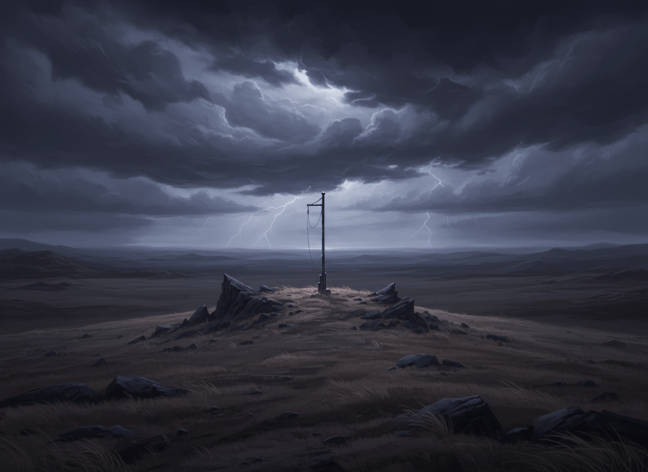
You will be left like a lonely flagpole on a hill
or a tattered banner on a distant mountaintop.”
Again, another passage of Scripture from Isaiah with very descriptive language. Bulging walls, broken pots, fireplaces and wells all describe a scenario where the choices the Judeans had made regarding their national security would come to grief. The problem was that the people had chosen to neglect the Lord’s offer of protection, preferring instead to buy their security from the Egyptians. But verse 15 in our verses today describes the offer the Lord had placed on the table. We read, “This is what the Sovereign LORD, the Holy One of Israel, says: “Only in returning to me and resting in me will you be saved. In quietness and confidence is your strength. But you would have none of it”. Egyptian horses were to be the Judeans salvation, or so they thought, not realising that their army would flee from the Assyrians, leaving the nation exposed “like a lonely flagpole on a hill”.
But this is a familiar theme from the oracles of Isaiah. God’s wayward people make wrong choices, suffer the consequences, and then find themselves with nowhere to turn except God Himself. Instead of being the first place to run to in a time of trouble, they make Him the last when it is usually too late. Time and time again we read this in the Old Testament, and not just in Isaiah. Prophet after prophet brought the same message. Jeremiah 1:16, “I will pronounce judgment on my people for all their evil— for deserting me and burning incense to other gods. Yes, they worship idols made with their own hands!” Ezekiel 2:3-4, ““Son of man,” he said, “I am sending you to the nation of Israel, a rebellious nation that has rebelled against me. They and their ancestors have been rebelling against me to this very day. They are a stubborn and hard-hearted people. But I am sending you to say to them, ‘This is what the Sovereign LORD says!’” Amos 1:3, “This is what the LORD says: “The people of Damascus have sinned again and again, and I will not let them go unpunished! They beat down my people in Gilead as grain is threshed with iron sledges“. Need I go on? Why did the Jews fail to turn to God to protect them in times of trouble? But before we go down the path of saying we would not behave that way, we should stop, pause, and reflect on our own life experiences. As we look back at decisions we have made, with the benefit of hindsight, what do we see? A smooth journey with the right decisions made at the right times, or do we see disasters narrowly averted in ways not immediately clear? I look back and see God’s hand occasionally giving me a gentle push away from making a wrong choice like a parent gently leading a small child away from a cliff edge. In life we pilgrims suffer from the same affliction that the Jews suffered from – sin and rebellion. There is something within people everywhere that I call the Sinatra syndrome (“I’ll do it my way”). Selfishness and pride replace humility and dependence on God. But aren’t we so grateful that He, compassionately and graciously, leads us back to a place of safety even at times when we don’t know He is doing it.
God reminded the Judeans that “Only in returning to me and resting in me will you be saved. In quietness and confidence is your strength”. These verses seem to describe a door in an otherwise impenetrable wall erected between two kingdoms, the world’s and God’s. Applying the scene to ourselves, we are in the kingdom of the world facing a situation far beyond what we can deal with. There is a door before us, marked “Return and Rest”. We only have to push it open and enter. It’s not locked. And to make it even more attractive, God is there beckoning to us, inviting us to enter. But the Judeans, and God’s people everywhere, even us pilgrims, instead prefer to sort out our problems ourselves, facing our battles, taking the consequences, shunning the door, God’s invitation.
There is an important lesson here for us pilgrims. Faith does not always mean doing more. Sometimes it means stopping, becoming still before God, and trusting Him to do what we cannot do ourselves. “Returning to me” speaks of repentance and renewed fellowship. When we have wandered, God invites us back. “Resting in me” speaks of dependence. We do not have to carry every burden ourselves. God is sufficient. “In quietness” speaks of a heart that has ceased striving. In the stillness, we learn to hear God’s voice above the noise of our circumstances. “In confidence is your strength” means that our strength comes from trusting God’s character and promises rather than our own ability to control events. But the tragedy of the passage is found in the final words: “But you would have none of it.” God offered them peace, but they preferred their own plans. How often can we do the same?
In another place, the Psalmist “got it”. We read in Psalm 46:10, “Be still, and know that I am God! I will be honoured by every nation. I will be honoured throughout the world“. The previous two verses describe what happens when God acts: “Come, see the glorious works of the LORD: See how he brings destruction upon the world. He causes wars to end throughout the earth. He breaks the bow and snaps the spear; he burns the shields with fire”. A picture builds here of God’s people looking on as He brings about the solution to an otherwise insoluble problem. We all experience problems in life. Some are so big that they almost drive us to distraction. Others are almost laughable in their triviality. But God cares about them all because He cares about us, His children. Faced with a crisis on the banks of the Red Sea, ” … Moses told the people, “Don’t be afraid. Just stand still and watch the Lord rescue you today. The Egyptians you see today will never be seen again. The Lord himself will fight for you. Just stay calm” (Exodus 14:13-14). Just stay calm. Great advice for worried pilgrims.
Dear Heavenly Father. Thank You that You care for us in the little things and the big things. Thank You for the security and protection that only comes from You. We are so grateful for all the ways in which You have provided what we need. And we thank You for the times when the load has been too heavy to carry, and You have carried us through. We worship You today. Amen.

