“Out of the stump of David’s family will grow a shoot— yes, a new Branch bearing fruit from the old root. And the Spirit of the Lord will rest on him— the Spirit of wisdom and understanding, the Spirit of counsel and might, the Spirit of knowledge and the fear of the Lord. He will delight in obeying the Lord. He will not judge by appearance nor make a decision based on hearsay. He will give justice to the poor and make fair decisions for the exploited. The earth will shake at the force of his word, and one breath from his mouth will destroy the wicked.”
Isaiah 11:1-4 NLT
Isaiah 11:1–4 is one of the great Messianic passages of Scripture, a prophetic vision that encompasses both the first and second coming of the Messiah. After the devastation described at the end of Isaiah 10, where the mighty trees of Assyria are cut down, Isaiah immediately introduces a picture of hope: not another towering cedar, but a tender shoot emerging from a seemingly lifeless stump. It is a passage that speaks of hope, humility, the character of Christ, and the transforming work of the Holy Spirit. The first three verses point to Jesus’s earthly life. He was born as a “[shoot] out of the stump of David’s family“. During His earthly ministry, the Spirit of the Lord rested upon Him, granting Him wisdom, understanding, and power. Verse 4 (“one breath from his mouth will destroy the wicked“) points to Christ’s future, ultimate return. This final act of righteous judgment and the complete eradication of evil corresponds with New Testament descriptions of the Second Coming. The Jewish faith does not separate the two, believing that the Messiah will come in one final act, bringing God’s Kingdom forever, but, with the benefit of hindsight, we see how there are two comings of Jesus, the Messiah, the first as a baby and the second as a conquering King.
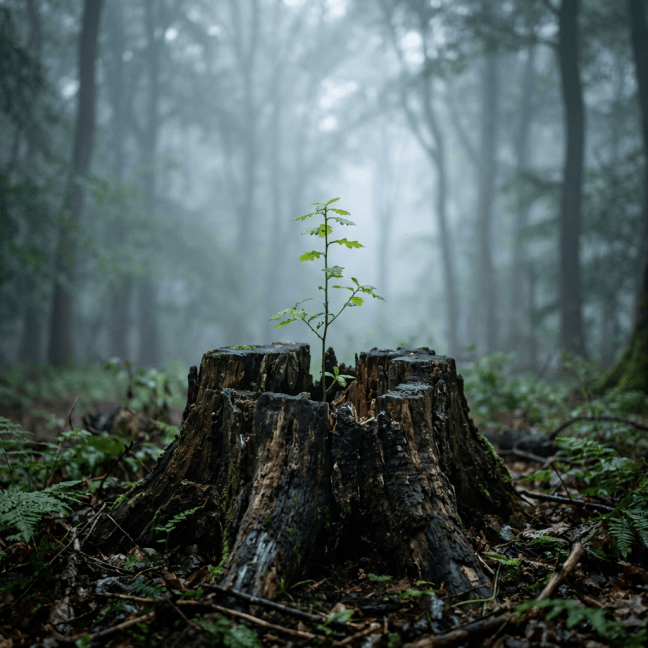
A stump remains after the tree has been cut down. It speaks of disappointment or failure, loss, broken dreams and what appears to be the end. We all know what a tree stump looks like. A lifeless and rotting remnant of a once glorious tree that reached up into the Heavens. Once a home for birds and other wildlife. A source of oxygen and a sump for carbon dioxide. A plant, slow-growing, but essential to the well-being of our planet. The nation of Judah was a bit like a tree, and the Assyrians were the lumberjacks. The cruel armies of Assyria left behind death and destruction, reducing the once proud and mighty Judah to a nation with no apparent future. The royal line of David had been reduced to almost nothing. Yet God saw what no one else could see.
From the rotting and apparently useless stump came a shoot. A green and vibrant copy of the original tree, and, left alone, it would eventually grow into another tree, as splendid as the one that was cut down. But this is how God often works. When we think everything has been lost, He begins something new. Abraham and Sarah were too old to have a son to make the nation God had promised them. Joseph’s dreams seemed buried in an Egyptian prison. Naomi believed her life was empty, her husband and sons dead and no more. The disciples thought everything ended at the cross, leaving them dejected and demoralised, without hope and a future without their Lord and Master. But God delights in bringing life out of what appears dead. He specialises in bringing miracles to situations that seem nothing more than fit for a grave, with a legacy of disillusionment.
For us pilgrims, perhaps our lives feel like a stump. Relationships have been cut down, a marriage broken, or a child who has become estranged. Plans that we had put so much hope in have failed, and there seems to be no way of bringing them to life again. Perhaps our health has deteriorated, bringing pain and a loss of mobility. Dementia may be starting to emerge in the life of a loved one, or a stroke has stopped our dreams right in their tracks. It could be that a church situation has become unbearable, and our faith has weakened in the face of hurt and rejection. But our God specialises in new beginnings. The stump is not the end of the story.
God brought Isaac from an elderly couple, a miracle if there ever was one. He raised Joseph from a prison cell to a palace. He turned the shame of the cross into the triumph of the resurrection. Again and again, God writes new chapters where we expected the story to finish. The shoot that emerged from Jesse’s stump looked insignificant, but it changed the world. God’s greatest work arrived quietly—in a stable, in a carpenter’s home, in the life of a servant King filled with the Spirit of the Lord.
Perhaps today we pilgrims are staring at the stump of something we once cherished. But we must never mistake God’s silence for His absence or for the idea that He no longer cares for us. What we might consider as the final ending to our story might be just the beginning of a new one. He is able to bring fresh life from places that seem beyond hope. The God of Isaiah is still the God who makes new things grow.
Dear Lord Jesus, thank You that You bring life out of what seems dead. When we look at the broken places in our lives, help us to trust that You are still at work. Fill us with Your Spirit, teach us to delight in Your ways, and help us to believe that no situation is beyond Your power to redeem. In Your precious name. Amen.

