

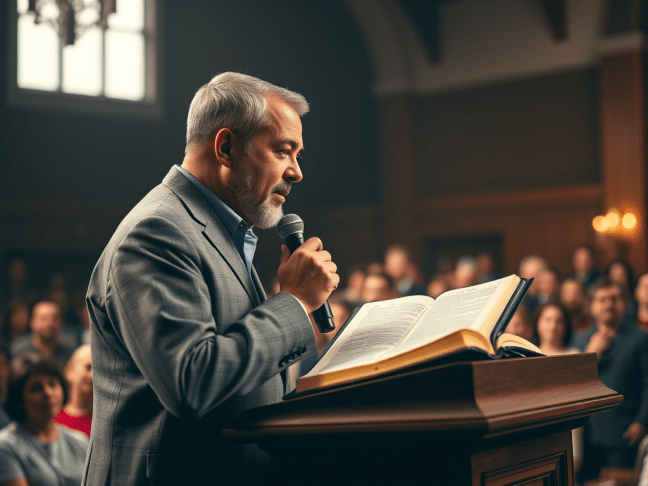
The Sign of Tongues

“So you see that speaking in tongues is a sign, not for believers, but for unbelievers. Prophecy, however, is for the benefit of believers, not unbelievers. Even so, if unbelievers or people who don’t understand these things come into your church meeting and hear everyone speaking in an unknown language, they will think you are crazy. But if all of you are prophesying, and unbelievers or people who don’t understand these things come into your meeting, they will be convicted of sin and judged by what you say. As they listen, their secret thoughts will be exposed, and they will fall to their knees and worship God, declaring, “God is truly here among you.””
1 Corinthians 14:22-25 NLT

Paul seems to contradict himself in these verses today. On the one hand, he said that speaking in tongues is a sign for unbelievers, but then he says that “if unbelievers or people who don’t understand these things come into your church meeting and hear everyone speaking in an unknown language, they will think you are crazy”. Which is it? If we extend what this all means to today’s Western churches, then we can see the problem. Most established churches have a liturgy that excludes the possibility of speaking in tongues in public during the meeting. I can just imagine that the church wardens would descend on such a person and, unless they desisted from their message, they would be escorted out the door. Those churches with a freer form of service, such as the one I attend, still only rarely hear the public message of tongues, although it features greatly in personal prayer and praying for healing, for example. But someone walking in off the street and hearing a church full of people all speaking out their messages in tongues would very quickly reach the conclusion that everyone there is mad! 

On the other hand, Paul said that the same random person, an unbeliever, who walked into the church and found messages of prophecy being spoken out, would be able to understand what was being said and would be convicted of sin. This would be because the Holy Spirit brings the prophecies. We know the ministry of the Holy Spirit from what Jesus said, referring to the time when the Comforter comes, in John 16:8, “And when he comes, he will convict the world of its sin, and of God’s righteousness, and of the coming judgment”. Paul said such people, hearing the prophecy being spoken, would “fall to their knees and worship God, declaring, “God is truly here among [them]””. 

“God is truly here”

This was all good practical advice from Paul, as he appealed to the intelligence of the Corinthian believers, and logically explained something that, surprisingly, had not occurred to them. But why should Paul be concerned about what unbelievers think? That is an easy question to answer, because Paul was not only an Apostle, but was an extraordinarily effective evangelist. He was very concerned about the salvation of the peoples in his time, and in particular, his fellow Jews. He wrote to the Romans, “I have great sorrow and unceasing anguish in my heart. For I could wish that I myself were cursed and cut off from Christ for the sake of my people, those of my own race, the people of Israel” (Romans 9:2-4a). Later on in Romans, Paul wrote, “It has always been my ambition to preach the gospel where Christ was not known, so that I would not be building on someone else’s foundation” (Romans 15:20). And we can read from 2 Corinthians 11 what Paul suffered in the process of evangelism.

We pilgrims, too, must be concerned about what people think. Too many Christians adopt an offensive attitude toward the unsaved people around them. They behave in ways that demand a contemptuous response rather than one that is attractive and able to perhaps open a door for the Gospel to be delivered. Paul wrote in 1 Corinthians 9:19-23, “Though I am free and belong to no-one, I have made myself a slave to everyone, to win as many as possible. To the Jews I became like a Jew, to win the Jews. To those under the law I became like one under the law (though I myself am not under the law), so as to win those under the law. To those not having the law I became like one not having the law (though I am not free from God’s law but am under Christ’s law), so as to win those not having the law. To the weak I became weak, to win the weak. I have become all things to all people so that by all possible means I might save some. I do all this for the sake of the gospel, that I may share in its blessings“. In that context, Paul perhaps foresaw a situation in which a believer invited an unsaved neighbour into the church. What would this person find there? Chaos with the church members babbling away in tongues, or a place where there were prophetic messages, bringing conviction of sin?

“Is the Holy Spirit alive
and well in my church?”

We pilgrims go to a church, I’m sure. Do we feel comfortable about inviting our friends and neighbours there, or is it a place that, deep down, we’re ashamed of? Is it a place where the Holy Spirit is alive and well, and able to bring messages through His gifts that will bring conviction of sin? If we think not, or we’re not sure, perhaps some further prayerful thought is required about where our spiritual home should be.

Dear Father God. We want to be in the place where You want us to be. It must be a place where Your Spirit is free to live and move in the hearts and minds of believers, and where You can be freely worshipped. Please lead and guide us, we pray, and help us to reach out to those around us with the Gospel and Your message of hope. In the name of Your dear Son, Jesus. Amen.


Appointments

All of you together are Christ’s body, and each of you is a part of it. Here are some of the parts God has appointed for the church: first are apostles, second are prophets, third are teachers, then those who do miracles, those who have the gift of healing, those who can help others, those who have the gift of leadership, those who speak in unknown languages.”
1 Corinthians 12:27-28 NLT

At the end of a long chapter about spiritual gifts, written in reply to a previous question from the Corinthians believers, Paul lists “some of the parts God has appointed for the church”. God gives each believer at least one gift through the Holy Spirit, who, as we know, dwells within each believer as a result of their salvation. In much of 1 Corinthians 12, Paul used the analogy of a human body to make a comparison with the Body of Christ, the church. And we now get to the point where Paul emphasises to the believers in the Corinthian church that they all constitute the Body of Christ. Just in case any of them felt left out, he wrote that each member of the church is a member of the Body, without exception. 

“If the Holy Spirit left our church, would we notice any difference?”

Today, we have many churches, some thriving, some in the process of being born, but, sadly, others coming to a point where they will soon die and disappear, all much as we would expect from human life. Churches are organic entities, kept alive by the power of the Holy Spirit within them, and when they deny His presence, their life starts to dwindle. Someone once asked, “If the Holy Spirit left our church, would we notice any difference?” And it is true – churches get locked into a liturgy and become a sort of religious social club, lacking any particular relevance in today’s world. Paul wrote to Timothy with a warning about such Spirit-less churches, “They will act religious, but they will reject the power that could make them godly. Stay away from people like that!” (2 Timothy 3:5). 

Next, in the verses we are considering today, Paul went on to list “some of the parts God has appointed for the church”. We should note that he did not supply a complete list of the gifts given to the Church, but just those that are more obvious. There is one notable up-front role missing, and that is the role of a pastor. In Ephesians 4:11-12, Paul wrote, “Now these are the gifts Christ gave to the church: the apostles, the prophets, the evangelists, and the pastors and teachers. Their responsibility is to equip God’s people to do his work and build up the church, the body of Christ”. However, it would neither be helpful nor necessary to provide a long list of all the functions and jobs necessary in a church or fellowship. Each body of believers is unique, as is a human body, and although some roles are common to all, many more are a reflection of the local needs. The Amplified version of 1 Corinthians 12:28 reads, “So God has appointed and placed in the church [for His own use]: first apostles [chosen by Christ], second prophets [those who foretell the future, those who speak a new message from God to the people], third teachers, then those who work miracles, then those with the gifts of healings, the helpers, the administrators, and speakers in various kinds of [unknown] tongues”

We should also note that any one role is no more important than any other. God does not do favouritism. So, an apostle is no more important than a teacher, who is no more important than a helper or administrator, or even the person who cleans the toilets. All roles are necessary for the church to function in the way God intends. 

The church is God’s hands, mouth, and feet in this world—the body of Christ:.

Some might ask the question, “What is the purpose of the Church”? A quotation from “gotquestions.org” might be helpful. “So, what is the purpose of the church? Paul gave an excellent illustration to the believers in Corinth. The church is God’s hands, mouth, and feet in this world—the body of Christ. We are to be doing the things that Jesus Christ would do if He were here physically on the earth. The church is to be “Christian,” “Christ-like,” and Christ-following”. To do all of these things, we need Holy Spirit gifts functioning in the church. Without them, the Body of Christ will not survive for long. And we remember we all have at least one gift to edify the Body of Christ.

Dear Father God. Through Your Son Jesus, You have established Your church. We thank You for the gifts given to our churches and fellowships, and pray that Your church will continue to grow, for Your glory. Amen.

More About Divisions

“But in the following instructions, I cannot praise you. For it sounds as if more harm than good is done when you meet together. First, I hear that there are divisions among you when you meet as a church, and to some extent I believe it. But, of course, there must be divisions among you so that you who have God’s approval will be recognised!”
1 Corinthians 11:17-19 NLT

Paul is building up to another big issue with the Corinthians church. He has heard that there are divisions amongst the believers that are affecting the celebration of the Lord’s Supper. It must have been a rather rowdy assembly, because in the lack of unity and associated mix of good and bad behaviour, Paul wrote that there will be some who will receive God’s approval, and presumably those who wouldn’t. The good guys were those who were doing what they should in matters of church life. In the first chapter of 1 Corinthians, and after a section where he gave thanks to God for the believers in Corinth, he launched into an appeal for them to “live in harmony with each other”. However, in the early verses of his letter, Paul addressed the factional behaviour that he had heard about. Behaviour where some followed one leader, others followed another, with quarrelling resulting. It is quite extraordinary to compare these verses with a church today, where sometimes a bit of passionate behaviour would be very welcome, though not in the Corinthian way. 

The church in Corinth must have been one that we would not recognise through our 21st-century lenses. The origins of this fellowship began in a synagogue where Paul attempted to persuade the Jews there that Jesus was the Messiah. However, in return, we read that he received insults and opposition. Paul dramatically shook the dust off his clothes, indicating that there was nothing more he could do, and he then started the church in a house next door. There, we are told, Paul preached for eighteen months, “teaching the Word of God”. The Corinthian society must have been a bit unstable, because we read in Acts 18:12-13, “But when Gallio became governor of Achaia, some Jews rose up together against Paul and brought him before the governor for judgment. They accused Paul of “persuading people to worship God in ways that are contrary to our law””. I wonder how they did that? Did a few of the Jews grab Paul one day and, against his will, drag him before the Governor, expecting a favourable judgement? In today’s comparatively benign Western societies, such a thing would be unheard of. But to complete the story, the governor, a man called Gallio, was having none of their nonsense, “And he threw them out of the courtroom. The crowd then grabbed Sosthenes, the leader of the synagogue, and beat him right there in the courtroom. But Gallio paid no attention” (Acts 18:16-17). 

So, it is no surprise that behaviour such as that demonstrated by the Jews spilt over into the early Corinthian church. It must have been endemic in the Greek society. Instead of working out divisions amongst themselves, presumably with the help of the church leaders, the Corinthian believers contributed to a situation that was far from acceptable, and behaved in ways that brought themselves and the church into disrepute. The lack of unity in the Corinthian church could have had a lasting impact, potentially leading to the church’s division and even its demise. When the Pharisees accused Jesus of casting out demons by the power of satan, we read, “Jesus knew their thoughts and replied, “Any kingdom divided by civil war is doomed. A town or family splintered by feuding will fall apart” (Matthew 12:25). So we can see how Paul was so concerned about divisions appearing in Corinth. 

What about our churches today? One reason that we have so many denominations is that people have disagreed on what are often quite simple situations, such as the form of a service. And as a result, rather than come up with a Bible-based solution, a congregation divides. The evidence of such disagreements can be seen in the middle of Dunfermline, where I live. At one time, there were fourteen different churches in the centre of the City. But we must remember that church unity starts with ourselves. We must never look to others and use them as a reason for our own bad attitudes and behaviour. 

Dear Lord Jesus. Please help us assess our own attitudes and behaviour and bring us to repentance for the ways we have run down Your church. Please also help us to build up the people in our congregations and bring honour to You and Your name. Amen.

Lawsuits

“When one of you has a dispute with another believer, how dare you file a lawsuit and ask a secular court to decide the matter instead of taking it to other believers! Don’t you realise that someday we believers will judge the world? And since you are going to judge the world, can’t you decide even these little things among yourselves? Don’t you realise that we will judge angels? So you should surely be able to resolve ordinary disputes in this life. If you have legal disputes about such matters, why go to outside judges who are not respected by the church? I am saying this to shame you. Isn’t there anyone in all the church who is wise enough to decide these issues? But instead, one believer sues another—right in front of unbelievers!”
1 Corinthians 6:1-6 NLT

Paul has finally moved on from the chapters about the man sleeping with his stepmother, and he has now picked up another scandal in the Corinthian church. Apparently, there has been an occasion when a believer and member of the church has taken another believer to court, over some matter, perhaps concerned with business dealings. This would not have been about something illegal, but probably a civil matter to be settled in a secular court. In those days, the courts had a reputation for being corrupt, with bribery of judges and juries commonplace, but it would not just have been about the business dispute. The two parties concerned would have publicly attacked each other’s characters, and estrangement and animosity would have followed. What sort of dispute would this have been? Well, it was perhaps between a builder and a supplier, with one blaming the other for the quality of bricks. Or it could have been between a customer and a supplier of goods, with the dispute over the quantity of what had been ordered. But regardless of what the problem was, Paul was horrified that a dispute between two believers had to be settled in a civil, secular court.

Personally, I know of a believing businessman who was in a business partnership with another man, two men both in the same church. But one man made a poor decision that resulted in the loss of a substantial sum of money on a construction project. Worse, the partnership was consequently dissolved, and one of the men had to choose between taking his partner to court or accepting that he would personally lose a significant sum of money, covering the debt. There was little the church could do to help, although the rights and wrongs of the case were clear. The outcome was that the wronged partner decided to quietly take on board the financial loss, concluding that if the matter had gone to court, the experience would not have been honouring to God or the church of which he was a part.

But back to the Corinthians. How should the dispute have been settled? Paul asked them, “Can’t you decide even these little things among yourselves?” The proper remedy was to settle the matter themselves in a Godly way that would bring a proper resolution and which would not lead to a significant rift between the two believers. If necessary, involving other believers in the process would have been beneficial. We know that God is the Righteous Judge, and any matter brought before Him and in His name would have an eternal significance. There would have been no corruption and no ungodly outcome. Problem resolved.

What is the difference between settling a civil dispute inside and outside the church? Firstly, there should not have been a problem caused by either the quality or quantity of goods supplied in the first place. As believers, we must work to the highest, righteous standards, to ensure that what we do is beyond the normal expectations of society. This principle is not just about builders and the like, but applies in all areas of our lives. As an example from the 19th century, Hartley’s jam was a market leader in the UK. William Hartley’s deep Christian faith guided his business ethics and practices, influencing his brand’s reputation for quality, and there are many other examples of men and women who put their faith in God before their wealth and business interests.

Was Paul advocating that all civil disputes should be settled within the church? Not necessarily, I think, because it depends on the circumstances. Maybe Paul was just focusing on this one particular situation as being suitable for internal resolution. Or perhaps he was developing a theme that originated in the Corinthian church’s reputation for quarrelling, fearing that there were more potential lawsuits lurking in the wings. Paul wrote, “Can’t you decide even these little things among yourselves“? It would have been a disaster for the church there if even the smallest dispute had to be settled in a secular, civil court.

How do we pilgrims handle a disagreement with another believer? Jesus said, “‘Therefore, if you are offering your gift at the altar and there remember that your brother or sister has something against you, leave your gift there in front of the altar. First go and be reconciled to them; then come and offer your gift. Settle matters quickly with your adversary who is taking you to court. Do it while you are still together on the way, or your adversary may hand you over to the judge, and the judge may hand you over to the officer, and you may be thrown into prison. Truly I tell you, you will not get out until you have paid the last penny” (Matthew 5:23-26). There we have it – words straight from the Master’s voice.

Dear Father God. Please forgive us when something inside of us rises up and causes dissent and strife, or worse. Help us to resolve matters and keep a clear conscience in matters of both relationships and business dealings. In Jesus’ name. Amen.


Divisions In The Church

I appeal to you, brothers and sisters, in the name of our Lord Jesus Christ, that all of you agree with one another in what you say and that there be no divisions among you, but that you be perfectly united in mind and thought. My brothers and sisters, some from Chloe’s household have informed me that there are quarrels among you. What I mean is this: one of you says, ‘I follow Paul’; another, ‘I follow Apollos’; another, ‘I follow Cephas’; still another, ‘I follow Christ.’”
1 Corinthians 1:10-12 NLT

Divisions in the church? Sadly there have been many over the centuries, with apparently unresolved differences leading to breakups of denominations, that in themselves were formed by similar previous divisions, and so it went on, right back to the heady days when the early church was formed in Jerusalem. In the last three hundred years or so the Presbyterian movement that formed the Church of Scotland has divided into sub-denominations, such as the Free Church of Scotland, the United Presbyterian Church, the United Free Church, and there have even been some mergers between previously-divided churches. What a mess! But the Early Church was not immune from division. We read about the doctrinal or theological differences forming the Gnostics, the Marcionists, the Montanists, and so on. And here in the Corinthian church we see the basis for conflict and division, as different factions emerge, each following a different leader known about at the time. Some even distanced themselves from such pettiness, only to introduce another well meaning but further division in that they “follow Christ”, something we should all be doing above all else, by the way. How is it that people can never seem to agree and end up creating different denominations, churches and fellowships? And even at a local level, discord between church members is destructive and something the devil encourages.

Paul appealed to the Corinthians and asked, ‘that all of you agree with one another in what you say and that there be no divisions among you, but that you be perfectly united in mind and thought”. Sounds good on paper of course and he was sincere in his request but it is sad that the church there in Corinth had lapsed into so much disagreement. How can believers become “perfectly united in mind and thought”?  If we asked the same of believers today are we likely to get a positive response?

 Jesus said something significant about unity. In Jesus’ High Priestly prayer we read John 17:11, where Jesus prayed, “Now I am departing from the world; they are staying in this world, but I am coming to you. Holy Father, you have given me your name; now protect them by the power of your name so that they will be united just as we are“. That is an awesome prayer. Is it possible to be united just as the Father, Son and Holy Spirit, the Trinity that forms the God we worship? Such unity shouldn’t be impossible but it obviously is, to look at the different factions that make up the believers today and in the last two thousand years. In His prayer, Jesus returned to unity, as we read in John 17:21-22, “I pray that they will all be one, just as you and I are one—as you are in me, Father, and I am in you. And may they be in us so that the world will believe you sent me. I have given them the glory you gave me, so they may be one as we are one“. Oh Jesus! We are so sorry that Your Church, the Bride that You are returning to one day, has become so fractious and divided. What a tragedy!

Today, I live in the centre of a Scottish city called Dunfermline, and at one time there were fourteen different church buildings within a 1/4 mile radius from a central point in the High Street. Even today, there are eight within a short walk from my home. Hardly a witness to an aspiring and inquiring believer, who was faced with such a bewildering selection of churches. And that is the issue that Jesus was praying about because through unity between believers a strong witness goes out to the world around them. The next verse in John 17 reads, “ … May they experience such perfect unity that the world will know that you sent me and that you love them as much as you love me”. When Christians are united in Christ, the world sees two things clearly: Jesus was sent by the Father, and Jesus loves His church. 

In Romans 15:5-6, Paul wrote, “May God, who gives this patience and encouragement, help you live in complete harmony with each other, as is fitting for followers of Christ Jesus. Then all of you can join together with one voice, giving praise and glory to God, the Father of our Lord Jesus Christ”. There’s a reason why there should be unity between believers – to give glory to God. As Christians, we must aspire to the unity of faith, and we again refer to Paul’s writings. He said, “Make every effort to keep yourselves united in the Spirit, binding yourselves together with peace” (Ephesians 4:3). I can almost hear him say that as he agonised over the churches and fellowships he had planted, a spiritual father if there ever was one. But he hit the nail on the head when he referred to unity in the Spirit. We have all the power of the Holy Spirit within us that will help us overcome disagreements that inevitable will occur in the family of God. 

But we pilgrims should not look for unity with people and churches, even denominations, that have abandoned the purity of God’s Word and instead replace it with compromises to try and make them more acceptable to the secular society around them. We see that in the Church of Scotland, as it embraces worldly views on gender and same sex marriage, degrading and abandoning Biblical truths and accelerating its denominational decline. We should also avoid being involved in churches that are led, or have been established, by charismatic figures with no accountability, and with their own agenda and ideology. The JW’s come to mind. 

But back to the Corinthians. They were building factions within their church by following different leaders prominent at that time, leaders such as Apollos, Paul and Peter, and that was leading to quarrels between them. Paul’s appeal to them was to pursue unity, a unity founded on relationships with Jesus and His truth. It is only though Jesus that we can find our way to the Father, as he said in John 14:6, “ …I am the way, the truth, and the life. No one can come to the Father except through me“. The way to avoid “divisions in the Church” is to start with Jesus and all He has done for us. One day we will have the daunting prospect of standing before Him, to give an account of our lives. Romans 14:12, “Yes, each of us will give a personal account to God“. 

If we find ourselves in a place where we disagree with other believers or our leaders, what should we do? We start with Ephesians 4:3 and do our best to resolve differences. If this is unsuccessful, then we prayerfully consider what other options there are, asking God to lead and guide us. And in the case that difficulties remain unresolved we must sadly find a home where we can worship God “in spirit and truth”. And we remember that one day perfect unity will prevail as we join the Heavenly congregation John wrote about in Revelation 7:9-10, “After this I saw a vast crowd, too great to count, from every nation and tribe and people and language, standing in front of the throne and before the Lamb. They were clothed in white robes and held palm branches in their hands. And they were shouting with a great roar, “Salvation comes from our God who sits on the throne and from the Lamb!”” In the end it will be all about Jesus. There is no-one else worthy of our praise and worship, and to whom all the glory is His by right.

Dear Father God. We are so sorry for the times when we have quarrelled and left churches by putting our own interests over the interests of others. Please forgive us we pray and lead us to the place where You want us to be. In Jesus’ name. Amen.

‭‭

The House of God

“The one thing I ask of the Lord— the thing I seek most— is to live in the house of the Lord all the days of my life, delighting in the Lord’s perfections and meditating in his Temple. For he will conceal me there when troubles come; he will hide me in his sanctuary. He will place me out of reach on a high rock. Then I will hold my head high above my enemies who surround me. At his sanctuary I will offer sacrifices with shouts of joy, singing and praising the Lord with music.”
Psalm 27:4-6 NLT

What would we pilgrims most desire in our lives? Not an easy question to answer, because our desires would be focused on the issue or challenge that we are currently having to deal with. If we’re hungry, we would want to be fed. If we were homeless, it would be a home. If we’re unemployed, it would be a job. Or perhaps the car has just broken down for the nth time, and we would really like to replace it. But David had a different focus – he wanted “to live in the house of the Lord all the days of [his] life“. Where was David when he wrote this? The commentaries assume that he was still in his pre-king days, being chased around the wilderness by King Saul. In his weariness though, his utmost desire was to be in the Lord’s presence. There he fantasised he would find a place of safety, a place of communion with his precious Lord, the place where he wouldn’t have to continually look over his shoulder in case a spear was coming his way. More, he would find a place where he was untouchable by his enemies. And once there David imagined he would be free to offer the sacrifices required “with shouts of joy, singing and praising the Lord with music”. His imagination also ran forward to the time when there would be a Temple fit for God, and in which the Lord would live.

But back to our question. Would we pilgrims, faced with all the issues in our lives, primarily express the same desire that David did, to spend time in God’s house? Would we push aside the immediate, answering the emails and texts, painting the kitchen, doing the shopping, washing the car and so on, just so that we could spend time meditating on the things of God? John Wesley is credited with getting up at 4am every day to pray because he wouldn’t consider starting his day without prayer. A sobering thought for us sleepy heads who struggle to cast off the duvet and end up dashing out of the door, briefcase in one hand and a slice of toast in the other, hoping we wouldn’t be late for work.

We read in the Book of Acts about the early disciples, who ” … worshiped together at the Temple each day, met in homes for the Lord’s Supper, and shared their meals with great joy and generosity—” (Acts 2:46). We may not have that opportunity today, but the sentiment behind this verse provides a picture of the early believers sharing the same excitement about the Lord and His house that David did. Isaiah too, in a time of a national crisis (a potential time of political instability), decided to go to the Temple – Isaiah 6:1, “It was in the year King Uzziah died that I saw the Lord. He was sitting on a lofty throne, and the train of his robe filled the Temple“. Here’s the thing. If Isaiah hadn’t gone to the Lord’s house that day he would never have had a vision of the Lord, and would never have been ordained into the prophetic ministry that underpinned the rest of his life. After the vision Isaiah wrote, “Then I heard the Lord asking, “Whom should I send as a messenger to this people? Who will go for us?” I said, “Here I am. Send me”” (Isaiah 6:8). As we imagine being there with Isaiah in the Temple, did we too feel that lift in our spirits, a personal “send me”, as the Lord asked us the same question?

We pilgrims may be one of the Isaiah’s of our generation, but we will never know until we spend time with God. It is only in His presence that we will find our purpose and calling. The problem for many believers today is that they are looking for an instant solution. I once knew somebody who had an inkling to be a worship leader. So they found a guitar and learned a few chords and a couple of songs and then went to the pastor with the request that they be allowed to lead worship on the next Sunday. No prayer. No submission to the Lord. No Isaiah-in-the-Temple moment, that would have endorsed their ministry. And a huffy response when their request was refused. David, first and foremost, spent time in the Lord’s presence, learning how to play music and worship Him during those long hours looking after the sheep. With the necessary skills he was one day going to be engaged to play in King Saul’s presence . We read in 1 Samuel 16:18, “One of the servants said to Saul, “One of Jesse’s sons from Bethlehem is a talented harp player. Not only that—he is a brave warrior, a man of war, and has good judgment. He is also a fine-looking young man, and the Lord is with him””. 

But we pilgrims are people who love the Lord, and of course we spend time in His presence every day. We too join with God’s people whenever we can, spending time with them and with the Lord. We worship and pray together, and the Lord blesses us with words of prophecy, with answers to our prayers, and with the resources we need to face the day. And we pray for others too so that they may discover what we have found. I heard recently of a young man who met an old friend with whom he had lost touch, a friend who was previously a self-declared atheist, but who subsequently in his own journey had discovered the Lord. This friend invited the young man to church, the friendship renewed and another soul was saved for the Kingdom. Things happen when we go to church. 

Where is our “Temple”? Where do we meet with God, in a place where He can speak to us and commission us? And where we will receive a vision of the Lord, “high and lifted up”. There is no better place than with our brothers and sisters in Christ, so at the next opportunity let’s expect something to happen. Perhaps God will show up in a vision. Perhaps we will receive a prophetic word from someone. All we have to do is go to church with an expectant heart. We won’t be disappointed.

Dear loving Heavenly Father, please help us to have expectant and willing hearts, looking out for Your presence today, and every day. We repent of the way of life we adopt which has no room for You. Please help us, we pray, in Jesus’ name. Amen.

The Holy Place

“Who may climb the mountain of the Lord? Who may stand in his holy place? Only those whose hands and hearts are pure, who do not worship idols and never tell lies. They will receive the Lord’s blessing and have a right relationship with God their Saviour. Such people may seek you and worship in your presence, O God of Jacob.”
Psalm 24:3-6 NLT

David asks a question – “Who may climb the mountain of the Lord”? But before we move on to the answer, we must ask what the Lord’s mountain is, or was, and where it actually was. To the Jews there was a sacred place on which the Temple could be found called Mount Zion, a hill located in Jerusalem. So David was perhaps focused on a specific place when he wrote this Psalm. But in answer to the original questionnaire “Who may climb“, the “mountain of the Lord” was a “holy place” and was not to be defiled by anyone who was a sinner. Anyone coming into the Lord’s “holy place” needed to be clean and pure inside and out, and telling lies and the worship of idols were specifically highlighted as impure actions. Not just that, however, their hearts had to be pure. David may have written this Psalm in anticipation of the day when the Temple was finally built by his son Solomon (2 Chronicles 5) and he could foresee a procession of priests carrying the Ark of the Lord into the Holy Place. Or perhaps it was earlier than that, with the Ark brought into the special tent prepared by David to his City, Jerusalem, as we read in 2 Samuel 6. But there was a misconception in those days that to worship God you had to be in a special place, somewhere considered holy, somewhere such as when Jacob had the ladder experience in a dream. We read in Genesis 28:16-17, “Then Jacob awoke from his sleep and said, “Surely the Lord is in this place, and I wasn’t even aware of it!” But he was also afraid and said, “What an awesome place this is! It is none other than the house of God, the very gateway to heaven!”” Before he left Jacob anointed a memorial stone, naming the place the House of God, or Bethel. 

Much later, when Jesus stopped by a well on a journey from Galilee to Jerusalem, he had an encounter with a Samaritan woman who asked him a question, “So tell me, why is it that you Jews insist that Jerusalem is the only place of worship, while we Samaritans claim it is here at Mount Gerizim, where our ancestors worshiped?”” (John 4:20).In response, Jesus told her, “ … Believe me, dear woman, the time is coming when it will no longer matter whether you worship the Father on this mountain or in Jerusalem” (John 4:21). In Matthew 6:6, Jesus said, “But when you pray, go away by yourself, shut the door behind you, and pray to your Father in private. Then your Father, who sees everything, will reward you”. Jesus set the scene for believers everywhere that the “holy place” in their lives was somewhere private where they could be on their own with the Lord. 

At first glance, these words about mountains, holy places and idol worship seem to be a million miles away from us pilgrims on 21st Century Planet Earth. But there are some lessons to be learned, and some spiritual insights that we would do well to follow. We pilgrims look around our country, the UK, and can see many churches, considered sacred places of worship by many. Apparently, there are over 40,000 “places of worship”, many of them ornate and impressive buildings. But it may come as a surprise to many of our fellow believers that they don’t have to go there to find God. For many years, particularly as a young boy, I was convinced that there was something of God underneath that ornate cloth draped over a table called an altar at the front of the church, the place where the minister went through certain ceremonial functions particularly in the communion service. Every time the minister or church official walked in its vicinity, they genuflected before moving on, further affirming my thoughts. Without a doubt, many Christians are helped in their faith by the stained glass windows, the altar ornately decorated, the carvings and the statues. God may be there but only inasmuch as He is everywhere, always on hand for those who call upon His name. In Jeremiah 23:24 we read, “Can anyone hide from me in a secret place? Am I not everywhere in all the heavens and earth?” says the Lord”. David wrote, in another Psalm, “I can never escape from your Spirit! I can never get away from your presence! If I go up to heaven, you are there; if I go down to the grave, you are there. If I ride the wings of the morning, if I dwell by the farthest oceans, even there your hand will guide me, and your strength will support me” (Psalm 139:7-10). God is omnipresent. And regarding all the churches, Isaiah wrote, “This is what the Lord says: ‘Heaven is my throne, and the earth is my footstool. Where is the house you will build for me? Where will my resting-place be?”(Isaiah 66:1). No matter how wonderful and amazing a church building is, it will never be good enough for God to live there. The answer to the question “where is God” is perhaps found in the hearts and minds of believers everywhere, wherever they are.

We pilgrims can draw close to God regardless of our location, latitude or longitude. My favourite place is in God’s creation, the woods and parks that adorn our countryside, because it is there that I find that God listens to my fumbling prayers. Amongst the trees and birdsong I find a “holy place”, where, in His presence, I first confess my sins so that I can indeed “climb the mountain of the Lord” with a pure heart. Others find a place of communion with God in their bedrooms or studies or even a prison cell. But cleansed of our sin, regardless of where we are, we can indeed climb into God’s presence, where we will receive His blessing, and worship Him once again.

Dear Father God. In Your presence we find peace for our souls and comfort in our struggles. You are the only One worth worshiping. Amen.

In the Assembly

“I will proclaim your name to my brothers and sisters. I will praise you among your assembled people. Praise the Lord, all you who fear him! Honour him, all you descendants of Jacob! Show him reverence, all you descendants of Israel!”
Psalm 22:22-23 NLT

A distinct shift in perspective from David, now that he has moved on from writing about his enemies, the “bulls of Bashan”. After declaring that God was his strength and writing down his prayer for salvation “from the horns of these wild oxen”, David moves on into the realm of praising God. He starts with a proclamation about the name of the Lord to his “brothers and sisters”. What would he have said? It would not have been just a straight mentioning of the word “God”, or “Lord”. There is so much more behind the “name of the Lord”. To the Jews, there was something so sacred about the “name of the Lord” that they wouldn’t say it out loud, instead using some other reference. So sad that today the name of God has been degraded to become a swear word, a ubiquitous utterance to many. Exodus 20:7 means nothing to such people, “You must not misuse the name of the Lord your God. The Lord will not let you go unpunished if you misuse his name”. But we pilgrims know the implication and significance of God’s name, as did David. In Proverbs 18:10 we read, “The name of the Lord is a strong fortress; the godly run to him and are safe“. Paul wrote in Romans 10:13, “For “Everyone who calls on the name of the Lord will be saved””, and Paul was under no illusions about the name of Jesus when he wrote, “Therefore, God elevated him to the place of highest honour and gave him the name above all other names, that at the name of Jesus every knee should bow, in heaven and on earth and under the earth, and every tongue declare that Jesus Christ is Lord, to the glory of God the Father” (Philippians 2:9-11).‭‭ So, all those people who misuse or denigrate the “name of the Lord” are in for a nasty shock one day.

We pilgrims have much to say about the name of God, and we proclaim His name at every opportunity, realising and understanding what it means. We speak of God with reverence and awe, with a “fear” that acknowledges that we are in His presence continually, human beings created by God and walking in and upon God’s creation wherever we go, and of course aware that He is all-powerful. And that’s the thing. People, in particular those who have rejected God, generally think, with an arrogance that is breathtaking, that their Godless ideologies can exclude God from their lives totally. They think that they were born by accident in a world that accidentally happened, with life upon it again the result of an accident, thus reducing God to the margins, to be rejected and considered the domain of the feeble and unintelligent. And in that environment of lies they, of course, have no time for God, let alone His name. Jesus warned about disregarding God when He said, “Dear friends, don’t be afraid of those who want to kill your body; they cannot do any more to you after that. But I’ll tell you whom to fear. Fear God, who has the power to kill you and then throw you into hell. Yes, he’s the one to fear” (Luke 12:4-5).

But we pilgrims have much to say about God’s name. There are all the wonderful Old Testament names of God, such as Elohim, Jehovah Nissi, Jehovah Jireh, and many more, each displaying and proclaiming a truth about God, and His many character facets. We will never, this side of eternity, ever fully understand God and our feeble attempts to name Him are just that – feeble. But on our journeys through life we find new things about God almost daily, as we ponder His name, through reading His Word, through our interactions with His people, through prayer, through meditation in the Word, and more.

It is sad that many Christians lack the opportunity to proclaim and praise His name in the assemblies because they have perhaps given up on churches and fellowships or lack the opportunities to get to one. In some parts of the world, there are no churches because the authorities have closed them down or don’t allow them to exist in the first place, for example in North Korea. But here in the UK we have plenty of choice and it is sad to find fellow brothers and sisters in Christ who have denied themselves the privilege of being able to worship God in a corporate setting. But David was always seeking any opportunity to “praise [God] among [His] assembled people”. In fact, David was so keen to be in God’s presence that he wrote, “How lovely is your dwelling place, O Lord of Heaven’s Armies. I long, yes, I faint with longing to enter the courts of the Lord. With my whole being, body and soul, I will shout joyfully to the living God” (Psalm 84:1-2). He continued, “What joy for those who can live in your house, always singing your praises“, and verse 10 reads, “A single day in your courts is better than a thousand anywhere else! I would rather be a gatekeeper in the house of my God than live the good life in the homes of the wicked”. I think David liked nothing better that praise God with his brothers and sisters!

I would encourage all pilgrims to heed Hebrews 10:25, “And let us not neglect our meeting together, as some people do, but encourage one another, especially now that the day of his return is drawing near“. Of course God can speak to us on our own and in isolation – with Him all things are possible – but He also brings His Word through our brothers and sisters. And there is something special about worshipping with fellow believers, “praising [God] among [His] assembled people”.  After all, we will have to get used to it as Heaven will be full of corporate worship (Revelation 7:9-10).

Dear Father God. For those of us without a spiritual home, please help us find the church or fellowship You want us to join, so that we too can spend time praising You with our brothers and sisters. In Jesus’ name. Amen.

They Trusted in God

“Yet you are holy, enthroned on the praises of Israel. Our ancestors trusted in you, and you rescued them. They cried out to you and were saved. They trusted in you and were never disgraced.”
Psalm 22:3-5 NLT

David wrote that his ancestors and the ancestors of those in his nation “trusted in [God]” and as a consequence were rescued. And because of that trust, they were saved and “were never disgraced”. The ancestry of the Jews was well recorded in the Bible, with frequent listings of the ancestry of a particular person. Women were only rarely mentioned, these lists being male dominated, but the most significant can be found in Matthew, with the “record of the ancestors of Jesus the Messiah, a descendant of David and of Abraham” (Matthew 1:1). There follows a list of Jesus’ ancestors starting with Abraham, and the list terminates with “All those listed above include fourteen generations from Abraham to David, fourteen from David to the Babylonian exile, and fourteen from the Babylonian exile to the Messiah” (Matthew 1:17). Worthy of note were four remarkable women, Tamar, Rahab, Ruth and Bathsheba, but there were forty two generations listed in total. But if we select various men in the list we can indeed find many whose trust in God was recorded in the Old Testament. In Genesis 15:6 we find, “And Abram believed the Lord, and the Lord counted him as righteous because of his faith“. In Psalm 56:4, David wrote, “I praise God for what he has promised. I trust in God, so why should I be afraid? What can mere mortals do to me?” And then we have, “Hezekiah trusted in the Lord, the God of Israel. There was no one like him among all the kings of Judah, either before or after his time” (2 Kings 18:5). It is remarkable that there is such a genealogy backed by occasional stories of Jesus’ ancestors trusting in God, but when the Angel Gabriel visited that young Jewish woman, little more than a girl herself, God knew what was behind her, and He was never disappointed, because Mary was a remarkable woman, ready and willing even at a young age, to take on the responsibility of raising God’s own Son, Jesus, and trust God in the process.

How much of our ancestry do we pilgrims know? I know very little beyond my grandparents, with just a few hints remaining in fading sepia prints of their parents, and even then I know nothing about their spirituality other than my mother’s parents went to a particular church and their remains are buried in the graveyard there. But I suppose the question remains about the legacy we are leaving for the generations that will follow us. Near where I live is a graveyard with grave stones recording the names, and sometimes families, or people who died in the 18th and 19th centuries, and in the church, the Dunfermline Abbey, there are other plaques that go right back to the 11th Century I believe. King Robert the Bruce was supposed to be buried there in 1329, but the Abbey is an old building, solid and reassuring, but sadly now little more than a mausoleum, standing there as a reminder of a move of God’s Spirit in a previous generation long ago. 

But the important fact about our ancestry is that, although records of people and their names are long lost, their impacts live on in the generations that followed them. By that I mean that they laid a Christian foundation that has stood the test of time. We may have ageing congregations in some churches, with dwindling numbers, but God is once again on the move. I was greatly encouraged to receive an email from Gavin Calver, CEO of the Evangelical Alliance, yesterday, and the first paragraph reads, “It was hugely encouraging to see new research ‘The Quiet Revival’ released by the Bible Society this week. The research says that Gen Z is leading a massive rise in church attendance, with 16% of 18–24-year-olds attending church and more men going to church than women. Overall church attendance has risen by 50% over the last six years, resulting in over two million more people going to church”. Jesus is in control of His church and He made a promise to His disciple Peter one day, “Now I say to you that you are Peter (which means ‘rock’), and upon this rock I will build my church, and all the powers of hell will not conquer it” (Matthew 16:18). And the fact that we pilgrims are here today, proclaiming the Lordship of Christ, is an indication that Jesus’ promise still stands, with not even all the powers at the disposal of the devil able to destroy it.

What legacy are we pilgrims leaving our children, grandchildren, great-grandchildren and beyond? For myself, I pray that it will be more than an epitaph on a tombstone somewhere. But if we don’t have a legacy plan in place it will be a lost opportunity. As David said in the verses from Psalm 22 we are considering today, we trust in God to rescue us, to save us, and to keep us from disgrace. That’s what happened to his ancestors and because of that he knew that the Lord was holy and there was nothing more he enjoyed more than seeing God “enthroned on the praises of Israel”. We pilgrims look forward to the future generations in our family lines and we pray that they too will look back at us, assured that their ancestors did something special in God, trusting in Him with their lives.

Dear Father God. We declare our trust in You, the only One worthy of all the praise and all the glory. Amen.

The House of God

“Because of your unfailing love, I can enter your house; I will worship at your Temple with deepest awe. Lead me in the right path, O Lord, or my enemies will conquer me. Make your way plain for me to follow.
Psalm 5:7-8 NLT

David was perhaps on a bit of an emotional roller coaster as he wrote this Psalm. He woke up crying for help and groaning in misery. He then reminded God of the wicked people around and how God could not entertain any contact with them, and he then relaxed into familiar territory, with thoughts of the Temple, the House of God. There, David knew he could find a place where there was spiritual solace and security with His Lord and God. David recognised that the reason he could go to the Temple was because of God’s “unfailing love”. And it was there that he could worship the Lord “with deepest awe”. Touching base again with God, David found that his perspective changed and he saw the need to trust the Lord in the difficult military and political situations before him.

There is of course much here that is of help to us pilgrims. Because God loves us, we can enter His presence at any time. But are we sure of that? Psalm 24:3-4, “Who may climb the mountain of the Lord? Who may stand in his holy place? Only those whose hands and hearts are pure, who do not worship idols and never tell lies”. There are of course prerequisites to entering into God’s presence. But once there, and assured of His love, our spirits turn to worship. Worship of our wonderful Heavenly Father and no-one else. In His presence the reality of who He is floods over us, and with the “deepest awe” we bow at His feet. We of course do not need to be in Jerusalem, in the Temple as David was. Neither do we need to enter one of the many churches and cathedrals that abound in our nation. In the quiet of our closets we find God and the opportunity for worship. My “closet” is often the natural world around me, where the Creator can be found in His creation. 

We also find that out of our worship experience God speaks to us through His Spirit. He gently nudges us towards the right paths. He reviews with us our current perspectives and offers alternatives. He points out anything within us that shouldn’t be there. A spiritual cleansing results and “makes [His] way plain for [us] to follow”. 

Love and worship. The very essence of our relationship with God. The powerhouse of pilgrim life. There is no better way.

Dear Heavenly Father. Please forgive us for the times when we try and exclude You from our lives and stumble into error, and places where we shouldn’t be. Amen.