
“Right now you have plenty and can help those who are in need. Later, they will have plenty and can share with you when you need it. In this way, things will be equal. As the Scriptures say, “Those who gathered a lot had nothing left over, and those who gathered only a little had enough.”
2 Corinthians 8:14-15 NLT
Paul quoted a Scripture from the days of Manna, that whole food supplied by God for the Israelite nation while they were in the desert, transitioning from Egypt to their Promised Land. Manna was indeed a whole food because it not only contained all the carbohydrates, proteins, fats, and vitamins necessary for life, but was also available for forty years to a whole nation of somewhere between two and five million people. This could have amounted to up to 150 billion meals! We remember the two occasions when Jesus miraculously fed a crowd who had come to hear him in a remote place: on one occasion, five thousand men, and on the other, four thousand. But wasn’t the Manna time an even greater blessing from God? In the Exodus account, we read about the instructions that Moses gave to the Israelites when they discovered the “flaky substance as fine as frost” covering the ground outside their tents. Moses said to them, “These are the Lord’s instructions: Each household should gather as much as it needs. Pick up two quarts for each person in your tent” (Exodus 16:16). This was one occasion when the Israelites were obedient, and the next two verses read, “So the people of Israel did as they were told. Some gathered a lot, some only a little. But when they measured it out, everyone had just enough. Those who gathered a lot had nothing left over, and those who gathered only a little had enough. Each family had just what it needed”. The miracle didn’t end with the supply of manna. It continued with the distribution of the food to all the people.
In our verses today from 2 Corinthians. Paul also said if all the churches he had established shared all their resources, then “things will be equal”. That is a noble principle, but one that does not sit easily in today’s society. Today, people are driven by selfish desires, and only the affluent West can claim to have the choice and sufficiency of food to match those desires. In some ways, the sin of selfishness is compounded by people using fat-reducing drugs to offset the effects of eating too many and too much of the wrong foods. Imagine a society where supermarkets are replaced by distribution points where people collect a bag of food each day, no more and no less. In that society (Utopian?), there would be enough food available to feed the world. But sin would soon take over, and a black market would emerge. I’m sure there are politicians and activists in the UK today, religious or not, who would enthusiastically embrace such a society.
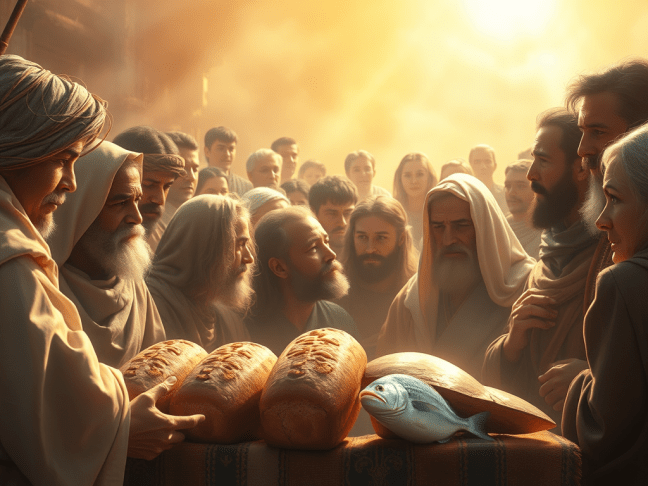
“five barley loaves and two fish“
But we pilgrims live in this kingdom of sin, although we are citizens of God’s Kingdom, and we share God’s love and grace with those around us, perhaps by demonstrating the same unselfish behaviour as the young boy with a packed lunch. John 6:8-9, “Then Andrew, Simon Peter’s brother, spoke up. “There’s a young boy here with five barley loaves and two fish. But what good is that with this huge crowd?” There was a season in our lives when the church my wife and I attended always seemed to have visitors on a Sunday, and more often than not, we ended up needing extra places at the dinner table. There were many times we prayed over what seemed to be a pathetically small joint of meat, only to find that there was more than enough. God will supply what we need as we reach out to Him in faith.
We find that some people in our societies need a meal and lack the resources to provide for themselves. There are a number of reasons why this should be the case, some self-inflicted, but regardless of the reasons, we believers must share God’s love and compassion, doing what we can to help them. When my daughter was very ill in hospital, my wife sometimes lacked the time to make meals, but there were two neighbours who occasionally blessed us with a meal, and one lady even helped with our washing and ironing. We will always be grateful for what they did. Some Christians also help at food banks, often run by churches, which are always stocked with food to help the unfortunate. A local church also allows homeless people to sleep in their building overnight, supplying a breakfast the next morning if necessary. We live in a different society from the first-century communities and cities in the Biblical countries that Paul would have known, but the principles that Paul wrote about still apply. Once again, we remember that we are “salt and light” in places where God has planted us. We mustn’t turn our backs on opportunities to bless someone.
Dear Father God. Thank You for the resources that You have provided for us. Please lead us to needy people whom You want to bless. In Jesus’name. Amen.

