Resurrection Bodies

“But someone may ask, “How will the dead be raised? What kind of bodies will they have?” What a foolish question! When you put a seed into the ground, it doesn’t grow into a plant unless it dies first. And what you put in the ground is not the plant that will grow, but only a bare seed of wheat or whatever you are planting. Then God gives it the new body he wants it to have. A different plant grows from each kind of seed. Similarly there are different kinds of flesh—one kind for humans, another for animals, another for birds, and another for fish.”
1 Corinthians 15:35-39 NLT

Obviously, some people in the Corinthian church had asked two questions – “How will the dead be raised?” and “What kind of bodies will they have?” These seem like logical questions, perhaps asked by a new believer who had been raised in a culture that didn’t really believe in such things. Mainstream First Century Greek thought generally rejected the idea of bodily resurrection, viewing it as impossible, even for gods; to them, death meant the permanent dissolution of the body, with the soul going to a shadowy Hades. So here was a man called Paul, preaching about the Son of the only real God, the God-man who had been killed on a Roman cross, buried in a tomb carved out of rock, but who had been resurrected and provided with a body that was real, although it also had special powers. But Paul continued with the astonishing revelation that all believers will also receive a body just like that of Jesus.

My wife and I have a two-year-old great-grandson, who is at the “why” stage in his early years. Faced with a new situation, he has to find out “why” he is getting a particular response from an adult around him. His mind is like a sponge, absorbing all the new knowledge he is given, a process that places a specific responsibility on his parents and others who come into contact with him. A new Christian, recently saved, will also have many questions, although in the two questions today we have a “How” and a “What”, instead of a “Why”. In response, Paul used the analogy of a seed being planted to produce a plant. We all know the result of planting a seed in fertile soil: after a period of time, a green shoot will appear and keep growing until it becomes a mature plant. He said that the seed planted is different from the plant that grows, a process that follows God’s purposes for the vegetable kingdom. Paul continued to describe the differences with the animal kingdom. 

There is a general belief that once they die, a person’s soul goes to Heaven and then looks down on the loved ones left behind, showing approval, or otherwise, of how they are living their lives on earth. But there is a problem with this expectation, because it is not based on anything more than an emotional whim. The Bible teaches that there are two places for the disembodied spirits in the afterlife. For a believer, their spirit immediately goes to be with the Lord in a state of conscious presence. “Yes, we are fully confident, and we would rather be away from these earthly bodies, for then we will be at home with the Lord (2 Corinthians 5:8). Paul also wrote, “I’m torn between two desires: I long to go and be with Christ, which would be far better for me. But for your sakes, it is better that I continue to live” (Philippians 1:23-24). This state of “conscious presence” Jesus described as being in paradise. The thief on the cross next to Jesus said, “Jesus, remember me when you come into your Kingdom.” And Jesus replied, “I assure you, today you will be with me in paradise”” (Luke 23:42-43).

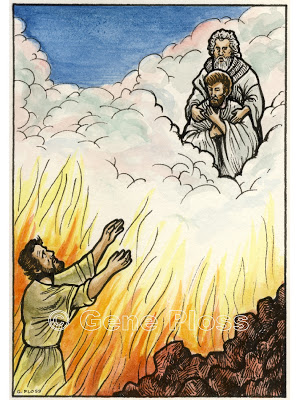
There, the spirit of the believer will live until it is given a new resurrected body. But the unrighteous go to a place of torment. We read in the story of the Rich Man and a poor beggar called Lazarus that the Rich Man died “and he went to the place of the dead. There, in torment, he saw Abraham in the far distance with Lazarus at his side. “The rich man shouted, ‘Father Abraham, have some pity! Send Lazarus over here to dip the tip of his finger in water and cool my tongue. I am in anguish in these flames’” (Luke 16:23-24). There, the unrighteous spirits will await final judgment in the “Lake of Fire” (see Revelation 20). To an unbeliever, all this seems a bit harsh, and, sadly, many people, when presented with Biblical facts, will reject them.

So, the responsibility for us pilgrims is to do what Jesus has asked us to do. To those believers questioning why it was taking Jesus so long to return, Peter wrote, “The Lord isn’t really being slow about his promise, as some people think. No, he is being patient for your sake. He does not want anyone to be destroyed, but wants everyone to repent” (2 Peter 3:9). We pilgrims have been commissioned to make disciples of the people around us, fulfilling God’s desires and purposes for this world. Jesus said that all who believe in Him will not perish. “Perishing” is the default state, leading to the position the Rich Man found himself in after death. But Jesus continued that all who believe in Him will inherit eternal life in a place He called Paradise. This has to be Good News. But we won’t find Good News presented to us in news reports and social media. Jesus has left the responsibility for spreading the Gospel to us. I carry tracts in my pocket just in case I meet someone whom the Holy Spirit has prepared for such an encounter. I expect pilgrims everywhere will do the same, but perhaps the next person we meet will go away with a new revelation of God, and the angels in Heaven will start preparing for a party. Are we ready for just such an encounter? Mordecai said to Queen Esther, “If you keep quiet at a time like this, deliverance and relief for the Jews will arise from some other place, but you and your relatives will die. Who knows if perhaps you were made queen for just such a time as this?” (Esther 4:14). We pilgrims are in a unique place in history, in this world for “such a time as this”.

Dear Father God. You want no one to perish, and neither do we. Thank You for Your grace and patience. Amen.

A Dusty End

“Let the rich of the earth feast and worship. Bow before him, all who are mortal, all whose lives will end as dust. Our children will also serve him. Future generations will hear about the wonders of the Lord. His righteous acts will be told to those not yet born. They will hear about everything he has done.”
Psalm 22:29-31 NLT

Why did David write, “all whose lives will end as dust” rather than “those who will die”? Both phrases mean the same thing, both referring to a human being’s mortality, but of course we know that. About Adam we read in Genesis 3:19, “By the sweat of your brow will you have food to eat until you return to the ground from which you were made. For you were made from dust, and to dust you will return“. Adam was originally made from dust, as we read in Genesis 2:7, “Then the Lord God formed the man from the dust of the ground. He breathed the breath of life into the man’s nostrils, and the man became a living person“. But were human beings originally intended to be immortal, because it was only after the Fall that Adam was informed about his ultimate demise and destination. In Genesis 1:27 we read, “So God created human beings in his own image. In the image of God he created them; male and female he created them”. We know that God is immortal, so if human beings were made “in His image”, would that have included immortality? God intended a very different world to what we have today, with the first inhabitants living a very long time, even after sin had entered Planet Earth. 

Most people are unable to contemplate the end to their earthly lives. When we were young, such a subject was never given much thought because the prevailing attitude was that we would live forever. People generally know that they have to face death one day but it is something they can’t control and therefore don’t think about it. A friend of mine once said, “I don’t fear death, but I just don’t want to be involved”. But death can and does happen to all ages and the wise amongst us make suitable preparations. I don’t mean getting affairs in order, planning a funeral service or starting a funeral plan with the local undertakers. I mean ensuring that the bits of us that are immortal, our souls and spirits, go to live in the right place. That is something we do have control over, through the grace of God.

People of all ages and regardless of sex all have bodies that one day “will end as dust”. Increasing years will introduce aches and pains and even serious health challenges reducing qualities of life, and Western countries in particular are facing into the problem of having a large and health-demanding elderly population. A human being is made up of many chemicals and a large amount of water (about 60% of an average adult’s body apparently) but it will all one day break down into its constituent parts, parts that David defined as “dust”. A depressing thought for most people, but for us pilgrims it will be just the beginning of an adventure we can only marvel at and look forward to. 

Paul wrote quite a bit about the process of dying but he followed it with the facts about resurrection. In 1 Corinthians 15:42b Paul wrote, “ … Our earthly bodies are planted in the ground when we die, but they will be raised to live forever.” He continues in verse 44, “They are buried as natural human bodies, but they will be raised as spiritual bodies. For just as there are natural bodies, there are also spiritual bodies“. In our current human lives, we have a glimpse of what it means to live in the Kingdom of God, but we will never experience the fulness of such a life until we have a body that is appropriate for God’s Kingdom. And then comes the crescendo of the final experience, “For our dying bodies must be transformed into bodies that will never die; our mortal bodies must be transformed into immortal bodies” (1 Corinthians 15:53). 

But we must read 1 Corinthians 15:47-49, “Adam, the first man, was made from the dust of the earth, while Christ, the second man, came from heaven. Earthly people are like the earthly man, and heavenly people are like the heavenly man. Just as we are now like the earthly man, we will someday be like the heavenly man”. We must meditate on this and chew over the wonder of it all. One day we will have a body like Jesus’ resurrected body. Read that sentence again, and again. Jesus was about 33 when He was so brutally put to death. Do we ever want to be 33 again? In a body that will never die. In a body which will never experience death, or pain, or sickness? Is that a resounding “YES” that I can hear?

I suppose we must think for a moment on the fate of all those who don’t believe in Jesus. They too will be resurrected but will find themselves standing before a Great White Throne. Revelation 20:12, 15, “I saw the dead, both great and small, standing before God’s throne. And the books were opened, including the Book of Life. And the dead were judged according to what they had done, as recorded in the books. … And anyone whose name was not found recorded in the Book of Life was thrown into the lake of fire“. Has anyone thought why people have to be “thrown” into their final destination? Purely because they don’t want to go there. Hell will not be a place that anyone will walk into by choice. Jesus said, “The Son of Man will send his angels, and they will remove from his Kingdom everything that causes sin and all who do evil. And the angels will throw them into the fiery furnace, where there will be weeping and gnashing of teeth” (Matthew 13:41-42).‭‭ 

But we won’t dwell on the fate of the wicked, because we do our best to tell them about what is ahead. Not to frighten them into the Kingdom, as preachers of old used to do, preaching sermons in which they dangled their audience over the flames of hell. William Booth was reported to have said, “Most Christians would like to send their recruits to Bible college for five years. I would like to send them to hell for five minutes. That would do more than anything else to prepare them for a lifetime of compassionate ministry. I am not waiting for a move of God, I am a move of God!” But we tell our friends and families and anyone we meet about our testimonies of God’s grace. How God has done so much for us, saving us from the finality of a horrible existence beyond the grave, that will ultimately be full of their dust.

Father God. We thank You for Your grace and favour, so liberally poured out on mankind, grace manifested by Your free gift of salvation. Please help us to tell all who we meet about You . In Jesus’ name. Amen.