

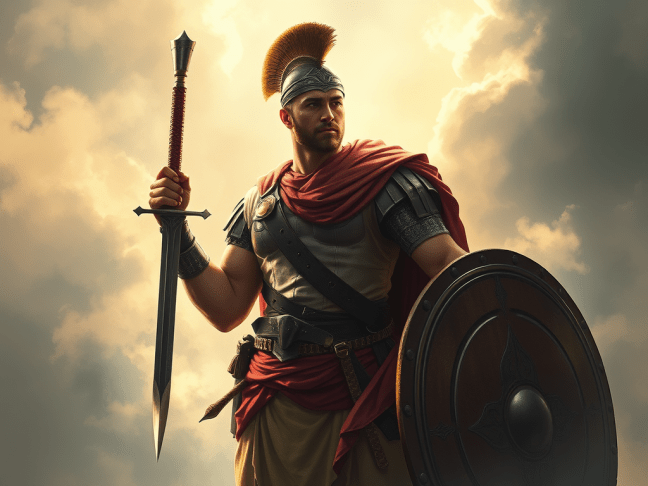
“We faithfully preach the truth. God’s power is working in us. We use the weapons of righteousness in the right hand for attack and the left hand for defence. We serve God whether people honour us or despise us, whether they slander us or praise us. We are honest, but they call us impostors.”
2 Corinthians 6:7-8 NLT
Paul adopts a military perspective, writing about “weapons”, “attack” and “defence” in our verses from 2 Corinthians 6. Such a stance may have resonated more with his Corinthian audience than it would today, but we can all get the picture. Hand-held weapons in those days would have been bladed objects of various lengths and types. The sight of Roman soldiers in those days was common, so the weapons they carried would have been visible to everyone. A short stabbing sword was supplemented by a dagger worn on their left side, making them formidable opponents. So perhaps the sword was the attacking weapon and the dagger more for defence, but I speculate, and I’m sure situations in combat were not that simple. The Roman soldiers also would have held a shield with their left hand, and that possibility would have fitted more with Paul’s analogy. But theological scholars lack a clear understanding of what Paul meant by his reference to “weapons of righteousness”.
But what was the battle that Paul was fighting? He was not the sort of man who would have aggressively pursued a military situation. Although he suffered much through abuse at the hands of people, those he upset with his Gospel message, he was never physically aggressive. The key to his battle can be found in Ephesians 6. He wrote, “For we are not fighting against flesh-and-blood enemies, but against evil rulers and authorities of the unseen world, against mighty powers in this dark world, and against evil spirits in the heavenly places” (Ephesians 6:12). That changes the perspective entirely, because both the weapons and armour favoured by the Roman soldiers would have been useless. After all, it would be no good slashing at a demon, even if it was visible, with a sword. Faced with someone intent on harming him, Paul would have addressed the evil spirit behind the person before him, not with a physical weapon, but with “the weapons of righteousness in the right hand for attack and the left hand for defence”.
Paul’s weapon of choice was righteousness. In the Ephesians 6 account, God’s righteousness was the body armour. The sword analogy referred to “… the sword of the Spirit, which is the word of God” (Ephesians 6:17b). The battle that Paul was fighting was driven by his desire to serve God. Paul was going to do God’s work regardless of the opposition he faced. The enemy, the devil, had the Middle East at that time well and truly in his clutches, and the last thing that he wanted was for God to start to take this territory from him. There was a confusion of gods in that part of the world, and even pockets of God’s people, the Jews, seemed ineffective in pushing back the forces of darkness. The devil wasn’t concerned about them, even though they might have been a minor irritation. What did concern him was this man Paul, who was proclaiming the Gospel of Good News about Jesus, the God-man who defeated the devil through Calvary’s cross. His message, backed up by the power of the Holy Spirit, marked with miracles and other demonstrations of God’s power, was responsible for major conversions from the kingdom of darkness, the devil’s kingdom, to the Kingdom of Light, God’s Kingdom.
So how did the “evil rulers and authorities of the unseen world, [the] mighty powers in this dark world, and [the] evil spirits in the heavenly places” fight back? One way was by undermining Paul’s character. Earlier in this Epistle, Paul wrote, “We reject all shameful deeds and underhanded methods. We don’t try to trick anyone or distort the word of God. We tell the truth before God, and all who are honest know this” (2 Corinthians 4:2). Why did Paul feel he had to write this? Probably because there were some in the Corinthian church who were accusing Paul and his colleagues of duplicity in their ministries. What better way for the devil to destroy Paul’s hard work than to infiltrate the very organisation that he had established? But Paul had the sword of righteousness ready and waiting, and with it he was able to refute the falsehoods being spoken about him. And what was that weapon? It was the Word of God.
We pilgrims will face the same hassles that Paul did as we push back against the forces of darkness that attempt to overpower us. For some believers, the devil and his accomplices are successful. These believers are like the seed that falls on stony ground. Matthew 13:20-21, “The seed on the rocky soil represents those who hear the message and immediately receive it with joy. But since they don’t have deep roots, they don’t last long. They fall away as soon as they have problems or are persecuted for believing God’s word”. But we pilgrims are like the seed that fell on good soil. Matthew 13:23, “The seed that fell on good soil represents those who truly hear and understand God’s word and produce a harvest of thirty, sixty, or even a hundred times as much as had been planted!” Yes, there will be troubles coming our way, if we haven’t already experienced them. But because of Jesus and His righteousness, we have already overcome them.
Dear Heavenly Father. Thank You for Your Son Jesus, who has destroyed the works of the enemy. Through Jesus, we can now live forever in Your Kingdom, safe in a place where the devil can never reach us. No matter what happens to us in this life, You will protect us by the power of Your Word, and one day we will live with You, forever and ever. Amen.
 Being a Pilgrim