

“It’s the same for you. If you speak to people in words they don’t understand, how will they know what you are saying? You might as well be talking into empty space. There are many different languages in the world, and every language has meaning. But if I don’t understand a language, I will be a foreigner to someone who speaks it, and the one who speaks it will be a foreigner to me. And the same is true for you. Since you are so eager to have the special abilities the Spirit gives, seek those that will strengthen the whole church.”
1 Corinthians 14:9-12 NLT
There are indeed many languages in the world, and they create barriers between people groups who cannot understand each other. In a sense, it is tragic that the main form of communication between human beings is lost in the articulation of syllables. Paul was writing to the Corinthians, who used a form of common Greek in their everyday lives and when they met together for worship, but because it was quite a cosmopolitan city, other forms of Greek as well as Aramaic and even Hebrew would have been heard. And that is just in one city. In my home city of Dunfermline in Scotland, the predominant language is English with a Scottish accent reflecting Dunfermline’s location in the County of Fife, but other languages can be heard here from immigrants and tourists. And around Scotland, there are other variations on English, with accents in some places almost incomprehensible. In the Western Isles and parts of the mainland, another language is spoken: Gaelic. I recently heard that there are 89,000 Gaelic speakers and a further 132,000 with some degree of understanding. But why so many different languages, and how did we get the situation where, globally, there are over 7,000 of them? To find out, we have to turn to Genesis 11.
At the time of the Flood, all the inhabitants were destroyed except for Noah, his three sons and their wives, and it was from these that the world was repopulated, as we read in Genesis 10:32, “These are the clans that descended from Noah’s sons, arranged by nation according to their lines of descent. All the nations of the earth descended from these clans after the great flood”. There are, of course, many who believe that the Flood was a local occurrence, and most parts of the earth were unaffected. But then the sedimentary geological formations in most parts of the world, together with their fossil records, have to be explained. For anyone interested in researching further, the film “Is Genesis History” is available on YouTube.
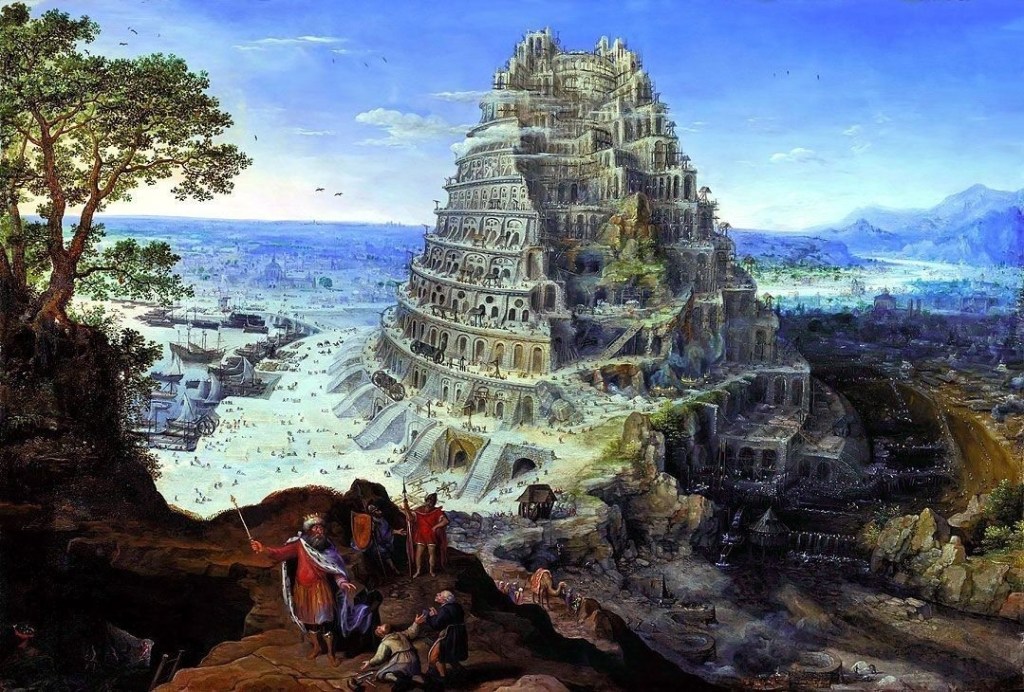
But over the page from Genesis 10 we read, “At one time all the people of the world spoke the same language and used the same words. As the people migrated to the east, they found a plain in the land of Babylonia and settled there” (Genesis 11:1-2). The next few verses explain how the pride and arrogance of the people in the Babylonian region, and their attempts to become like God by building a tower planned to reach Heaven, were frustrated when He confused them with different languages. As a result, the people scattered and eventually populated the earth. Genesis 11:8-9, “In that way, the Lord scattered them all over the world, and they stopped building the city. That is why the city was called Babel, because that is where the Lord confused the people with different languages. In this way he scattered them all over the world”.
But back to 1 Corinthians 11, and Paul’s analogy of natural languages being as incomprehensible to different people groups as speaking in tongues would be in a church. Such tongues may have meaning, Paul said, but he wrote, “If you speak to people in words they don’t understand, how will they know what you are saying? You might as well be talking into empty space”. This must have been a stark wake-up call to the Corinthians, bringing with it a generous dose of common sense. The Corinthians apparently overemphasised the gift of speaking in tongues, believing it had a special spiritual significance. But the form of tongues Paul was writing about was the one used for personal devotions. In 1 Corinthians 14:2, Paul wrote, “For if you have the ability to speak in tongues, you will be talking only to God, since people won’t be able to understand you. You will be speaking by the power of the Spirit, but it will all be mysterious”.
Can I ask you a question, my reader?
Do you speak in tongues?
Can I ask you a question, my reader? Do you speak in tongues? Whether Christians “should” be able to speak in tongues is a matter of theological debate, but many Christians believe it is a valid spiritual gift given by the Holy Spirit for today. Some denominations emphasise the importance of the gift, believing it is still available today and a way to strengthen spiritual life and pray according to God’s will. Other Christians believe it is not a necessary gift for all believers and that not everyone receives it, as the Bible teaches that there are different spiritual gifts for different people. Personally, I believe that all Christians have access to the gift of tongues, and those without it should seek God through prayer, but it is possible that they will receive one or more of the other Holy Spirit Gifts, either in addition to or instead of it. Jesus said, “So if you sinful people know how to give good gifts to your children, how much more will your heavenly Father give good gifts to those who ask him” (Matthew 7:11). In faith, we come to God, asking for His gifts with thankful hearts. He will answer our prayers.
Dear Heavenly Father. We reverently bow before You today with thankful hearts, believing that You give us good gifts. We ask today for a fresh infilling of Your Holy Spirit and for the ability to speak in the Heavenly language that You have provided for each one of us. In Jesus’ name. Amen.
 Being a Pilgrim