

“For I swear, dear brothers and sisters, that I face death daily. This is as certain as my pride in what Christ Jesus our Lord has done in you. And what value was there in fighting wild beasts—those people of Ephesus—if there will be no resurrection from the dead? And if there is no resurrection, “Let’s feast and drink, for tomorrow we die!” Don’t be fooled by those who say such things, for “bad company corrupts good character.””
1 Corinthians 15:31-33 NLT
It appears that the early believers in Ephesus were having a difficult time. The Romans loved their “games,” where gladiators fought each other, often to death, and unfortunate people were set against wild animals such as lions for the entertainment of the crowd. So when this movement of Christ-followers emerged, they became candidates for the lions unless they recanted their faith and denied Christ. But looking closer at 1 Corinthians 15:32, it seems Paul was referring to having to fight the wild beasts, who were the people of Ephesus. He wasn’t, as far as we can tell, a violent man, so to what was he referring?
“The name of the Lord Jesus
was greatly honoured“.
As a background, Paul found himself in Ephesus on his Third Missionary Journey. We read in Acts 19:8, “Then Paul went to the synagogue and preached boldly for the next three months, arguing persuasively about the Kingdom of God”. At first, he had great success: “This went on for the next two years, so that people throughout the province of Asia—both Jews and Greeks—heard the word of the Lord” (Acts 19:10). After the “Seven Sons of Sceva” episode, we read, “The story of what happened spread quickly all through Ephesus, to Jews and Greeks alike. A solemn fear descended on the city, and the name of the Lord Jesus was greatly honoured. Many who became believers confessed their sinful practices” … “So the message about the Lord spread widely and had a powerful effect” (Acts 19:17-18, 20).
But all was not well in the Ephesian silversmith industry. A businessman called Demetrius had a good business going, manufacturing images and shrines of the Greek goddess Artemis. We are told that he “kept many craftsmen busy”. A riot broke out when the silversmiths objected to Paul’s preaching, claiming it was damaging their livelihood. We can read all about it in Acts 19. On this occasion, Paul was prevented from getting involved by the Ephesian believers, but the raw hatred and religious fervour could have spilt over into violence against Paul. There was also a possibility that Paul’s “wild beasts” referred to the demonic influences in Ephesus, with the Seven Sons of Sceva’s attempt to cast out a demon indicating the demonic stronghold present in that city.
Paul’s reference to “fighting wild beasts—those people of Ephesus” was perhaps referring to his experiences there. The riot in Ephesus would have been a frightening experience, and at such times, men behave as “wild beasts”, out of control and capable of violence. But if we have difficulty understanding the silversmith’s anger and reaction, think about the UK Miners’ Strike in 1984, where there were scenes of violence directed against the police and the government. If the Prime Minister of the day, Margaret Thatcher, had personally tried to reason with the miners, she would have been just as vulnerable as Paul would have been, had he found himself before the braying mob of Ephesian beasts.
Paul pointed out to the Corinthian believers that there was no value in fighting the “wild beasts”, regardless of what they were, if there was no resurrection from the dead. Why should I have faced into such danger for no benefit, Paul argued? In fact, to make his point to those who believed there was no resurrection, Paul went on to say that the people might just as well make the best of their lives on earth. He quoted from Isaiah 22:13, “But instead, you dance and play; you slaughter cattle and kill sheep. You feast on meat and drink wine. You say, “Let’s feast and drink, for tomorrow we die!””
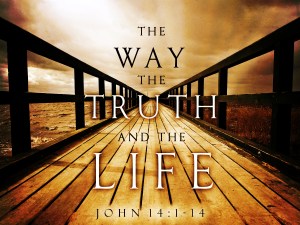
The same logic applies to believers today. If there is nothing to look forward to after death, then why bother with having faith in a lie? If, when we die, there’s just blackness and a realm of nothingness, we might as well live life to the max, complete with every sin imaginable. But because of Jesus, and our faith in Him, we, like Paul, have a different future from those around us who don’t believe there will be something better over the terminal horizon. Jesus said, “Don’t let your hearts be troubled. Trust in God, and trust also in me. There is more than enough room in my Father’s home. If this were not so, would I have told you that I am going to prepare a place for you? When everything is ready, I will come and get you, so that you will always be with me where I am” (John 14:1-3). A few verses on in John 14, Jesus also said, “ … I am the way, the truth, and the life. No one can come to the Father except through me”.
We pilgrims have much to look forward to. A life to come that is worth fighting for. A life that will be in God’s presence in a place Jesus called Paradise. So we keep short accounts with God as we persevere in our journeys to glory. We follow the Master in obedience, doing His work as He has ordained. The enemy, the devil, and his minions will do their utmost to destroy us, “But you belong to God, my dear children. You have already won a victory over those people, because the Spirit who lives in you is greater than the spirit who lives in the world” (1 John 4:4). We are equipped for the battles ahead, and we put on the spiritual armour of Ephesians 6 with the confidence and certainty that we are on the winning side.
Dear Father God. Thank You for Jesus. We thank You for all He did for us at Calvary, and for showing us the way to glory. Amen.
 Being a Pilgrim